
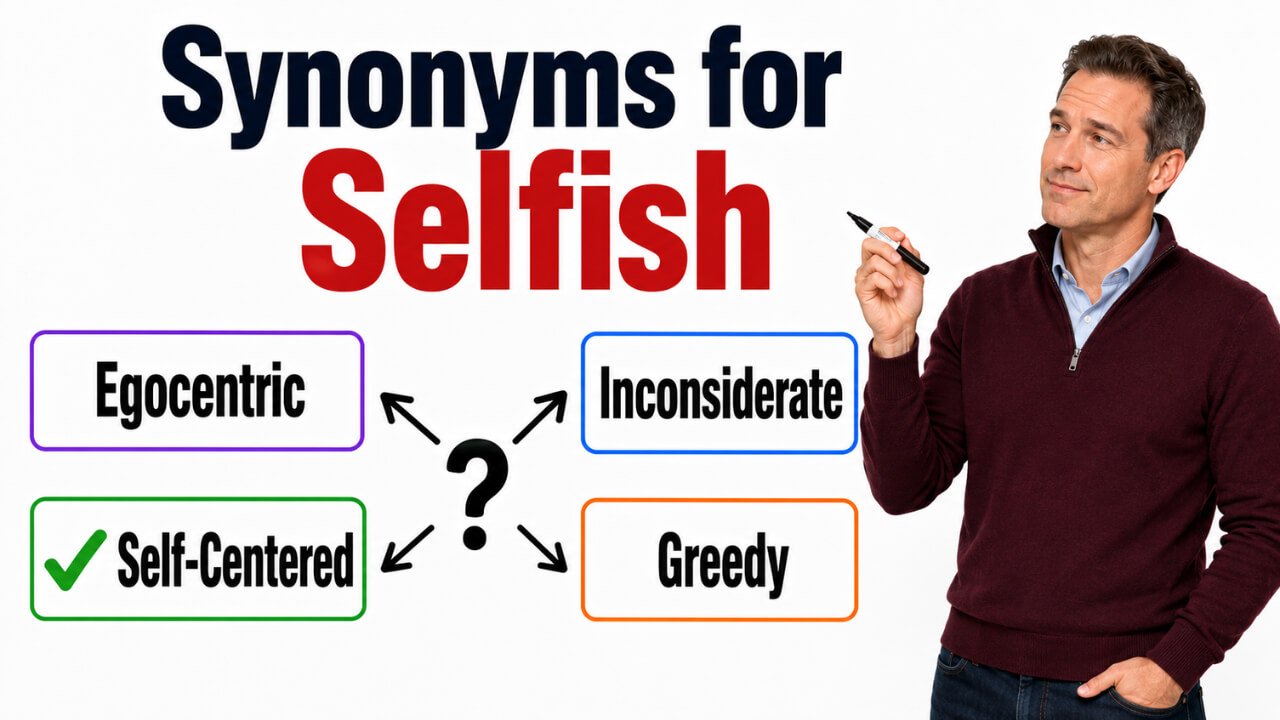
Quick Answer: Synonyms for selfish include self centered, egocentric, self absorbed, inconsiderate, greedy, self serving, self interested, narcissistic, uncaring, and thoughtless. Use self centered for someone focused mainly on themselves, inconsiderate for rude or careless behavior, greedy for wanting more than a fair share, self serving for actions done for personal benefit, and egocentric for a stronger or more formal meaning.
Pronunciation and Word Details
Word: Selfish
Pronunciation: /ˈselfɪʃ/
Part of Speech: Adjective
Meaning: Selfish means caring too much about your own needs, wishes, or benefit and too little about others.
US Pronunciation:
UK Pronunciation:
What Does “Selfish” Mean?
Selfish means putting your own needs, comfort, profit, attention, or wishes before other people in an unfair or uncaring way. It is an adjective used to describe a person, action, choice, attitude, habit, or motive.
The word often has a negative meaning. A selfish person may ignore others, take more than they need, refuse to share, or make decisions that benefit only themselves. A selfish action may hurt others because it lacks kindness, fairness, or consideration.
Selfish can appear before a noun, as in selfish behavior, or after a linking verb, as in his decision was selfish. It can describe small daily actions, serious moral choices, emotional relationships, business decisions, or social behavior.
Meaning, Tone, and Context of “Selfish”
Selfish has a critical and negative tone. It is direct, clear, and commonly used in everyday speech, personal writing, essays, opinion writing, and moral discussion. It can sound emotional when used in arguments, so choosing a softer synonym may sometimes be better.
In casual speech, selfish is a common word for someone who thinks only about themselves. In formal writing, alternatives like self interested, self serving, egocentric, or inconsiderate may sound more precise. In psychology related writing, narcissistic may be used, but it should be used carefully because it can suggest a stronger personality pattern.
The word is not always about money. A person can be selfish with time, attention, support, credit, space, affection, or responsibility. The context decides whether the best synonym is greedy, thoughtless, self centered, uncaring, or opportunistic.
When and How to Use “Selfish”
For Personal Behavior: Use selfish when someone thinks mainly about themselves and ignores how others feel.
Example: It was selfish of him to leave without helping.
For Lack of Consideration: Use selfish when an action causes inconvenience or hurt because the person did not think about others.
Example: Taking the last seat while an elderly person stood nearby was selfish.
For Greed: Use selfish when someone wants more money, food, attention, or advantage than is fair.
Example: She made a selfish choice by keeping all the reward for herself.
For Motives: Use selfish when someone does something mainly for personal gain.
Example: His apology sounded selfish because he only wanted to avoid blame.
For Relationships: Use selfish when someone takes emotional support but does not give care in return.
Example: A healthy friendship cannot survive selfish habits.
For Moral Judgment: Use selfish when a choice is clearly unfair, unkind, or harmful to others.
Example: Ignoring the team’s needs for personal comfort was selfish.
Best Synonyms for Selfish
Self Centered: Focused mainly on oneself and one’s own needs.
Example: His self centered attitude made teamwork difficult.
Egocentric: Thinking everything is about oneself.
Example: Her egocentric view made it hard for her to understand others.
Self Absorbed: Deeply focused on one’s own feelings, problems, or interests.
Example: He was too self absorbed to notice his friend was upset.
Inconsiderate: Not thinking about other people’s feelings, needs, or comfort.
Example: It was inconsiderate to play loud music late at night.
Greedy: Wanting more than one needs or deserves.
Example: The greedy child refused to share the candy.
Self Serving: Done mainly to benefit oneself.
Example: His self serving speech sounded more like an excuse than an apology.
Self Interested: Concerned mainly with personal advantage or benefit.
Example: The decision was self interested rather than fair.
Narcissistic: Extremely focused on oneself, one’s image, or one’s importance.
Example: His narcissistic behavior pushed people away.
Thoughtless: Careless about how one’s actions affect others.
Example: It was thoughtless to cancel at the last moment without explaining.
Uncaring: Showing little concern for others.
Example: Her uncaring response hurt the whole group.
50 Synonyms for Selfish with Short Meanings
- Self Centered: Focused mainly on oneself.
- Egocentric: Seeing everything from one’s own viewpoint.
- Self Absorbed: Too focused on personal feelings or interests.
- Inconsiderate: Not thinking about others.
- Greedy: Wanting more than a fair share.
- Self Serving: Done for personal benefit.
- Self Interested: Concerned with one’s own advantage.
- Narcissistic: Excessively focused on oneself.
- Thoughtless: Careless about others’ feelings.
- Uncaring: Lacking concern for others.
- Egotistical: Thinking too highly of oneself.
- Egoistic: Acting from self interest.
- Egoistical: Excessively concerned with oneself.
- Self Seeking: Looking for personal gain.
- Selfish Minded: Having a habit of putting oneself first.
- Self Focused: Concentrating mainly on personal needs.
- Self Obsessed: Excessively concerned with oneself.
- Self Important: Acting as if one matters more than others.
- Self Loving: Too admiring of oneself.
- Self Regarding: Focused on one’s own interests.
- Self Protective: Mainly concerned with protecting oneself.
- Self Indulgent: Giving oneself too much pleasure or comfort.
- Spoiled: Used to getting one’s own way.
- Entitled: Believing one deserves special treatment.
- Demanding: Expecting too much from others.
- Possessive: Wanting to control or keep something for oneself.
- Grasping: Eager to take more than is fair.
- Avaricious: Extremely greedy for wealth or gain.
- Covetous: Wanting what belongs to others.
- Materialistic: Too focused on possessions or money.
- Mercenary: Motivated mainly by money or reward.
- Opportunistic: Taking advantage of situations for personal gain.
- Exploitative: Using others unfairly for benefit.
- Manipulative: Controlling others for personal advantage.
- Calculating: Carefully planning for selfish benefit.
- Uncharitable: Lacking generosity or kindness.
- Stingy: Unwilling to share money or resources.
- Mean: Ungenerous or unkind.
- Ungenerous: Not willing to give or share.
- Miserly: Extremely unwilling to spend or share.
- Close Fisted: Very unwilling to give money or help.
- Hard Hearted: Lacking sympathy or compassion.
- Insensitive: Not aware of or concerned about others’ feelings.
- Unfeeling: Showing no emotional concern.
- Heartless: Cruel or lacking kindness.
- Cold: Emotionally distant or uncaring.
- Indifferent: Not caring about others or outcomes.
- Unmindful: Not aware of others’ needs or feelings.
- Careless: Not showing enough attention or concern.
- Irresponsible: Ignoring duties or effects on others.
Read Also:
Synonyms for Thoughtful
Synonyms for Selfish by Context
When Selfish Means Self Centered
Use these synonyms when a person focuses mainly on their own needs, feelings, comfort, or importance.
Self Centered: Best for everyday speech and general criticism.
Example: Her self centered attitude made the conversation one sided.
Egocentric: Best for a stronger or more formal description.
Example: His egocentric thinking made him ignore the team’s ideas.
Self Absorbed: Best when someone is lost in their own world.
Example: He was too self absorbed to notice that others needed help.
Self Obsessed: Best when the focus on oneself feels extreme.
Example: The self obsessed speaker turned every topic back to herself.
When Selfish Means Greedy
Use these synonyms when selfish means wanting too much money, food, attention, control, or advantage.
Greedy: Best for wanting more than one needs or deserves.
Example: The greedy player wanted all the credit for the win.
Grasping: Best for someone eager to take as much as possible.
Example: His grasping behavior made the deal feel unfair.
Avaricious: Best for formal writing about extreme greed.
Example: The avaricious ruler cared more about wealth than people.
Stingy: Best when someone refuses to share money or resources.
Example: It felt stingy to bring food and refuse to share it.
When Selfish Means Inconsiderate
Use these synonyms when someone does not think about other people’s comfort, needs, or feelings.
Inconsiderate: Best for rude or careless behavior that affects others.
Example: It was inconsiderate to speak loudly during the meeting.
Thoughtless: Best when the person may not be cruel but fails to think.
Example: His thoughtless comment embarrassed her.
Insensitive: Best when someone ignores emotional impact.
Example: The insensitive joke hurt several people.
Unmindful: Best for a softer formal tone.
Example: She seemed unmindful of the stress her request caused.
When Selfish Means Self Serving
Use these synonyms when a person acts for personal benefit while pretending to help others.
Self Serving: Best for actions, comments, or decisions made for personal gain.
Example: His self serving explanation did not convince anyone.
Opportunistic: Best when someone uses a situation for advantage.
Example: The opportunistic move helped him but hurt the group.
Exploitative: Best when someone uses others unfairly.
Example: The exploitative plan benefited one person at everyone else’s expense.
Manipulative: Best when selfishness includes control or pressure.
Example: Her manipulative behavior made others feel guilty for saying no.
When Selfish Means Uncaring
Use these synonyms when a person shows little kindness, sympathy, or concern.
Uncaring: Best for a direct description of emotional coldness.
Example: His uncaring response made the situation worse.
Heartless: Best for a harsh or strongly negative tone.
Example: It was heartless to laugh at someone’s pain.
Hard Hearted: Best for refusing sympathy or kindness.
Example: The hard hearted decision ignored the family’s needs.
Indifferent: Best when someone simply does not care.
Example: She remained indifferent to the problems around her.
Another Word for Selfish
Another word for selfish is self centered. It is the best general replacement because it clearly means focused too much on oneself. However, the best alternative depends on context. Use greedy when the issue is taking too much, inconsiderate when the issue is not thinking about others, self serving when the action is done for personal benefit, and egocentric when the person sees everything as being about them.
Original: His selfish behavior upset the whole group.
Better Option: His self centered behavior upset the whole group.
Original: It was selfish to keep all the money.
Better Option: It was greedy to keep all the money.
Original: Her selfish comment hurt his feelings.
Better Option: Her thoughtless comment hurt his feelings.
Original: The decision was selfish and unfair.
Better Option: The decision was self serving and unfair.
When Not to Use “Selfish”
Do not use selfish when a more precise word explains the problem better. Selfish is clear, but it can sound emotional, broad, or judgmental. In formal writing, words like self interested, inconsiderate, self serving, or egocentric may sound more accurate.
Weak: The policy was selfish.
Better: The policy was self serving.
Weak: He gave a selfish answer.
Better: He gave an inconsiderate answer.
Weak: She was selfish about the snacks.
Better: She was greedy about the snacks.
Weak: His selfish attitude was clear in the report.
Better: His self interested attitude was clear in the report.
Weak: The speaker sounded selfish throughout the speech.
Better: The speaker sounded egocentric throughout the speech.
Weak: It was selfish to forget her birthday.
Better: It was thoughtless to forget her birthday.
Words Commonly Confused With Selfish
Selfish vs Self Centered: Selfish means putting yourself first in a way that may hurt or ignore others. Self centered means focused mainly on yourself. Self centered often describes attitude, while selfish often describes behavior or choices.
Selfish vs Greedy: Selfish is broad and can involve time, attention, care, credit, comfort, or money. Greedy usually means wanting more wealth, food, power, attention, or possessions than is fair.
Selfish vs Inconsiderate: Selfish suggests personal benefit or self focus. Inconsiderate means not thinking about how your actions affect others. A person can be inconsiderate without planning to gain anything.
Selfish vs Self Serving: Selfish can describe any unfair self focus. Self serving often describes actions, statements, or decisions designed to benefit the person doing them.
Selfish vs Narcissistic: Selfish is a general word. Narcissistic is much stronger and suggests extreme self focus, admiration, or a pattern of behavior. Use it carefully.
Selfish vs Egotistical: Selfish focuses on putting your interests first. Egotistical focuses on thinking too highly of yourself.
Selfish vs Entitled: Selfish means caring too much about yourself. Entitled means believing you deserve special treatment, even when you do not.
Which Synonym Should You Choose?
Choose self centered when describing someone who focuses mainly on themselves in everyday speech.
Choose egocentric when you need a stronger or more formal word for someone who sees everything from their own viewpoint.
Choose self absorbed when someone is too focused on their own thoughts, feelings, or problems.
Choose inconsiderate when the behavior is rude because it ignores other people’s comfort or feelings.
Choose thoughtless when the person failed to think, but may not have intended harm.
Choose greedy when someone wants more than a fair share of money, food, praise, control, or attention.
Choose self serving when an action, statement, apology, or decision is mainly for personal advantage.
Choose self interested when writing formally about motives, choices, or policies.
Choose narcissistic only when the self focus is extreme and clearly connected to image, admiration, or personal importance.
Choose uncaring when the main problem is lack of concern, warmth, or sympathy.
Real Life Examples of “Selfish” in Sentences
Original: He made a selfish decision without asking the team.
Better Option: He made a self serving decision without asking the team.
Original: It was selfish to take the largest portion first.
Better Option: It was greedy to take the largest portion first.
Original: Her selfish behavior made her friends feel ignored.
Better Option: Her self centered behavior made her friends feel ignored.
Original: The comment sounded selfish and rude.
Better Option: The comment sounded inconsiderate and rude.
Original: He was too selfish to notice her sadness.
Better Option: He was too self absorbed to notice her sadness.
Original: The manager’s selfish plan hurt the workers.
Better Option: The manager’s exploitative plan hurt the workers.
Original: She gave a selfish excuse for missing the event.
Better Option: She gave a self serving excuse for missing the event.
Original: His selfish attitude caused problems at home.
Better Option: His egocentric attitude caused problems at home.
Original: It felt selfish to ignore their request for help.
Better Option: It felt uncaring to ignore their request for help.
Original: The selfish child refused to share the toys.
Better Option: The spoiled child refused to share the toys.
Synonym Groups and Usage Differences
Self Focus Group
This group includes self centered, egocentric, self absorbed, self focused, and self obsessed. Use these words when selfish means someone thinks mainly about themselves.
Example: His self centered habits made every conversation about him.
Greed Group
This group includes greedy, grasping, avaricious, covetous, stingy, and miserly. Use these words when selfish means wanting too much or refusing to share.
Example: Her greedy response showed she wanted all the benefits.
Inconsideration Group
This group includes inconsiderate, thoughtless, insensitive, careless, and unmindful. Use these words when selfish means failing to think about others.
Example: His inconsiderate behavior disturbed everyone in the room.
Personal Gain Group
This group includes self serving, self interested, self seeking, opportunistic, and mercenary. Use these words when the focus is personal advantage.
Example: The self serving proposal helped him more than the group.
Lack of Compassion Group
This group includes uncaring, heartless, hard hearted, unfeeling, cold, and indifferent. Use these words when selfishness appears as emotional distance or lack of sympathy.
Example: Her uncaring reply made the problem feel even heavier.
Entitlement Group
This group includes entitled, spoiled, demanding, self important, and possessive. Use these words when selfishness comes from expecting special treatment or control.
Example: His entitled attitude made him expect praise without effort.
Antonyms of Selfish
Generous: Willing to give, share, or help others.
Selfless: Caring more about others than personal benefit.
Considerate: Thoughtful about other people’s needs and feelings.
Kind: Warm, caring, and helpful toward others.
Thoughtful: Careful to consider how others feel.
Caring: Showing concern and support for others.
Compassionate: Feeling and showing sympathy for others’ suffering.
Altruistic: Acting to help others without expecting personal gain.
Unselfish: Not putting oneself first unfairly.
Giving: Willing to offer time, help, attention, or resources.
Charitable: Generous and helpful, especially toward those in need.
Helpful: Ready to assist others.
Comparison: Selfish vs Related Words
Selfish vs Self Centered
Selfish describes putting personal needs first unfairly. Self centered describes a person who focuses too much on themselves.
Example With Selfish: It was selfish to take all the credit.
Example With Self Centered: His self centered attitude made teamwork difficult.
Selfish vs Greedy
Selfish can refer to many kinds of unfair self focus. Greedy usually means wanting too much of something.
Example With Selfish: She made a selfish choice.
Example With Greedy: She made a greedy choice by keeping all the money.
Selfish vs Inconsiderate
Selfish suggests personal concern comes before others. Inconsiderate means careless about others’ comfort or feelings.
Example With Selfish: It was selfish to ignore everyone’s needs.
Example With Inconsiderate: It was inconsiderate to arrive late without warning.
Selfish vs Self Serving
Selfish is general. Self serving is often used for statements, actions, plans, or decisions that mainly benefit the person behind them.
Example With Selfish: His selfish choice upset the group.
Example With Self Serving: His self serving choice protected his own image.
Selfish vs Narcissistic
Selfish means overly concerned with personal needs. Narcissistic is stronger and suggests extreme self focus, admiration, or personal importance.
Example With Selfish: Her selfish response ignored the team.
Example With Narcissistic: Her narcissistic response made the issue all about her.
Selfish vs Entitled
Selfish means caring too much about oneself. Entitled means expecting special treatment or privileges.
Example With Selfish: He was selfish with his time.
Example With Entitled: He felt entitled to everyone’s time.
Common Phrases and Expressions With Selfish
Selfish Behavior: Actions that put personal needs before others unfairly.
Selfish Attitude: A way of thinking that focuses too much on oneself.
Selfish Choice: A decision made mainly for personal benefit.
Selfish Motive: A reason based on personal gain rather than fairness.
Selfish Person: Someone who often puts themselves first.
Selfish Act: A specific action that shows lack of concern for others.
Selfish Interest: Personal benefit placed above other concerns.
Selfish Desire: A wish that ignores fairness or others’ needs.
Selfish Reasons: Personal reasons that may not consider other people.
Selfish Habit: A repeated pattern of putting oneself first.
Common Mistakes to Avoid
Using Selfish Too Broadly: Do not call every personal choice selfish. Sometimes setting boundaries, resting, or saying no is healthy, not selfish.
Ignoring Context: A person may be greedy with money, inconsiderate with time, or self absorbed in conversation. Choose the synonym that matches the exact behavior.
Using Narcissistic Too Casually: Narcissistic is much stronger than selfish. Do not use it unless the behavior is clearly extreme or centered on admiration and self importance.
Confusing Greedy With Selfish: Greedy is mainly about wanting too much. Selfish can involve care, attention, comfort, praise, credit, or responsibility.
Choosing a Synonym That Sounds Too Harsh: Words like heartless, exploitative, and manipulative are strong. Use them only when the sentence truly needs that level of criticism.
Repeating Selfish Too Often: Repetition can weaken your writing. Replace it with self centered, inconsiderate, greedy, self serving, or thoughtless when the meaning is specific.
Using Selfish for Healthy Boundaries: Saying no, protecting your time, or taking care of your health is not always selfish. Use selfish only when the action unfairly ignores or harms others.
Conclusion
Synonyms for selfish help you describe unfair self focus with more accuracy and better tone. Use self centered for general self focus, inconsiderate for careless behavior, greedy for wanting more than a fair share, self serving for personal advantage, and egocentric for a stronger formal meaning. Words like thoughtless, uncaring, and self absorbed also work well in the right context. The best synonym depends on whether the problem is greed, attitude, motive, or lack of concern.
FAQs About Synonyms for Selfish
What are the best synonyms for selfish?
The best synonyms for selfish are self centered, egocentric, self absorbed, inconsiderate, greedy, self serving, self interested, thoughtless, and uncaring.
What is another word for selfish?
Another word for selfish is self centered. It is a clear and natural replacement when someone focuses too much on themselves.
What is a formal synonym for selfish?
A formal synonym for selfish is self interested or self serving. Use egocentric when describing a stronger focus on oneself.
What is a softer word for selfish?
A softer word for selfish is thoughtless or inconsiderate. These words sound less harsh and may suggest the person did not mean to hurt others.
What is a stronger word for selfish?
A stronger word for selfish is egocentric, narcissistic, exploitative, or heartless, depending on the exact meaning.
Is greedy the same as selfish?
No. Greedy usually means wanting too much of something, such as money, food, praise, or power. Selfish is broader and can describe any unfair focus on oneself.
Is self care selfish?
Self care is not selfish when it protects your health, peace, and responsibilities. It becomes selfish only when it unfairly ignores, uses, or harms others.
