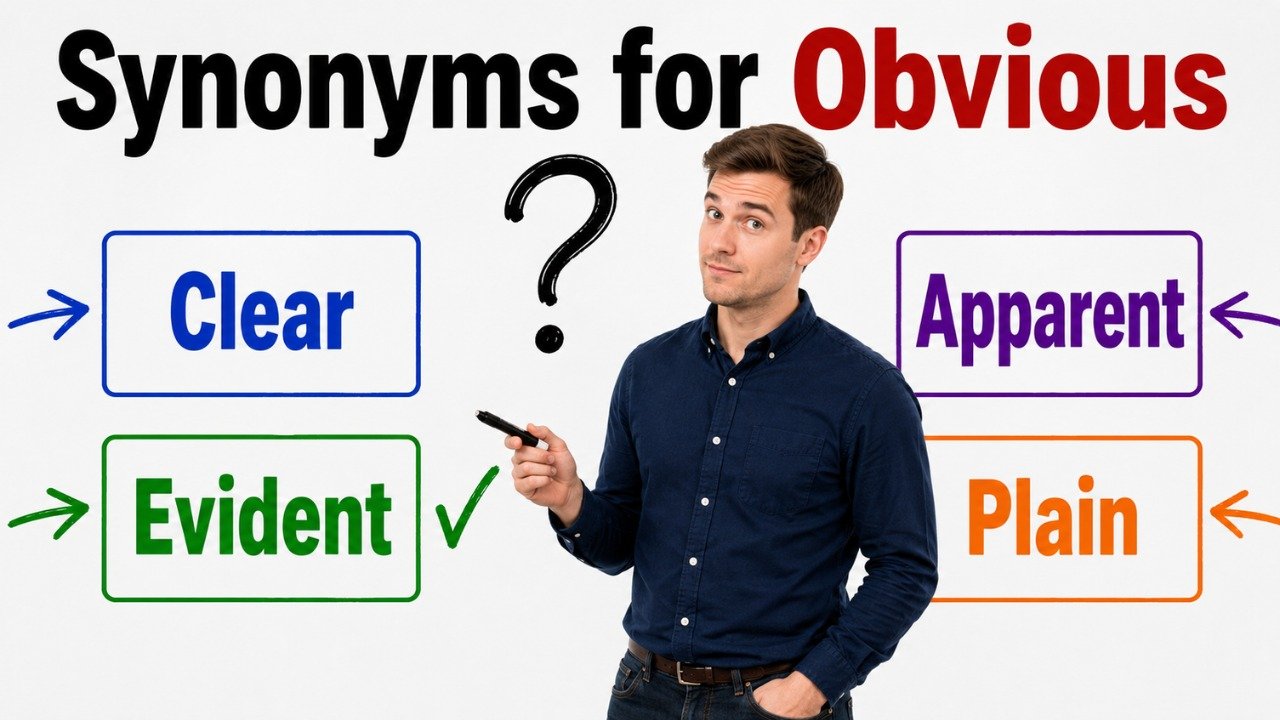
Quick Answer: Synonyms for obvious include clear, evident, apparent, plain, visible, noticeable, unmistakable, self evident, transparent, and undeniable. Use clear for easy understanding, evident for facts or proof, apparent for something that seems true, visible for something seen, unmistakable for no possible confusion, and undeniable when something cannot reasonably be questioned.
Pronunciation and Word Details
Word: Obvious
Pronunciation: /ˈɑːbviəs/
Part of Speech: Adjective
Meaning: Obvious means easy to see, understand, notice, or recognize without needing much explanation.
US Pronunciation:
UK Pronunciation:
What Does “Obvious” Mean?
Obvious means clear or easy to notice. It is an adjective used when something can be understood quickly, seen plainly, or recognized without deep thought.
The word can describe facts, mistakes, answers, signs, feelings, choices, meanings, reasons, and results. For example, an obvious mistake is easy to spot. An obvious answer is simple to understand. An obvious problem is clear enough that people do not need a long explanation to recognize it.
Meaning, Tone, and Context of “Obvious”
Obvious has a neutral tone in many situations, but it can sometimes sound slightly critical or dismissive. When you say something is obvious, you may mean it is clear, but you may also suggest that someone should have noticed it sooner.
In formal writing, evident, apparent, clear, or undeniable often sound more polished. In casual speech, obvious, plain, clear, and easy to see are more natural. In academic or professional writing, evident is useful when discussing proof, while apparent works well when something seems true based on what is seen or known.
When and How to Use “Obvious”
For Clarity: Use obvious when something is easy to understand.
Example: The answer was obvious after she explained the rule.
For Visible Signs: Use obvious when something can be seen clearly.
Example: There was an obvious crack in the glass.
For Clear Mistakes: Use obvious when an error is easy to notice.
Example: The report had an obvious spelling mistake.
For Strong Evidence: Use obvious when facts point clearly to one result.
Example: It was obvious that the plan needed more work.
For Emotional Signals: Use obvious when feelings are easy to read.
Example: His disappointment was obvious from his expression.
Best Synonyms for Obvious
Clear: Easy to understand or recognize.
Example: The instructions were clear and simple.
Evident: Clearly shown by facts, signs, or proof.
Example: Her progress was evident in the final test.
Apparent: Easy to see or understand from what is known.
Example: It became apparent that the schedule was too full.
Plain: Simple, direct, and easy to notice.
Example: The message was plain to everyone in the room.
Visible: Able to be seen.
Example: The damage was visible from the street.
Noticeable: Easy to see, hear, or recognize.
Example: There was a noticeable change in his voice.
Unmistakable: So clear that it cannot be confused with anything else.
Example: There was an unmistakable look of joy on her face.
Self evident: Clear without needing proof or explanation.
Example: The value of honesty is self evident in this situation.
Transparent: Easy to understand or see through.
Example: Her reason for refusing was transparent.
Undeniable: Impossible to deny or reasonably question.
Example: The results showed undeniable improvement.
50 Synonyms for Obvious with Short Meanings
- Clear: Easy to understand or notice.
- Evident: Clearly shown by facts or signs.
- Apparent: Easy to recognize from what is seen.
- Plain: Simple and easy to see.
- Visible: Able to be seen clearly.
- Noticeable: Easy to observe or recognize.
- Unmistakable: Impossible to confuse with something else.
- Undeniable: Too clear to be denied.
- Transparent: Easy to see through or understand.
- Self evident: Clear without extra proof.
- Manifest: Clearly shown or easy to recognize.
- Patent: Clearly visible or evident.
- Conspicuous: Easily seen because it stands out.
- Distinct: Clearly different or easy to identify.
- Explicit: Stated clearly and directly.
- Lucid: Clear and easy to understand.
- Recognizable: Easy to identify or know again.
- Perceptible: Able to be noticed by the senses.
- Observable: Able to be seen or noticed.
- Discernible: Possible to see, hear, or understand.
- Blatant: Very obvious in a rough or unpleasant way.
- Glaring: Extremely obvious, especially as a fault.
- Striking: Very noticeable or impressive.
- Prominent: Standing out clearly.
- Pronounced: Strongly noticeable or clear.
- Open: Clear and not hidden.
- Overt: Done or shown openly.
- Direct: Clear and straightforward.
- Straightforward: Easy to understand and not complicated.
- Simple: Easy to understand.
- Understandable: Easy to grasp or follow.
- Comprehensible: Able to be understood.
- Plainly seen: Easy to notice visually.
- Plain to see: Easy for anyone to notice.
- Easy to see: Clear from appearance or evidence.
- Easy to understand: Simple to recognize in meaning.
- Crystal clear: Very clear and easy to understand.
- Beyond doubt: Too certain to question.
- Unquestionable: Not open to serious doubt.
- Indisputable: Too clear to argue against.
- Incontrovertible: Impossible to disprove or deny.
- Palpable: So clear it almost feels physical.
- Tangible: Clear, real, and noticeable.
- Detectable: Able to be noticed or found.
- Revealing: Showing something clearly.
- Telling: Clearly showing the truth or meaning.
- Revealed: Made clear or shown.
- Exposed: No longer hidden.
- Unhidden: Not covered or concealed.
- Inescapable: Too clear or certain to avoid.
Read Also:
Synonyms for Intelligent

Synonyms for Obvious by Context
When Obvious Means Clear
Use clear, plain, lucid, explicit, and straightforward when something is easy to understand. These words work well for explanations, instructions, answers, meanings, and messages.
Synonyms: Clear, plain, lucid, explicit, straightforward.
Example: The teacher gave a clear explanation of the rule.
When Obvious Means Easily Seen
Use visible, noticeable, observable, perceptible, and conspicuous when something can be seen or noticed easily. These words are useful for physical signs, changes, colors, damage, or behavior.
Synonyms: Visible, noticeable, observable, perceptible, conspicuous.
Example: The stain was noticeable on the white shirt.
When Obvious Means Evident From Proof
Use evident, apparent, manifest, undeniable, and indisputable when facts or signs make something clear. These words are useful in essays, reports, arguments, and analysis.
Synonyms: Evident, apparent, manifest, undeniable, indisputable.
Example: The data made the improvement evident.
When Obvious Means Impossible to Miss
Use unmistakable, glaring, striking, pronounced, and prominent when something is very clear or stands out strongly.
Synonyms: Unmistakable, glaring, striking, pronounced, prominent.
Example: There was a glaring error in the final paragraph.
When Obvious Means Too Clear to Deny
Use undeniable, unquestionable, indisputable, beyond doubt, and incontrovertible when something is so certain that it cannot be fairly rejected.
Synonyms: Undeniable, unquestionable, indisputable, beyond doubt, incontrovertible.
Example: Her talent was undeniable after the performance.
Another Word for Obvious
Another word for obvious is clear. It is the best general replacement because it works in formal writing, casual speech, explanations, instructions, and everyday descriptions. However, the best alternative depends on context. Use evident when facts show something, apparent when something seems clear, visible when it can be seen, and undeniable when it cannot be questioned.
Original: The mistake was obvious.
Better Option: The mistake was clear.
Original: It was obvious that he was tired.
Better Option: It was apparent that he was tired.
Original: The improvement was obvious in her writing.
Better Option: The improvement was evident in her writing.
Original: The crack was obvious on the wall.
Better Option: The crack was visible on the wall.
When Not to Use “Obvious”
Do not use obvious when the tone may sound rude, impatient, or dismissive. Saying that something is obvious can sometimes make the reader or listener feel that they missed something simple. In polite writing, clear, apparent, or understandable may sound softer.
Also avoid obvious when a more specific word would be better. If something is easy to see, use visible or noticeable. If facts prove it, use evident. If it cannot be denied, use undeniable. If a mistake is extremely clear, use glaring.
Weak: It is obvious that you did not understand the lesson.
Better: It is clear that the lesson needs more explanation.
Weak: The obvious reason is that the plan failed.
Better: The apparent reason is that the plan lacked detail.
Weak: There was an obvious error in every line.
Better: There was a glaring error in every line.
Weak: Her happiness was obvious.
Better: Her happiness was unmistakable.
Words Commonly Confused With Obvious
Obvious vs Clear: Obvious means easy to notice or understand. Clear is broader and often sounds more neutral or polite.
Obvious vs Evident: Obvious can be based on quick recognition, while evident often means supported by signs, facts, or proof.
Obvious vs Apparent: Obvious suggests something is easy to see or understand. Apparent means something seems clear based on what is known.
Obvious vs Visible: Obvious can describe ideas, reasons, and facts. Visible usually describes something that can be physically seen.
Obvious vs Noticeable: Obvious is stronger than noticeable. Noticeable means easy to observe, while obvious often means hard to miss.
Obvious vs Blatant: Obvious is neutral in many contexts. Blatant is negative and often describes something done openly in a bad or shameless way.
Which Synonym Should You Choose?
Choose clear when you want the safest and most flexible synonym for obvious.
Choose evident when facts, results, signs, or proof make something clear.
Choose apparent when something seems true based on what can be seen or understood.
Choose visible when the meaning is physical and something can be seen with the eyes.
Choose noticeable when something stands out but is not necessarily extreme.
Choose unmistakable when something is so clear that it cannot be confused.
Choose undeniable when something is too strong or certain to reject.
Choose glaring when describing a very clear mistake, problem, or fault.
Choose explicit when something is stated directly rather than implied.
Choose transparent when a motive, reason, or meaning is easy to see through.
Real Life Examples of “Obvious” in Sentences
Original: The answer was obvious after the teacher explained it.
Better Option: The answer was clear after the teacher explained it.
Original: It was obvious that the room needed cleaning.
Better Option: It was apparent that the room needed cleaning.
Original: Her improvement was obvious in the final essay.
Better Option: Her improvement was evident in the final essay.
Original: The scratch was obvious on the table.
Better Option: The scratch was visible on the table.
Original: His nervousness was obvious during the speech.
Better Option: His nervousness was noticeable during the speech.
Original: The error in the title was obvious.
Better Option: The error in the title was glaring.
Original: Their excitement was obvious from their smiles.
Better Option: Their excitement was unmistakable from their smiles.
Original: The solution was obvious to the whole team.
Better Option: The solution was plain to the whole team.
Original: It is obvious that the rule is important.
Better Option: It is self evident that the rule is important.
Original: The benefits of practice are obvious.
Better Option: The benefits of practice are undeniable.
Synonym Groups and Usage Differences
Clarity Group
Clear, plain, lucid, explicit, and straightforward describe ideas, instructions, meanings, and explanations that are easy to understand.
Example: The guide gave a clear answer to the question.
Visibility Group
Visible, noticeable, observable, perceptible, and conspicuous describe things that can be seen, noticed, or detected.
Example: The change in color was noticeable after one day.
Evidence Group
Evident, apparent, manifest, revealing, and telling describe something made clear by facts, signs, or results.
Example: The final score made the team’s progress evident.
Certainty Group
Undeniable, unquestionable, indisputable, beyond doubt, and incontrovertible describe something too certain to reject.
Example: The report gave undeniable proof of improvement.
Strong Problem Group
Glaring, blatant, pronounced, striking, and conspicuous describe something that stands out strongly, often in a negative or intense way.
Example: The essay had a glaring grammar mistake in the first sentence.
Antonyms of Obvious
Unclear: Not easy to understand.
Hidden: Not visible or not easy to find.
Concealed: Deliberately covered or kept out of sight.
Subtle: Not immediately obvious or noticeable.
Vague: Not clear or exact.
Confusing: Difficult to understand.
Ambiguous: Having more than one possible meaning.
Unnoticeable: Not easy to see or observe.
Obscure: Not well known, clear, or easy to understand.
Doubtful: Not certain or not clearly true.
Comparison: Obvious vs Related Words
Obvious vs Clear
Obvious means easy to notice or understand, sometimes so easy that no explanation is needed. Clear is more neutral and often better for polite or professional writing.
Example With Obvious: The mistake was obvious to everyone.
Example With Clear: The mistake was clear after the review.
Obvious vs Evident
Obvious can come from immediate recognition. Evident often means something is shown by facts, signs, or results.
Example With Obvious: It was obvious that he was upset.
Example With Evident: His disappointment was evident in his voice.
Obvious vs Apparent
Obvious suggests something is easy to notice. Apparent suggests something seems clear based on available information.
Example With Obvious: The answer was obvious from the diagram.
Example With Apparent: It became apparent that the diagram was incomplete.
Obvious vs Visible
Obvious can describe ideas, emotions, reasons, or physical signs. Visible mostly describes something that can be seen.
Example With Obvious: The reason for the delay was obvious.
Example With Visible: The damage was visible on the door.
Obvious vs Blatant
Obvious can be neutral, while blatant is usually negative. Blatant often describes a fault, lie, mistake, or unfair action that is done openly.
Example With Obvious: The problem was obvious after the test.
Example With Blatant: The report contained a blatant error.
Common Phrases and Expressions With Obvious
Obvious Reason: A reason that is easy to understand.
Obvious Mistake: A mistake that is easy to notice.
Obvious Answer: An answer that is clear or simple.
Obvious Choice: A choice that seems clearly best.
Obvious Difference: A difference that can be easily seen.
Obvious Sign: A clear indication of something.
Obvious Problem: A problem that is easy to recognize.
Obvious Meaning: A meaning that does not need much explanation.
Obvious Result: A result that is easy to predict or understand.
Obvious Fact: A fact that is clear and hard to question.
Common Mistakes to Avoid
A common mistake is using obvious when clear would sound more polite. Obvious can sometimes imply that the reader should already understand something, so use it carefully in feedback, teaching, and professional writing.
Another mistake is using obvious for every clear idea. Choose visible for physical things, evident for proof, apparent for something that seems true, and undeniable for strong certainty. This makes your writing more precise.
Avoid using blatant as a simple replacement for obvious unless the meaning is negative. A blatant mistake is not just clear. It is very clear in an unpleasant or careless way. Also avoid repeating obvious too often in one paragraph because it can make your writing sound flat.
Conclusion
Synonyms for obvious help you describe clarity, visibility, proof, and certainty with better accuracy. Use clear for general meaning, evident for facts, apparent for what seems true, visible for what can be seen, noticeable for easy observation, glaring for strong mistakes, and undeniable for something impossible to reject. The best synonym depends on whether you are describing an idea, a sign, a result, a problem, or a fact. Choosing the right word makes your writing clearer and more natural.
FAQs About Synonyms for Obvious
What is the best synonym for obvious?
The best synonym for obvious is clear because it is simple, natural, and useful in many contexts. Evident, apparent, and noticeable may be better when you need a more specific meaning.
What is a formal synonym for obvious?
A formal synonym for obvious is evident, apparent, manifest, or undeniable. These words work well in essays, reports, analysis, and professional writing.
What is a casual synonym for obvious?
A casual synonym for obvious is clear, plain, or easy to see. These choices sound natural in everyday conversation.
Is evident the same as obvious?
Evident and obvious are similar, but evident often suggests that facts or signs show something clearly. Obvious can mean something is easy to notice or understand immediately.
What is a stronger word than obvious?
A stronger word than obvious is undeniable, unmistakable, glaring, or indisputable. The best choice depends on whether you mean certainty, visibility, or a very clear mistake.
Can apparent be a synonym for obvious?
Apparent can be a synonym for obvious when something seems clear from what is seen or known. However, apparent can sometimes mean something seems true but may not be fully proven.
What is the opposite of obvious?
The opposite of obvious can be unclear, hidden, subtle, vague, obscure, confusing, or ambiguous. The best antonym depends on whether the meaning is about visibility, understanding, or certainty
