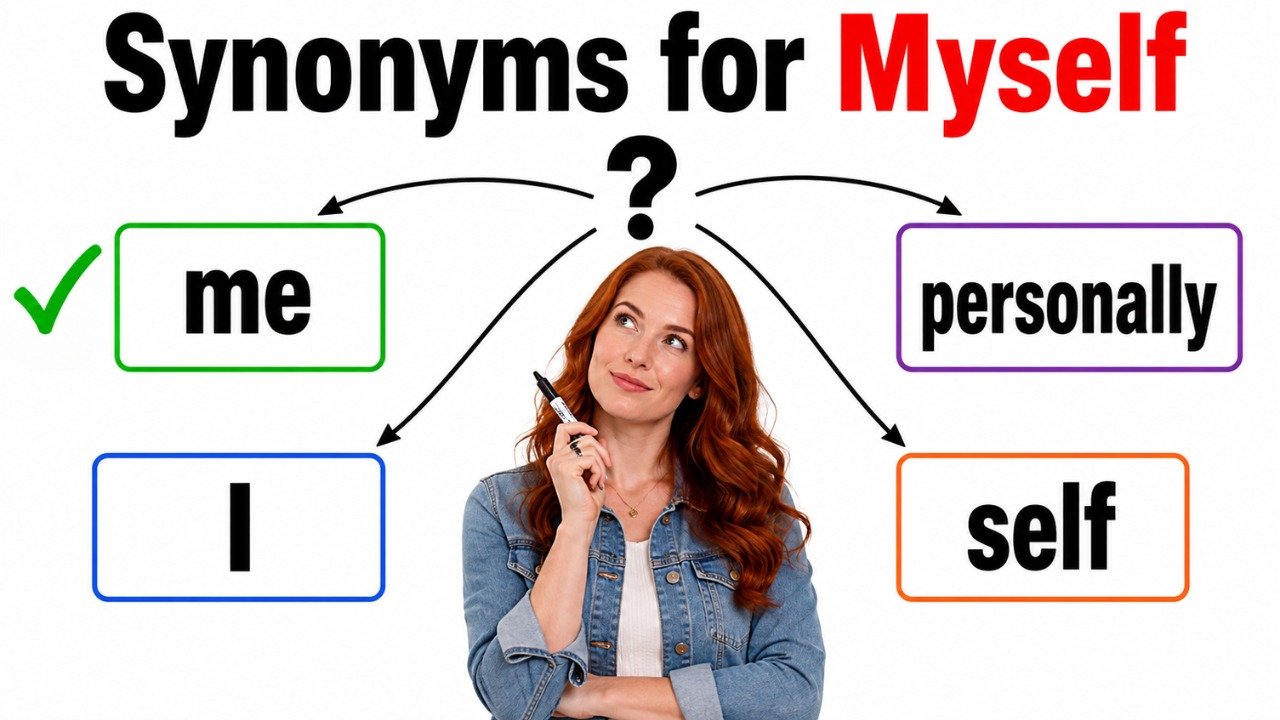
Quick Answer: Useful synonyms for myself include personally, on my own, alone, independently, unaided, in person, the real me, my true self, my own self, and for my part. Use personally when emphasizing your involvement, on my own or unaided when acting without help, in person when physically present, and my true self when discussing identity. Myself has no universal synonym because it can function as both a reflexive pronoun and an intensive pronoun.
Pronunciation and Word Details
Word: Myself.
Pronunciation: /maɪˈself/
Part of Speech: Reflexive pronoun and intensive pronoun.
Meaning: A pronoun used when the speaker refers back to themselves or emphasizes their personal involvement.
US Pronunciation:
UK Pronunciation:
What Does “Myself” Mean?
Myself is a pronoun that refers back to the speaker or adds emphasis to the pronoun I.
As a reflexive pronoun, myself is used when the subject and object of a sentence refer to the same person.
Example: I taught myself how to cook.
The person performing the action and the person receiving the action are both the speaker.
As an intensive pronoun, myself emphasizes that the speaker personally performed an action.
Example: I prepared the entire presentation myself.
Removing myself from this sentence would not change its basic meaning, but it would remove the emphasis.
Myself also appears in expressions related to independence, privacy, personal benefit, thoughts, identity, and emotional condition.
Independence: I completed the assignment by myself.
Personal Benefit: I bought a new notebook for myself.
Private Thought: I kept my concerns to myself.
Identity: I finally feel like myself again.
Emphasis: I myself witnessed the event.
Meaning, Tone, and Context of “Myself”
Myself is a neutral and standard English pronoun. It is appropriate in formal writing, everyday conversation, academic work, professional communication, and personal storytelling when used correctly.
Its tone depends on the sentence.
When myself is reflexive, the tone is usually neutral. It simply shows that the speaker receives or experiences their own action.
Example: I reminded myself about the appointment.
When it adds emphasis, myself can sound confident, deliberate, or personal.
Example: I checked every figure myself.
In phrases such as by myself or on my own, it communicates independence or solitude.
Example: I traveled by myself for the first time.
In emotional contexts, myself may refer to identity, personality, health, or a familiar emotional state.
Example: I have not felt like myself recently.
Myself can sound unnatural or incorrect when it is used merely to sound formal. It should not automatically replace I or me.
When and How to Use “Myself”
For Reflexive Actions
Use myself when you perform an action that affects you.
Example: I accidentally cut myself while preparing dinner.
For Personal Emphasis
Use myself when you want to emphasize that you personally performed an action.
Example: I wrote the entire report myself.
For Acting Independently
Use by myself when you complete something without assistance or companionship.
Example: I assembled the desk by myself.
For Personal Benefit
Use for myself when something is intended for your own use, enjoyment, or advantage.
Example: I saved a portion of the dessert for myself.
For Private Thoughts
Use to myself when thoughts, information, or feelings remain private.
Example: I kept the surprising news to myself.
For Personal Identity
Use myself when discussing your true personality, character, or emotional state.
Example: I feel more comfortable being myself around close friends.
For Personal Responsibility
Use myself when emphasizing that you accept responsibility for an action or decision.
Example: I made the final decision myself.
For Physical Presence
Use myself when emphasizing that you were personally present rather than sending another person.
Example: I delivered the documents myself.
For Learning Independently
Use taught myself when you learned something without a formal teacher.
Example: I taught myself how to play the instrument.
For Internal Reflection
Use myself when evaluating your own thoughts, behavior, abilities, or feelings.
Example: I asked myself whether I had made the right choice.
Best Synonyms for Myself
Personally
Synonym: Personally emphasizes that the speaker was directly involved.
Example: I personally reviewed every application.
On My Own
Synonym: On my own means without help or companionship.
Example: I completed the research on my own.
Alone
Synonym: Alone means without another person present.
Example: I prefer to study alone.
Independently
Synonym: Independently means without relying on another person.
Example: I managed the project independently.
Unaided
Synonym: Unaided means without receiving assistance.
Example: I solved the problem unaided.
In Person
Synonym: In person means physically present rather than represented by someone else.
Example: I submitted the documents in person.
My Own Self
Synonym: My own self strongly emphasizes personal identity or involvement.
Example: I needed to understand my own self more clearly.
The Real Me
Synonym: The real me means the speaker’s genuine personality or identity.
Example: Close friends understand the real me.
My True Self
Synonym: My true self refers to an authentic personality or identity.
Example: I can express my true self through creative work.
For My Part
Synonym: For my part introduces the speaker’s personal opinion, responsibility, or contribution.
Example: For my part, I support the proposed change.
50 Synonyms for Myself with Short Meanings
- Me: The object form of I in sentences that can be restructured.
- I Personally: A phrase emphasizing the speaker’s direct involvement.
- Personally: By the speaker directly rather than another person.
- My Own Self: The speaker’s individual identity or person.
- My Very Own Self: An emphatic and informal reference to the speaker.
- On My Own: Without help, support, or companionship.
- Alone: Without another person present.
- Independently: Without depending on someone else.
- Unaided: Without receiving help.
- Unassisted: Completed without another person’s assistance.
- Singlehandedly: Done entirely by one person.
- Without Help: Completed without assistance.
- Without Assistance: Performed without support from others.
- Under My Own Power: Accomplished using personal ability or effort.
- Through My Own Efforts: Achieved because of personal work.
- In Person: With the speaker physically present.
- Personally Speaking: From the speaker’s individual position or experience.
- Directly: Without using another person as an intermediary.
- Firsthand: Through direct personal experience.
- With My Own Hands: Through the speaker’s direct physical effort.
- Of My Own Accord: Because of a personal and voluntary decision.
- Voluntarily: By personal choice rather than force.
- On My Own Initiative: Through an action started by the speaker.
- For My Own Benefit: Intended to help or advantage the speaker.
- For My Own Use: Intended for the speaker to use personally.
- On My Own Behalf: As a representative of personal interests.
- For My Own Sake: For the speaker’s personal welfare or advantage.
- Privately: Without sharing something with other people.
- Inwardly: Within the speaker’s thoughts or emotions.
- My Inner Self: The speaker’s private thoughts, feelings, and character.
- My True Self: The speaker’s genuine identity or personality.
- My Real Self: The person the speaker genuinely is.
- My Authentic Self: The speaker’s honest and natural identity.
- My Personal Identity: The qualities that define the speaker.
- My Individuality: The speaker’s unique character and qualities.
- My Own Person: An independently thinking and acting individual.
- The Person I Am: A direct description of the speaker’s identity.
- The Real Me: The speaker’s genuine personality.
- My Private Self: The identity shown away from public attention.
- My Individual Self: The speaker considered as a separate person.
- My Independent Self: The part of the speaker that acts autonomously.
- My Own Identity: The speaker’s personal sense of who they are.
- Self: A person’s individual identity or character.
- For My Part: Regarding the speaker’s opinion or contribution.
- On My Part: Concerning the speaker’s responsibility or action.
- As for Me: A phrase introducing the speaker’s personal position.
- In My View: According to the speaker’s understanding.
- From My Perspective: Based on the speaker’s experience or viewpoint.
- In My Opinion: According to what the speaker personally believes.
- From My Point of View: As understood from the speaker’s position.
Read Also:
Synonyms for Sea
Synonyms for Myself by Context
When Myself Adds Emphasis
Use personally, I personally, my own self, directly, or firsthand when emphasizing personal involvement.
Personally: I personally checked the final document.
I Personally: I personally approved the revised schedule.
Directly: I dealt directly with the customer.
Firsthand: I experienced the problem firsthand.
My Own Self: I wanted to confirm the result with my own eyes and judgment.
When Myself Means Without Help
Use on my own, independently, unaided, unassisted, or singlehandedly when describing an independent action.
On My Own: I completed the task on my own.
Independently: I conducted the investigation independently.
Unaided: I reached the destination unaided.
Unassisted: I solved the puzzle unassisted.
Singlehandedly: I singlehandedly organized the entire event.
When Myself Means Without Companionship
Use alone, on my own, privately, or without company when no one else is present.
Alone: I spent the afternoon alone.
On My Own: I went to the appointment on my own.
Privately: I considered the decision privately.
Without Company: I ate lunch without company.
When Myself Refers to Personal Presence
Use in person, personally, directly, or firsthand when the speaker was physically present.
In Person: I delivered the application in person.
Personally: I personally welcomed every guest.
Directly: I spoke directly with the manager.
Firsthand: I observed the situation firsthand.
When Myself Refers to Personal Identity
Use my true self, the real me, my authentic self, my inner self, or my own identity.
My True Self: I want my writing to reflect my true self.
The Real Me: Only close friends know the real me.
My Authentic Self: I feel free to express my authentic self.
My Inner Self: Quiet reflection helps me understand my inner self.
My Own Identity: I developed a stronger sense of my own identity.
When Myself Introduces an Opinion
Use for my part, as for me, in my view, in my opinion, or from my perspective.
For My Part: For my part, I believe the plan is practical.
As for Me: As for me, I would choose the simpler option.
In My View: In my view, the first proposal is clearer.
In My Opinion: In my opinion, the deadline should be extended.
From My Perspective: From my perspective, the discussion was productive.
When Myself Refers to Personal Effort
Use through my own efforts, with my own hands, under my own power, or on my own initiative.
Through My Own Efforts: I achieved the result through my own efforts.
With My Own Hands: I built the table with my own hands.
Under My Own Power: I reached the finish line under my own power.
On My Own Initiative: I began the research on my own initiative.
Another Word for Myself
There is no single word that can replace myself in every sentence. The best alternative depends on whether it expresses emphasis, independence, identity, privacy, or personal opinion.
Personally is usually the strongest replacement when myself adds emphasis. On my own works when the meaning is without help, while my true self works when discussing identity.
Original: I checked the calculations myself.
Better Option: I personally checked the calculations.
Original: I completed the assignment by myself.
Better Option: I completed the assignment on my own.
Original: I spoke to the director myself.
Better Option: I spoke to the director in person.
Original: I want to remain true to myself.
Better Option: I want to remain true to my authentic identity.
When Not to Use “Myself”
Do not use myself simply because it sounds more formal than I or me. This is one of the most common pronoun errors in English.
When the Correct Word Is I
Use I when the speaker is part of the subject performing an action.
Weak: Sarah and myself will attend the meeting.
Better: Sarah and I will attend the meeting.
When the Correct Word Is Me
Use me when the speaker receives an action and the sentence does not already have I as its subject.
Weak: Please send the details to David and myself.
Better: Please send the details to David and me.
When There Is No Reflexive Relationship
Myself normally refers back to I within the same clause.
Weak: The manager contacted myself yesterday.
Better: The manager contacted me yesterday.
When It Creates Unnecessary Emphasis
Avoid myself when the sentence does not need extra stress on personal involvement.
Weak: I myself went to the office at nine.
Better: I went to the office at nine.
When It Makes Formal Writing Wordy
Personally or a direct sentence may sound clearer in professional writing.
Weak: The final figures were reviewed by myself.
Better: I reviewed the final figures.
When It Is Used as a Subject Alone
Myself cannot normally replace I as the subject of a standard sentence.
Weak: Myself completed the project.
Better: I completed the project.
When the Sentence Already Shows Personal Involvement
Avoid repeating the same idea unnecessarily.
Weak: I personally completed the work myself.
Better: I completed the work myself.
Words Commonly Confused With Myself
Myself vs Me: Myself refers back to I or adds emphasis. Me is the regular object pronoun used when another person performs the action.
Myself vs I: I is the subject pronoun. Myself cannot normally act as the subject by itself.
Myself vs Mine: Myself refers to the speaker as a person. Mine shows that something belongs to the speaker.
Myself vs My Own: Myself is a pronoun. My own appears before a noun or refers to something personally possessed.
Myself vs Yourself: Myself refers to the speaker. Yourself refers to the person being addressed.
Myself vs Oneself: Myself is specific to the speaker. Oneself refers generally to any person.
Myself vs Personally: Myself can be reflexive or emphatic. Personally usually emphasizes direct involvement or introduces an opinion.
Myself vs By Myself: Myself alone may be reflexive or emphatic. By myself usually means alone or without help.
Myself vs On My Own: Myself has several grammatical functions. On my own specifically emphasizes independence or solitude.
Which Synonym Should You Choose?
Choose personally when emphasizing that you directly performed an action.
Choose on my own when describing something completed without help.
Choose alone when no other person was present.
Choose independently in formal writing about work, research, decisions, or learning.
Choose unaided when emphasizing that no assistance was provided.
Choose singlehandedly when one person completed a difficult or substantial task.
Choose in person when emphasizing physical presence.
Choose firsthand when describing direct personal knowledge or experience.
Choose with my own hands when emphasizing physical effort or craftsmanship.
Choose of my own accord when an action was voluntary.
Choose my true self when discussing identity, personality, or emotional honesty.
Choose the real me in casual conversation about genuine personality.
Choose my authentic self in reflective or personal development writing.
Choose for my part when introducing a personal opinion or contribution.
Choose in my view in reports, essays, discussions, or professional communication.
Choose from my perspective when explaining how personal experience affects an opinion.
Choose me when a sentence requires an ordinary object pronoun rather than a reflexive pronoun.
Choose I when the speaker is the grammatical subject of the sentence.
Real Life Examples of “Myself” in Sentences
Original: I completed the research myself.
Better Option: I completed the research independently.
Original: I traveled to the conference by myself.
Better Option: I traveled to the conference alone.
Original: I built the bookcase myself.
Better Option: I built the bookcase with my own hands.
Original: I delivered the package myself.
Better Option: I delivered the package in person.
Original: I saw the damage myself.
Better Option: I saw the damage firsthand.
Original: I bought the equipment for myself.
Better Option: I bought the equipment for my own use.
Original: I want to express myself honestly.
Better Option: I want to express my authentic self honestly.
Original: I consider myself fortunate.
Better Option: I believe I am fortunate.
Original: I kept the information to myself.
Better Option: I kept the information private.
Original: I taught myself how to design the website.
Better Option: I learned how to design the website independently.
Synonym Groups and Usage Differences
Emphasis Group
Personally, I personally, directly, firsthand, and in person emphasize the speaker’s involvement.
Personally is the most flexible choice. In person emphasizes physical presence, while firsthand emphasizes direct experience or knowledge.
Example: I personally reviewed the original records.
Independence Group
On my own, independently, unaided, unassisted, and singlehandedly describe action without help.
On my own is natural in conversation. Independently suits formal writing. Singlehandedly adds stronger emphasis and often suggests a challenging achievement.
Example: I completed the entire project independently.
Solitude Group
Alone, on my own, privately, and without company describe situations where no other person is present.
Alone is the most direct choice. Privately focuses more on the absence of public attention than physical isolation.
Example: I prefer to work alone when preparing reports.
Personal Effort Group
Through my own efforts, with my own hands, under my own power, and on my own initiative emphasize personal work.
With my own hands is best for physical creation. On my own initiative means the speaker began an action without being instructed.
Example: I restored the old table with my own hands.
Identity Group
My true self, the real me, my authentic self, my inner self, and my personal identity describe who the speaker genuinely is.
The real me sounds conversational. My authentic self sounds thoughtful and reflective. My inner self refers to private thoughts and emotions.
Example: Writing allows me to explore my inner self.
Opinion Group
For my part, as for me, in my opinion, in my view, and from my perspective introduce a personal position.
In my opinion is common and direct. From my perspective emphasizes that experience or circumstances shape the opinion.
Example: From my perspective, the revised plan is more practical.
Personal Benefit Group
For my own benefit, for my own sake, for my own use, and on my own behalf describe something intended for the speaker.
For my own use focuses on possession or practical use. For my own sake emphasizes personal welfare.
Example: I made the decision for my own benefit.
Antonyms of Myself
Myself has no single direct antonym because it is a pronoun. Its opposites depend on whether the sentence refers to identity, independence, privacy, or personal action.
Others: People apart from the speaker.
Someone Else: Another person rather than the speaker.
Another Person: An individual other than the speaker.
You: The person or people being addressed.
Them: Other people receiving an action.
Together: In the company of another person.
Collectively: As part of a group rather than individually.
With Help: Assisted by another person.
Dependently: While relying on someone else.
Publicly: In a way that is open to other people.
Outwardly: In a way visible to others rather than internally.
By Another: Performed through someone other than the speaker.
Comparison of Myself and Related Words
Myself vs Me
Myself is reflexive or emphatic. Me is the normal object pronoun.
Example With Myself: I prepared myself for the interview.
Example With Me: The interviewer asked me several questions.
Myself vs I
I performs the action as the subject. Myself refers back to I or emphasizes it.
Example With Myself: I wrote the article myself.
Example With I: I wrote the article yesterday.
Myself vs Personally
Myself may show reflexive action or emphasis. Personally mainly expresses direct involvement or an individual opinion.
Example With Myself: I repaired the chair myself.
Example With Personally: I personally inspected the repaired chair.
Myself vs By Myself
Myself can emphasize the person performing an action. By myself usually means alone or without assistance.
Example With Myself: I signed the document myself.
Example With By Myself: I completed the paperwork by myself.
Myself vs On My Own
Myself has grammatical reflexive and intensive uses. On my own specifically communicates independence or solitude.
Example With Myself: I reminded myself about the deadline.
Example With On My Own: I managed the assignment on my own.
Myself vs My Own
Myself refers to the speaker. My own emphasizes possession or something belonging personally to the speaker.
Example With Myself: I introduced myself to the group.
Example With My Own: I brought my own notebook.
Myself vs Mine
Myself refers to the speaker as a person. Mine replaces a noun and shows ownership.
Example With Myself: I made myself a cup of tea.
Example With Mine: The blue cup is mine.
Myself vs Oneself
Myself refers specifically to the speaker. Oneself refers generally to any person.
Example With Myself: I must remind myself to remain patient.
Example With Oneself: One must remind oneself to remain patient.
Common Phrases and Expressions With “Myself”
By Myself: Alone or without assistance.
All by Myself: Completely alone or entirely without help.
For Myself: For personal benefit, ownership, or use.
To Myself: Privately or within personal thought.
I Myself: A phrase strongly emphasizing the speaker.
Keep to Myself: Avoid unnecessary interaction with other people.
Keep Something to Myself: Avoid sharing information, feelings, or opinions.
Have Something to Myself: Use or enjoy something without other people present.
Be Myself: Behave naturally and express a genuine personality.
Feel Like Myself: Experience a normal or familiar physical and emotional state.
Common Mistakes to Avoid
Using Myself Instead of I
Myself should not normally be used as the subject of a sentence.
Incorrect: James and myself prepared the report.
Correct: James and I prepared the report.
Using Myself Instead of Me
Do not use myself as an ordinary object pronoun when the sentence has no I referring back to it.
Incorrect: The invitation was sent to my colleague and myself.
Correct: The invitation was sent to my colleague and me.
Using Myself to Sound More Formal
Myself is not a more polite or professional form of me.
Incorrect: Please contact myself with any concerns.
Correct: Please contact me with any concerns.
Using the Wrong Reflexive Pronoun
The reflexive pronoun must match the subject.
Incorrect: She prepared myself for the presentation.
Correct: She prepared herself for the presentation.
Using Myself Without an Antecedent
In reflexive use, myself normally needs I as its antecedent.
Incorrect: The manager introduced myself to the guests.
Correct: I introduced myself to the guests.
Repeating the Same Emphasis
Avoid using several emphatic expressions together.
Repetitive: I personally completed the task myself on my own.
Improved: I completed the task on my own.
Misplacing I Myself
I myself is grammatical, but it can sound overly forceful when emphasis is unnecessary.
Awkward: I myself purchased some paper this morning.
Natural: I purchased some paper this morning.
Confusing Myself With My Own
Use my own before a noun and myself as a pronoun.
Incorrect: I brought myself laptop.
Correct: I brought my own laptop.
Conclusion
Synonyms for myself change according to grammar and context. Use personally for direct involvement, on my own for independence, alone for solitude, and in person for physical presence. My true self and the real me are suitable when discussing identity, while in my view introduces a personal opinion. Remember that myself cannot automatically replace I or me. Choosing the correct alternative makes your sentences clearer, more natural, and grammatically accurate.
FAQs About Synonyms for Myself
What Is the Best Synonym for Myself?
Personally is a strong alternative when myself adds emphasis. On my own, alone, in person, and my true self fit other meanings.
Is Myself a Synonym for Me?
Not exactly. Myself is reflexive or emphatic, while me is the ordinary object form of I.
Can I Say “John and Myself”?
Use John and I when the phrase is the subject. Use John and me when it is the object.
What Is Another Way to Say “By Myself”?
Useful alternatives include alone, on my own, independently, unaided, and without assistance.
What Is a Formal Alternative to Myself?
Personally, independently, unaided, in person, and on my own behalf are suitable formal alternatives in different contexts.
What Is the Difference Between Myself and I?
I is a subject pronoun. Myself refers back to I or emphasizes the speaker’s personal involvement.
Can Myself Begin a Sentence?
Myself should not normally serve as the subject alone. Write I completed the work rather than myself completed the work.
