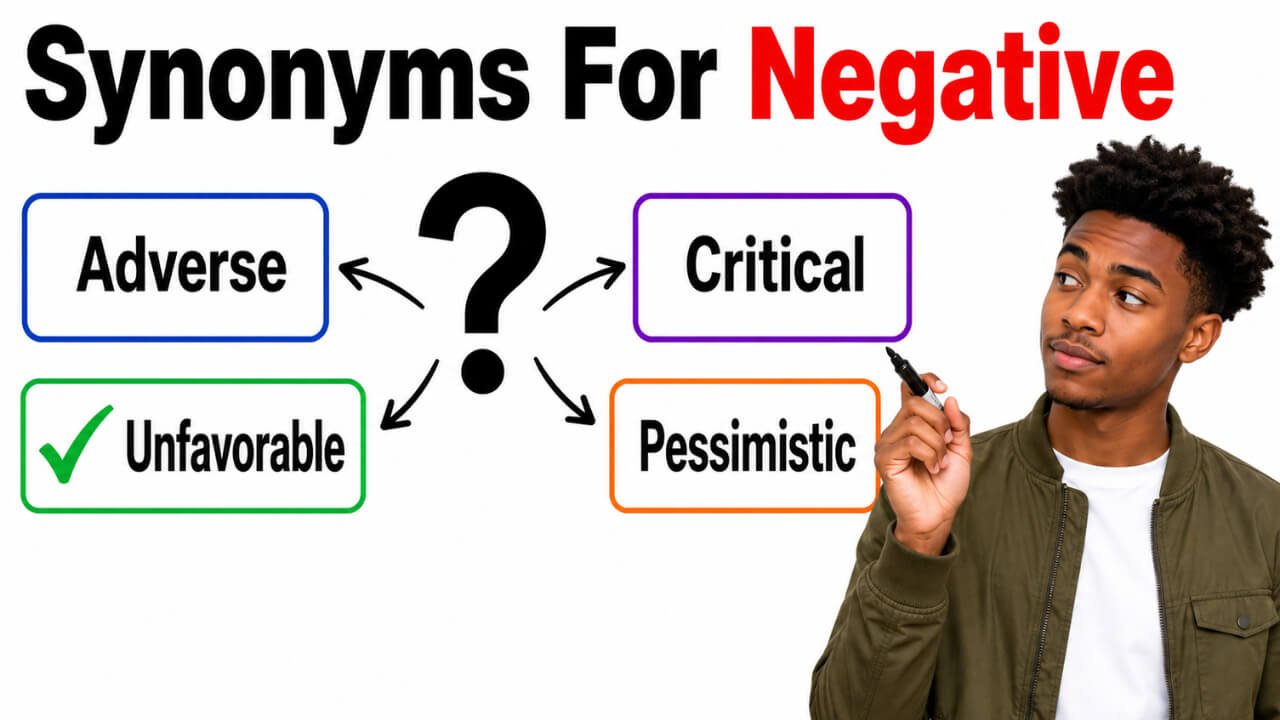
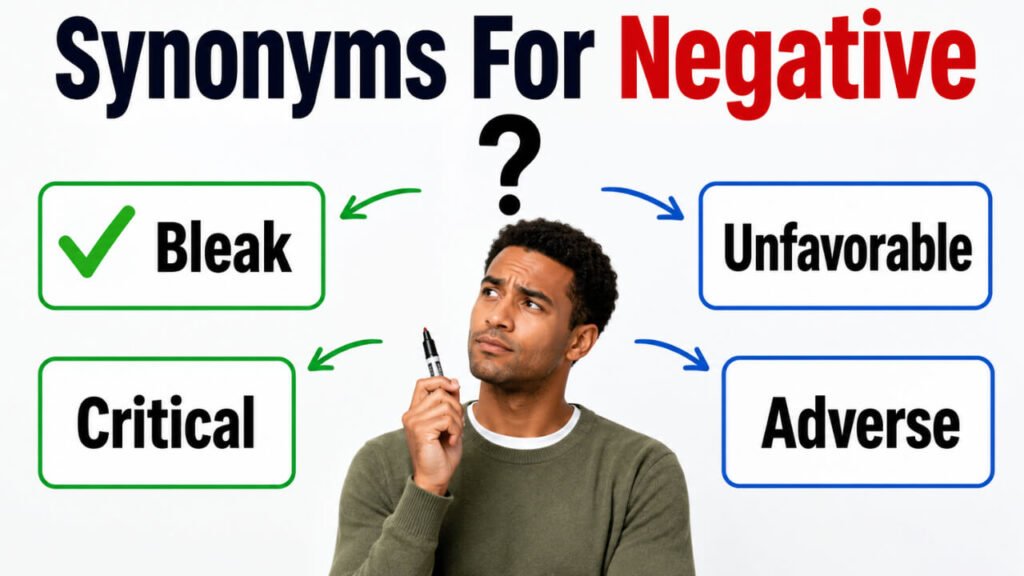
Quick Answer: The best synonyms for negative include unfavorable, pessimistic, critical, harmful, adverse, unpleasant, damaging, dismissive, contrary, and minus. Use unfavorable for opinions, results, or conditions, pessimistic for attitude, harmful for effects, critical for judgment, adverse for formal writing, and minus when talking about numbers or values below zero.
Pronunciation and Word Details
Word: Negative.
Pronunciation: /ˈneɡətɪv/.
Part of Speech: Adjective and noun.
Meaning: Negative means not positive, unfavorable, harmful, denying, critical, or less than zero, depending on context.
US Pronunciation:
UK Pronunciation:
What Does “Negative” Mean?
Negative means not positive, supportive, helpful, or favorable.
The word negative can work as an adjective or a noun. As an adjective, it can describe a bad result, an unpleasant attitude, harmful effect, critical comment, denying answer, or number below zero. As a noun, it can mean a negative answer, a negative result, or a value less than zero.
In sentence context, negative changes meaning based on what it describes. A negative person may be pessimistic. A negative review may be critical. A negative effect may be harmful. A negative number is below zero. A negative response means no, refusal, or denial.
Meaning, Tone, and Context of “Negative”
Negative is usually neutral in grammar, but its emotional tone often feels unpleasant, critical, doubtful, or unfavorable.
In everyday conversation, negative commonly describes attitude, mood, comments, feelings, or reactions. In formal writing, it can describe effects, outcomes, evidence, consequences, test results, business conditions, and data. In grammar, logic, and mathematics, it can describe denial, opposition, or values below zero.
The word can sound serious when used in reports, academic writing, health related writing, or professional communication. It can sound personal when used to describe someone’s attitude, behavior, or outlook. Because it has several meanings, the best synonym depends strongly on context.
When and How to Use “Negative”
For Attitude: Use negative when someone expects bad results or focuses on problems.
Example: His negative attitude made the discussion harder.
For Results: Use negative when an outcome is poor, unfavorable, or not successful.
Example: The report showed negative results.
For Effects: Use negative when something causes harm, damage, or a bad influence.
Example: Too much pressure can have a negative effect on learning.
For Comments: Use negative when words are critical, discouraging, or unsupportive.
Example: Her negative comments lowered the team’s confidence.
For Denial: Use negative when the answer means no or shows refusal.
Example: He gave a negative response to the request.
For Numbers: Use negative when a number is below zero.
Example: The temperature dropped to a negative value at night.
Best Synonyms for Negative
Unfavorable: Not positive, helpful, or supportive.
Example: The plan received an unfavorable response from the group.
Pessimistic: Expecting bad results or focusing on problems.
Example: His pessimistic view made the situation seem worse.
Critical: Pointing out faults, problems, or weaknesses.
Example: The teacher gave critical feedback on the essay.
Harmful: Causing damage, pain, or a bad effect.
Example: Poor sleep can be harmful to concentration.
Adverse: Unfavorable or harmful, especially in formal writing.
Example: The policy had adverse effects on small businesses.
Unpleasant: Not enjoyable, comfortable, or positive.
Example: They had an unpleasant experience during the trip.
Damaging: Causing harm, loss, or weakness.
Example: False information can be damaging to trust.
Dismissive: Showing rejection, lack of respect, or lack of interest.
Example: His dismissive tone made the question feel unimportant.
Contrary: Opposite, opposing, or not agreeing with something.
Example: The evidence gave a contrary impression.
Minus: Less than zero or showing subtraction.
Example: The answer was a minus number.
50 Synonyms for Negative with Short Meanings
- Unfavorable: Not helpful, supportive, or positive.
- Pessimistic: Expecting bad results.
- Critical: Focused on faults or problems.
- Harmful: Causing damage or trouble.
- Adverse: Unfavorable or damaging in effect.
- Unpleasant: Not enjoyable or comfortable.
- Damaging: Causing harm, loss, or weakness.
- Dismissive: Rejecting or showing little respect.
- Contrary: Opposite or opposed in meaning.
- Minus: Below zero or involving subtraction.
- Bad: Not good or desirable.
- Poor: Low in quality or value.
- Undesirable: Not wanted or not suitable.
- Discouraging: Making someone lose hope or confidence.
- Disapproving: Showing dislike or criticism.
- Rejecting: Refusing to accept or support.
- Opposing: Acting against something.
- Hostile: Unfriendly or strongly against something.
- Unhelpful: Not useful or supportive.
- Doubtful: Not confident or uncertain.
- Skeptical: Questioning or not easily convinced.
- Cynical: Distrustful of motives or sincerity.
- Bleak: Without hope or encouragement.
- Gloomy: Sad, dark, or without optimism.
- Sour: Unfriendly, bitter, or unpleasant in tone.
- Bitter: Angry, resentful, or harsh.
- Harsh: Severe, rough, or unkind.
- Severe: Serious, strict, or intense.
- Unkind: Not caring or gentle.
- Unfriendly: Not warm, welcoming, or kind.
- Depressing: Making someone feel sad or hopeless.
- Grim: Serious, worrying, or unpleasant.
- Dark: Serious, sad, or lacking hope.
- Dismal: Very bad, sad, or disappointing.
- Disappointing: Not meeting hopes or expectations.
- Troubling: Causing worry or concern.
- Problematic: Causing difficulty or concern.
- Destructive: Causing serious harm or damage.
- Injurious: Harmful or damaging, especially in formal use.
- Detrimental: Causing harm or disadvantage.
- Unproductive: Not producing useful results.
- Counterproductive: Having the opposite of the desired effect.
- Invalid: Not legally, logically, or officially acceptable.
- False: Not true or correct.
- Incorrect: Not accurate or right.
- Denying: Saying that something is not true.
- Refusing: Saying no to a request or offer.
- Opposite: Completely different or against something.
- Reverse: Moving or acting in the opposite direction.
- Below zero: Less than zero in number or value.
Read Also:
Synonyms for Creative

Synonyms for Negative by Context
When Negative Means Unfavorable
Use these synonyms when negative means not good, not supportive, or not helpful.
Unfavorable: The proposal received an unfavorable reaction.
Poor: The company had poor results this month.
Undesirable: The change created undesirable effects.
Disappointing: The final score was disappointing for the team.
When Negative Means Pessimistic
Use these words when negative describes attitude, mood, or outlook.
Pessimistic: She had a pessimistic view of the situation.
Gloomy: His gloomy mood affected the whole room.
Bleak: The forecast gave a bleak picture of the future.
Cynical: His cynical comment suggested he did not trust the plan.
When Negative Means Critical
Use these synonyms when negative describes judgment, comments, or feedback.
Critical: The review was critical but fair.
Disapproving: She gave him a disapproving look.
Harsh: His harsh words hurt her confidence.
Dismissive: The manager gave a dismissive reply.
When Negative Means Harmful
Use these words when negative means causing damage, risk, or bad effects.
Harmful: Stress can be harmful when it continues for too long.
Damaging: The rumor was damaging to his reputation.
Adverse: The decision had adverse consequences.
Detrimental: Lack of practice can be detrimental to progress.
When Negative Means Denying or Refusing
Use these synonyms when negative means saying no or not accepting something.
Denying: The answer was denying the claim.
Rejecting: Her rejecting response ended the discussion.
Refusing: His refusing tone made the decision clear.
Opposing: The group gave an opposing statement.
When Negative Means Below Zero
Use these words when negative appears in mathematics, measurement, or values.
Minus: The result was a minus figure.
Below zero: The temperature fell below zero.
Reverse: The graph showed a reverse movement.
Opposite: The value moved in the opposite direction.
Another Word for Negative
The best single replacement for negative is often unfavorable. It works well in many general contexts, especially when describing results, opinions, reactions, effects, or conditions. However, the best alternative depends on meaning. Use pessimistic for attitude, harmful for effects, critical for comments, adverse for formal writing, and minus for numbers.
Original: The report had a negative tone.
Better Option: The report had a critical tone.
Original: She gave a negative answer.
Better Option: She gave a rejecting answer.
Original: The medicine had a negative effect.
Better Option: The medicine had an adverse effect.
Original: He always has negative thoughts.
Better Option: He often has pessimistic thoughts.
When Not to Use “Negative”
Do not use negative when a more exact word would make your sentence clearer. Negative can be too broad because it may mean bad, harmful, critical, refusing, pessimistic, false, or below zero.
Use pessimistic when the meaning is about attitude. Use harmful or damaging when the meaning is about effects. Use critical when the meaning is about comments or judgment. Use minus or below zero when the meaning is mathematical.
Weak: The decision had a negative result.
Better: The decision had an unfavorable result.
Weak: His negative words upset everyone.
Better: His harsh words upset everyone.
Weak: She is negative about every plan.
Better: She is pessimistic about every plan.
Weak: The change created negative effects.
Better: The change created harmful effects.
Words Commonly Confused With Negative
Negative vs Bad: Negative is broader and can mean unfavorable, denying, harmful, or below zero. Bad mainly means poor, wrong, or unpleasant.
Negative vs Pessimistic: Negative can describe results, comments, effects, or numbers. Pessimistic describes a person, view, or attitude that expects bad outcomes.
Negative vs Critical: Negative can mean generally unfavorable. Critical means judging, analyzing, or pointing out faults.
Negative vs Harmful: Negative may simply mean not positive. Harmful means something causes real damage or injury.
Negative vs Adverse: Negative is common in everyday and general writing. Adverse is more formal and usually describes harmful effects, conditions, or consequences.
Negative vs False: Negative can mean denying or not positive. False means not true or not correct.
Negative vs Minus: Negative can describe mood, opinion, or effect. Minus is mainly used for numbers, subtraction, or values below zero.
Which Synonym Should You Choose?
Choose unfavorable when writing about results, reactions, reviews, opinions, or conditions.
Choose pessimistic when describing a person’s attitude, outlook, thoughts, or expectations.
Choose critical when writing about comments, reviews, feedback, judgment, or evaluation.
Choose harmful when something causes damage, danger, pain, or a bad effect.
Choose adverse when you need a formal word for harmful conditions, results, or consequences.
Choose damaging when the effect causes loss, weakness, or harm to reputation, trust, health, or progress.
Choose dismissive when someone rejects an idea, question, or person without respect.
Choose skeptical when someone doubts a claim or is not easily convinced.
Choose minus when writing about numbers, subtraction, temperature, or values below zero.
Choose unpleasant when describing an experience, feeling, memory, or situation that is not enjoyable.
Real Life Examples of “Negative” in Sentences
Original: His negative attitude affected the meeting.
Better Option: His pessimistic attitude affected the meeting.
Original: The article received negative feedback.
Better Option: The article received critical feedback.
Original: The plan produced negative results.
Better Option: The plan produced unfavorable results.
Original: Too much noise has a negative effect on focus.
Better Option: Too much noise has a harmful effect on focus.
Original: She gave a negative reply to the offer.
Better Option: She gave a rejecting reply to the offer.
Original: The test result was negative.
Better Option: The test result showed no positive finding.
Original: The temperature reached a negative number.
Better Option: The temperature reached a value below zero.
Original: His negative comment hurt the team.
Better Option: His harsh comment hurt the team.
Original: The change had a negative impact on sales.
Better Option: The change had an adverse impact on sales.
Original: Her negative view made the problem feel bigger.
Better Option: Her gloomy view made the problem feel bigger.
Synonym Groups and Usage Differences
Unfavorable Result Group
This group includes words used for poor outcomes, weak reactions, or disappointing conditions. Use these when negative describes a result, review, report, or response.
Example: The survey showed an unfavorable reaction to the new rule.
Pessimistic Attitude Group
This group describes people, thoughts, moods, and expectations that focus on problems or bad outcomes.
Example: His pessimistic outlook made the task seem harder than it was.
Critical Comment Group
This group fits feedback, reviews, opinions, and judgment. These words show disapproval, fault finding, or strong evaluation.
Example: The editor gave critical comments to improve the article.
Harmful Effect Group
This group describes damage, risk, injury, or a bad influence. Use it for health, behavior, decisions, habits, and consequences.
Example: Poor planning can have detrimental effects on progress.
Denial and Refusal Group
This group fits answers, replies, decisions, and statements that reject or deny something.
Example: The committee gave a rejecting response to the request.
Mathematical Value Group
This group is for numbers, measurement, temperature, direction, or values below zero.
Example: The final number was below zero after the calculation.
Antonyms of Negative
Positive: Favorable, helpful, supportive, or above zero.
Favorable: Showing approval, benefit, or support.
Optimistic: Expecting good results or better outcomes.
Helpful: Giving support, use, or benefit.
Beneficial: Producing good effects or advantages.
Pleasant: Enjoyable, comfortable, or agreeable.
Supportive: Giving help, approval, or encouragement.
Approving: Showing agreement or acceptance.
Constructive: Helpful and focused on improvement.
Encouraging: Giving hope, confidence, or motivation.
Affirmative: Saying yes or showing agreement.
Valid: Correct, acceptable, or supported by reason.
True: Correct and based on fact.
Above zero: Greater than zero in number or value.
Comparison: Negative vs Related Words
Negative vs Pessimistic
Negative is a broad word that can describe attitude, results, comments, effects, or numbers. Pessimistic only describes a doubtful or hopeless outlook.
Example With Negative: He had a negative reaction to the plan.
Example With Pessimistic: He had a pessimistic view of the plan.
Negative vs Unfavorable
Negative can mean many things, including harmful, denying, or below zero. Unfavorable usually means not supportive, not good, or not beneficial.
Example With Negative: The results were negative.
Example With Unfavorable: The results were unfavorable for the team.
Negative vs Critical
Negative can describe something bad or not positive. Critical means judging or pointing out problems, and it can sometimes be useful or constructive.
Example With Negative: She made a negative comment.
Example With Critical: She made a critical comment about the structure.
Negative vs Harmful
Negative may describe a general bad effect. Harmful is stronger and means something causes real damage.
Example With Negative: The habit had a negative effect.
Example With Harmful: The habit had a harmful effect on his health.
Negative vs Adverse
Negative is common in everyday writing. Adverse is more formal and often appears with effects, conditions, outcomes, and consequences.
Example With Negative: The weather had a negative effect on travel.
Example With Adverse: The weather had an adverse effect on travel.
Negative vs Minus
Negative can describe attitude, meaning, effect, or value. Minus is mainly used for mathematics, subtraction, and values below zero.
Example With Negative: The number is negative.
Example With Minus: The number is minus five.
Common Phrases and Expressions With Negative
Negative Attitude: A way of thinking that focuses on problems or bad results.
Negative Effect: A bad or harmful influence.
Negative Impact: A damaging or unfavorable result.
Negative Feedback: Critical or unfavorable comments.
Negative Response: A reply that says no or rejects something.
Negative Result: A result that is unfavorable or shows absence of something expected.
Negative Review: A critical or disapproving opinion.
Negative Thought: A thought focused on fear, doubt, or problems.
Negative Number: A number less than zero.
Negative Energy: A mood or feeling that seems unpleasant, discouraging, or tense.
Common Mistakes to Avoid
A common mistake is using negative for every bad situation. The word is useful, but it can become vague when a sentence needs precision. Instead of writing negative effect, use harmful effect, adverse effect, or damaging effect when the meaning is stronger.
Another mistake is confusing negative with pessimistic. A person can be pessimistic, but a result is usually unfavorable, poor, or disappointing. Similarly, a comment may be critical or harsh rather than simply negative.
Writers also confuse negative with false. A negative answer can mean no, but a false statement means not true. These words should not be used as exact replacements in every sentence.
Avoid repeating negative several times in the same paragraph. Choose clearer synonyms by context, such as unfavorable, critical, harmful, adverse, dismissive, pessimistic, or minus.
Conclusion
The keyword synonyms for negative includes many useful choices because negative has several meanings. Use unfavorable for results, pessimistic for attitude, critical for comments, harmful for effects, adverse for formal writing, and minus for numbers. A strong synonym makes your writing clearer and more accurate. Instead of using negative repeatedly, choose the word that matches the exact meaning, tone, and sentence context.
FAQs About Synonyms for Negative
What is the best synonym for negative?
The best synonym for negative is unfavorable in many general contexts. For attitude, pessimistic is often better.
What are simple synonyms for negative?
Simple synonyms for negative include bad, poor, unfavorable, harmful, critical, pessimistic, and unpleasant.
Is pessimistic the same as negative?
Not exactly. Pessimistic means expecting bad results, while negative can also mean harmful, unfavorable, critical, denying, or below zero.
What is a formal synonym for negative?
Formal synonyms for negative include adverse, unfavorable, detrimental, injurious, and counterproductive.
What is another word for negative attitude?
Another word for negative attitude is pessimistic attitude, gloomy outlook, cynical view, or discouraging mindset.
What is the opposite of negative?
The opposite of negative is usually positive. Other antonyms include favorable, optimistic, helpful, beneficial, supportive, and affirmative.
Which synonym for negative is best for professional writing?
For professional writing, use unfavorable for results, adverse for effects, critical for feedback, and detrimental for serious harm
