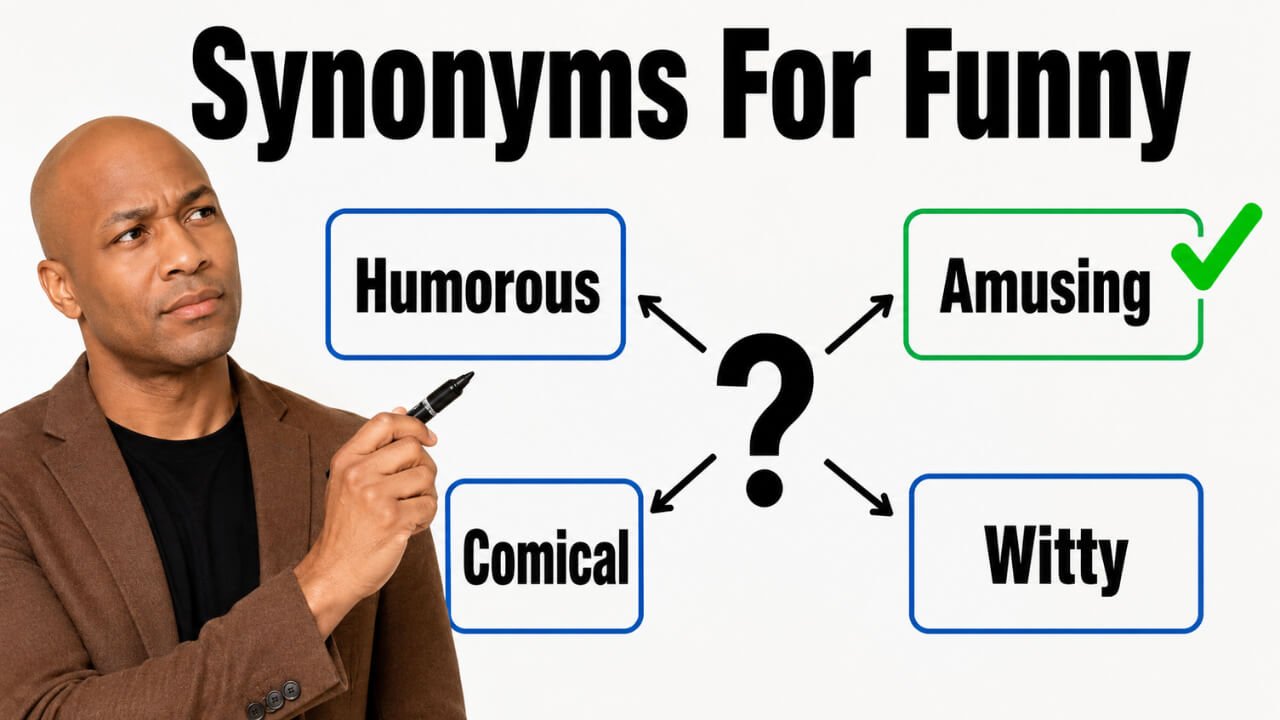
Quick Answer: The best synonyms for funny are humorous, amusing, comical, witty, hilarious, entertaining, laughable, comic, playful, and strange. Use humorous in formal or neutral writing, amusing for mild comedy, witty for smart jokes, hilarious for very strong laughter, and strange when funny means odd, unusual, or suspicious.
Pronunciation and Word Details
Word: Funny
Pronunciation: /ˈfʌni/
Part of Speech: Adjective
Meaning: Causing laughter, amusement, or sometimes seeming strange or unusual.
US Pronunciation:
UK Pronunciation:
What Does “Funny” Mean?
Funny means causing laughter, amusement, or entertainment. It is most often used as an adjective to describe a joke, person, story, show, comment, situation, or expression that makes people laugh.
The word funny can also mean strange, unusual, or not quite right. For example, “That noise sounds funny” does not mean the noise is making you laugh. It means the noise seems odd or unusual. Because of these two meanings, context is very important when choosing synonyms for funny.
Meaning, Tone, and Context of “Funny”
Funny is usually a casual, friendly, and conversational word. It is common in daily speech, light writing, personal descriptions, reviews, and informal communication.
When funny means laughable or amusing, it has a positive tone. It can describe someone with a good sense of comedy, a joke that works well, or a story that makes people smile. When funny means strange or suspicious, the tone becomes more cautious or unclear.
In formal writing, words like humorous, amusing, comic, or witty may sound more precise. In casual speech, funny, hilarious, and entertaining feel natural.
When and How to Use “Funny”
For Comedy: Use funny when something makes people laugh or smile.
Example: Her story was funny and easy to remember.
For Personality: Use funny to describe someone who often says amusing things.
Example: My cousin is funny without trying too hard.
For Entertainment: Use funny when a performance, scene, or moment is enjoyable because of comedy.
Example: The scene was funny because the timing felt natural.
For Strange Situations: Use funny when something seems odd, unusual, or suspicious.
Example: The door made a funny sound when it opened.
For Light Reactions: Use funny when something is amusing but not extremely laughable.
Example: It was funny to see everyone react at the same time.
Best Synonyms for Funny
Humorous: Showing comedy or causing mild laughter.
Example: His humorous speech made the whole room relax.
Amusing: Pleasantly entertaining or lightly funny.
Example: The child told an amusing story about school.
Comical: Funny in a silly, exaggerated, or entertaining way.
Example: His comical expression made everyone laugh.
Witty: Funny in a smart, quick, and sharp way.
Example: She gave a witty answer during the conversation.
Hilarious: Extremely funny and likely to cause strong laughter.
Example: The mistake was so hilarious that nobody could stop laughing.
Entertaining: Enjoyable, interesting, and fun to watch or hear.
Example: His entertaining stories kept the guests interested.
Laughable: So funny, silly, or ridiculous that it causes laughter.
Example: The excuse was laughable because nobody believed it.
Comic: Related to comedy or meant to make people laugh.
Example: The actor had excellent comic timing.
Playful: Light, fun, and cheerful in tone.
Example: Her playful comment made the conversation warmer.
Strange: Odd or unusual, especially when funny means not normal.
Example: There was a strange smell coming from the kitchen.
50 Synonyms for Funny with Short Meanings
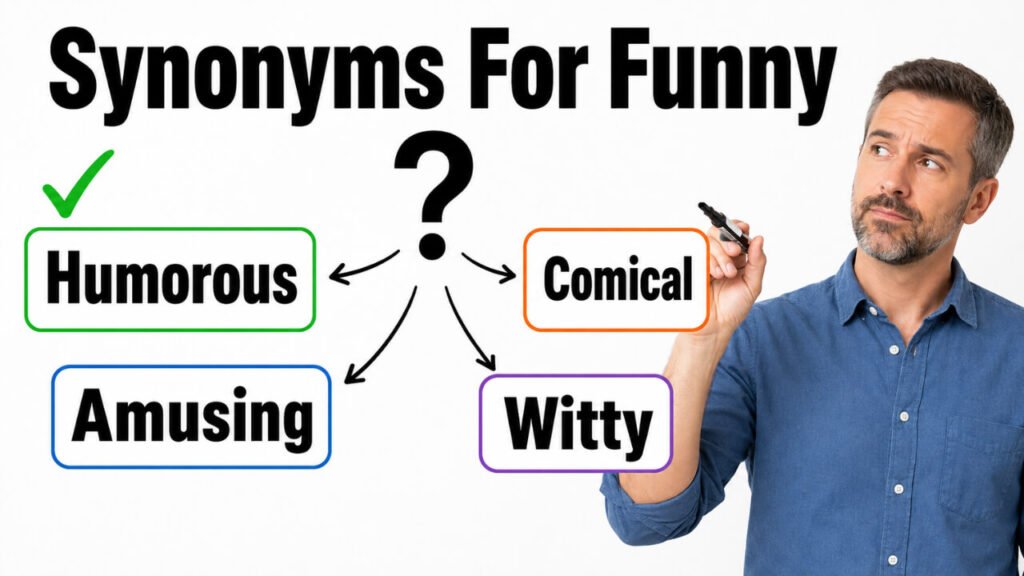
- Humorous: Causing laughter in a pleasant way.
- Amusing: Lightly entertaining or enjoyable.
- Comical: Funny in an exaggerated or silly way.
- Witty: Smart and quick in a funny way.
- Hilarious: Extremely funny.
- Entertaining: Enjoyable and engaging.
- Laughable: Funny because it seems silly or ridiculous.
- Comic: Related to comedy or laughter.
- Playful: Light, cheerful, and fun.
- Jovial: Cheerful and full of good mood.
- Cheerful: Pleasant and happy in tone.
- Jocular: Fond of joking or cheerful comedy.
- Droll: Funny in an unusual or dry way.
- Whimsical: Imaginative, unusual, and lightly funny.
- Ridiculous: So silly that it becomes funny.
- Absurd: Strange or unreasonable in a funny way.
- Silly: Lightly foolish and amusing.
- Goofy: Foolish but funny and harmless.
- Waggish: Playfully funny or joking.
- Facetious: Treating a serious matter in a joking way.
- Mirthful: Full of laughter or happiness.
- Jokey: Full of jokes or joking energy.
- Clownish: Funny in a silly or exaggerated way.
- Farce like: Funny because of exaggerated confusion.
- Satirical: Funny while criticizing something.
- Ironical: Funny through contrast between meaning and reality.
- Sarcastic: Sharp and mocking in a funny or biting way.
- Tongue in cheek: Not meant seriously, often gently funny.
- Light: Easy, relaxed, and amusing.
- Fun: Enjoyable and amusing.
- Lively: Full of energy and entertainment.
- Jesting: Joking or not speaking seriously.
- Merry: Cheerful and full of laughter.
- Gleeful: Happy and full of delight.
- Side splitting: Extremely funny.
- Rib tickling: Very amusing.
- Laugh inducing: Causing laughter.
- Smile worthy: Likely to make someone smile.
- Entertainingly odd: Strange in an enjoyable way.
- Offbeat: Unusual and interestingly funny.
- Odd: Different from normal.
- Strange: Unusual or not expected.
- Peculiar: Different in a noticeable way.
- Curious: Odd or interesting.
- Unusual: Not common or expected.
- Bizarre: Very strange.
- Weird: Informal word for strange or odd.
- Suspicious: Not seeming right or trustworthy.
- Unexpected: Surprising in a funny or unusual way.
- Outlandish: Very unusual, strange, or exaggerated.
Read Also:
Synonyms for Negative
Synonyms for Funny by Context
When Funny Means Humorous
Use these words when funny means something causes laughter or amusement.
Humorous: A polished word for something that makes people laugh.
Example: The speaker gave a humorous example to explain the idea.
Amusing: A softer word for something lightly funny.
Example: The story was amusing but not too silly.
Comical: Best for funny actions, expressions, or situations.
Example: His comical reaction made the room laugh.
Hilarious: Best for something extremely funny.
Example: The ending was hilarious and completely unexpected.
When Funny Means Witty
Use these words when funny means smart, sharp, or quick with words.
Witty: Smart and funny at the same time.
Example: Her witty reply impressed everyone.
Jocular: Cheerful and full of jokes.
Example: His jocular tone made the meeting feel relaxed.
Droll: Dry, unusual, and quietly funny.
Example: He made a droll comment that took a second to understand.
Facetious: Joking when the subject might be serious.
Example: She gave a facetious answer instead of a direct one.
When Funny Means Silly
Use these words when funny means light, foolish, or not serious.
Silly: Funny because it is harmlessly foolish.
Example: The silly dance made the children laugh.
Goofy: Funny in a clumsy or playful way.
Example: His goofy smile made the picture better.
Clownish: Funny in an exaggerated way.
Example: The clownish walk made the scene memorable.
Ridiculous: So unreasonable or silly that it becomes funny.
Example: His ridiculous excuse made everyone smile.
When Funny Means Strange
Use these words when funny means odd, unusual, or not normal.
Strange: Odd or unfamiliar.
Example: The soup had a strange taste.
Odd: Different from what is expected.
Example: His answer sounded odd.
Peculiar: Noticeably unusual.
Example: There was a peculiar mark on the wall.
Suspicious: Strange in a way that causes doubt.
Example: The message looked suspicious.
When Funny Means Entertaining
Use these words when funny means enjoyable, lively, or fun to experience.
Entertaining: Enjoyable and interesting.
Example: The storyteller was entertaining from beginning to end.
Lively: Full of energy and movement.
Example: The lively scene kept the audience interested.
Playful: Light and cheerful.
Example: His playful tone made the message feel friendly.
Fun: Simple, enjoyable, and pleasant.
Example: The activity was fun for everyone.
Another Word for Funny
The best single replacement for funny is humorous when you mean something makes people laugh. It is clear, natural, and works well in both casual and formal writing. However, the best alternative depends on context. Use witty for smart comedy, amusing for gentle comedy, hilarious for strong laughter, and strange when funny means odd.
Original: His answer was funny.
Better Option: His answer was witty.
Original: The story was funny.
Better Option: The story was amusing.
Original: The scene was funny.
Better Option: The scene was hilarious.
Original: The machine made a funny sound.
Better Option: The machine made a strange sound.
When Not to Use “Funny”
Do not use funny when the meaning could be unclear. Since funny can mean both amusing and strange, readers may misunderstand the sentence if the context is weak.
Avoid using funny too many times in one paragraph. Choose a more exact synonym when you want to show the type of comedy, such as witty, comic, amusing, or hilarious.
Weak: The funny man told a funny story with a funny ending.
Better: The witty man told an amusing story with a hilarious ending.
Weak: The report had a funny result.
Better: The report had an unusual result.
Weak: She made a funny comment during the serious meeting.
Better: She made a facetious comment during the serious meeting.
Weak: That is a funny answer.
Better: That is a witty answer.
Words Commonly Confused With Funny
Funny vs Humorous: Funny is more casual. Humorous is more polished and works better in formal writing.
Funny vs Amusing: Funny can mean strongly or lightly laughable. Amusing usually means mildly entertaining.
Funny vs Hilarious: Funny can describe any level of comedy. Hilarious means extremely funny.
Funny vs Witty: Funny can be general. Witty means smart, quick, and clever in expression.
Funny vs Comical: Funny is broad. Comical often describes exaggerated actions, faces, or situations.
Funny vs Strange: Funny can mean amusing or odd. Strange only means unusual or not normal.
Funny vs Ridiculous: Funny can be positive. Ridiculous can sound critical because it means foolish or unreasonable.
Which Synonym Should You Choose?
Choose humorous when you want a clear, polished synonym for funny in writing, essays, descriptions, or formal sentences.
Choose amusing when something is pleasant, light, and gently funny.
Choose witty when a person, reply, joke, or comment is smart and quick.
Choose hilarious when something causes loud or strong laughter.
Choose comical when an action, expression, scene, or mistake looks funny.
Choose entertaining when something is enjoyable, interesting, and fun, but not only about laughter.
Choose playful when the tone is light, friendly, and cheerful.
Choose strange when funny means odd, unusual, or not right.
Choose suspicious when funny means something feels wrong or doubtful.
Choose ridiculous when something is so silly or unreasonable that it becomes laughable.
Real Life Examples of “Funny” in Sentences
Original: The joke was funny.
Better Option: The joke was hilarious.
Original: She wrote a funny story.
Better Option: She wrote an amusing story.
Original: His reply was funny.
Better Option: His reply was witty.
Original: The scene looked funny.
Better Option: The scene looked comical.
Original: That smell is funny.
Better Option: That smell is strange.
Original: The excuse sounded funny.
Better Option: The excuse sounded suspicious.
Original: He has a funny way of explaining things.
Better Option: He has a humorous way of explaining things.
Original: The children made funny faces.
Better Option: The children made comical faces.
Original: Her message had a funny tone.
Better Option: Her message had a playful tone.
Original: It was funny to watch them argue over a small detail.
Better Option: It was amusing to watch them argue over a small detail.
Synonym Groups and Usage Differences
Humor Group
Words in this group describe things that make people laugh in a general way.
Synonyms: Humorous, amusing, comic, comical, hilarious.
Example: The humorous speech made a serious topic easier to understand.
Wit Group
Words in this group describe smart, quick, or sharp comedy.
Synonyms: Witty, droll, jocular, facetious, waggish.
Example: Her witty answer changed the mood of the conversation.
Silly Group
Words in this group describe light, foolish, or exaggerated comedy.
Synonyms: Silly, goofy, ridiculous, clownish, absurd.
Example: His goofy reaction made the moment more enjoyable.
Entertainment Group
Words in this group describe something enjoyable, lively, or fun.
Synonyms: Entertaining, lively, playful, fun, merry.
Example: The lively story kept everyone smiling.
Strange Group
Words in this group describe the meaning of funny as odd or unusual.
Synonyms: Strange, odd, peculiar, curious, weird.
Example: The room had a strange smell after the rain.
Suspicion Group
Words in this group describe funny when something does not feel right.
Synonyms: Suspicious, questionable, doubtful, unusual, odd.
Example: His explanation sounded suspicious.
Antonyms of Funny
Serious: Not joking or amusing.
Unfunny: Not causing laughter.
Dull: Boring or lacking interest.
Boring: Not entertaining or exciting.
Sad: Unhappy or emotionally heavy.
Solemn: Formal, serious, and not playful.
Plain: Simple and not amusing or unusual.
Ordinary: Normal and not strange.
Typical: Expected and not unusual.
Natural: Normal, expected, or not odd.
Comparison: Funny vs Related Words
Funny vs Humorous
Funny is common in everyday speech, while humorous sounds more polished and suitable for formal writing.
Example With Funny: The teacher told a funny story.
Example With Humorous: The teacher gave a humorous explanation.
Funny vs Amusing
Funny can describe mild or strong laughter. Amusing usually describes something gently entertaining.
Example With Funny: The video was funny.
Example With Amusing: The short story was amusing.
Funny vs Witty
Funny is broad. Witty means funny because of intelligence, timing, or smart word choice.
Example With Funny: His comment was funny.
Example With Witty: His comment was witty and well timed.
Funny vs Hilarious
Funny can be light or strong. Hilarious means extremely funny.
Example With Funny: The joke was funny.
Example With Hilarious: The joke was hilarious.
Funny vs Comical
Funny can describe jokes, people, situations, or odd things. Comical often describes visible actions, scenes, or expressions.
Example With Funny: His mistake was funny.
Example With Comical: His expression was comical.
Funny vs Strange
Funny can mean amusing or odd. Strange only means unusual, unfamiliar, or not expected.
Example With Funny: The box made a funny noise.
Example With Strange: The box made a strange noise.
Common Phrases and Expressions With Funny
Funny Story: A story that makes people laugh.
Funny Joke: A joke that causes amusement.
Funny Face: A silly or comical facial expression.
Funny Feeling: A strange or uncertain feeling.
Funny Sound: A noise that seems odd or unusual.
Funny Business: Suspicious or dishonest behavior.
Funny Enough: Surprisingly or interestingly.
Funny Thing: An unusual, amusing, or interesting fact.
Funny Side: The amusing part of a situation.
Funny Bone: A sensitive part of the elbow, also used for sense of comedy.
Common Mistakes to Avoid
One common mistake is using funny when the meaning is not clear. A sentence like “That sounds funny” can mean amusing, strange, or suspicious. Choose a more exact word if clarity matters.
Another mistake is repeating funny too often. Strong writing uses precise alternatives like witty, amusing, hilarious, comical, or strange.
Writers also sometimes use a strong synonym in the wrong context. Hilarious should be saved for very funny things, not mild amusement. Facetious should be used carefully because it can suggest that someone is joking when seriousness is expected.
Avoid using funny in formal reports when you mean unusual. In that case, choose unusual, odd, irregular, or strange.
Conclusion
The keyword synonyms for funny includes many useful choices because funny can mean amusing, witty, entertaining, silly, or strange. Use humorous for polished writing, amusing for gentle comedy, witty for smart remarks, hilarious for strong laughter, and comical for funny actions or scenes. When funny means odd, choose strange, peculiar, unusual, or suspicious. The best synonym depends on tone, context, and the exact meaning you want to express.
FAQs About Synonyms for Funny
What is the best synonym for funny?
The best general synonym for funny is humorous. It works well when describing jokes, stories, people, or comments that cause laughter.
What is a stronger word than funny?
A stronger word than funny is hilarious. It means extremely funny and suggests strong laughter.
What is a formal synonym for funny?
A formal synonym for funny is humorous. In some contexts, comic and amusing also sound polished.
What is another word for a funny person?
Another word for a funny person is witty if the person uses smart jokes. You can also say humorous, jocular, or entertaining.
What does funny mean besides humorous?
Funny can also mean strange, odd, unusual, or suspicious. For example, “This food tastes funny” means it tastes strange, not amusing.
Is amusing the same as funny?
Amusing is close to funny, but it is usually softer. Something amusing makes people smile or feel entertained, while funny can cause stronger laughter.
What synonym should I use for funny in writing?
Use humorous for general writing, witty for smart comedy, amusing for light comedy, and hilarious for something extremely funny
