
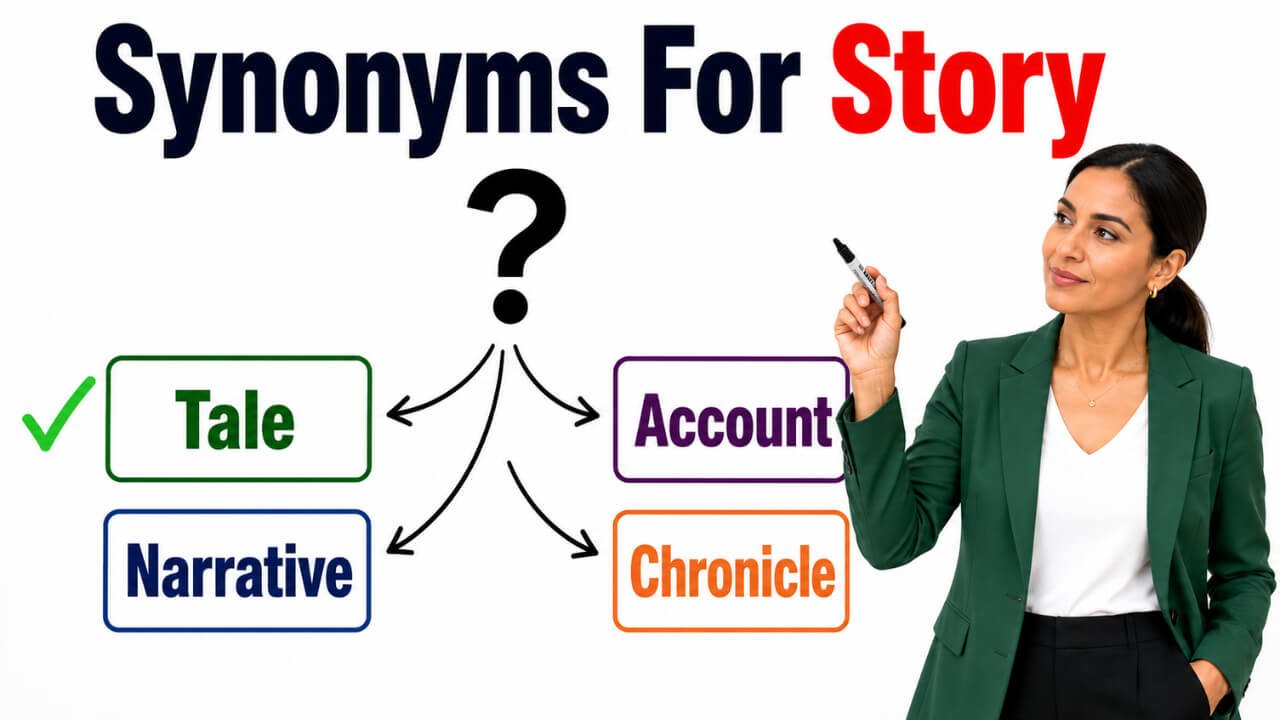
Quick Answer: The best synonyms for story are narrative, tale, account, report, chronicle, anecdote, plot, version, history, and fable. Use narrative for formal writing, tale for imaginative or traditional writing, account for real events, report for facts or news, plot for the events inside fiction, and version when describing one person’s side of what happened.
Pronunciation and Word Details
Word: Story
Pronunciation: /ˈstɔːri/
Part of Speech: Noun
Meaning: A description of real or imagined events, usually told in a connected way.
US Pronunciation:
UK Pronunciation:
What Does “Story” Mean?
Story means a spoken or written description of events, people, actions, or experiences. It is a noun and can refer to something real, imagined, personal, historical, fictional, or reported.
A story can be a short tale, a long novel, a news report, a personal experience, a version of events, or the main plot of a book or film. In everyday speech, story is a flexible word because it can describe both creative writing and factual explanation.
Meaning, Tone, and Context of “Story”
Story is a neutral and common word. It works in casual speech, school writing, creative writing, personal communication, journalism, literature, and grammar discussions.
When story refers to fiction, it has a creative and imaginative tone. When it refers to real events, it can mean an account, report, history, or record. When it refers to one side of a situation, it can mean a version. In some contexts, story can also mean an excuse or false claim, as in “That sounds like a story.”
For formal writing, narrative, account, report, and chronicle are often better choices. For creative or literary writing, tale, fable, legend, saga, and plot may fit better.
When and How to Use “Story”
For Fiction: Use story when talking about imagined events, characters, settings, and plots.
Example: The story follows a brave child who solves a village mystery.
For Personal Experience: Use story when someone shares something that happened in life.
Example: She told a story about her first day at school.
For News or Information: Use story when referring to a reported event or public matter.
Example: The story about the storm spread quickly through the town.
For One Side of Events: Use story when someone explains their version of what happened.
Example: His story was different from hers.
For Structure in Writing: Use story when discussing plot, conflict, characters, and resolution.
Example: A strong story needs a clear beginning, middle, and ending.
For Suspicion or Doubt: Use story when a statement sounds like an excuse or invention.
Example: Nobody believed his story about being late.
Best Synonyms for Story
Narrative: A connected description of events, often used in formal or literary writing.
Example: The narrative explains how the family survived the difficult journey.
Tale: A story, often imaginative, traditional, or entertaining.
Example: The old tale was passed down through many generations.
Account: A description of real events from someone’s point of view.
Example: Her account of the accident was clear and detailed.
Report: A factual description of an event, issue, or situation.
Example: The report gave important details about the flood.
Chronicle: A record of events in the order they happened.
Example: The book is a chronicle of village life over fifty years.
Anecdote: A short personal story about a real incident.
Example: He shared an anecdote from his childhood.
Plot: The main sequence of events in a story, novel, play, or film.
Example: The plot becomes more exciting after the first chapter.
Version: One person’s explanation or side of what happened.
Example: Her version of the incident sounded more believable.
History: A record or explanation of past events.
Example: The museum tells the history of the old city.
Fable: A short story that often teaches a moral lesson.
Example: The fable teaches the value of patience.
50 Synonyms for Story with Short Meanings
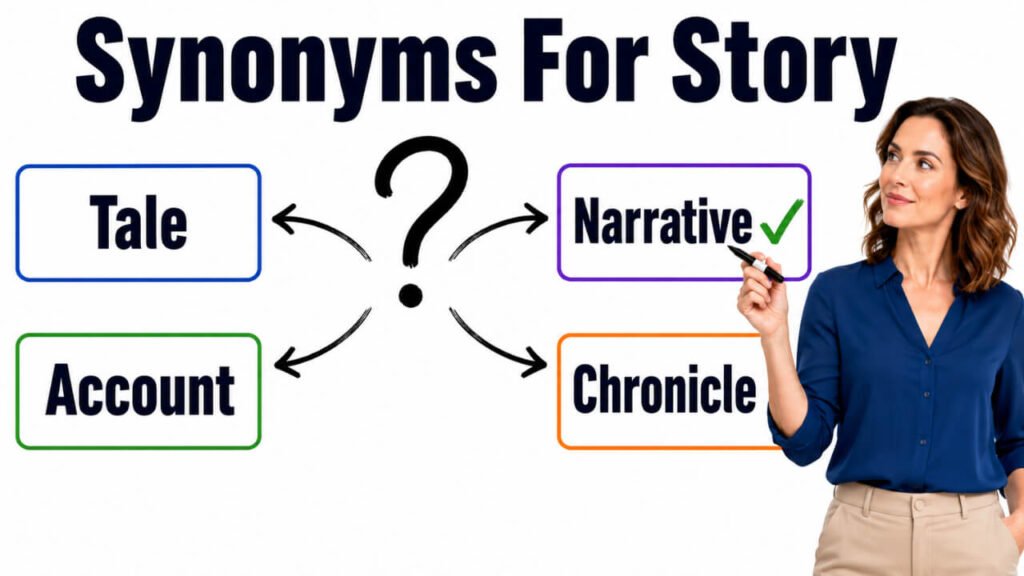
- Narrative: A connected description of events.
- Tale: An entertaining or imaginative story.
- Account: A description of real events.
- Report: A factual statement about an event.
- Chronicle: A record of events in order.
- Anecdote: A short personal story.
- Plot: The main events of a fictional work.
- Version: One person’s side of events.
- History: A record of past events.
- Fable: A short moral story.
- Legend: A traditional story from the past.
- Myth: An ancient story explaining beliefs or origins.
- Saga: A long story about events or adventures.
- Yarn: An informal or entertaining tale.
- Narration: The act or style of telling a story.
- Recital: A detailed telling of events.
- Description: A spoken or written explanation of something.
- Explanation: A clear statement that makes something understood.
- Record: A written account of facts or events.
- Statement: A formal or clear expression of facts.
- Testimony: A serious account given as evidence.
- Memoir: A personal record of life experiences.
- Biography: The story of someone’s life written by another person.
- Autobiography: The story of someone’s life written by that person.
- Novel: A long fictional story in book form.
- Fiction: Imagined writing, events, or characters.
- Short Story: A brief fictional narrative.
- Parable: A simple story with a lesson.
- Fairy Tale: A magical or traditional story.
- Folktale: A traditional story from a culture or community.
- Drama: A story written or performed with conflict and emotion.
- Storyline: The line of events in a story.
- Scenario: A possible situation or imagined sequence.
- Episode: One event or part of a larger story.
- Incident: A specific event that happened.
- Experience: Something someone lived through.
- Adventure: An exciting or unusual experience.
- Event: Something that happens.
- Case: A situation, matter, or example being discussed.
- Article: A written piece about a subject or event.
- Feature: A detailed written piece about a topic.
- News Item: A short report about recent events.
- Piece: A written work or article.
- Sketch: A short written scene or description.
- Profile: A written description of a person or subject.
- Confession: A personal admission or revealing account.
- Disclosure: A statement that reveals information.
- Claim: A statement someone says is true.
- Excuse: A reason given to explain behavior or failure.
- Fabrication: An invented or false story.
Read Also:
Synonyms for Funny
Synonyms for Story by Context
When Story Means a Narrative
Use these words when story means a connected piece of writing or speech with characters, events, and meaning.
Narrative: A formal or literary word for a connected story.
Example: The narrative shows how courage grows through hardship.
Tale: A simple, traditional, or imaginative story.
Example: The tale describes a traveler who finds wisdom in a forest.
Fiction: Imagined writing based on invented people or events.
Example: The book is fiction, but its message feels real.
Short Story: A brief narrative with a clear focus.
Example: The short story ends with a surprising lesson.
When Story Means a Real Account
Use these words when story means a factual or personal explanation of what happened.
Account: A person’s description of real events.
Example: Her account helped everyone understand the situation.
Report: A factual explanation of an event or issue.
Example: The report included the main facts of the case.
Record: A written account kept for information.
Example: The record shows what happened during the meeting.
Testimony: A serious statement about what someone saw or knows.
Example: His testimony supported the victim’s account.
When Story Means a Traditional Tale
Use these words when story refers to cultural, moral, or old imaginative writing.
Legend: A traditional story connected with the past.
Example: The legend tells of a hidden city under the mountain.
Myth: A traditional story about beliefs, gods, origins, or nature.
Example: The myth explains why the moon changes shape.
Fable: A short story with a moral lesson.
Example: The fable teaches that pride can lead to trouble.
Folktale: A story passed down within a culture or community.
Example: The folktale explains the value of kindness.
When Story Means Plot
Use these words when story means the structure or sequence of events in fiction.
Plot: The main chain of events in a story.
Example: The plot becomes tense when the hero loses the map.
Storyline: The connected direction of events.
Example: The storyline follows two friends searching for their family.
Scenario: A possible or imagined situation.
Example: The writer created a scenario where every choice had a cost.
Episode: One part or event in a larger story.
Example: The episode reveals an important secret about the main character.
When Story Means One Side of Events
Use these words when story means someone’s explanation, opinion, or side.
Version: One person’s way of explaining what happened.
Example: His version of the argument was different from hers.
Statement: A clear expression of facts or claims.
Example: The witness gave a statement after the incident.
Claim: Something someone says is true.
Example: Her claim needed more evidence.
Explanation: A reason or description that makes something clear.
Example: His explanation made the delay easier to understand.
When Story Means an Excuse or Lie
Use these words when story means something invented, doubtful, or not fully honest.
Excuse: A reason given to avoid blame.
Example: His excuse for missing class sounded weak.
Fabrication: A false or invented account.
Example: The entire story was a fabrication.
Claim: A statement that may need proof.
Example: His claim did not match the facts.
Lie: A false statement made on purpose.
Example: She knew the story was a lie.
Another Word for Story
The best single replacement for story is narrative when you mean a connected description of events. It is clear, formal, and useful in writing about books, essays, speeches, personal experiences, and public messages. However, the best alternative depends on context. Use tale for imaginative writing, account for real events, report for factual information, and plot for fiction structure.
Original: The story explains his childhood.
Better Option: The narrative explains his childhood.
Original: She told a story about the accident.
Better Option: She gave an account of the accident.
Original: The newspaper published a story about the fire.
Better Option: The newspaper published a report about the fire.
Original: The story of the novel is exciting.
Better Option: The plot of the novel is exciting.
When Not to Use “Story”
Do not use story when a more exact word would make the meaning clearer. In formal writing, story can sometimes sound too general. Use narrative for a connected explanation, account for real events, report for facts, and plot for fiction.
Avoid using story when it could suggest fiction instead of truth. For example, calling a serious statement a story may make it sound less believable. Also, avoid repeating story too often in the same paragraph.
Weak: The story in the report tells the story of the story.
Better: The report explains the account in clear detail.
Weak: His story about the accident was written in the file.
Better: His account of the accident was written in the file.
Weak: The story of the novel has a good story.
Better: The novel has a strong plot and a clear narrative.
Weak: The officer listened to her story.
Better: The officer listened to her statement.
Words Commonly Confused With Story
Story vs Narrative: Story is broad and common. Narrative is more formal and usually means a connected explanation of events.
Story vs Tale: Story can be real or imagined. Tale often sounds imaginative, traditional, or entertaining.
Story vs Account: Story can be fictional or factual. Account usually means a real description of events.
Story vs Report: Story may include emotion, style, or imagination. Report focuses on facts and information.
Story vs Plot: Story can mean the whole narrative. Plot means the sequence of main events inside a creative work.
Story vs History: Story can be personal, fictional, or factual. History refers to past events, records, or development over time.
Story vs Version: Story can be any description of events. Version means one person’s side or form of the same event.
Story vs Anecdote: Story can be long or short. Anecdote is usually a short personal incident.
Which Synonym Should You Choose?
Choose narrative when writing about a connected sequence of events in formal writing, literature, essays, or analysis.
Choose tale when the writing feels imaginative, traditional, simple, or entertaining.
Choose account when describing real events from a person’s point of view.
Choose report when writing about facts, news, findings, events, or official information.
Choose chronicle when events are recorded in the order they happened.
Choose anecdote when telling a short personal incident.
Choose plot when talking about the main events in a novel, play, or film.
Choose storyline when explaining the direction of a fictional or dramatic work.
Choose version when referring to one person’s side of events.
Choose fabrication when the story is false or invented.
Real Life Examples of “Story” in Sentences
Original: She told a story about her trip.
Better Option: She shared an anecdote about her trip.
Original: The story of the book is powerful.
Better Option: The narrative of the book is powerful.
Original: His story about the accident was detailed.
Better Option: His account of the accident was detailed.
Original: The story appeared in the morning paper.
Better Option: The report appeared in the morning paper.
Original: The story has too many characters.
Better Option: The plot has too many characters.
Original: Her story of success motivated the class.
Better Option: Her journey of success motivated the class.
Original: The old story teaches a lesson.
Better Option: The old fable teaches a lesson.
Original: His story did not sound true.
Better Option: His explanation did not sound true.
Original: The story follows a young traveler.
Better Option: The storyline follows a young traveler.
Original: Each witness gave a different story.
Better Option: Each witness gave a different version.
Synonym Groups and Usage Differences
Narrative Group
This group works best for connected writing, literature, essays, and meaningful event descriptions.
Synonyms: Narrative, narration, storyline, plot, drama.
Example: The narrative shows how the character changes after loss.
Factual Account Group
This group works best for real events, evidence, statements, and serious descriptions.
Synonyms: Account, report, record, statement, testimony.
Example: The witness gave a clear account of the event.
Traditional Story Group
This group works best for old, cultural, moral, or imaginative stories.
Synonyms: Tale, legend, myth, fable, folktale.
Example: The fable uses animals to teach a moral lesson.
Personal Experience Group
This group works best for life events, memories, and lived experiences.
Synonyms: Anecdote, memoir, experience, confession, biography.
Example: Her memoir includes a moving story about her family.
News and Article Group
This group works best for public information, journalism, and written pieces.
Synonyms: Report, article, feature, news item, piece.
Example: The feature gives a detailed account of the local festival.
Doubtful Claim Group
This group works best when story means an excuse, false statement, or doubtful explanation.
Synonyms: Excuse, claim, fabrication, lie, version.
Example: His excuse sounded like a fabrication.
Antonyms of Story
Fact: Something known or proven to be true.
Truth: What is real or accurate.
Reality: The actual state of things.
Silence: No spoken or written account.
Proof: Evidence that supports truth.
Evidence: Information that helps show what happened.
Recordless: Having no written account or record.
Nonfiction: Writing based on real facts and events.
Data: Facts or information used for analysis.
Verification: Confirmation that something is true.
Comparison: Story vs Related Words
Story vs Narrative
Story is a general word for real or imagined events. Narrative is more formal and focuses on how events are connected and told.
Example With Story: The story is about a young artist.
Example With Narrative: The narrative shows the artist’s growth through struggle.
Story vs Tale
Story can be factual or fictional. Tale often suggests an imaginative, old, magical, or traditional piece of storytelling.
Example With Story: She wrote a story about friendship.
Example With Tale: She wrote a tale about a lost kingdom.
Story vs Account
Story can sound creative or general. Account sounds factual and is often used for real events.
Example With Story: He told his story about the storm.
Example With Account: He gave an account of the storm.
Story vs Report
Story can include emotion, style, or personal detail. Report is more factual, structured, and information focused.
Example With Story: The story described the village flood.
Example With Report: The report described the damage caused by the flood.
Story vs Plot
Story can mean the whole creative work, including characters, setting, theme, and events. Plot means the main sequence of events.
Example With Story: The story is emotional and memorable.
Example With Plot: The plot moves quickly after the first chapter.
Story vs Anecdote
Story can be long, short, real, or imagined. Anecdote is usually a short personal story about one event.
Example With Story: He told a story about his childhood.
Example With Anecdote: He shared an anecdote about his first school day.
Story vs Version
Story can be any telling of events. Version means one particular form or side of the same event.
Example With Story: Her story was emotional.
Example With Version: Her version was different from the witness statement.
Common Phrases and Expressions With Story
True Story: A story based on real events.
Short Story: A brief fictional narrative.
Life Story: A description of someone’s life experiences.
Success Story: An account of achievement or improvement.
Love Story: A story about romance or emotional connection.
Bedtime Story: A story told before sleep.
Story Time: A time for telling or reading stories.
Cover Story: A false explanation used to hide the truth.
Back Story: Events that happened before the main story.
Side Story: A smaller story connected to the main one.
Common Mistakes to Avoid
A common mistake is using story when the meaning should be more specific. If you are writing about facts, report or account may be clearer. If you are writing about fiction structure, plot or storyline may be better.
Another mistake is confusing story with history. A story can be fictional, personal, or factual, while history focuses on past events and records.
Writers also repeat story too often. Instead of writing “The story has a good story,” use stronger words like plot, narrative, theme, character arc, or setting.
Avoid calling serious evidence a story when you mean statement, testimony, or account. Story can sometimes sound less formal or less reliable.
Conclusion
The keyword synonyms for story covers many useful words because story can mean a narrative, account, report, tale, plot, version, or even an excuse. Use narrative for formal writing, tale for imaginative writing, account for real events, report for facts, plot for fiction, and version for one person’s side of events. Choosing the right synonym helps your writing sound clearer, more natural, and more precise.
FAQs About Synonyms for Story
What is the best synonym for story?
The best general synonym for story is narrative. It works well when describing a connected series of events in speech or writing.
What is another word for story in writing?
Another word for story in writing is narrative. For fiction structure, plot or storyline may be better.
What is a formal synonym for story?
A formal synonym for story is account when discussing real events and narrative when discussing connected writing or explanation.
What is another word for a short story?
Another word for a short story can be tale, anecdote, fable, or narrative, depending on the meaning and context.
What is another word for a true story?
Another word for a true story is account, report, record, or testimony. These words suggest factual events.
What is another word for story in a book?
Another word for story in a book is plot, narrative, or storyline. Plot focuses on the main events, while narrative focuses on how the story is told.
What is a synonym for story when it means lie?
When story means a lie, possible synonyms include fabrication, excuse, false claim, or made up account
