
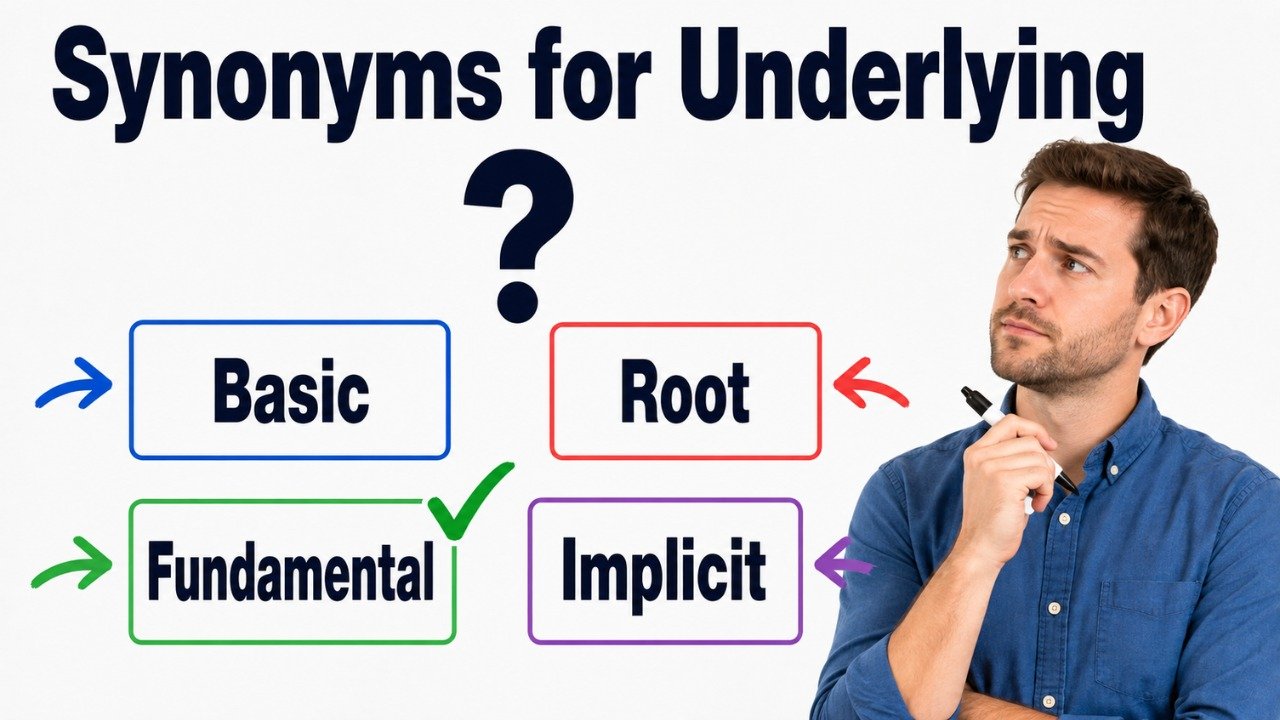
Quick Answer: The best synonyms for underlying include fundamental, basic, essential, root, hidden, implicit, inherent, primary, foundational, and concealed. Use fundamental or foundational when describing an important principle or structure, root when discussing the main cause of a problem, hidden or concealed when something is not immediately visible, implicit when a meaning is suggested rather than directly stated, inherent when a quality naturally belongs to something, and primary when referring to a main or central factor. The best choice depends on whether underlying describes a cause, meaning, condition, principle, structure, or hidden element.
Pronunciation and Word Details
Word: Underlying
Pronunciation: /ˌʌndərˈlaɪɪŋ/
Part of Speech: Adjective
Meaning: Existing beneath the surface or forming the basic cause, principle, structure, or meaning of something.
US Pronunciation:
UK Pronunciation:
What Does “Underlying” Mean?
Underlying means existing beneath something physically or serving as the basic cause, principle, condition, or meaning behind something.
As an adjective, underlying often describes something that is important but not immediately obvious.
For example, an underlying problem is a deeper problem that causes visible difficulties. An underlying principle is a basic idea on which a system, argument, or belief is built.
The word can also describe something physically located beneath another layer.
Example: The underlying rock determines some features of the landscape.
In communication, underlying can describe an emotion, intention, or meaning that is suggested rather than openly stated.
Example: There was an underlying sense of disappointment in her response.
Underlying is therefore useful when discussing hidden causes, basic structures, deeper meanings, important principles, and conditions beneath the surface.
Meaning, Tone, and Context of “Underlying”
Underlying is a neutral to slightly formal word. It appears frequently in academic writing, professional reports, essays, analysis, science, medicine, psychology, economics, business, and everyday explanations.
When describing causes, underlying suggests that the visible issue may only be a symptom of something deeper.
Example: The discussion focused on the underlying causes of the conflict.
When describing principles or ideas, the word has a formal and analytical tone.
Example: Trust is an underlying principle of successful cooperation.
In emotional or conversational contexts, underlying can describe feelings that are present but not openly expressed.
Example: Her calm voice could not completely hide the underlying anxiety.
In physical descriptions, underlying simply means positioned beneath another surface or layer.
Because the word has several related meanings, the best synonym depends heavily on context.
When and How to Use “Underlying”
For a Basic Cause
Use underlying when describing the deeper reason behind an event, problem, or condition.
Example: The team worked to identify the underlying cause of the repeated errors.
For a Fundamental Principle
Underlying can describe a basic principle on which an idea, system, or argument depends.
Example: Equality is an underlying principle of the policy.
For a Hidden Problem
Use underlying when a problem exists beneath more obvious symptoms.
Example: The disagreement revealed an underlying communication problem.
For an Unspoken Meaning
Underlying can describe a meaning, message, or intention that is suggested but not directly expressed.
Example: The underlying message of the speech was a call for cooperation.
For a Hidden Emotion
The word can describe an emotion that exists even though it is not openly shown.
Example: There was underlying tension throughout the meeting.
For a Basic Structure
Use underlying when describing the structure or framework that supports something.
Example: The underlying structure of the system remained unchanged.
For a Physical Layer
Underlying may literally mean located beneath another surface.
Example: The damaged surface exposed the underlying material.
For an Existing Condition
Underlying can describe a condition that continues to exist and influences another situation.
Example: The temporary improvement did not solve the underlying issue.
Best Synonyms for Underlying
Fundamental
Synonym: Basic and extremely important to the nature of something.
Example: Respect is a fundamental part of a healthy relationship.
Basic
Synonym: Forming the simplest or most important foundation of something.
Example: The basic problem was a lack of clear communication.
Foundational
Synonym: Providing the base on which something develops.
Example: Reading is a foundational skill for further learning.
Root
Synonym: Existing as the main or original cause of something.
Example: The investigation identified the root cause of the failure.
Hidden
Synonym: Present but not easily seen, noticed, or understood.
Example: The report uncovered several hidden problems.
Implicit
Synonym: Suggested or understood without being directly stated.
Example: There was an implicit warning in his remarks.
Inherent
Synonym: Existing naturally as a permanent or essential part of something.
Example: Every investment carries inherent uncertainty.
Primary
Synonym: Most important or central among several factors.
Example: Cost was the primary concern for the committee.
Essential
Synonym: Absolutely necessary or central to something.
Example: Clear communication is essential to effective teamwork.
Concealed
Synonym: Deliberately or naturally kept from being seen or noticed.
Example: The investigation revealed a concealed weakness in the plan.
50 Synonyms for Underlying with Short Meanings
- Fundamental: Forming the basic nature of something.
- Basic: Existing at the simplest or most important level.
- Foundational: Providing the base for something else.
- Root: Forming the original or main cause.
- Hidden: Present but not easily noticed.
- Implicit: Suggested without being directly stated.
- Inherent: Naturally existing as part of something.
- Primary: Most important or central.
- Essential: Necessary to the nature or success of something.
- Concealed: Kept from being visible or obvious.
- Core: Forming the central or most important part.
- Central: Most important to an idea or situation.
- Principal: Main or most significant.
- Chief: Most important among several factors.
- Main: Most important or prominent.
- Base: Forming the supporting level of something.
- Subjacent: Situated directly beneath something.
- Subsurface: Existing below the surface.
- Deep: Existing far beneath the surface or obvious level.
- Deep Seated: Firmly established at a deeper level.
- Latent: Present but not yet visible or active.
- Unseen: Existing without being visible.
- Invisible: Not directly seen or noticed.
- Unspoken: Present or understood without being said.
- Unexpressed: Existing without being openly communicated.
- Unstated: Understood without being directly mentioned.
- Tacit: Understood without being openly expressed.
- Implied: Suggested rather than explicitly stated.
- Subtle: Present in a way that is difficult to notice.
- Buried: Hidden beneath another layer or issue.
- Embedded: Firmly placed within something.
- Intrinsic: Belonging naturally to the essential nature of something.
- Innate: Naturally existing rather than acquired.
- Internal: Existing within something.
- Structural: Related to the basic framework of something.
- Constitutional: Forming part of the basic nature or structure.
- Elementary: Forming the simplest or most basic level.
- Rudimentary: Basic and not highly developed.
- Original: Existing at the beginning or source.
- Initial: Existing at the first stage.
- Causal: Connected with producing a result.
- Source: Acting as the origin of something.
- Originating: Giving rise to something.
- Preexisting: Already present before another condition or event.
- Supporting: Providing a base or foundation.
- Subordinate: Located or operating beneath another level.
- Background: Existing behind the main visible situation.
- Underlying Factor: A deeper element influencing a result.
- Driving: Acting as an important force behind something.
- Governing: Controlling or shaping how something operates.
Read Also:
Synonyms for Symbolize

Synonyms for Underlying by Context
When Underlying Means Fundamental
Fundamental, basic, foundational, core, essential, central, and principal are useful when underlying describes an important principle, idea, or structure.
Example: Trust is a fundamental part of effective teamwork.
Example: The foundational idea behind the theory is relatively simple.
When Underlying Means a Root Cause
Root, primary, causal, source, originating, driving, and main work well when describing the deeper reason behind an event or problem.
Example: The investigation focused on the root cause of the equipment failure.
Example: Poor planning was the primary factor behind the delay.
When Underlying Means Hidden
Hidden, concealed, buried, unseen, invisible, subtle, and latent describe something that exists but is not immediately obvious.
Example: The inspection uncovered a hidden defect.
Example: A subtle tension remained throughout the conversation.
When Underlying Means Implied
Implicit, implied, tacit, unspoken, unstated, and unexpressed work when underlying refers to a message, feeling, assumption, or meaning that is not directly stated.
Example: His comments contained an implicit criticism of the proposal.
Example: There was an unspoken expectation that everyone would cooperate.
When Underlying Means Inherent
Inherent, intrinsic, innate, internal, and constitutional describe qualities that belong naturally to something.
Example: Uncertainty is inherent in many predictions.
Example: Flexibility is an intrinsic feature of the design.
When Underlying Means Physically Beneath
Subjacent, subsurface, buried, base, and supporting can describe something located beneath another material, surface, or structure.
Example: The subsurface layer contained a different type of soil.
Example: Workers examined the supporting structure beneath the floor.
When Underlying Means Structural
Structural, foundational, base, supporting, core, and constitutional fit situations involving frameworks, systems, or organization.
Example: The engineers identified a structural weakness in the building.
Example: The foundational framework remained stable despite later changes.
Another Word for Underlying
Fundamental is often the best general replacement for underlying when describing a basic principle, reason, or condition.
However, root is usually more precise for causes, hidden works better for something difficult to see, implicit suits meanings that are suggested rather than stated, and inherent works when a quality naturally belongs to something.
Original: The underlying problem is poor communication.
Better Option: The root problem is poor communication.
Original: The argument is based on an underlying principle of fairness.
Better Option: The argument is based on a fundamental principle of fairness.
Original: There was an underlying sense of concern in the room.
Better Option: There was a subtle sense of concern in the room.
Original: The underlying message was clear.
Better Option: The implicit message was clear.
When Not to Use “Underlying”
Underlying is useful, but it can sound vague when a more precise synonym clearly identifies the intended meaning.
Avoid using underlying when you specifically mean root cause.
Weak: The underlying cause of the problem was poor maintenance.
Better: The root cause of the problem was poor maintenance.
If something is simply hidden from view, hidden or concealed may be clearer.
Weak: The underlying document was difficult to find.
Better: The hidden document was difficult to find.
When describing a principle that is central to an argument, fundamental may sound more precise.
Weak: The underlying principle of the argument is equality.
Better: The fundamental principle of the argument is equality.
Underlying can also become repetitive in analytical writing.
Weak: The underlying cause affected the underlying structure and created an underlying problem.
Better: The root cause affected the basic structure and created a deeper problem.
Use the word when its sense of something beneath the surface or behind an obvious result adds useful meaning.
Words Commonly Confused With Underlying
Underlying vs Fundamental: Underlying may describe something hidden beneath another issue or forming its basis. Fundamental specifically emphasizes something basic and essential.
Underlying vs Hidden: Underlying does not always mean hidden. A principle can be underlying even when people know it exists. Hidden specifically means difficult or impossible to see or notice.
Underlying vs Root: Root usually refers to an original or primary cause. Underlying is broader and can describe causes, meanings, feelings, structures, or principles.
Underlying vs Implicit: Implicit refers specifically to something suggested but not directly stated. Underlying can also describe physical layers, causes, conditions, and structures.
Underlying vs Inherent: Inherent means naturally belonging to something. Underlying means existing beneath the surface or serving as a deeper basis or cause.
Underlying vs Subtle: Subtle describes something difficult to notice because it is delicate or indirect. Underlying refers more broadly to something that exists beneath an obvious surface or situation.
Which Synonym Should You Choose?
Choose fundamental when discussing an important principle, concept, condition, or feature.
Choose basic when you want a simple and neutral alternative.
Choose foundational when describing something that supports the development of a system, theory, skill, or structure.
Choose root when referring to the main cause of a problem.
Choose primary when identifying the most important factor among several possibilities.
Choose hidden when something exists but cannot easily be seen or noticed.
Choose concealed when something has been deliberately or effectively kept from view.
Choose implicit when discussing a meaning, message, assumption, or idea that is suggested rather than stated.
Choose inherent when describing a quality that naturally belongs to something.
Choose intrinsic in formal or academic writing when emphasizing an essential internal quality.
Choose subtle when describing feelings, meanings, or differences that are present but difficult to notice.
Choose latent when something exists but has not yet become active or obvious.
Choose structural when discussing the basic framework of a system, organization, or physical object.
Choose subsurface when something is physically located below a surface.
For essays and reports, fundamental, foundational, inherent, intrinsic, structural, and primary often provide useful precision.
For discussion of problems and analysis, root, causal, primary, and driving are especially useful.
For emotions or meanings, subtle, implicit, unspoken, and hidden may sound more natural.
Real Life Examples of “Underlying” in Sentences
Original: The underlying cause of the problem was poor planning.
Better Option: The root cause of the problem was poor planning.
Original: The report examines the underlying principles of the system.
Better Option: The report examines the fundamental principles of the system.
Original: There was underlying tension between the two groups.
Better Option: There was subtle tension between the two groups.
Original: The underlying message of the article was clear.
Better Option: The implicit message of the article was clear.
Original: The underlying structure remained stable.
Better Option: The foundational structure remained stable.
Original: The researchers investigated the underlying factors behind the change.
Better Option: The researchers investigated the primary factors behind the change.
Original: The underlying condition continued to affect performance.
Better Option: The preexisting condition continued to affect performance.
Original: The discussion revealed an underlying disagreement.
Better Option: The discussion revealed a hidden disagreement.
Original: The underlying assumption was never directly stated.
Better Option: The implicit assumption was never directly stated.
Original: Workers repaired the underlying material before replacing the surface.
Better Option: Workers repaired the subsurface material before replacing the surface.
Synonym Groups and Usage Differences
Fundamental Group
Fundamental, basic, foundational, core, essential, central, and principal describe ideas or elements that form the basis of something.
Fundamental emphasizes importance, while foundational emphasizes support for later development.
Example: Cooperation is a fundamental principle of the agreement.
Cause Group
Root, primary, causal, source, driving, originating, and main describe factors that produce or influence a result.
Root is especially useful when identifying the deepest cause of a problem.
Example: Investigators discovered the root cause of the repeated failures.
Hidden Group
Hidden, concealed, buried, unseen, invisible, subtle, and latent describe things that are not immediately noticeable.
Hidden is broad, while latent often suggests something that exists but has not yet become active.
Example: The test revealed a hidden weakness in the material.
Implied Meaning Group
Implicit, implied, tacit, unspoken, unstated, and unexpressed describe ideas or feelings communicated indirectly.
Implicit works particularly well in formal writing.
Example: The statement contained an implicit request for cooperation.
Inherent Quality Group
Inherent, intrinsic, innate, internal, and constitutional describe characteristics that naturally belong to a person, system, or object.
Intrinsic is often more formal than inherent.
Example: Some degree of uncertainty is inherent in forecasting.
Structural Group
Structural, foundational, base, supporting, constitutional, and core describe the framework on which something depends.
These words are useful in academic, organizational, and technical writing.
Example: The review uncovered a structural problem in the organization.
Antonyms of Underlying
The opposite of underlying depends on its meaning.
Obvious: Easily seen or understood.
Visible: Able to be directly seen.
Apparent: Clearly noticeable or evident.
Explicit: Directly and clearly stated.
Expressed: Openly communicated.
Stated: Clearly presented in words.
Surface: Existing at the outer or most obvious level.
Superficial: Existing only at the surface rather than deeply.
Secondary: Less important than a primary factor.
Peripheral: Existing away from the central or most important part.
External: Existing outside rather than within something.
Overt: Openly displayed rather than hidden.
Comparison: Underlying vs Related Words
Underlying vs Fundamental
Underlying suggests something that forms the basis of another thing or exists beneath an obvious level. Fundamental emphasizes something necessary, basic, or extremely important.
Example With Underlying: The study examined the underlying assumptions of the theory.
Example With Fundamental: The study examined the fundamental principles of the theory.
Underlying vs Root
Underlying can refer to any deeper cause or condition. Root more strongly suggests the original or primary cause.
Example With Underlying: The team investigated the underlying reasons for the decline.
Example With Root: The team identified the root cause of the decline.
Underlying vs Hidden
Underlying can be important even when it is known. Hidden specifically means not visible, obvious, or easily discovered.
Example With Underlying: The underlying principle is fairness.
Example With Hidden: The inspection revealed a hidden defect.
Underlying vs Implicit
Underlying is broader and may describe causes, structures, feelings, or principles. Implicit specifically describes something suggested without direct expression.
Example With Underlying: The underlying concern was financial stability.
Example With Implicit: His statement contained an implicit warning.
Underlying vs Inherent
Underlying describes something that serves as a deeper basis or exists beneath another level. Inherent describes a quality that naturally belongs to something.
Example With Underlying: The underlying issue is a lack of trust.
Example With Inherent: Risk is inherent in many forms of investment.
Common Phrases and Expressions With “Underlying”
Underlying Cause: A deeper reason responsible for a result or problem.
Underlying Problem: A basic problem behind more visible difficulties.
Underlying Issue: A deeper matter affecting a situation.
Underlying Condition: An existing condition that influences another situation.
Underlying Principle: A basic idea on which something is based.
Underlying Meaning: A deeper or indirect meaning beneath the obvious wording.
Underlying Assumption: An idea accepted as true without always being directly stated.
Underlying Structure: The basic framework supporting something.
Underlying Factors: Deeper influences that contribute to a result.
Underlying Tension: Conflict or discomfort that exists without being openly expressed.
Common Mistakes to Avoid
One common mistake is treating underlying and hidden as exact synonyms. Something underlying may be known and visible, while something hidden is specifically difficult to see or discover.
Another mistake is using underlying when root would describe a cause more precisely.
Example: Root cause is often clearer than underlying cause when discussing the original reason for a failure.
Do not use implicit as a replacement when the context involves a physical layer or structure. Implicit only works for meanings, ideas, messages, assumptions, or intentions that are suggested rather than directly stated.
Avoid confusing inherent with underlying. An inherent quality naturally belongs to something, while an underlying factor may simply influence or support it.
Writers should also avoid repeating underlying too frequently in analytical paragraphs. Fundamental, root, primary, hidden, structural, implicit, and inherent can add precision when they match the intended meaning.
Finally, do not choose a more complicated synonym simply to sound formal. The clearest word is usually the strongest choice.
Conclusion
Synonyms for underlying change according to whether the word describes a cause, principle, structure, meaning, feeling, or hidden condition. Fundamental and foundational work well for basic ideas, root and primary suit deeper causes, hidden and subtle describe less visible elements, and implicit fits unspoken meanings. Inherent and intrinsic are useful for natural qualities, while structural and subsurface fit technical contexts. Choosing the alternative that matches the exact meaning makes sentences clearer, more precise, and easier for readers to understand.
FAQs About Synonyms for Underlying
What Is the Best Synonym for Underlying?
Fundamental is a strong general synonym when underlying means basic or essential. Root, hidden, implicit, or inherent may be more accurate in specific contexts.
What Is Another Word for Underlying Cause?
Root cause, primary cause, basic cause, fundamental cause, and driving factor can replace underlying cause depending on the context.
What Is a Synonym for Underlying Problem?
Root problem, basic problem, fundamental issue, hidden problem, and deeper issue are useful alternatives.
What Is Another Word for Underlying Meaning?
Implicit meaning, implied meaning, deeper meaning, hidden meaning, and unspoken meaning are natural alternatives.
Are Underlying and Fundamental the Same?
They overlap, but they are not identical. Fundamental emphasizes something basic and essential, while underlying can also describe hidden causes, physical layers, feelings, and indirect meanings.
What Is a Formal Synonym for Underlying?
Fundamental, foundational, intrinsic, inherent, structural, implicit, and primary are useful formal alternatives.
What Is a Synonym for Underlying in Academic Writing?
Fundamental, foundational, primary, intrinsic, structural, implicit, causal, and inherent are especially useful in academic and analytical writing.
