
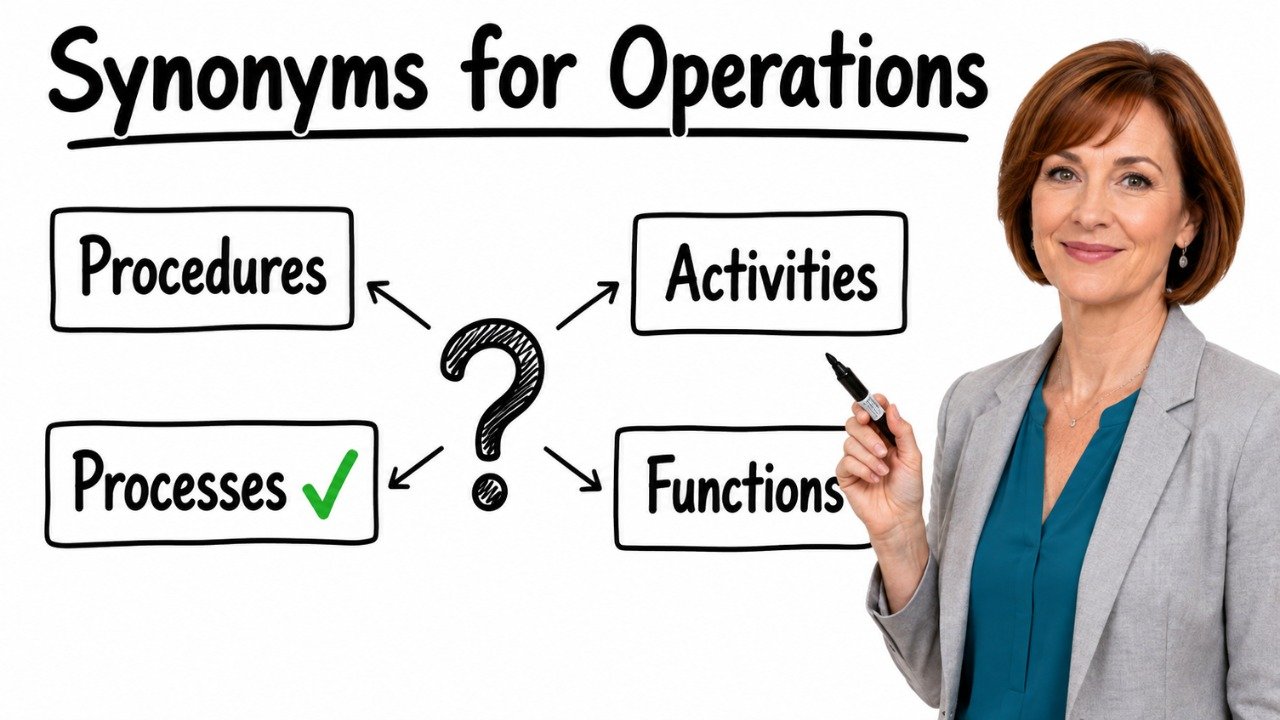
Quick Answer: The best synonyms for operations include processes, activities, procedures, functions, tasks, workflows, practices, administration, production, and logistics. Processes works best for organized stages, while activities describes general work being performed. Procedures suits formal instructions, functions refers to assigned purposes, and workflows describes connected tasks. Administration is useful for organizational management, production fits manufacturing contexts, and logistics refers to the movement and coordination of people, materials, or supplies.
Pronunciation and Word Details
Word: Operations.
Pronunciation: /ˌɑːpəˈreɪʃənz/
Part of Speech: Plural noun.
Meaning: Organized activities, processes, or functions carried out to achieve a particular purpose.
US Pronunciation:
UK Pronunciation:
What Does “Operations” Mean?
Operations means the activities, processes, and functions involved in running an organization, completing a mission, producing goods, or achieving a specific result.
The word is the plural form of operation. It can describe routine business activities, technical processes, military actions, medical procedures, manufacturing systems, or organized projects.
Business Context: The company improved its daily operations.
Production Context: Factory operations continued throughout the evening.
Technical Context: The system performs several operations automatically.
Medical Context: The hospital completed three operations that morning.
Military Context: The unit carried out operations in the region.
Mathematical Context: Addition and multiplication are basic mathematical operations.
The correct meaning depends on the subject. In workplace writing, operations usually refers to the practical activities required to keep an organization functioning.
Meaning, Tone, and Context of “Operations”
Operations is a neutral and professional word. It commonly appears in business, management, manufacturing, medicine, mathematics, technology, logistics, security, and military communication.
Professional Tone: Operations is common in reports, workplace documents, plans, and formal discussions.
Business Tone: It describes the practical work involved in running a company or department.
Technical Tone: It can refer to actions performed by machines, systems, software, or mathematical rules.
Medical Tone: It may describe surgical procedures performed to treat an injury or condition.
Strategic Tone: It can refer to organized missions, campaigns, or coordinated actions.
Conversational Tone: In ordinary speech, people may use simpler alternatives such as work, activities, tasks, or processes.
The word is broad, so a more specific synonym may improve clarity. Processes is clearer when discussing stages, while procedures is better for formal instructions.
When and How to Use “Operations”
For Business Activities
Use operations to describe the regular work needed to run a company, institution, or department.
Example: The manager is responsible for the organization’s daily operations.
For Organized Processes
Use operations when several connected processes work together toward a common goal.
Example: The new system has made warehouse operations more efficient.
For Manufacturing
Use operations to describe production, assembly, packaging, maintenance, or quality control activities.
Example: Manufacturing operations will expand next month.
For Logistics
Use operations when discussing transportation, storage, scheduling, inventory, or supply coordination.
Example: Severe weather disrupted delivery operations.
For Technical Actions
Use operations for actions completed by computers, machines, equipment, or mathematical systems.
Example: The software can perform complex operations within seconds.
For Medical Procedures
Use operations when referring to surgical treatment.
Example: Both operations were completed successfully.
For Missions and Campaigns
Use operations for planned actions carried out by military, security, emergency, or rescue teams.
Example: Rescue operations continued during the night.
For Organizational Management
Use operations when discussing how resources, people, systems, and responsibilities are coordinated.
Example: She oversees finance, staffing, and administrative operations.
Best Synonyms for Operations
Processes
Synonym: Processes means organized stages or actions used to complete work.
Example: The team reviewed its production processes.
Activities
Synonym: Activities means actions or work performed by people or organizations.
Example: The report summarizes the department’s main activities.
Procedures
Synonym: Procedures means established instructions for completing a task correctly.
Example: Employees must follow the proper safety procedures.
Functions
Synonym: Functions means the duties, purposes, or roles performed by a person, system, or department.
Example: The software supports several important business functions.
Workflows
Synonym: Workflows means connected tasks arranged in a particular sequence.
Example: Automated workflows reduced processing time.
Tasks
Synonym: Tasks means individual pieces of work that must be completed.
Example: The supervisor assigned the daily tasks.
Practices
Synonym: Practices means customary or established ways of carrying out work.
Example: The organization introduced safer working practices.
Administration
Synonym: Administration means the management and organization of an institution or department.
Example: She has extensive experience in office administration.
Production
Synonym: Production means the process of creating, manufacturing, or preparing goods.
Example: Production increased after the equipment upgrade.
Logistics
Synonym: Logistics means the coordination of transportation, storage, supplies, and resources.
Example: The event required careful logistics and planning.
50 Synonyms for Operations with Short Meanings
- Processes: Organized stages used to complete work.
- Activities: Actions carried out for a purpose.
- Procedures: Established methods or instructions.
- Functions: Duties or purposes performed by something.
- Tasks: Specific pieces of work.
- Workflows: Connected tasks completed in sequence.
- Practices: Regular or accepted ways of working.
- Administration: Management of organizational affairs.
- Production: Creation or manufacture of goods.
- Logistics: Coordination of people, materials, and supplies.
- Actions: Things done to achieve a result.
- Work: Physical or mental effort toward a goal.
- Duties: Responsibilities required by a role.
- Routines: Regularly repeated activities.
- Methods: Particular ways of completing something.
- Systems: Connected parts working together.
- Management: Control and organization of resources.
- Execution: The act of carrying out a plan.
- Implementation: The process of putting a plan into effect.
- Performance: The act of completing assigned work.
- Conduct: The management or carrying out of an activity.
- Running: The practical management of an organization.
- Handling: The act of managing a task or situation.
- Coordination: Organization of people or activities.
- Organization: Arrangement of resources and responsibilities.
- Management activities: Work related to directing an organization.
- Business activities: Commercial or organizational work.
- Undertakings: Planned tasks, projects, or responsibilities.
- Projects: Organized work with a defined purpose.
- Programs: Coordinated activities designed to meet an objective.
- Initiatives: Planned actions intended to create improvement.
- Efforts: Organized attempts to achieve something.
- Missions: Important assignments with clear objectives.
- Campaigns: Coordinated actions toward a particular result.
- Maneuvers: Planned movements or strategic actions.
- Exercises: Organized activities performed for practice or training.
- Services: Work performed to meet a need.
- Transactions: Exchanges or completed business dealings.
- Dealings: Business interactions or arrangements.
- Mechanisms: Systems or processes that produce a result.
- Techniques: Skilled ways of performing an activity.
- Protocols: Formal rules for handling specific situations.
- Measures: Actions taken to achieve a purpose.
- Arrangements: Plans made for activities or resources.
- Proceedings: Organized actions or formal events.
- Manufacturing: Production of goods using tools or machinery.
- Distribution: Delivery of goods or resources to recipients.
- Maintenance: Work that keeps equipment or systems functioning.
- Fieldwork: Practical work carried out outside an office.
- Assignments: Specific duties or pieces of work.
Read Also:
Synonyms for Time management
Synonyms for Operations by Context
When Operations Means Business Activities
In business writing, operations describes the regular activities required to keep an organization working.
Useful synonyms include activities, functions, administration, management, work, practices, and business activities.
Example With Operations: The director supervises the company’s operations.
Example With Administration: The director supervises the company’s administration.
Example With Business Activities: The director supervises the company’s business activities.
Administration emphasizes organizational management. Business activities is broader and may include sales, finance, customer service, and production.
When Operations Means Processes
When operations refers to a sequence of connected actions, processes, procedures, workflows, systems, and methods are suitable alternatives.
Example With Operations: The factory improved its packaging operations.
Example With Processes: The factory improved its packaging processes.
Example With Workflows: The factory improved its packaging workflows.
Processes focuses on stages. Workflows emphasizes the order in which tasks move between people or systems.
When Operations Means Duties or Tasks
For individual responsibilities, use tasks, duties, assignments, functions, activities, or work.
Example With Operations: The staff completed all scheduled operations.
Example With Tasks: The staff completed all scheduled tasks.
Example With Duties: The staff completed all scheduled duties.
Tasks refers to separate pieces of work, while duties suggests responsibilities connected to a role.
When Operations Means Management
When the word describes the running of an organization, administration, management, coordination, conduct, organization, or handling may be more precise.
Example With Operations: She manages the institution’s operations.
Example With Administration: She manages the institution’s administration.
Example With Coordination: She manages the institution’s coordination activities.
Management is broad, while coordination focuses on bringing people, schedules, and resources together.
When Operations Means Production
In manufacturing contexts, suitable synonyms include production, manufacturing, assembly, processing, distribution, and maintenance.
Example With Operations: Production operations resumed after the inspection.
Example With Production: Production resumed after the inspection.
Example With Manufacturing: Manufacturing resumed after the inspection.
Production describes the creation of goods. Manufacturing is especially suitable when machinery, equipment, or factory systems are involved.
When Operations Means Logistics
For transportation, inventory, storage, and supply management, use logistics, distribution, coordination, handling, or supply activities.
Example With Operations: Delivery operations were delayed by flooding.
Example With Logistics: Delivery logistics were affected by flooding.
Example With Distribution: Distribution was delayed by flooding.
Logistics emphasizes planning and coordination. Distribution focuses on delivering products or resources.
When Operations Means Planned Missions
For military, rescue, emergency, or security contexts, suitable alternatives include missions, campaigns, actions, maneuvers, exercises, and efforts.
Example With Operations: Rescue operations began before sunrise.
Example With Missions: Rescue missions began before sunrise.
Example With Efforts: Rescue efforts began before sunrise.
Mission suggests a specific assignment. Effort is broader and often sounds less technical.
When Operations Means Medical Procedures
When operations refers to surgery, use surgeries, procedures, treatments, or interventions.
Example With Operations: The patient required two operations.
Example With Procedures: The patient required two surgical procedures.
Example With Surgeries: The patient required two surgeries.
Surgery is the clearest everyday alternative. Procedure is more formal and may include treatments that do not involve major surgery.
When Operations Means Technical Actions
For computers, machines, mathematics, or engineering, use functions, processes, calculations, actions, procedures, or commands.
Example With Operations: The program performs several operations.
Example With Functions: The program performs several functions.
Example With Calculations: The program performs several calculations.
Functions refers to capabilities. Calculations is more precise when numbers or mathematical rules are involved.
Another Word for Operations
Another word for operations is processes when the sentence describes organized stages of work. However, the best replacement depends on the intended meaning.
Use activities for general work, procedures for formal methods, functions for duties, administration for management, and logistics for the movement of resources.
Original: The organization changed its daily operations.
Better Option: The organization changed its daily processes.
Original: She is responsible for office operations.
Better Option: She is responsible for office administration.
Original: The company reviewed its delivery operations.
Better Option: The company reviewed its delivery logistics.
Original: The machine completes several operations automatically.
Better Option: The machine completes several functions automatically.
When Not to Use “Operations”
Operations may sound too broad when the reader needs to know exactly what type of work is being discussed.
When the Meaning Is Too General
Use a precise term such as production, administration, logistics, or maintenance instead of the broad word operations.
Weak: The company improved its operations.
Better: The company improved its inventory and delivery processes.
When Referring to One Simple Task
Operations can sound unnecessarily formal when only one action is involved.
Weak: I completed the email operation.
Better: I sent the email.
When Discussing Clear Instructions
Use procedures or instructions when describing steps that people must follow.
Weak: Employees should follow the security operations.
Better: Employees should follow the security procedures.
When Referring to Responsibilities
Use duties, tasks, or functions when discussing assigned work.
Weak: Her operations include preparing reports.
Better: Her duties include preparing reports.
When Discussing Surgical Treatment
Operations is correct, but surgery or surgical procedure may sound more natural in some sentences.
Weak: He had an operation procedure last week.
Better: He had surgery last week.
When Repetition Reduces Clarity
Avoid repeating operations several times in the same paragraph.
Weak: The operations manager reviewed operations and changed several operations.
Better: The operations manager reviewed the workflows and changed several procedures.
Words Commonly Confused With Operations
Operations vs Processes: Operations refers to the overall activities required to achieve a purpose. Processes are the organized stages within those activities.
Operations vs Procedures: Operations describes work being carried out. Procedures are the official instructions used to complete that work.
Operations vs Functions: Operations refers to activities or actions. Functions refers to the duties, roles, or purposes of a person, department, or system.
Operations vs Activities: Operations often sounds organized and professional. Activities is broader and can describe almost anything people do.
Operations vs Tasks: Operations may include many connected tasks. A task is one specific piece of work.
Operations vs Administration: Operations focuses on practical work and execution. Administration focuses on management, records, policies, and organizational control.
Operations vs Logistics: Operations includes all major activities of an organization. Logistics focuses on transportation, storage, inventory, and supply coordination.
Operations vs Production: Operations may include planning, staffing, purchasing, maintenance, and delivery. Production focuses specifically on creating goods or services.
Operations vs Management: Operations is the work being performed. Management is the direction and control of that work.
Operations vs Projects: Operations are often continuous and repetitive. Projects usually have a specific goal, beginning, and completion point.
Which Synonym Should You Choose?
Choose processes when describing organized stages of work.
Choose activities when referring to general actions performed by a group or organization.
Choose procedures when discussing official instructions, rules, or approved methods.
Choose functions when describing the roles or purposes of a department, system, or employee.
Choose tasks when referring to individual pieces of work.
Choose workflows when describing how tasks move from one stage or person to another.
Choose administration when discussing office management, records, policies, or organizational control.
Choose production when discussing the creation of goods, materials, or services.
Choose logistics when discussing transportation, storage, inventory, scheduling, or supplies.
Choose duties when describing responsibilities connected to a position.
Choose execution when emphasizing the carrying out of a plan.
Choose implementation when describing the introduction of a policy, system, or strategy.
Choose maintenance when discussing work that keeps equipment or systems functional.
Choose missions when discussing organized rescue, security, or military assignments.
Choose procedures or surgeries when operations refers to medical treatment.
Real Life Examples of “Operations” in Sentences
Original: The company plans to expand its operations.
Better Option: The company plans to expand its business activities.
Original: She manages the daily operations of the office.
Better Option: She manages the daily administration of the office.
Original: The factory suspended operations for repairs.
Better Option: The factory suspended production for repairs.
Original: The team simplified its operations.
Better Option: The team simplified its workflows.
Original: The organization reviewed its financial operations.
Better Option: The organization reviewed its financial processes.
Original: Delivery operations resumed in the afternoon.
Better Option: Distribution resumed in the afternoon.
Original: The computer performs several operations at once.
Better Option: The computer performs several functions at once.
Original: Emergency operations continued throughout the night.
Better Option: Emergency efforts continued throughout the night.
Original: The hospital scheduled two operations.
Better Option: The hospital scheduled two surgical procedures.
Original: The department improved its customer service operations.
Better Option: The department improved its customer service practices.
Synonym Groups and Usage Differences
Process Group
Processes, procedures, workflows, methods, systems, and mechanisms belong to the process group.
These words describe how work moves from one stage to another. Processes is broad, procedures emphasizes instructions, and workflows focuses on task sequence.
Example: The organization redesigned its approval workflows.
Activity Group
Activities, actions, work, tasks, duties, assignments, and routines belong to the activity group.
These words refer to work being completed. Tasks and assignments are specific, while activities and work are more general.
Example: The team completed its scheduled tasks.
Management Group
Administration, management, coordination, organization, conduct, running, and handling belong to the management group.
These terms describe the direction, organization, or control of people and resources.
Example: She is responsible for the administration of the department.
Business Group
Business activities, dealings, transactions, services, practices, and undertakings belong to the business group.
These alternatives describe commercial actions, professional services, or organizational responsibilities.
Example: The company recorded an increase in customer transactions.
Production Group
Production, manufacturing, processing, maintenance, and distribution belong to the production group.
These words relate to creating, preparing, maintaining, or delivering goods.
Example: Manufacturing increased after the equipment was replaced.
Planning and Execution Group
Execution, implementation, initiatives, programs, projects, measures, and efforts belong to the planning and execution group.
These words describe planned work and the actions used to complete it.
Example: Successful implementation requires clear responsibilities.
Mission Group
Missions, campaigns, maneuvers, exercises, actions, and fieldwork belong to the mission group.
These words are suitable for security, rescue, military, research, and emergency contexts.
Example: Rescue missions continued despite difficult conditions.
Technical Group
Functions, calculations, processes, commands, mechanisms, and procedures belong to the technical group.
These terms describe actions performed by machines, software, systems, or mathematical rules.
Example: The system completes complex calculations automatically.
Antonyms of Operations
The opposite of operations depends on whether the word refers to activity, production, management, or organized action.
Inactivity: A state in which no work or action occurs.
Idleness: A lack of purposeful activity.
Shutdown: The stopping of a business, machine, or system.
Closure: The act of ending or stopping an organization’s activities.
Suspension: A temporary pause in work or activity.
Stoppage: An interruption that prevents work from continuing.
Disruption: An event that interrupts normal processes.
Disorganization: A lack of proper order or coordination.
Mismanagement: Poor or ineffective control of activities.
Neglect: Failure to perform necessary duties.
Failure: Inability to complete an intended function.
Termination: The formal ending of an activity or process.
Abandonment: The act of leaving a project or task unfinished.
Delay: A situation in which work does not happen at the expected time.
Interruption: A temporary break in continuous activity.
Comparison: Operations vs Related Words
Operations vs Processes
Operations includes all the activities required to run a system or organization. Processes are the structured stages used to complete particular work.
Example With Operations: The company improved its warehouse operations.
Example With Processes: The company improved its order checking processes.
Operations vs Procedures
Operations describes active work. Procedures describes the approved steps people follow while performing that work.
Example With Operations: Airport operations continued normally.
Example With Procedures: Staff followed the correct security procedures.
Operations vs Activities
Operations sounds more organized and professional. Activities is a broader word that can refer to formal or informal actions.
Example With Operations: The director supervises regional operations.
Example With Activities: The director supervises regional training activities.
Operations vs Functions
Operations refers to actions or work. Functions refers to purposes, abilities, or responsibilities.
Example With Operations: The system controls several operations.
Example With Functions: The system provides several useful functions.
Operations vs Tasks
Operations may include many people, systems, and tasks. A task is one specific piece of work.
Example With Operations: The supervisor manages daily operations.
Example With Tasks: The supervisor assigns daily tasks.
Operations vs Administration
Operations focuses on practical execution. Administration focuses on planning, records, policies, and organizational management.
Example With Operations: He oversees warehouse operations.
Example With Administration: She oversees office administration.
Operations vs Logistics
Operations covers a broad range of organizational activities. Logistics is limited mainly to the movement, storage, and coordination of resources.
Example With Operations: The company expanded its international operations.
Example With Logistics: The company improved its international logistics.
Operations vs Production
Operations may include purchasing, staffing, planning, production, maintenance, and delivery. Production refers specifically to creating goods or services.
Example With Operations: The manager reviewed all factory operations.
Example With Production: The manager increased factory production.
Operations vs Projects
Operations are usually continuous and support regular organizational needs. Projects are temporary and have a particular objective.
Example With Operations: Routine operations continue throughout the year.
Example With Projects: The construction project will finish in October.
Operations vs Management
Operations refers to the activities being performed. Management refers to the people and decisions that direct those activities.
Example With Operations: Efficient operations reduced delays.
Example With Management: Effective management reduced delays.
Common Phrases and Expressions With “Operations”
Daily Operations: Regular activities performed each day.
Business Operations: Activities required to run a company.
Operational Operations: This phrase is usually repetitive and should be replaced with operational activities or business operations.
Core Operations: The most important activities of an organization.
Internal Operations: Activities performed within an organization.
Global Operations: Organizational activities carried out in several countries or regions.
Manufacturing Operations: Processes involved in producing goods.
Field Operations: Practical activities carried out away from the main office.
Rescue Operations: Organized actions intended to save people.
Military Operations: Planned actions performed by armed forces.
Surgical Operations: Medical procedures involving surgery.
Computer Operations: Actions performed by a computer system.
Mathematical Operations: Rules such as addition, subtraction, multiplication, and division.
Operational Efficiency: The ability to perform work with minimal waste, delay, or expense.
Operations Management: The planning and control of processes that produce goods or services.
Common Mistakes to Avoid
Using Operations for Every Type of Work
Operations is broad. Use a more specific word when the exact activity is known.
Unclear: We improved our operations.
Clear: We improved our inventory tracking and delivery processes.
Confusing Operations With Procedures
Operations describes work being performed. Procedures tells people how to perform it.
Incorrect: Read the operations before using the machine.
Correct: Read the operating procedures before using the machine.
Confusing Operations With Functions
A function is a purpose or ability. An operation is an action or organized activity.
Incorrect: The main operation of this button is volume control.
Correct: The main function of this button is volume control.
Using the Plural Form for One Medical Procedure
Use operation when referring to one surgery and operations when referring to more than one.
Incorrect: She had an operations last month.
Correct: She had an operation last month.
Repeating Operations Too Often
Repeated use can make writing sound vague and mechanical.
Repetitive: The operations team reviewed operations and improved operations.
Improved: The operations team reviewed its processes and improved daily workflows.
Choosing an Overly Formal Alternative
Words such as undertakings or proceedings may sound unnatural in ordinary workplace communication.
Unnatural: Please complete your daily undertakings.
Natural: Please complete your daily tasks.
Using a Synonym Without Checking Context
Not every synonym fits every meaning of operations. Logistics cannot replace operations when discussing surgery, and administration cannot replace it when discussing mathematics.
Incorrect: The patient required two logistics.
Correct: The patient required two surgical procedures.
Creating Redundant Phrases
Avoid combinations that repeat the same meaning.
Weak: Operational operations were improved.
Better: Operational processes were improved.
Conclusion
The best synonyms for operations depend on the type of work being described. Use processes for organized stages, procedures for formal instructions, activities for general work, and functions for assigned purposes. Administration is suitable for organizational management, while production and manufacturing fit industrial contexts. Logistics works best for transportation, storage, and supply coordination. Choosing a precise alternative from these synonyms for operations makes reports, essays, emails, and everyday communication clearer and more informative.
FAQs About Synonyms for Operations
What Is the Best Synonym for Operations?
Processes is one of the best general synonyms for operations when discussing organized work. Activities is better for general actions, while administration fits management contexts.
What Is Another Word for Business Operations?
Business activities, organizational functions, administration, processes, and commercial activities are useful alternatives. The best choice depends on the specific type of work.
Can Processes Replace Operations?
Processes can replace operations when the sentence focuses on stages or methods. It may not work when operations refers to surgery, missions, or an entire organization’s activities.
What Is a Formal Synonym for Operations?
Procedures, administration, functions, execution, implementation, and undertakings are formal alternatives. Procedures and administration are usually the most natural choices.
What Is a Simple Synonym for Operations?
Activities, work, tasks, and processes are simple alternatives. Activities is broad, while tasks refers to specific pieces of work.
What Is the Difference Between Operations and Logistics?
Operations includes all major activities involved in running an organization. Logistics focuses specifically on transportation, storage, inventory, and supply coordination.
Is Operations Singular or Plural?
Operations is plural. The singular form is operation. Use operation for one action, process, or surgery and operations for several activities or procedures.
