
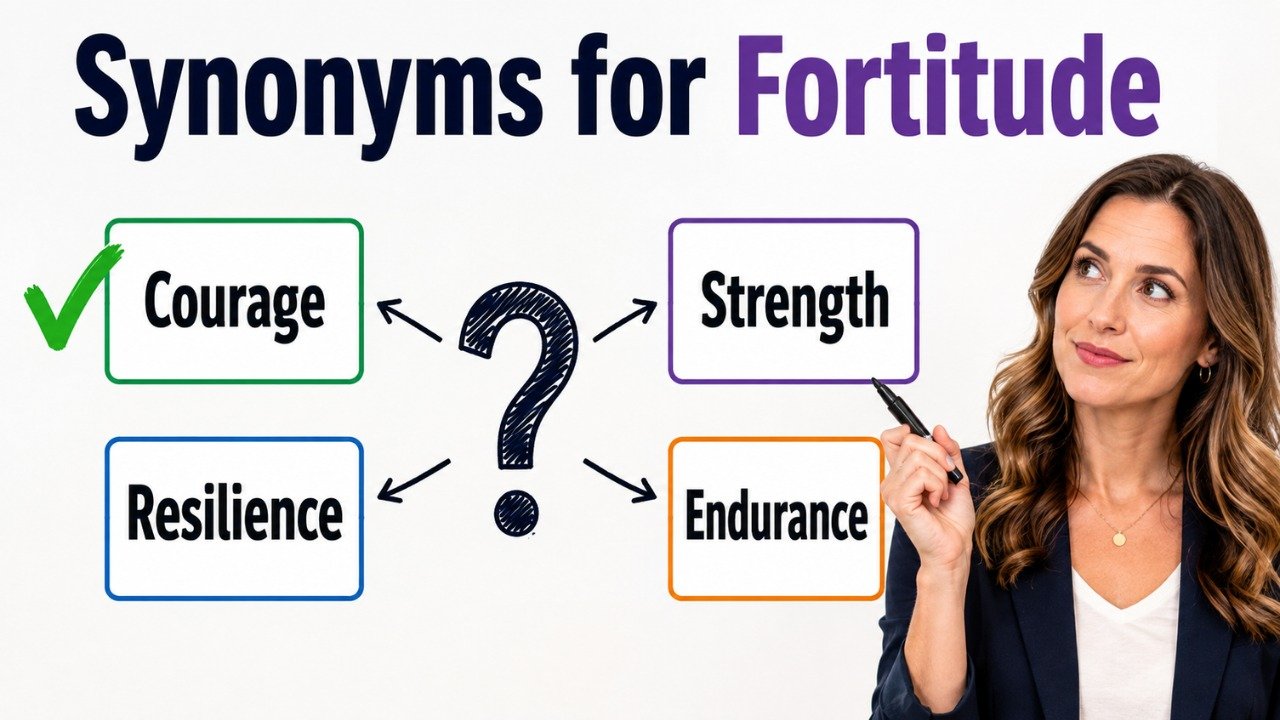
Quick Answer: Synonyms for fortitude include courage, bravery, resilience, endurance, resolve, determination, steadfastness, perseverance, grit, and inner strength. Use courage or bravery when someone faces danger, resilience when a person recovers from hardship, endurance when someone tolerates pain or difficulty, and perseverance when effort continues over time. Resolve and determination emphasize firm decisions, while steadfastness describes loyalty to a purpose. Grit is common in conversational writing, whereas fortitude and strength of character are more suitable for formal descriptions of mental and moral strength.
Pronunciation and Word Details
Word: Fortitude.
Pronunciation: /ˈfɔːr.tə.tuːd/
Part of Speech: Noun.
Meaning: Mental and emotional strength that allows someone to face pain, danger, difficulty, or hardship without giving up.
US Pronunciation:
UK Pronunciation:
What Does “Fortitude” Mean?
Fortitude means the mental, emotional, or moral strength needed to face hardship, fear, pain, or pressure with courage.
It is a noun that describes a strong quality within a person. Someone with fortitude remains steady during difficult circumstances instead of becoming overwhelmed or giving up.
The word often appears in serious, formal, literary, academic, and professional contexts. It can describe the strength required to survive illness, cope with loss, resist pressure, complete a demanding task, or defend an important principle.
Example: She faced the difficult recovery with remarkable fortitude.
Fortitude can refer to emotional strength during personal hardship, moral strength when defending what is right, or mental strength when handling pressure.
Example: Speaking honestly in that situation required moral fortitude.
Meaning, Tone, and Context of “Fortitude”
Fortitude has a formal, serious, and respectful tone. It usually expresses admiration for someone who remains courageous and controlled during difficult circumstances.
The word is stronger and more specific than general words such as strength. It does not usually describe physical power. Instead, it focuses on inner courage, mental toughness, patience, and emotional endurance.
Fortitude is commonly used in:
- Formal writing about courage and character.
- Personal descriptions of hardship and recovery.
- Historical accounts of people facing danger.
- Academic discussions of ethics and human behavior.
- Speeches about leadership and responsibility.
- Professional writing about resilience under pressure.
- Literary descriptions of suffering and survival.
In casual conversation, people may use grit, courage, strength, or toughness instead.
Formal: She demonstrated exceptional fortitude throughout the crisis.
Conversational: She showed real strength throughout the crisis.
Fortitude can describe both visible bravery and quiet endurance. A person does not need to perform a dramatic act to show fortitude. Remaining calm, patient, and determined during a long period of difficulty can also demonstrate it.
When and How to Use “Fortitude”
For Facing Hardship
Use fortitude when someone remains mentally strong during a difficult experience.
Example: The family showed great fortitude after losing their home.
For Handling Pain
Use fortitude when a person tolerates physical or emotional pain without losing courage.
Example: He endured months of treatment with patience and fortitude.
For Resisting Pressure
Use fortitude when someone refuses to abandon a belief or decision despite strong pressure.
Example: The witness needed considerable fortitude to tell the truth.
For Moral Courage
Use fortitude when a person does what is right even when doing so is uncomfortable or risky.
Example: Challenging the unfair decision required moral fortitude.
For Long Term Challenges
Use fortitude when strength must be maintained over an extended period.
Example: Completing the demanding program required discipline and fortitude.
For Leadership
Use fortitude when a leader remains calm, responsible, and decisive during a crisis.
Example: Her fortitude helped the team remain focused during the emergency.
For Emotional Recovery
Use fortitude when someone gradually rebuilds confidence after grief, disappointment, or failure.
Example: He found the fortitude to begin again after the setback.
Best Synonyms for Fortitude
Courage
Synonym: The ability to face fear, danger, pain, or uncertainty.
Example: It took courage to admit the serious mistake.
Bravery
Synonym: Willingness to face danger or difficulty without being controlled by fear.
Example: Her bravery inspired everyone around her.
Resilience
Synonym: The ability to recover and become strong again after hardship.
Example: The community showed resilience after the disaster.
Endurance
Synonym: The ability to continue despite pain, tiredness, or difficulty.
Example: The journey tested their physical and mental endurance.
Resolve
Synonym: Firm determination to complete an action or maintain a decision.
Example: He approached the challenge with renewed resolve.
Determination
Synonym: A strong intention to succeed or continue despite obstacles.
Example: Her determination helped her complete the difficult course.
Steadfastness
Synonym: Firm and loyal commitment that does not weaken under pressure.
Example: His steadfastness gave the group confidence.
Perseverance
Synonym: Continued effort despite delay, failure, or difficulty.
Example: Success came through patience and perseverance.
Grit
Synonym: Courage and determination when facing demanding situations.
Example: Finishing the competition required discipline and grit.
Inner Strength
Synonym: Personal emotional or mental power used to manage hardship.
Example: She relied on her inner strength during the difficult period.
50 Synonyms for Fortitude with Short Meanings
- Courage: The ability to face fear, danger, or pain.
- Bravery: Willingness to confront danger or difficulty.
- Resilience: The ability to recover after hardship.
- Endurance: Strength to continue despite pain or difficulty.
- Strength: Mental or emotional power during challenges.
- Resolve: Firm determination to follow a decision.
- Determination: A strong intention to achieve something.
- Steadfastness: Firm commitment that remains unchanged.
- Perseverance: Continued effort despite obstacles or failure.
- Grit: Courage and determination under pressure.
- Stamina: Strength to continue a demanding activity.
- Tenacity: Determined refusal to give up.
- Nerve: Courage when facing danger or pressure.
- Mettle: Strength of character during a difficult test.
- Spirit: Emotional energy and courage during hardship.
- Boldness: Confidence and willingness to take risks.
- Valor: Great courage, especially when facing danger.
- Fearlessness: The quality of not being controlled by fear.
- Hardiness: The ability to survive difficult conditions.
- Toughness: Strength that allows someone to handle hardship.
- Constancy: Steady loyalty or determination over time.
- Firmness: Strength and stability in a decision or belief.
- Willpower: Mental control used to resist difficulty or temptation.
- Patience: Calm endurance during delay, pain, or trouble.
- Persistence: Continued action despite problems or opposition.
- Resistance: The ability to withstand pressure or harmful forces.
- Durability: The ability to remain strong through difficult conditions.
- Backbone: Courage and strength of character.
- Pluck: Lively courage and determination.
- Gallantry: Brave and honorable behavior during danger.
- Heroism: Exceptional courage shown through brave action.
- Intrepidity: Fearless courage in a dangerous situation.
- Dauntlessness: Courage that is not weakened by fear.
- Stoicism: Calm acceptance of pain or hardship.
- Composure: Calm control during stress or difficulty.
- Equanimity: Emotional calmness in challenging circumstances.
- Self Control: The ability to manage emotions and reactions.
- Moral Courage: Strength to do what is right despite risk.
- Inner Strength: Personal mental and emotional power.
- Strength of Character: Firm moral and emotional qualities.
- Staying Power: Ability to continue for a long period.
- Emotional Strength: Ability to manage painful feelings and stress.
- Mental Strength: Ability to remain focused and steady under pressure.
- Firmness of Purpose: Strong commitment to an important goal.
- Calm Resolve: Quiet and controlled determination.
- Unwavering Courage: Bravery that does not weaken.
- Steadfast Courage: Firm bravery maintained through hardship.
- Strength of Mind: Mental power to manage fear or difficulty.
- Grace Under Pressure: Calm and dignified behavior during stress.
- Unshakable Resolve: Determination that cannot easily be weakened.
Read Also:
Synonyms for Brainstorm
Synonyms for Fortitude by Context
When Fortitude Means Courage
Courage, bravery, valor, nerve, boldness, and fearlessness are useful when fortitude refers to facing fear or danger.
Courage is the broadest alternative. Bravery often describes a visible action, while valor is stronger and more formal.
Example With Fortitude: She showed fortitude when she entered the damaged building.
Example With Courage: She showed courage when she entered the damaged building.
Example With Bravery: Her bravery was clear when she entered the damaged building.
When Fortitude Means Emotional Strength
Inner strength, emotional strength, composure, equanimity, and stoicism describe the ability to manage painful emotions or stressful circumstances.
Composure focuses on outward calmness. Equanimity describes emotional balance, while stoicism suggests accepting pain without complaint.
Example With Fortitude: He handled the painful news with fortitude.
Example With Composure: He handled the painful news with composure.
Example With Emotional Strength: He showed emotional strength after receiving the painful news.
When Fortitude Means Endurance
Endurance, stamina, hardiness, toughness, durability, and staying power describe the ability to continue through pain, exhaustion, or difficult conditions.
Endurance is the most direct alternative. Stamina is common for sustained physical or mental activity.
Example With Fortitude: The demanding expedition tested their fortitude.
Example With Endurance: The demanding expedition tested their endurance.
Example With Stamina: The demanding expedition tested their stamina.
When Fortitude Means Determination
Resolve, determination, tenacity, perseverance, persistence, and firmness of purpose describe commitment to a goal despite obstacles.
Resolve emphasizes a firm decision. Perseverance and persistence emphasize continued effort, while tenacity suggests refusing to let go of a goal.
Example With Fortitude: She needed fortitude to complete the project.
Example With Determination: She needed determination to complete the project.
Example With Perseverance: She completed the project through perseverance.
When Fortitude Means Moral Strength
Moral courage, strength of character, backbone, steadfastness, and constancy describe the strength to defend values or behave honorably.
Moral courage is best when a person risks criticism or punishment to do what is right.
Example With Fortitude: Refusing the dishonest offer required fortitude.
Example With Moral Courage: Refusing the dishonest offer required moral courage.
Example With Backbone: She had the backbone to refuse the dishonest offer.
When Fortitude Means Calmness Under Pressure
Composure, equanimity, self control, calm resolve, and grace under pressure describe controlled behavior during stress.
Composure is suitable for professional and everyday contexts. Grace under pressure adds the idea of dignity and confidence.
Example With Fortitude: The manager responded to the crisis with fortitude.
Example With Composure: The manager responded to the crisis with composure.
Example With Grace Under Pressure: The manager showed grace under pressure during the crisis.
Another Word for Fortitude
Courage is often the best single replacement for fortitude because both words describe strength when facing fear, pain, danger, or hardship.
However, the best synonym depends on the situation. Use resilience for recovery, endurance for continuing through pain, resolve for a firm decision, and perseverance for sustained effort.
Original: She faced the difficult diagnosis with fortitude.
Better Option: She faced the difficult diagnosis with courage.
Original: The long recovery demanded fortitude.
Better Option: The long recovery demanded endurance.
Original: He found the fortitude to continue after failing.
Better Option: He found the determination to continue after failing.
Original: The community responded to the disaster with fortitude.
Better Option: The community responded to the disaster with resilience.
When Not to Use “Fortitude”
Fortitude may sound too formal in relaxed conversation. A simpler word such as courage, strength, toughness, or grit may sound more natural.
Weak: I needed fortitude to clean the entire kitchen.
Better: I needed determination to clean the entire kitchen.
Do not use fortitude when describing physical strength alone.
Weak: His fortitude allowed him to lift the heavy table.
Better: His physical strength allowed him to lift the heavy table.
Avoid using fortitude when the intended meaning is recovery after difficulty. Resilience may be more precise.
Weak: The company showed fortitude by quickly recovering from the loss.
Better: The company showed resilience by quickly recovering from the loss.
Do not use fortitude for minor or ordinary actions unless the sentence is intentionally humorous.
Weak: She showed fortitude by answering the telephone.
Better: She showed confidence by answering the difficult call.
Avoid repeating fortitude several times within the same paragraph.
Weak: His fortitude inspired the team, and that fortitude helped them develop greater fortitude.
Better: His courage inspired the team, and his example helped them develop greater resilience.
Use a more specific word when readers need to know what type of strength is being described.
Weak: The task required fortitude.
Better: The task required patience, concentration, and perseverance.
Words Commonly Confused With Fortitude
Fortitude vs Courage: Fortitude is the inner strength to endure prolonged pain or hardship. Courage is the broader ability to face fear, danger, or uncertainty.
Fortitude vs Bravery: Fortitude often describes lasting mental strength. Bravery often describes a particular courageous action.
Fortitude vs Resilience: Fortitude helps someone endure hardship while it is happening. Resilience helps someone recover after hardship.
Fortitude vs Endurance: Fortitude includes mental, emotional, and moral courage. Endurance focuses on the ability to continue despite pain, fatigue, or difficulty.
Fortitude vs Perseverance: Fortitude is inner strength during hardship. Perseverance is continued effort toward a goal despite problems or delay.
Fortitude vs Determination: Fortitude concerns strength under pressure. Determination concerns a firm intention to achieve a result.
Fortitude vs Strength: Strength is a broad word that may be physical, mental, emotional, or moral. Fortitude specifically refers to inner strength during difficult circumstances.
Fortitude vs Grit: Fortitude is more formal and often emphasizes dignified endurance. Grit is more conversational and emphasizes toughness and sustained determination.
Fortitude vs Stoicism: Fortitude includes courage and endurance. Stoicism focuses more specifically on accepting pain or hardship without showing strong emotion.
Which Synonym Should You Choose?
Choose courage when describing the general ability to face fear, danger, pain, or uncertainty.
Choose bravery when emphasizing a clear courageous action.
Choose resilience when discussing recovery from hardship, loss, failure, or change.
Choose endurance when someone continues through pain, fatigue, or difficult conditions.
Choose resolve when emphasizing a firm decision that will not change.
Choose determination when discussing a strong desire to succeed.
Choose perseverance when effort continues over a long period despite obstacles.
Choose grit in casual or motivational writing about courage, effort, and toughness.
Choose steadfastness when describing loyalty to a principle, person, or purpose.
Choose composure when someone remains outwardly calm during pressure.
Choose moral courage when a person does what is right despite criticism, risk, or personal loss.
Choose strength of character in formal writing about a person’s values, discipline, and integrity.
Choose fortitude itself when you need a formal word that combines courage, endurance, emotional strength, and self control.
Real Life Examples of “Fortitude” in Sentences
Original: She showed fortitude during months of difficult treatment.
Better Option: She showed endurance during months of difficult treatment.
Original: He faced the dangerous situation with fortitude.
Better Option: He faced the dangerous situation with courage.
Original: The family responded to the loss with fortitude.
Better Option: The family responded to the loss with emotional strength.
Original: Completing the demanding course required fortitude.
Better Option: Completing the demanding course required perseverance.
Original: She needed fortitude to defend her decision.
Better Option: She needed moral courage to defend her decision.
Original: The leader demonstrated fortitude during the crisis.
Better Option: The leader demonstrated composure during the crisis.
Original: His fortitude helped him recover from repeated setbacks.
Better Option: His resilience helped him recover from repeated setbacks.
Original: The long journey tested their fortitude.
Better Option: The long journey tested their stamina.
Original: She found the fortitude to begin again.
Better Option: She found the resolve to begin again.
Original: The witness spoke with remarkable fortitude.
Better Option: The witness spoke with remarkable bravery.
Synonym Groups and Usage Differences
Courage Group
Courage, bravery, valor, boldness, nerve, fearlessness, and intrepidity describe the ability to confront danger or fear.
Courage is neutral and widely used. Valor is more formal and often connected with heroic danger. Nerve can sound informal and may suggest confidence in a tense moment.
Example: It took courage to enter the dangerous area.
Endurance Group
Endurance, stamina, hardiness, toughness, durability, and staying power describe the ability to continue through demanding conditions.
Endurance can be physical or mental. Stamina emphasizes energy over time, while toughness suggests resistance to pain or difficulty.
Example: The long climb required considerable endurance.
Determination Group
Resolve, determination, perseverance, persistence, tenacity, grit, and firmness of purpose describe commitment to continuing or succeeding.
Determination describes intention. Perseverance describes continued action, and tenacity emphasizes refusing to give up.
Example: Her perseverance helped her finish the difficult assignment.
Emotional Stability Group
Composure, equanimity, stoicism, self control, calm resolve, and grace under pressure describe emotional control during stress.
Composure refers to visible calmness. Equanimity suggests a stable and balanced mind. Stoicism may suggest hiding or accepting pain without complaint.
Example: He maintained his composure during the tense discussion.
Moral Strength Group
Moral courage, strength of character, backbone, steadfastness, firmness, and constancy describe strong values and principled behavior.
Backbone is more conversational. Strength of character and moral courage are appropriate for formal writing.
Example: Reporting the misconduct required moral courage.
Recovery Group
Resilience, inner strength, emotional strength, mental strength, and spirit describe the ability to survive, recover, and continue after hardship.
Resilience is the strongest word for recovery. Inner strength is broader and more personal.
Example: Her resilience helped her rebuild her life after the loss.
Antonyms of Fortitude
The opposite of fortitude may describe fear, weakness, hesitation, emotional instability, or an inability to continue.
Cowardice: Lack of courage when facing danger or difficulty.
Fearfulness: A tendency to become easily afraid.
Timidity: Lack of confidence or courage.
Weakness: Lack of mental, emotional, or physical strength.
Fragility: The quality of being easily harmed or weakened.
Vulnerability: Openness to emotional or physical harm.
Hesitation: Delay caused by uncertainty or fear.
Indecision: Inability to make or maintain a decision.
Despair: Complete loss of hope.
Defeatism: Expectation of failure before making a full effort.
Faintheartedness: Lack of courage or determination.
Instability: Lack of emotional steadiness or control.
Impatience: Difficulty calmly enduring delay or hardship.
Surrender: The act of giving up resistance or effort.
Helplessness: The feeling of being unable to act or improve a situation.
Comparison Between Fortitude and Related Words
Fortitude vs Courage
Fortitude is sustained inner strength during hardship. Courage is the general ability to act despite fear.
Example With Fortitude: She endured the long recovery with fortitude.
Example With Courage: She showed courage by agreeing to the difficult procedure.
Fortitude vs Bravery
Fortitude often develops across a difficult period. Bravery may appear in one immediate action.
Example With Fortitude: He faced years of difficulty with fortitude.
Example With Bravery: He showed bravery by rescuing the injured person.
Fortitude vs Resilience
Fortitude allows someone to withstand hardship. Resilience allows someone to recover from it.
Example With Fortitude: She faced the crisis with fortitude.
Example With Resilience: She rebuilt her life with resilience after the crisis.
Fortitude vs Endurance
Fortitude includes courage, emotional strength, and moral firmness. Endurance mainly emphasizes continuing through pain or fatigue.
Example With Fortitude: The decision required moral fortitude.
Example With Endurance: The demanding race required physical endurance.
Fortitude vs Perseverance
Fortitude is the inner strength needed during difficulty. Perseverance is the act of continuing toward a goal.
Example With Fortitude: He accepted the painful criticism with fortitude.
Example With Perseverance: He improved his skills through perseverance.
Fortitude vs Grit
Fortitude has a formal and dignified tone. Grit is a direct, conversational word for toughness and determination.
Example With Fortitude: She displayed remarkable fortitude throughout the trial.
Example With Grit: She relied on grit to finish the demanding task.
Fortitude vs Strength
Strength has a broad meaning and can refer to the body, mind, emotions, or influence. Fortitude refers specifically to inner strength during hardship.
Example With Fortitude: He showed fortitude during the painful recovery.
Example With Strength: Regular exercise improved his physical strength.
Common Phrases and Expressions With “Fortitude”
Mental Fortitude: Strength of mind during stress, fear, or pressure.
Moral Fortitude: Courage to defend ethical principles or do what is right.
Emotional Fortitude: Ability to manage painful emotions and remain steady.
Inner Fortitude: Personal strength that helps someone endure hardship.
Physical Fortitude: Bodily endurance combined with mental toughness.
Great Fortitude: An impressive level of inner courage and endurance.
Remarkable Fortitude: Unusually strong courage during difficulty.
Show Fortitude: Demonstrate strength and courage during hardship.
Require Fortitude: Demand considerable courage, endurance, or determination.
Test Someone’s Fortitude: Place someone in a situation that challenges inner strength.
Common Mistakes to Avoid
Confusing Fortitude With Physical Strength
Fortitude mainly refers to mental, emotional, or moral strength.
Incorrect: His fortitude helped him lift the heavy equipment.
Correct: His physical strength helped him lift the heavy equipment.
Using Fortitude for Minor Actions
Fortitude is usually reserved for serious challenges, pain, danger, or pressure.
Unnatural: She showed fortitude by making a cup of tea.
Natural: She showed patience while preparing the complicated meal.
Confusing Fortitude With Resilience
Fortitude describes enduring difficulty. Resilience describes recovering from it.
Less Precise: The town showed fortitude by rebuilding after the storm.
Better: The town showed resilience by rebuilding after the storm.
Choosing an Overly Formal Word
Fortitude may sound unnatural in simple casual conversations.
Formal: I needed fortitude to complete my household tasks.
Natural: I needed determination to complete my household tasks.
Repeating the Word Too Often
Use courage, endurance, resilience, resolve, or inner strength to create natural variety.
Repetitive: Her fortitude inspired others because her fortitude remained strong throughout the crisis.
Improved: Her courage inspired others because her resolve remained strong throughout the crisis.
Using the Wrong Synonym
Bravery, perseverance, resilience, and composure do not express exactly the same idea.
Use bravery for danger, perseverance for continued effort, resilience for recovery, and composure for emotional calmness.
Adding Unnecessary Modifiers
Fortitude already expresses strong inner courage, so excessive modifiers can sound unnatural.
Weak: He showed very extremely powerful fortitude.
Better: He showed exceptional fortitude.
Creating Vague Sentences
Explain what hardship required fortitude.
Vague: She needed fortitude.
Clear: She needed fortitude to remain calm during the difficult hearing.
Conclusion
Synonyms for fortitude include courage, bravery, resilience, endurance, resolve, perseverance, grit, and inner strength. Courage suits general fear or danger, while bravery often describes a visible courageous act. Resilience emphasizes recovery, endurance describes continuing through pain, and perseverance focuses on sustained effort. Resolve expresses firm intention, while composure describes calmness under pressure. Choosing the right alternative helps readers understand whether the sentence refers to moral courage, emotional control, mental toughness, recovery, or determination.
FAQs About Synonyms for Fortitude
What Is the Best Synonym for Fortitude?
Courage is the best general synonym for fortitude. Endurance, resilience, resolve, or inner strength may be more precise in specific contexts.
Is Resilience a Synonym for Fortitude?
Yes, but the meanings are slightly different. Fortitude helps a person endure hardship, while resilience helps a person recover after it.
Is Bravery the Same as Fortitude?
Bravery often describes facing immediate danger. Fortitude usually describes sustained mental or emotional strength during a difficult experience.
What Is a Formal Synonym for Fortitude?
Moral courage, steadfastness, strength of character, intrepidity, and perseverance are suitable formal alternatives.
What Is a Casual Synonym for Fortitude?
Grit, nerve, toughness, backbone, and inner strength are more conversational alternatives.
What Is the Opposite of Fortitude?
Common opposites include cowardice, weakness, timidity, fearfulness, despair, and faintheartedness.
Can Fortitude Describe Emotional Strength?
Yes. Fortitude often describes the emotional strength needed to face grief, pain, pressure, uncertainty, or a long recovery.
