
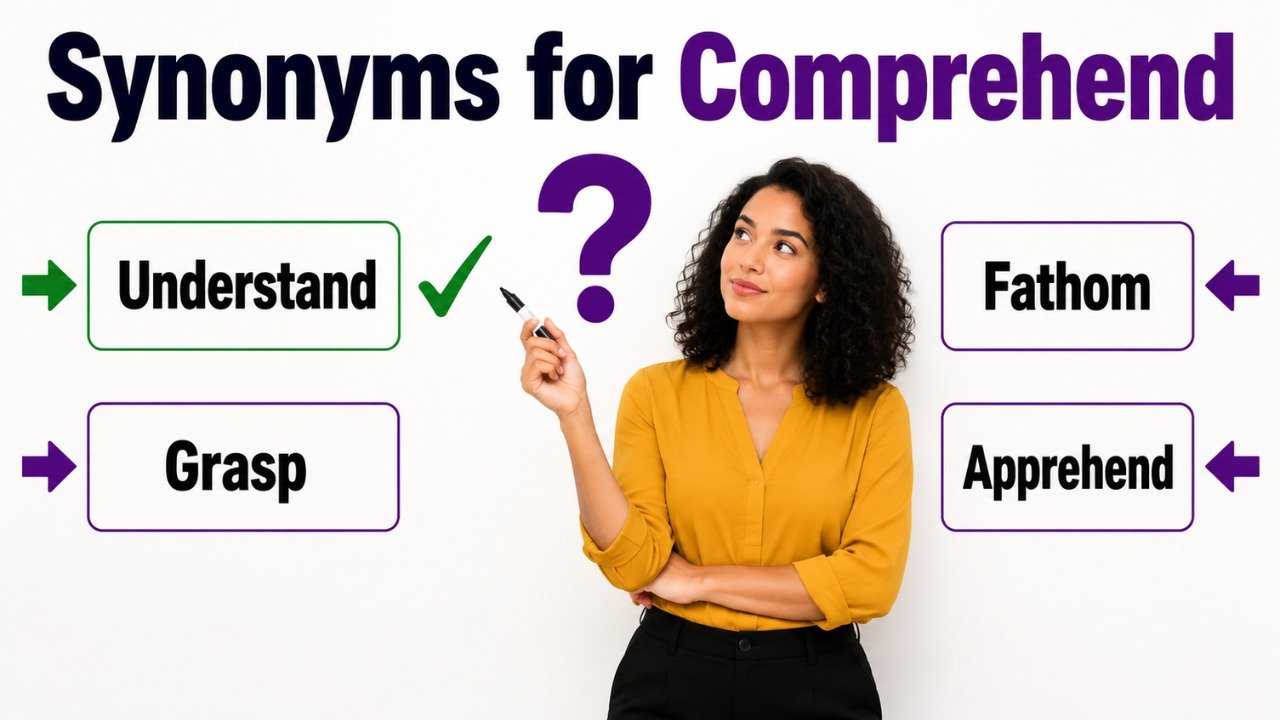
Quick Answer: The best synonyms for comprehend include understand, grasp, perceive, apprehend, follow, recognize, realize, absorb, fathom, and make sense of. Use understand as the most natural general replacement, grasp for gaining a clear or quick understanding, and fathom for understanding something difficult or mysterious. Apprehend suits formal or academic writing, while get and make sense of sound more natural in casual conversation. Use follow when understanding instructions, arguments, or explanations.
Pronunciation and Word Details
Word: Comprehend.
Pronunciation: /ˌkɑːm.prɪˈhend/
Part of Speech: Verb.
Meaning: To understand the meaning, importance, nature, or details of something.
US Pronunciation:
UK Pronunciation:
What Does “Comprehend” Mean?
Comprehend means to understand something clearly and completely.
It is a verb used when someone understands an idea, explanation, situation, fact, instruction, or consequence. The word often suggests a thoughtful or complete level of understanding rather than a brief awareness.
In a sentence, comprehend usually takes a direct object. You can comprehend an idea, a problem, a language, a situation, or the importance of an event.
General Understanding: She could comprehend the basic instructions.
Complex Understanding: Few people could comprehend the full complexity of the theory.
Emotional Understanding: He could not comprehend how deeply his words had affected her.
Understanding Consequences: The students began to comprehend the consequences of their choices.
Comprehend can also have the less common meaning of including or containing something. This use is highly formal and uncommon in everyday English.
Meaning, Tone, and Context of “Comprehend”
Comprehend has a neutral to formal tone. It is more common in academic writing, professional explanations, serious discussions, educational material, and descriptions of complex understanding.
In everyday conversation, people are more likely to use understand, get, see, or follow.
Formal Tone: The researchers struggled to comprehend the unexpected results.
Academic Tone: Students must comprehend the central argument before evaluating it.
Professional Tone: The manager ensured that everyone comprehended the new procedure.
Emotional Tone: She could not comprehend the scale of the loss.
Conversational Tone: I do not get what he is saying.
Comprehend often emphasizes mental effort. It may suggest that the subject is difficult, surprising, detailed, or emotionally overwhelming.
When and How to Use “Comprehend”
For General Understanding
Use comprehend when someone understands the meaning or nature of something.
Example: The children could comprehend the simple explanation.
For Complex Ideas
Use comprehend when an idea requires concentration, knowledge, or careful thought.
Example: It took several readings to comprehend the scientific argument.
For Instructions
Use comprehend when discussing whether someone understands directions, rules, or procedures.
Example: Make sure every employee comprehends the safety instructions.
For Importance
Use comprehend when someone understands why something matters.
Example: He did not comprehend the importance of arriving on time.
For Consequences
Use comprehend when someone recognizes the possible effects of an action or decision.
Example: They failed to comprehend the long term consequences of the change.
For Scale or Size
Use comprehend when something is so large, serious, or unusual that it is difficult to understand fully.
Example: It is difficult to comprehend the enormous size of the universe.
For Feelings and Experiences
Use comprehend when trying to understand another person’s emotions or experiences.
Example: She could not fully comprehend the fear he had experienced.
Best Synonyms for Comprehend
Understand
Synonym: Understand means to know the meaning, reason, or nature of something.
Example: I understand the instructions clearly.
Grasp
Synonym: Grasp means to gain a clear mental understanding of an idea.
Example: She quickly grasped the main point of the lesson.
Perceive
Synonym: Perceive means to notice, recognize, or understand something through thought or the senses.
Example: He perceived the hidden meaning behind her words.
Apprehend
Synonym: Apprehend means to understand or recognize something, especially in formal writing.
Example: The reader must apprehend the central idea of the argument.
Follow
Synonym: Follow means to understand the development of an explanation, story, or argument.
Example: I could not follow the speaker’s reasoning.
Recognize
Synonym: Recognize means to identify or become aware of the meaning or importance of something.
Example: She recognized the seriousness of the problem.
Realize
Synonym: Realize means to become fully aware of a fact or situation.
Example: He finally realized why the decision mattered.
Absorb
Synonym: Absorb means to take information into the mind and understand or remember it.
Example: The students needed time to absorb the new material.
Fathom
Synonym: Fathom means to understand something difficult, mysterious, or surprising.
Example: I cannot fathom why they rejected the reasonable offer.
Make Sense of
Synonym: Make sense of means to understand something confusing or complicated.
Example: She examined the notes carefully to make sense of the results.
50 Synonyms for Comprehend with Short Meanings
- Understand: To know the meaning or nature of something.
- Grasp: To understand an idea clearly.
- Perceive: To notice or understand something.
- Apprehend: To understand through careful thought.
- Follow: To understand an explanation or argument.
- Recognize: To identify or understand the importance of something.
- Realize: To become aware of a fact.
- Absorb: To take in and understand information.
- Fathom: To understand something difficult or mysterious.
- Interpret: To explain or understand the meaning of something.
- Discern: To recognize something that is not immediately clear.
- Appreciate: To understand the value or importance of something.
- Digest: To consider and understand information gradually.
- Assimilate: To take in and fully understand new knowledge.
- Learn: To gain knowledge or understanding.
- Know: To possess information or understanding.
- Get: To understand something in casual speech.
- See: To understand a point or situation.
- Catch: To hear and understand something.
- Gather: To understand something from available information.
- Infer: To reach an understanding from evidence.
- Deduce: To understand something through logical reasoning.
- Construe: To interpret a word, action, or statement in a particular way.
- Decode: To understand a message, sign, or system.
- Decipher: To discover the meaning of something confusing.
- Master: To gain complete knowledge or control of a subject.
- Figure Out: To understand something by thinking about it.
- Work Out: To find an answer or understand a problem.
- Puzzle Out: To understand something through careful effort.
- Make Sense Of: To find meaning in something confusing.
- Take In: To notice, absorb, and understand information.
- Get the Idea: To understand the basic meaning.
- Get the Point: To understand the main message.
- Catch On: To begin understanding something.
- Cotton On: To gradually understand what is happening.
- Wrap Your Mind Around: To make an effort to understand something difficult.
- See the Meaning: To recognize what something expresses.
- Understand the Significance: To recognize why something matters.
- Become Aware Of: To begin noticing or understanding something.
- Be Conscious Of: To know that something exists or is happening.
- Be Familiar With: To have knowledge or understanding of something.
- Be Aware Of: To know or recognize a fact or situation.
- Read Correctly: To interpret words, behavior, or situations accurately.
- Register: To be noticed and understood by the mind.
- Penetrate: To understand the deeper meaning of something.
- See Through: To understand the true nature of something.
- Get the Picture: To understand the complete situation.
- Come to Understand: To develop understanding gradually.
- Form a Clear Idea Of: To create a definite mental understanding.
- Get Your Head Around: To understand something difficult or unfamiliar.
Read Also:
Synonyms for Marvelous
Synonyms for Comprehend by Context
When Comprehend Means Understand Generally
The most natural choices for general understanding are understand, get, see, know, and follow.
Understand: The most flexible synonym for formal and informal situations.
Example: I understand what you are trying to explain.
Get: A casual alternative used in everyday conversation.
Example: I get why she was disappointed.
See: Useful when acknowledging another person’s point.
Example: I see what you mean now.
Follow: Best for arguments, instructions, stories, and explanations.
Example: Are you able to follow the discussion?
When Comprehend Means Grasp a Difficult Idea
Use grasp, fathom, master, penetrate, or wrap your mind around when understanding requires mental effort.
Grasp: Suggests gaining a clear understanding of an important idea.
Example: He struggled to grasp the mathematical concept.
Fathom: Emphasizes difficulty, mystery, or disbelief.
Example: She could not fathom his sudden decision.
Master: Means developing complete knowledge or ability.
Example: It took years for her to master the subject.
Wrap Your Mind Around: A conversational expression for understanding something complicated.
Example: I am still trying to wrap my mind around the discovery.
When Comprehend Means Notice or Recognize
Use perceive, recognize, realize, discern, register, or become aware of when understanding begins with awareness.
Perceive: Refers to noticing or interpreting something.
Example: She perceived a change in his attitude.
Recognize: Emphasizes identifying a fact, pattern, or importance.
Example: The team recognized the need for improvement.
Realize: Describes a moment of new awareness.
Example: He realized that he had misunderstood the question.
Discern: Suggests noticing something subtle or difficult to detect.
Example: She could discern a clear pattern in the data.
When Comprehend Means Interpret Meaning
Use interpret, construe, decode, decipher, or read when understanding messages, language, actions, or signs.
Interpret: Best for explaining the meaning of language, information, art, or behavior.
Example: Different readers may interpret the poem differently.
Construe: A formal word for understanding a statement or action in a particular way.
Example: His silence was construed as disagreement.
Decode: Suitable for messages, symbols, systems, or hidden information.
Example: The technician decoded the signal.
Decipher: Emphasizes difficulty in discovering meaning.
Example: We could barely decipher the faded handwriting.
When Comprehend Means Learn and Absorb
Use absorb, digest, assimilate, learn, master, or take in when understanding information over time.
Absorb: Means to receive and remember knowledge.
Example: She absorbed everything the instructor explained.
Digest: Suggests needing time to process information.
Example: Give me a moment to digest the news.
Assimilate: Refers to fully incorporating new knowledge into existing understanding.
Example: Students need practice to assimilate complex information.
Take In: Means to notice and mentally process information.
Example: He was too shocked to take in what she had said.
Another Word for Comprehend
The best single replacement for comprehend is understand because it works naturally in most situations. However, the strongest alternative depends on whether the context involves general meaning, difficult ideas, sudden awareness, detailed information, or casual conversation.
Original: She could not comprehend the instructions.
Better Option: She could not understand the instructions.
Original: He finally comprehended the complexity of the problem.
Better Option: He finally grasped the complexity of the problem.
Original: I cannot comprehend why they made that choice.
Better Option: I cannot fathom why they made that choice.
Original: The students slowly comprehended the new material.
Better Option: The students slowly absorbed the new material.
When Not to Use “Comprehend”
In Very Casual Conversation
Comprehend may sound overly formal in a simple conversation. Use understand, get, or see instead.
Weak: I do not comprehend what you are saying.
Better: I do not understand what you are saying.
When Describing Sudden Awareness
Realize is usually more accurate when someone suddenly becomes aware of a fact.
Weak: She comprehended that she had left her keys inside.
Better: She realized that she had left her keys inside.
When Discussing Instructions or Arguments
Follow may sound more natural when referring to the order or logic of an explanation.
Weak: I could not comprehend the final part of the presentation.
Better: I could not follow the final part of the presentation.
When Meaning Interpretation
Interpret, decode, or decipher may be more precise when discussing language, symbols, messages, or behavior.
Weak: The expert comprehended the ancient symbols.
Better: The expert deciphered the ancient symbols.
When Meaning Deep or Difficult Understanding
Fathom or grasp may communicate the difficulty more strongly.
Weak: I cannot comprehend how the error occurred.
Better: I cannot fathom how the error occurred.
When the Word Becomes Repetitive
Repeating comprehend can make writing sound heavy or unnatural. Replace repeated uses with context specific alternatives.
Weak: She comprehended the theory and comprehended its practical importance.
Better: She understood the theory and recognized its practical importance.
Words Commonly Confused With Comprehend
Comprehend vs Understand: Both mean knowing the meaning or nature of something. Understand is more common and flexible, while comprehend often sounds more formal and complete.
Comprehend vs Grasp: Comprehend describes understanding generally. Grasp often suggests successfully understanding an important or difficult point.
Comprehend vs Apprehend: Apprehend can mean understand, but it is highly formal. It can also mean arresting someone or anticipating something with anxiety.
Comprehend vs Perceive: Comprehend focuses on mental understanding. Perceive focuses on noticing, sensing, or becoming aware of something.
Comprehend vs Realize: Comprehend means understanding something. Realize usually describes becoming aware of a fact, often suddenly.
Comprehend vs Fathom: Comprehend is neutral. Fathom emphasizes that something is difficult, mysterious, shocking, or nearly impossible to understand.
Comprehend vs Know: Know means possessing information. Comprehend means understanding the meaning, significance, or operation of that information.
Comprehend vs Interpret: Comprehend means understanding something. Interpret means deciding, explaining, or presenting what something means.
Which Synonym Should You Choose?
Choose understand for the most natural and widely useful alternative in both speech and writing.
Choose grasp when discussing an idea, principle, lesson, problem, or concept that requires mental effort.
Choose comprehend for formal writing, academic explanations, serious situations, and complete understanding.
Choose apprehend in highly formal, philosophical, academic, or legal style, but use it carefully because it has other meanings.
Choose follow when understanding instructions, arguments, conversations, stories, presentations, or sequences.
Choose perceive when noticing a feeling, pattern, difference, attitude, or hidden meaning.
Choose recognize when identifying the importance, existence, or seriousness of something.
Choose realize when someone suddenly becomes aware of a fact or situation.
Choose absorb when discussing learning, studying, reading, or receiving a large amount of information.
Choose fathom when something is difficult, mysterious, surprising, or emotionally hard to understand.
Choose interpret when discussing language, behavior, literature, data, signs, or meaning.
Choose make sense of for friendly, natural, and conversational writing.
Choose decipher or decode when the information is hidden, confusing, symbolic, or difficult to read.
Choose digest when someone needs time to process complicated or surprising information.
Real Life Examples of “Comprehend” in Sentences
Original: The student could not comprehend the final question.
Better Option: The student could not understand the final question.
Original: She quickly comprehended the main idea of the lesson.
Better Option: She quickly grasped the main idea of the lesson.
Original: I cannot comprehend why he ignored the warning.
Better Option: I cannot fathom why he ignored the warning.
Original: He comprehended that the situation had become serious.
Better Option: He realized that the situation had become serious.
Original: The audience struggled to comprehend the speaker’s argument.
Better Option: The audience struggled to follow the speaker’s argument.
Original: She comprehended the sadness behind his smile.
Better Option: She perceived the sadness behind his smile.
Original: The employees needed time to comprehend the new information.
Better Option: The employees needed time to absorb the new information.
Original: We finally comprehended the meaning of the coded message.
Better Option: We finally decoded the meaning of the coded message.
Original: He did not comprehend the importance of her advice.
Better Option: He did not appreciate the importance of her advice.
Original: Scientists are still trying to comprehend the unexpected results.
Better Option: Scientists are still trying to make sense of the unexpected results.
Synonym Groups and Usage Differences
General Understanding Group
Understand, know, see, get, and comprehend express general mental understanding.
Understand is the most neutral and flexible choice. Get and see are more conversational, while comprehend sounds more formal.
Example: I understand the reason for the delay.
Deep Understanding Group
Grasp, fathom, master, penetrate, and wrap your mind around describe deeper or more difficult understanding.
Grasp emphasizes gaining a firm understanding. Fathom often expresses difficulty or disbelief. Master suggests complete knowledge developed over time.
Example: She finally grasped the deeper meaning of the argument.
Awareness Group
Realize, recognize, perceive, discern, register, and become aware of describe noticing or becoming conscious of something.
Realize often refers to sudden awareness. Recognize emphasizes identification, while perceive and discern suggest noticing details or hidden qualities.
Example: He recognized the seriousness of the warning.
Interpretation Group
Interpret, construe, decode, decipher, and read correctly involve finding or explaining meaning.
Interpret works broadly with words, behavior, information, and creative works. Decode and decipher suit hidden, unclear, or symbolic messages.
Example: She interpreted his response as a polite refusal.
Learning Group
Absorb, assimilate, digest, learn, take in, and master relate to receiving and processing knowledge.
Absorb and take in focus on receiving information. Digest suggests gradual processing, while assimilate means integrating knowledge into existing understanding.
Example: The class needed time to digest the detailed explanation.
Informal Understanding Group
Get, catch on, get the point, get the picture, figure out, and get your head around are useful in casual conversation.
These alternatives sound friendly and natural but may be unsuitable for highly formal reports or academic essays.
Example: I finally get the point you are making.
Antonyms of Comprehend
The opposite of comprehend depends on whether the context involves understanding, awareness, interpretation, attention, or memory.
Misunderstand: To understand something incorrectly.
Misinterpret: To give something the wrong meaning.
Misconstrue: To form a mistaken understanding of words or actions.
Confuse: To fail to distinguish or understand clearly.
Overlook: To fail to notice an important fact or detail.
Ignore: To deliberately pay no attention to something.
Miss: To fail to notice or understand a point.
Forget: To lose information from memory.
Mistake: To identify or understand something incorrectly.
Fail to Grasp: To remain unable to understand an idea.
Be Unaware Of: To have no knowledge of something.
Remain Ignorant Of: To continue without necessary knowledge or understanding.
Comparison of Comprehend and Related Words
Comprehend vs Understand
Comprehend and understand have nearly the same basic meaning. Understand is more common in everyday English, while comprehend often suggests complete or careful mental understanding.
Example With Comprehend: She could not comprehend the scale of the disaster.
Example With Understand: She could not understand the instructions.
Comprehend vs Grasp
Comprehend refers broadly to understanding. Grasp often describes the moment someone gains a firm understanding of an important or difficult concept.
Example With Comprehend: The readers comprehended the author’s message.
Example With Grasp: The students quickly grasped the central principle.
Comprehend vs Apprehend
Both words can mean understand. However, apprehend is less common and more formal. It also has unrelated meanings involving arrest or anxious expectation.
Example With Comprehend: He comprehended the seriousness of the matter.
Example With Apprehend: The mind cannot easily apprehend such an abstract idea.
Comprehend vs Perceive
Comprehend focuses on understanding through thought. Perceive focuses on noticing, sensing, or interpreting something.
Example With Comprehend: She comprehended the explanation.
Example With Perceive: She perceived tension in the room.
Comprehend vs Realize
Comprehend means understanding the meaning or nature of something. Realize means becoming aware that something is true.
Example With Comprehend: He comprehended the purpose of the rule.
Example With Realize: He realized that he had broken the rule.
Comprehend vs Fathom
Comprehend is a general and formal word for understanding. Fathom suggests that something is especially difficult, strange, or surprising.
Example With Comprehend: They comprehended the basic process.
Example With Fathom: They could not fathom why the process had failed.
Comprehend vs Interpret
Comprehend involves receiving and understanding meaning. Interpret involves explaining, deciding, or expressing what that meaning is.
Example With Comprehend: She comprehended the written message.
Example With Interpret: She interpreted the message as a warning.
Common Phrases and Expressions With Comprehend
Fully Comprehend: To understand something completely.
Example: Few people fully comprehend the complexity of the issue.
Difficult to Comprehend: Hard to understand or mentally accept.
Example: The enormous distance is difficult to comprehend.
Unable to Comprehend: Not capable of understanding something.
Example: He was unable to comprehend the technical explanation.
Begin to Comprehend: To start developing an understanding.
Example: She began to comprehend why the change was necessary.
Comprehend the Meaning: To understand what words, actions, or signs express.
Example: The child could not comprehend the meaning of the phrase.
Comprehend the Scale: To understand the size or seriousness of something.
Example: It is hard to comprehend the scale of the project.
Comprehend the Consequences: To understand the possible results of an action.
Example: They did not comprehend the consequences of the decision.
Comprehend the Complexity: To understand how complicated something is.
Example: The report helped readers comprehend the complexity of the system.
Comprehend the Difference: To understand how two things are not the same.
Example: Students must comprehend the difference between fact and opinion.
Beyond Comprehension: Too difficult, shocking, or extraordinary to understand.
Example: The vastness of space can seem beyond comprehension.
Common Mistakes to Avoid
Using “Comprehend Of”
Comprehend is normally followed directly by its object. Do not add of after it.
Incorrect: She could not comprehend of the problem.
Correct: She could not comprehend the problem.
Using Comprehend for Sudden Awareness
Use realize when someone suddenly becomes aware of a fact.
Incorrect: I comprehended that my wallet was missing.
Correct: I realized that my wallet was missing.
Choosing an Overly Formal Word
Comprehend may sound unnatural in relaxed conversation.
Unnatural: Do you comprehend what I am saying?
Natural: Do you understand what I am saying?
Confusing Comprehend With Apprehend
Apprehend can mean understand, but it can also mean arrest or expect something with fear. Make sure the context is clear.
Unclear: The officer apprehended the problem.
Better: The officer understood the problem.
Repeating Comprehend Too Often
Repeated use can make writing sound stiff. Choose a synonym that matches each meaning.
Repetitive: She comprehended the instructions and comprehended their importance.
Improved: She understood the instructions and recognized their importance.
Using a Weak General Synonym
Words such as know may not communicate deep understanding.
Weak: He knew the complexity of the theory.
Better: He grasped the complexity of the theory.
Confusing Understanding With Interpretation
Understanding information and explaining its meaning are related but different actions.
Incorrect: The critic comprehended the poem for the audience.
Correct: The critic interpreted the poem for the audience.
Ignoring the Level of Understanding
Comprehend often suggests meaningful or complete understanding. Use notice or recognize when only awareness is intended.
Less Accurate: She comprehended a small change in his voice.
Better: She noticed a small change in his voice.
Conclusion
Synonyms for comprehend include understand, grasp, perceive, recognize, realize, absorb, fathom, follow, and interpret. Understand is the best general replacement, while grasp suits difficult ideas and fathom emphasizes confusion or disbelief. Use follow for explanations, absorb for learning, realize for sudden awareness, and interpret for meaning. Choosing the right alternative allows you to express the exact type, depth, and context of understanding while making your writing clearer, more natural, and more precise.
FAQs About Synonyms for Comprehend
What Is the Best Synonym for Comprehend?
Understand is the best general synonym because it works naturally in formal writing, casual speech, instructions, and everyday conversation.
Is Comprehend the Same as Understand?
The words are very similar. Comprehend is usually more formal and may suggest complete or thoughtful understanding.
What Is a Formal Synonym for Comprehend?
Apprehend, perceive, assimilate, interpret, and discern are useful formal alternatives, depending on the context.
What Is a Casual Synonym for Comprehend?
Get, see, catch on, figure out, and make sense of are natural choices for casual conversation.
What Is the Difference Between Comprehend and Grasp?
Comprehend means to understand something. Grasp often emphasizes successfully gaining a clear understanding of a difficult or important idea.
Can Comprehend Mean Include?
Comprehend can sometimes mean include, contain, or encompass, but this meaning is rare and highly formal in modern English.
What Is the Opposite of Comprehend?
Common opposites include misunderstand, misinterpret, misconstrue, overlook, confuse, and fail to grasp.
