
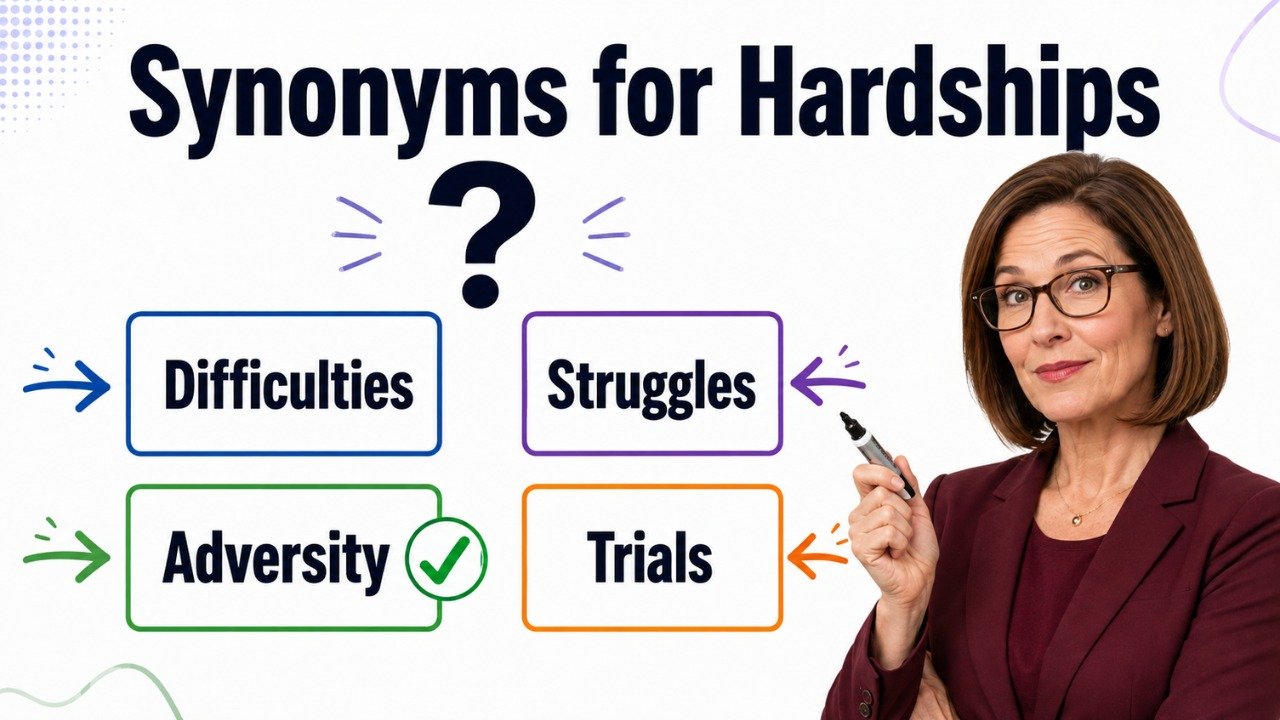
Quick Answer: Common synonyms for hardships include difficulties, adversity, struggles, challenges, troubles, trials, setbacks, misfortunes, suffering, and deprivation. Use difficulties for general problems, adversity for serious unfavorable conditions, struggles for sustained effort, challenges for problems that may be overcome, trials for painful experiences, setbacks for delays in progress, and deprivation for a lack of basic needs or comforts.
Pronunciation and Word Details
Word: Hardships.
Pronunciation: /ˈhɑːrdʃɪps/.
Part of Speech: Plural noun.
Meaning: Hardships are difficult conditions or painful experiences that cause struggle, suffering, or loss.
US Pronunciation:
UK Pronunciation:
What Does “Hardships” Mean?
Hardships means serious difficulties, painful conditions, or challenging experiences that make life harder.
Hardships is the plural form of hardship. It is a noun used for problems that require patience, effort, courage, or sacrifice to overcome.
The word may describe financial trouble, emotional pain, physical suffering, social disadvantage, personal loss, or difficult living conditions.
Financial Context: The family experienced financial hardships after losing its main source of income.
Emotional Context: She remained hopeful despite the hardships she had faced.
Physical Context: The journey exposed the travelers to hunger, exhaustion, and other hardships.
Social Context: The program supports people experiencing housing hardships.
Hardships usually refers to serious or lasting difficulties rather than small inconveniences. A delayed meeting may be annoying, but poverty, illness, displacement, and major loss are genuine hardships.
Meaning, Tone, and Context of “Hardships”
Hardships has a serious, sympathetic, and often emotional tone. It suggests that a person or group has experienced conditions that are painful, demanding, or unfair.
The word is neutral enough for conversation, news writing, essays, reports, speeches, historical discussions, and personal stories.
In formal writing, adversity, deprivation, affliction, economic distress, and unfavorable circumstances may provide greater precision.
In everyday conversation, struggles, troubles, hard times, and rough times often sound more natural.
In inspirational writing, challenges, trials, and obstacles may create a more hopeful tone because they suggest that progress is possible.
Neutral Tone: Many families faced hardships during the economic decline.
Emotional Tone: Her story reveals years of hardship and personal loss.
Formal Tone: The report examines the economic adversity experienced by rural communities.
Hopeful Tone: They overcame many challenges and built a secure future.
The correct synonym depends on whether the sentence describes poverty, emotional pain, a temporary setback, a dangerous ordeal, or a long period of struggle.
When and How to Use “Hardships”
For Financial Difficulty
Use hardships when people lack money, employment, food, housing, or other necessary resources.
Example: Rising costs created serious financial hardships for many households.
For Personal Struggle
Use hardships for painful life experiences that require strength and patience.
Example: She developed remarkable resilience through years of personal hardships.
For Difficult Living Conditions
The word can describe unsafe housing, harsh weather, limited resources, or poor access to essential services.
Example: The isolated community endured severe hardships during the winter.
For Emotional Suffering
Use hardships when loss, separation, disappointment, or trauma causes prolonged emotional difficulty.
Example: Their friendship helped them cope with emotional hardships.
For Historical Experiences
Hardships is commonly used when discussing war, migration, economic decline, natural disasters, or social inequality.
Example: The memoir describes the hardships experienced by displaced families.
For Obstacles to Progress
The word may describe problems that delay education, employment, recovery, or personal development.
Example: Despite numerous hardships, he completed his education.
For Inspirational Writing
Use hardships when highlighting courage, perseverance, gratitude, or personal growth.
Example: Her hardships did not prevent her from pursuing a meaningful life.
Best Synonyms for Hardships
Difficulties: Problems that make an action or situation harder.
Example: The team faced several difficulties during the project.
Adversity: Serious unfavorable conditions that test strength or courage.
Example: She remained determined in the face of adversity.
Struggles: Difficult efforts to overcome problems or achieve progress.
Example: He spoke honestly about his financial struggles.
Challenges: Difficult situations that require effort or skill.
Example: The new role brought unexpected challenges.
Troubles: Problems that cause worry, inconvenience, or distress.
Example: The family received support during its troubles.
Trials: Painful experiences that test patience, character, or faith.
Example: Their relationship survived many trials.
Setbacks: Problems that delay progress or success.
Example: Several setbacks slowed the recovery process.
Misfortunes: Unlucky events that cause suffering, damage, or loss.
Example: A series of misfortunes affected the small business.
Suffering: Physical or emotional pain caused by difficult conditions.
Example: The organization works to reduce human suffering.
Deprivation: A condition in which basic needs or comforts are unavailable.
Example: Long periods of deprivation affected the children’s health.
50 Synonyms for Hardships with Short Meanings
- Difficulties: Problems that make life or work harder.
- Adversity: Serious unfavorable conditions or experiences.
- Struggles: Sustained efforts against difficult circumstances.
- Challenges: Problems that require effort to overcome.
- Troubles: Situations that cause worry or distress.
- Trials: Difficult experiences that test strength or patience.
- Tribulations: Severe or prolonged periods of suffering.
- Misfortunes: Unlucky events that cause loss or pain.
- Setbacks: Problems that delay progress or success.
- Suffering: Physical or emotional pain.
- Deprivation: A lack of basic needs or comforts.
- Distress: Severe worry, pain, or difficulty.
- Affliction: A condition that causes pain or suffering.
- Misery: Great unhappiness or discomfort.
- Pain: Physical or emotional suffering.
- Sorrow: Deep sadness caused by loss or trouble.
- Burdens: Heavy responsibilities or difficult concerns.
- Obstacles: Conditions that block progress.
- Problems: Situations that require solutions.
- Ordeals: Extremely difficult or painful experiences.
- Crises: Dangerous or unstable periods requiring urgent action.
- Calamities: Events that cause severe damage or suffering.
- Disasters: Sudden events that create major loss or destruction.
- Woes: Serious troubles, sadness, or misfortune.
- Anguish: Intense emotional or physical pain.
- Grief: Deep sorrow caused by loss.
- Torment: Severe and continuing suffering.
- Discomfort: Physical or emotional uneasiness.
- Scarcity: A serious shortage of necessary resources.
- Poverty: A condition of lacking sufficient money or resources.
- Want: A lack of necessary possessions or comforts.
- Privation: A severe lack of basic necessities.
- Loss: The experience of no longer having someone or something.
- Reversals: Changes from success to difficulty or failure.
- Disappointments: Sadness caused by unmet hopes.
- Defeats: Failures to achieve a desired result.
- Blows: Events that cause sudden disappointment or damage.
- Impediments: Conditions that slow or prevent progress.
- Hindrances: Problems that make progress more difficult.
- Barriers: Conditions that prevent access or achievement.
- Complications: Additional problems that make a situation harder.
- Pressures: Demands that cause stress or difficulty.
- Strains: Conditions that place heavy demands on someone.
- Rough Times: Informal words for difficult periods.
- Hard Times: Periods of financial or personal difficulty.
- Trying Times: Periods that test patience and strength.
- Dark Days: Painful or discouraging periods.
- Vicissitudes: Unpleasant changes in life or circumstances.
- Harsh Conditions: Severe environments or living situations.
- Unfavorable Circumstances: Conditions that make success or comfort difficult.
Read Also:
Synonyms for Thrilled

Synonyms for Hardships by Context
When Hardships Means General Difficulties
Difficulties, problems, challenges, troubles, complications, and obstacles describe situations that make life or work harder.
Difficulties is the strongest neutral replacement. Challenges creates a more positive tone because it suggests that a solution may be possible.
Example With Hardships: The students faced many hardships during the course.
Example With Difficulties: The students faced many difficulties during the course.
Example With Challenges: The students faced several challenges during the course.
When Hardships Means Serious Adversity
Adversity, tribulations, trials, affliction, ordeals, and calamities describe serious experiences that test strength and endurance.
Adversity is formal and broad. Tribulations often refers to a series of severe troubles. An ordeal is one especially painful experience.
Example With Hardships: She endured many hardships throughout her life.
Example With Adversity: She endured considerable adversity throughout her life.
Example With Tribulations: She endured many trials and tribulations throughout her life.
When Hardships Means Financial Difficulty
Poverty, deprivation, privation, scarcity, want, financial distress, and hard times describe a lack of money or essential resources.
Poverty refers to a long term lack of income and resources. Deprivation describes the absence of necessities. Hard times is more conversational.
Example With Hardships: The community experienced economic hardships.
Example With Deprivation: The community experienced severe economic deprivation.
Example With Hard Times: The community went through hard times.
When Hardships Means Emotional Pain
Suffering, distress, anguish, grief, sorrow, misery, and torment describe emotional or psychological pain.
Distress is useful in formal and neutral writing. Anguish suggests intense pain, while grief is specifically connected with loss.
Example With Hardships: He rarely discussed his emotional hardships.
Example With Distress: He rarely discussed his emotional distress.
Example With Anguish: He rarely revealed his private anguish.
When Hardships Means Obstacles to Progress
Obstacles, barriers, setbacks, hindrances, impediments, and complications describe conditions that delay or prevent progress.
Setbacks temporarily slow progress. Barriers can prevent access completely. Hindrances make an activity more difficult without always stopping it.
Example With Hardships: Financial hardships delayed her education.
Example With Barriers: Financial barriers delayed her education.
Example With Setbacks: Financial setbacks delayed her education.
When Hardships Means Painful Experiences
Trials, ordeals, misfortunes, blows, reversals, and dark days describe difficult events or periods.
Misfortune emphasizes bad luck. A blow is a sudden upsetting event. Dark days refers to a deeply discouraging period.
Example With Hardships: The family survived several hardships.
Example With Misfortunes: The family survived several misfortunes.
Example With Ordeals: The family survived several painful ordeals.
Another Word for Hardships
The best general alternative for hardships is difficulties. It is clear, natural, and suitable for personal, professional, and academic writing.
The best replacement still depends on context. Use adversity for severe conditions, struggles for continuing personal effort, setbacks for delayed progress, and deprivation for a lack of basic necessities.
Original: The family overcame many hardships.
Better Option: The family overcame many difficulties.
Original: She remained hopeful despite years of hardships.
Better Option: She remained hopeful despite years of adversity.
Original: His hardships affected his education.
Better Option: His financial struggles affected his education.
Original: The project experienced several hardships.
Better Option: The project experienced several setbacks.
When Not to Use “Hardships”
Hardships can sound too serious when describing minor problems, short delays, or ordinary inconvenience.
When the Problem Is Small
Use inconvenience, difficulty, issue, or annoyance for minor situations.
Weak: Finding a parking space caused great hardships.
Better: Finding a parking space caused some inconvenience.
When Greater Precision Is Needed
Name the specific problem instead of using a broad word.
Weak: The town experienced many hardships.
Better: The town experienced food shortages, unemployment, and unsafe housing.
When Describing Project Delays
Use setbacks, obstacles, complications, or delays.
Weak: The project faced several hardships.
Better: The project faced several technical setbacks.
When Discussing Financial Conditions
Use poverty, deprivation, financial strain, or economic distress when those meanings are intended.
Weak: Many households experienced hardships.
Better: Many households experienced severe financial strain.
When Describing Emotional Pain
Use grief, anguish, distress, sorrow, or trauma if the source of pain is clear.
Weak: She felt hardships after the loss.
Better: She experienced deep grief after the loss.
When the Word Becomes Repetitive
Repeating hardships can make emotional writing sound general and monotonous.
Weak: They faced hardships at work, hardships at home, and hardships in their community.
Better: They faced pressure at work, financial strain at home, and social challenges in their community.
Words Commonly Confused With Hardships
Hardships vs Difficulties: Hardships are usually serious or prolonged, while difficulties can be minor or temporary.
Hardships vs Challenges: Hardships emphasizes suffering. Challenges emphasizes effort, problem solving, and the possibility of growth.
Hardships vs Adversity: Hardships refers to individual difficult conditions or experiences. Adversity is a broader state of serious misfortune.
Hardships vs Struggles: Hardships are the difficult conditions themselves. Struggles are the efforts people make while dealing with those conditions.
Hardships vs Setbacks: Hardships may affect general wellbeing. Setbacks specifically delay progress or success.
Hardships vs Suffering: Hardships are difficult circumstances. Suffering is the pain caused by those circumstances.
Hardships vs Poverty: Hardships can have many causes. Poverty specifically refers to insufficient money and resources.
Hardships vs Ordeals: Hardships may continue over a long period. An ordeal is usually one especially painful or frightening experience.
Which Synonym Should You Choose?
Choose difficulties for a broad and neutral replacement in most writing.
Choose adversity when describing serious unfavorable conditions that require courage or resilience.
Choose struggles when focusing on continuing personal, emotional, or financial effort.
Choose challenges when you want a constructive or hopeful tone.
Choose troubles for conversational writing about worry or personal problems.
Choose trials when discussing experiences that test patience, strength, character, or faith.
Choose setbacks when problems delay recovery, progress, or success.
Choose deprivation when people lack food, housing, education, healthcare, or other basic needs.
Choose poverty when the hardship is caused specifically by insufficient financial resources.
Choose suffering when emphasizing physical or emotional pain.
Choose distress in reports, formal communication, or discussions of emotional and financial difficulty.
Choose ordeal for one severe, painful, or frightening experience.
Choose misfortune when an unfortunate event is caused largely by bad luck.
Choose barriers when problems prevent access, participation, or achievement.
Choose hard times in informal conversation about a difficult period.
Real Life Examples of “Hardships” in Sentences
Original: The family experienced many hardships after moving.
Better Option: The family experienced many difficulties after moving.
Original: She remained strong despite years of hardships.
Better Option: She remained strong despite years of adversity.
Original: Financial hardships forced him to leave school.
Better Option: Financial struggles forced him to leave school.
Original: The business survived several hardships.
Better Option: The business survived several setbacks.
Original: The journey involved hunger, exhaustion, and other hardships.
Better Option: The journey involved hunger, exhaustion, and other ordeals.
Original: The report describes hardships in rural communities.
Better Option: The report describes deprivation in rural communities.
Original: The athlete overcame physical hardships during recovery.
Better Option: The athlete overcame physical challenges during recovery.
Original: They supported each other through personal hardships.
Better Option: They supported each other through personal troubles.
Original: The refugees experienced unimaginable hardships.
Better Option: The refugees experienced unimaginable suffering.
Original: Education helped her escape many hardships.
Better Option: Education helped her overcome many barriers.
Synonym Groups and Usage Differences
General Difficulty Group
Difficulties, problems, troubles, complications, and challenges describe conditions that require effort or solutions.
Difficulties is neutral. Troubles sounds more personal or conversational. Challenges creates a more constructive tone.
Example: The organization overcame several unexpected difficulties.
Adversity Group
Adversity, trials, tribulations, affliction, and vicissitudes describe serious or prolonged difficult conditions.
Adversity is common in formal and inspirational writing. Tribulations is more emotional and often refers to repeated suffering.
Example: His courage helped him overcome adversity.
Personal Struggle Group
Struggles, pressures, strains, burdens, and hard times describe continuing difficulties that affect daily life.
Struggles emphasizes effort. Burdens suggests heavy responsibilities, while strains often refers to emotional, physical, or financial pressure.
Example: She spoke openly about the pressures of caring for her family.
Pain and Suffering Group
Suffering, distress, anguish, misery, sorrow, grief, pain, and torment describe physical or emotional discomfort.
Distress is neutral and formal. Anguish is intense. Grief is connected with death or personal loss.
Example: The unexpected loss caused the family deep anguish.
Financial Hardship Group
Poverty, deprivation, privation, scarcity, want, and financial strain describe insufficient resources.
Poverty is broad and measurable. Deprivation emphasizes unmet needs. Privation suggests extremely harsh living conditions.
Example: The program provides food to families experiencing deprivation.
Obstacle Group
Obstacles, barriers, impediments, hindrances, and complications describe things that prevent or delay progress.
Barriers often block access. Hindrances slow progress. Impediments is a more formal choice.
Example: Limited transportation remains a barrier to employment.
Misfortune Group
Misfortunes, calamities, disasters, blows, reversals, and defeats describe events that cause loss or failure.
Calamity and disaster are strong words for major damage. Blow works for a sudden emotional or practical setback.
Example: The unexpected closure was a serious blow to the community.
Difficult Period Group
Hard times, rough times, trying times, and dark days describe unpleasant periods rather than individual problems.
Hard times commonly refers to financial or personal difficulty. Dark days has a stronger emotional tone.
Example: Her friends supported her through trying times.
Antonyms of Hardships
The opposite of hardships depends on whether the word refers to suffering, difficulty, poverty, or obstacles.
Ease: Freedom from difficulty or effort.
Comfort: A state of physical or emotional wellbeing.
Prosperity: A condition of financial success and security.
Success: The achievement of a desired result.
Advantage: A condition that improves the chance of success.
Opportunity: A favorable chance for progress.
Relief: The reduction or removal of pain or worry.
Pleasure: A feeling of happiness or enjoyment.
Wellbeing: A healthy, comfortable, and secure condition.
Security: Protection from danger, loss, or financial uncertainty.
Abundance: A plentiful supply of resources.
Fortune: Favorable circumstances or success.
Stability: A condition of safety and limited change.
Convenience: A condition that makes something easy to do.
Privilege: A special benefit or advantage.
Comparison: Hardships vs Related Words
Hardships vs Difficulties
Hardships are serious conditions that often cause suffering. Difficulties can include small, temporary, or technical problems.
Example With Hardships: The family endured severe hardships during the winter.
Example With Difficulties: The family experienced difficulties arranging transportation.
Hardships vs Adversity
Hardships refers to separate difficult experiences or conditions. Adversity describes a broader state of misfortune or difficulty.
Example With Hardships: She faced many hardships throughout her childhood.
Example With Adversity: She showed courage in the face of adversity.
Hardships vs Challenges
Hardships emphasizes pain, suffering, or deprivation. Challenges emphasizes problems that require effort and may lead to growth.
Example With Hardships: The illness created emotional and financial hardships.
Example With Challenges: The new position presented several professional challenges.
Hardships vs Struggles
Hardships are difficult circumstances. Struggles are ongoing efforts to manage or overcome those circumstances.
Example With Hardships: The family faced severe financial hardships.
Example With Struggles: The family discussed its financial struggles.
Hardships vs Setbacks
Hardships affect comfort, security, or wellbeing. Setbacks interrupt or delay progress.
Example With Hardships: Years of hardship affected his health.
Example With Setbacks: Several setbacks delayed his recovery.
Hardships vs Suffering
Hardships are the conditions that create difficulty. Suffering is the physical or emotional pain caused by those conditions.
Example With Hardships: The drought caused widespread hardships.
Example With Suffering: The drought caused widespread suffering.
Common Phrases and Expressions With “Hardships”
Face Hardships: Experience difficult conditions or situations.
Endure Hardships: Continue despite pain, difficulty, or deprivation.
Overcome Hardships: Successfully deal with serious difficulties.
Experience Hardships: Live through challenging circumstances.
Suffer Hardships: Be affected by painful or difficult conditions.
Financial Hardships: Serious difficulties caused by insufficient money.
Economic Hardships: Problems caused by unemployment, inflation, or economic decline.
Personal Hardships: Difficult experiences affecting an individual’s life.
Life’s Hardships: The painful and challenging experiences people encounter.
Hardships and Struggles: Difficult conditions and the effort needed to manage them.
Common Mistakes to Avoid
A common mistake is using hardships for minor inconvenience. The word usually refers to serious, painful, or prolonged difficulties.
Incorrect: The late delivery caused terrible hardships.
Better: The late delivery caused considerable inconvenience.
Do not assume that every synonym has the same tone. Challenges sounds constructive, adversity sounds formal, and misery sounds strongly emotional.
Avoid using hardship as a countable singular noun without an article.
Incorrect: Losing his job was hardship.
Correct: Losing his job was a hardship.
Correct: Losing his job caused considerable hardship.
Remember that hardship may be countable or uncountable depending on the sentence.
Countable: The family faced several hardships.
Uncountable: The decision caused financial hardship.
Do not confuse hardships with struggles. Hardships are difficult conditions, while struggles often describe attempts to cope with those conditions.
Avoid unnecessary repetition by naming the specific problem whenever possible.
Repetitive: The hardships included financial hardships and housing hardships.
Better: The difficulties included financial strain and unstable housing.
In formal writing, avoid vague statements such as people faced hardships without explaining what those hardships involved.
Vague: Residents experienced many hardships.
Clearer: Residents experienced food shortages, unemployment, and limited access to medical care.
Conclusion
Synonyms for hardships help writers describe adversity, struggle, loss, poverty, emotional pain, and delayed progress more accurately. Difficulties is the strongest neutral replacement, while adversity suits serious conditions and challenges creates a hopeful tone. Struggles emphasizes continuing effort, setbacks describes interrupted progress, and deprivation refers to missing basic needs. Suffering, anguish, and grief work when emotional or physical pain is central. The right synonym makes each sentence clearer, more precise, and more sensitive to the experience being described.
FAQs About Synonyms for Hardships
What Is the Best Synonym for Hardships?
Difficulties is the best general synonym because it is natural, clear, and suitable for most contexts.
What Is a Formal Synonym for Hardships?
Adversity, deprivation, affliction, tribulations, and unfavorable circumstances are useful formal alternatives.
What Is Another Word for Financial Hardships?
Financial struggles, economic distress, deprivation, poverty, financial strain, and hard times are suitable alternatives.
Are Hardships and Challenges the Same?
Not exactly. Hardships emphasize pain or suffering, while challenges emphasize problems that require effort and may be overcome.
What Is a Stronger Word Than Hardships?
Tribulations, ordeals, afflictions, calamities, and severe adversity can sound stronger than hardships.
What Is an Emotional Synonym for Hardships?
Suffering, anguish, misery, sorrow, grief, and distress are emotional alternatives.
What Is the Opposite of Hardships?
Ease, comfort, prosperity, security, relief, stability, and wellbeing are common opposites of hardships.
