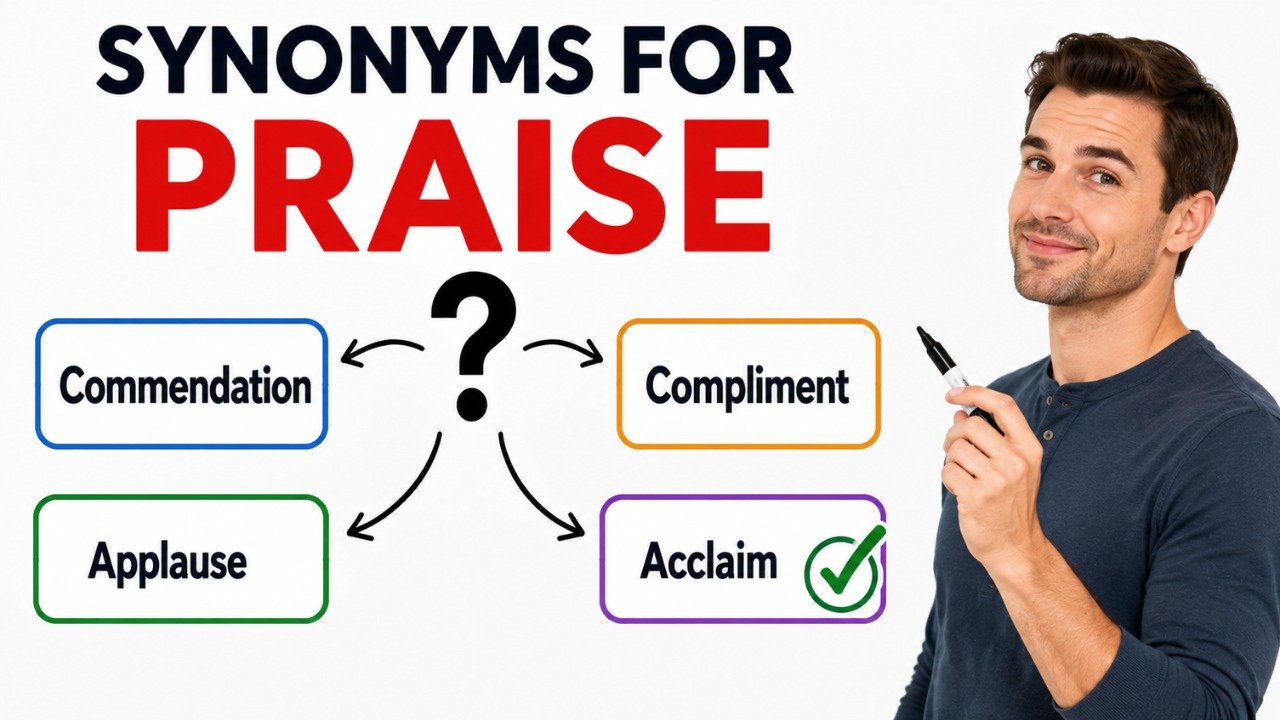
Quick Answer: The best synonyms for praise include acclaim, commendation, admiration, appreciation, compliment, recognition, applause, tribute, approval, and honor. Use commendation for formal recognition of good work, compliment for a friendly positive comment, and acclaim for enthusiastic public approval. Appreciation expresses gratitude for effort or value, while admiration shows deep respect for a person or achievement. Recognition suits professional settings, applause fits public approval, and tribute honors someone’s contribution or memory.
Pronunciation and Word Details
Word: Praise.
Pronunciation: /preɪz/
Part of Speech: Noun and verb.
Meaning: Words or actions that express approval, admiration, gratitude, or respect for someone or something.
US Pronunciation:
UK Pronunciation:
What Does “Praise” Mean?
Praise means expressing approval, admiration, or respect for someone or something.
As a noun, praise refers to positive words, approval, or recognition.
Example: The student received praise for her thoughtful answer.
As a verb, praise means to speak positively about a person, achievement, quality, or action.
Example: The teacher praised the class for working carefully.
Praise may be private or public. A parent can praise a child at home, while an organization may publicly praise a worker for excellent service.
The word can describe appreciation for effort, ability, character, kindness, creativity, leadership, or success.
Effort: The coach praised the players for continuing despite the difficulty.
Ability: The audience praised her skill as a speaker.
Character: His honesty earned praise from his colleagues.
Achievement: The research team received praise for completing the project.
Praise can also appear in devotional or spiritual contexts, where it means expressing honor, gratitude, or adoration toward a divine being.
Example: The community gathered to offer praise and gratitude.
The exact meaning depends on the sentence. Sometimes praise is a simple compliment. In other cases, it is formal recognition, enthusiastic public approval, or deep admiration.
Meaning, Tone, and Context of “Praise”
Praise usually has a positive, warm, and approving tone.
It can be casual when one person compliments another in conversation.
Casual Tone: Everyone praised her delicious cooking.
It can also be formal when a manager, teacher, judge, or public official recognizes someone’s actions.
Formal Tone: The committee praised the volunteers for their outstanding service.
Praise often carries emotional warmth because it makes people feel noticed and valued. However, its strength can range from a small compliment to widespread public acclaim.
Mild Praise: Your explanation was clear.
Strong Praise: Critics described the performance as extraordinary.
The word is common in education, parenting, workplaces, reviews, speeches, ceremonies, personal conversations, and devotional writing.
Educational Context: The teacher used praise to encourage careful reading.
Workplace Context: The employee received praise for solving the problem quickly.
Public Context: The rescue team earned widespread praise.
Personal Context: She praised her friend’s patience and kindness.
Devotional Context: The song expressed praise and gratitude.
Praise is generally sincere, but it can become negative when it is excessive, manipulative, or dishonest. In that situation, flattery may be more accurate.
Sincere Praise: His thoughtful work deserves recognition.
Insincere Praise: She used flattery to gain his support.
When and How to Use “Praise”
For Recognizing Good Work
Use praise when someone performs a task successfully or shows strong effort.
Example: The manager praised the team for completing the report early.
This type of praise may focus on skill, accuracy, cooperation, creativity, or responsibility.
For Encouraging Effort
Use praise to encourage someone who is learning, improving, or trying hard.
Example: The teacher praised the student’s effort even though the answer was incomplete.
Praising effort can sound more specific and useful than giving a general positive comment.
For Giving a Compliment
Use praise when expressing admiration for someone’s appearance, ability, idea, or personal quality.
Example: The guests praised her elegant design.
Compliment is often more natural for one short and personal positive comment.
For Formal Recognition
Use praise in professional, academic, or official writing when recognizing excellent conduct or achievement.
Example: The report praised the staff for maintaining high safety standards.
Commendation or recognition may be stronger choices in highly formal contexts.
For Public Approval
Use praise when many people express strong approval of a person, work, decision, or performance.
Example: The new community program received widespread praise.
Acclaim and applause are useful alternatives when the approval is public and enthusiastic.
For Expressing Appreciation
Use praise when thanking someone by recognizing the value of their effort.
Example: The director praised the volunteers for giving their time.
Appreciation and gratitude may be more precise when the main purpose is to say thank you.
For Honoring Achievement
Use praise when celebrating an important success, contribution, or quality.
Example: The ceremony praised the athletes for their dedication.
Honor, tribute, and recognition may suit ceremonies and formal occasions.
For Reviewing Creative Work
Use praise when discussing the strengths of a book, performance, speech, design, or artistic work.
Example: Reviewers praised the story’s realistic characters.
Acclaim is stronger when approval comes from many reviewers or members of the public.
For Admiring Character
Use praise when recognizing kindness, courage, honesty, patience, or generosity.
Example: The neighbors praised her generosity toward families in need.
Admiration and respect may better describe long lasting positive feelings.
For Devotional Expression
Use praise when expressing honor, gratitude, or adoration in a spiritual setting.
Example: The gathering included songs of praise and thanksgiving.
Adoration and glorification may express stronger devotional meaning.
Best Synonyms for Praise
Acclaim
Synonym: Strong and enthusiastic public approval.
Example: The young writer received acclaim for her first novel.
Acclaim is best when many people, reviewers, or experts publicly admire someone or something.
Commendation
Synonym: Formal approval or recognition for good conduct or achievement.
Example: The officer received a commendation for exceptional courage.
Commendation suits professional, official, academic, and ceremonial contexts.
Admiration
Synonym: A feeling of deep respect and approval.
Example: Her courage earned the admiration of the entire community.
Admiration describes a positive feeling rather than the words used to express it.
Appreciation
Synonym: Recognition of someone’s value, effort, help, or quality.
Example: The volunteers received sincere appreciation for their service.
Appreciation is especially suitable when praise also communicates gratitude.
Compliment
Synonym: A polite or friendly statement expressing approval.
Example: He gave her a compliment on her clear presentation.
Compliment is a natural choice for personal conversations and brief positive comments.
Recognition
Synonym: Public or formal acknowledgment of value, effort, or achievement.
Example: The scientist received recognition for her important discovery.
Recognition works well in workplaces, schools, ceremonies, reports, and professional writing.
Applause
Synonym: Public approval shown through clapping or enthusiastic support.
Example: The speaker received loud applause at the end of her speech.
Applause may describe literal clapping or figurative public approval.
Tribute
Synonym: Words or actions that show respect, admiration, or gratitude.
Example: The event was a tribute to the retiring teacher’s dedication.
Tribute is common when honoring a contribution, career, achievement, or memory.
Approval
Synonym: A positive judgment that something is good, acceptable, or worthy.
Example: The proposal received approval from the review panel.
Approval is often more neutral than praise and may also indicate official permission.
Honor
Synonym: Respect or public recognition given to someone for their qualities or achievements.
Example: The award was presented in honor of her years of service.
Honor is suitable for serious, respectful, formal, and ceremonial contexts.
50 Synonyms for Praise with Short Meanings
- Acclaim: Enthusiastic public approval.
- Admiration: Deep respect for someone or something.
- Appreciation: Recognition of value, effort, or quality.
- Applause: Approval expressed through clapping or public support.
- Approval: A positive judgment or favorable opinion.
- Commendation: Formal recognition of good work or conduct.
- Compliment: A polite statement expressing admiration.
- Recognition: Acknowledgment of achievement, effort, or value.
- Tribute: An expression of honor, respect, or gratitude.
- Honor: Respect or distinction given for worthy qualities.
- Adoration: Deep love, admiration, or devotion.
- Celebration: Public enjoyment or recognition of success.
- Endorsement: Public or official expression of support.
- Acknowledgment: Recognition of someone’s effort or contribution.
- Respect: Positive regard for someone’s qualities or achievements.
- Esteem: High respect and admiration.
- Regard: Respectful or favorable opinion.
- Gratitude: Thankfulness for help, kindness, or value.
- Thanks: Words expressing appreciation.
- Congratulations: Words celebrating someone’s achievement.
- Ovation: Enthusiastic applause from an audience.
- Salute: A respectful expression of admiration or honor.
- Recommendation: A favorable statement supporting someone or something.
- Positive Feedback: Helpful approval of work or performance.
- Favorable Comment: A positive statement about someone or something.
- Kind Words: Friendly statements of approval or encouragement.
- Good Word: A supportive or approving comment.
- Expression of Approval: Words or actions showing a positive judgment.
- Public Recognition: Open acknowledgment of achievement or value.
- Vote of Confidence: A clear expression of trust and support.
- Words of Appreciation: Statements recognizing effort, help, or value.
- Admire: To regard someone or something with respect.
- Applaud: To express approval or admiration.
- Approve: To have a favorable opinion of something.
- Appreciate: To recognize and value a quality or effort.
- Celebrate: To publicly recognize success or achievement.
- Commend: To formally praise someone or something.
- Congratulate: To express pleasure about someone’s success.
- Recognize: To acknowledge achievement, effort, or importance.
- Extol: To praise someone or something very highly.
- Exalt: To raise someone or something through strong praise.
- Glorify: To describe someone or something as especially great.
- Laud: To express strong formal praise.
- Hail: To publicly praise or welcome enthusiastically.
- Eulogize: To praise someone highly, often after death.
- Cheer: To express enthusiastic approval or encouragement.
- Thank: To express gratitude for help or kindness.
- Speak Highly Of: To describe someone or something very positively.
- Pay Tribute To: To publicly honor a person or contribution.
- Sing the Praises Of: To express enthusiastic and repeated admiration.
Read Also:
Synonyms for Technique
Synonyms for Praise by Context
When Praise Means a Personal Compliment
Compliment, kind words, favorable comment, admiration, and appreciation are useful in personal conversations.
Compliment: Best for a brief and friendly positive statement.
Example: She complimented him on his thoughtful speech.
Kind Words: Best for warm, supportive, or encouraging comments.
Example: Her kind words gave the nervous student confidence.
Favorable Comment: Best for a positive but neutral observation.
Example: The teacher made a favorable comment about his progress.
Admiration: Best when the positive feeling is deep and sincere.
Example: She expressed admiration for her friend’s patience.
Appreciation: Best when praise also communicates gratitude.
Example: He showed appreciation for her careful work.
When Praise Means Formal Recognition
Commendation, recognition, acknowledgment, honor, and approval fit professional or official contexts.
Commendation: Best for formal praise given for excellent performance or conduct.
Example: The firefighter received a commendation for bravery.
Recognition: Best for acknowledging achievement or contribution.
Example: The employee earned recognition for improving the process.
Acknowledgment: Best for making sure a contribution is noticed.
Example: The report included an acknowledgment of the research team’s work.
Honor: Best for serious recognition given through an award or ceremony.
Example: The community held a dinner in her honor.
Approval: Best when a person or group gives a favorable judgment.
Example: His careful work earned the supervisor’s approval.
When Praise Means Public Approval
Acclaim, applause, ovation, celebration, hail, and public recognition describe open approval from many people.
Acclaim: Best for strong approval from the public, experts, or reviewers.
Example: The performance received international acclaim.
Applause: Best for approval shown by an audience.
Example: Her final statement received enthusiastic applause.
Ovation: Best for prolonged and excited audience approval.
Example: The actor received a standing ovation.
Hail: Best for publicly describing someone as successful, important, or admirable.
Example: The invention was hailed as a major achievement.
Public Recognition: Best for open acknowledgment in professional or community settings.
Example: The volunteers received public recognition for their service.
When Praise Means Appreciation
Appreciation, gratitude, thanks, acknowledgment, and words of appreciation suit situations involving thankfulness.
Appreciation: Recognizes the value of someone’s effort or help.
Example: The director expressed appreciation for the team’s patience.
Gratitude: Communicates a strong feeling of thankfulness.
Example: She expressed gratitude to everyone who supported the project.
Thanks: A simple and direct expression of appreciation.
Example: He offered his thanks to the volunteers.
Acknowledgment: Recognizes a contribution that should not be overlooked.
Example: The speaker gave special acknowledgment to the event organizers.
Words of Appreciation: Warm statements recognizing help or effort.
Example: The students shared words of appreciation with their teacher.
When Praise Means Admiration
Admiration, esteem, respect, regard, adoration, and honor describe positive feelings toward a person or quality.
Admiration: Deep approval of ability, character, or achievement.
Example: Her honesty earned widespread admiration.
Esteem: High respect based on character or ability.
Example: The professor was held in high esteem by her students.
Respect: Positive regard for someone’s qualities, position, or conduct.
Example: His fair decisions earned the respect of the team.
Regard: A formal word for favorable opinion or respect.
Example: She is held in great regard by her colleagues.
Adoration: Very strong love and admiration.
Example: The performer received adoration from devoted supporters.
When Praise Means Celebrating Success
Congratulations, celebration, applause, salute, and recognition are useful when someone achieves something important.
Congratulations: Best for directly expressing happiness about success.
Example: We congratulated her on completing the difficult course.
Celebration: Best for publicly marking a successful event.
Example: The ceremony was a celebration of the team’s achievements.
Salute: Best for respectful recognition of effort, courage, or service.
Example: The event saluted the dedication of emergency workers.
Recognition: Best for officially acknowledging success.
Example: The award provided recognition for years of careful work.
When Praise Means Strong Formal Approval
Laud, commend, extol, acclaim, and exalt work well in formal, literary, or elevated writing.
Laud: To express strong approval in a formal style.
Example: The report lauded the organization’s responsible practices.
Commend: To formally praise a person, decision, or action.
Example: The judge commended the witness for speaking honestly.
Extol: To praise someone or something with great enthusiasm.
Example: The speaker extolled the benefits of patience and discipline.
Exalt: To raise someone or something through strong praise.
Example: The poem exalted courage above personal comfort.
Acclaim: To publicly praise an achievement or performance.
Example: Reviewers acclaimed the play for its powerful writing.
When Praise Has a Devotional Meaning
Adoration, glorification, worship, thanksgiving, and exaltation may express spiritual praise.
Adoration: Deep love and reverence.
Example: The prayer expressed adoration and gratitude.
Glorification: Strong praise that emphasizes greatness or honor.
Example: The hymn focused on glorification and thanksgiving.
Thanksgiving: An expression of gratitude in a devotional setting.
Example: The gathering included prayers of thanksgiving.
Exaltation: The act of raising someone or something to a position of great honor.
Example: The words expressed exaltation and reverence.
Worship is stronger than ordinary praise because it includes deep devotion and reverence.
When Praise Is Excessive or Insincere
Flattery, sweet talk, overstatement, and excessive admiration may describe praise that is not fully sincere.
Flattery: Praise given to please someone or gain an advantage.
Example: He used flattery to win the manager’s support.
Sweet Talk: Informal praise or charming speech used to persuade someone.
Example: She ignored his sweet talk and asked for clear evidence.
Overstatement: Praise that describes something as better than it truly is.
Example: Calling the small improvement revolutionary was an overstatement.
Flattery should not replace praise when the approval is honest and deserved.
Another Word for Praise
Commendation is one of the best formal replacements for praise. It clearly expresses approval of someone’s achievement, effort, or conduct.
However, the best alternative depends on context. Use compliment for a friendly personal comment, acclaim for enthusiastic public approval, appreciation for gratitude, and recognition for professional acknowledgment.
Original: The employee received praise for her excellent work.
Better Option: The employee received commendation for her excellent work.
Original: He gave praise to her new hairstyle.
Better Option: He gave her a compliment on her new hairstyle.
Original: The performance received praise from audiences everywhere.
Better Option: The performance received widespread acclaim.
Original: The volunteers deserved praise for their time and effort.
Better Option: The volunteers deserved recognition for their time and effort.
When Not to Use “Praise”
When You Mean Official Permission
Praise and approval can be related, but approval may also mean formal permission.
Weak: The project received praise to begin construction.
Better: The project received approval to begin construction.
When You Mean Gratitude
Praise may recognize good work, but thanks or appreciation is clearer when the main purpose is expressing gratitude.
Weak: I gave her praise for helping me carry the boxes.
Better: I thanked her for helping me carry the boxes.
When You Mean a Personal Compliment
Praise can sound too broad or formal for a short positive comment.
Weak: She gave praise to his new jacket.
Better: She complimented him on his new jacket.
When You Mean Public Popularity
Use acclaim when the approval comes from many people, reviewers, or experts.
Weak: The book gained a lot of praise across the country.
Better: The book gained widespread acclaim across the country.
When the Praise Is Insincere
Use flattery when positive words are exaggerated or intended to manipulate.
Weak: His praise was designed only to gain her support.
Better: His flattery was designed only to gain her support.
When You Mean Respect Without Verbal Approval
Admiration, esteem, or respect may be more precise when no praise was spoken.
Weak: She silently felt praise for his courage.
Better: She silently felt admiration for his courage.
When You Mean an Award
Praise may accompany an award, but it is not the award itself.
Weak: She received a praise for her scientific achievement.
Better: She received an award for her scientific achievement.
When Specific Feedback Is Needed
General praise can sound vague and provide little useful information.
Weak: Your work was good.
Better: Your explanation was clear, accurate, and easy to follow.
When the Tone Becomes Excessive
Strong words such as glorify or exalt may sound exaggerated in ordinary situations.
Weak: The manager glorified the employee for arriving on time.
Better: The manager thanked the employee for arriving on time.
When Praise Is Repeated Too Often
Using praise several times in one paragraph can make writing sound mechanical.
Weak: The teacher gave praise to the student, and the praise encouraged her to earn more praise.
Better: The teacher complimented the student, and the recognition encouraged her to keep improving.
Words Commonly Confused With Praise
Praise vs Compliment: Praise may recognize effort, character, or achievement in a broad or formal way. A compliment is usually a brief positive comment directed at a person.
Praise vs Appreciation: Praise expresses approval or admiration. Appreciation recognizes value and often includes gratitude.
Praise vs Admiration: Praise is usually expressed through words or actions. Admiration is the feeling of respect that may exist even when nothing is said.
Praise vs Approval: Praise expresses positive judgment. Approval can also mean formal acceptance or permission.
Praise vs Recognition: Praise is positive expression. Recognition formally or publicly acknowledges achievement or contribution.
Praise vs Acclaim: Praise can come from one person or many people. Acclaim is strong and widespread public approval.
Praise vs Commendation: Praise is a general term. Commendation is more formal and often connected to noteworthy conduct or achievement.
Praise vs Gratitude: Praise expresses admiration or approval. Gratitude expresses thankfulness for help, kindness, or benefit.
Praise vs Flattery: Praise is usually sincere and deserved. Flattery may be exaggerated, insincere, or used to influence someone.
Praise vs Tribute: Praise may be brief or informal. A tribute is a deliberate expression of honor, often connected to a person’s contribution, career, or memory.
Praise vs Endorsement: Praise expresses approval of quality or achievement. Endorsement publicly supports a person, idea, product, or proposal.
Praise vs Worship: Praise may be used in ordinary or devotional contexts. Worship involves deeper religious devotion, reverence, and spiritual practice.
Which Synonym Should You Choose?
Choose commendation for formal writing about excellent work, courage, conduct, or public service.
Choose acclaim when a performance, publication, achievement, or creative work receives enthusiastic public approval.
Choose compliment for friendly conversation about appearance, ability, personality, or a specific action.
Choose admiration when describing a deep feeling of respect for someone’s qualities or achievements.
Choose appreciation when recognizing effort, support, value, kindness, or contribution.
Choose recognition for professional reports, award ceremonies, workplace communication, and academic achievements.
Choose applause when approval is expressed by an audience or large group.
Choose ovation when the audience response is especially enthusiastic and prolonged.
Choose tribute when honoring a person’s career, service, achievement, contribution, or memory.
Choose honor for serious and respectful recognition.
Choose approval when describing a favorable judgment or official acceptance.
Choose acknowledgment when making sure someone’s effort or contribution is noticed.
Choose respect when the positive feeling is based on character, ability, experience, or position.
Choose esteem in formal writing about high and lasting respect.
Choose congratulations when directly celebrating another person’s success.
Choose gratitude or thanks when the main purpose is expressing thankfulness.
Choose positive feedback in workplaces, schools, reports, and performance discussions.
Choose commend in formal sentences that use praise as a verb.
Choose applaud when openly expressing approval of an action, decision, or achievement.
Choose laud in formal reports, essays, speeches, and serious public writing.
Choose extol when the praise is highly enthusiastic or elevated.
Choose hail when someone or something is publicly presented as impressive, successful, or important.
Choose eulogize when praising a person’s character or achievements, especially after death.
Choose flatter only when the positive words are excessive, insincere, or intended to gain favor.
Real Life Examples of “Praise” in Sentences
Original: The teacher gave the student praise for her careful work.
Better Option: The teacher gave the student commendation for her careful work.
Original: Everyone praised his clear presentation.
Better Option: Everyone complimented him on his clear presentation.
Original: The rescue workers received praise from the community.
Better Option: The rescue workers received recognition from the community.
Original: Reviewers praised the new performance.
Better Option: Reviewers acclaimed the new performance.
Original: She praised her colleague for helping with the project.
Better Option: She thanked her colleague for helping with the project.
Original: The audience praised the musicians at the end.
Better Option: The audience applauded the musicians at the end.
Original: The speech praised the doctor’s long career.
Better Option: The speech paid tribute to the doctor’s long career.
Original: He praised his daughter for completing the difficult task.
Better Option: He congratulated his daughter on completing the difficult task.
Original: The manager praised the team’s consistent effort.
Better Option: The manager expressed appreciation for the team’s consistent effort.
Original: The article praised her courage and honesty.
Better Option: The article lauded her courage and honesty.
Synonym Groups and Usage Differences
Formal Recognition Group
Commendation, recognition, acknowledgment, honor, and tribute belong to this group.
Commendation recognizes worthy action in an official way. Recognition makes an achievement visible. Acknowledgment ensures that a contribution is noticed. Honor and tribute carry deeper respect.
Example: The ceremony offered formal recognition and a special tribute to the volunteers.
Personal Compliment Group
Compliment, kind words, favorable comment, good word, and words of appreciation suit personal communication.
Compliment is direct and friendly. Kind words provide emotional support. A good word may help another person’s reputation. Words of appreciation combine praise with gratitude.
Example: Her kind words and sincere compliment increased his confidence.
Public Approval Group
Acclaim, applause, ovation, celebration, hail, and public recognition express approval from a larger audience.
Acclaim is widespread approval. Applause is an immediate public response. Ovation is especially enthusiastic. Hail is commonly used when people publicly describe someone or something as excellent.
Example: The performance earned acclaim and a long ovation.
Admiration Group
Admiration, respect, esteem, regard, and adoration describe positive feelings toward a person, quality, or achievement.
Admiration focuses on impressive qualities. Respect may come from character, knowledge, or position. Esteem and regard sound formal. Adoration is much stronger and more emotional.
Example: Her courage earned both admiration and respect.
Appreciation Group
Appreciation, gratitude, thanks, acknowledgment, and positive feedback recognize value, effort, or assistance.
Appreciation is broad and warm. Gratitude and thanks focus on thankfulness. Positive feedback recognizes strengths while often supporting improvement.
Example: The manager expressed appreciation and offered positive feedback.
Celebration Group
Congratulations, celebration, applause, cheers, and salute recognize success or achievement.
Congratulations is directed toward the person who succeeded. Celebration marks the event. Cheers and applause show group enthusiasm. A salute is respectful and often ceremonial.
Example: The team received congratulations and cheers after winning the competition.
Strong Praise Group
Laud, extol, exalt, glorify, hail, and acclaim communicate powerful admiration.
Laud is formal. Extol means praising something at length or with enthusiasm. Exalt raises someone or something to a highly honored position. Glorify may suggest praise that is too strong or uncritical.
Example: The speaker lauded the volunteers but avoided glorifying their difficult working conditions.
Devotional Praise Group
Adoration, glorification, exaltation, worship, and thanksgiving appear in devotional or spiritual contexts.
Adoration expresses deep love and reverence. Glorification and exaltation emphasize greatness and honor. Thanksgiving focuses on gratitude.
Example: The service included adoration, praise, and thanksgiving.
Support and Endorsement Group
Approval, endorsement, recommendation, vote of confidence, and good word express positive support.
Approval is a favorable judgment. Endorsement is often public. Recommendation encourages others to trust or choose someone. A vote of confidence expresses strong trust.
Example: Her recommendation gave the candidate an important vote of confidence.
Insincere Praise Group
Flattery, sweet talk, excessive praise, and empty compliments describe approval that may not be sincere.
Flattery is often used to gain an advantage. Sweet talk is informal and persuasive. Empty compliments sound positive but lack genuine meaning.
Example: Honest recognition is more valuable than empty compliments.
Antonyms of Praise
The opposite of praise depends on whether the context involves approval, admiration, support, or public recognition.
Criticism: Statements that identify faults or weaknesses.
Blame: Responsibility assigned for a mistake or harmful action.
Condemnation: Strong public or moral disapproval.
Censure: Formal and severe criticism.
Disapproval: A negative judgment about someone or something.
Reproach: Words expressing disappointment or blame.
Rebuke: A direct and sharp expression of disapproval.
Complaint: A statement expressing dissatisfaction.
Insult: A disrespectful or offensive comment.
Ridicule: Mockery intended to make someone appear foolish.
Denunciation: Strong public criticism or condemnation.
Disparagement: Speech that reduces someone’s value or reputation.
Scorn: Strong disrespect or contempt.
Contempt: A feeling that someone or something is unworthy of respect.
Rejection: Refusal to accept, support, or approve something.
Comparison: Praise vs Related Words
Praise vs Compliment
Praise may recognize effort, achievement, character, or quality. A compliment is usually a brief and personal positive comment.
Example With Praise: The teacher praised the student for months of steady effort.
Example With Compliment: The teacher complimented the student on her clear handwriting.
Praise vs Commendation
Praise is a broad everyday word. Commendation is more formal and often appears in professional or official contexts.
Example With Praise: The manager praised the assistant’s careful work.
Example With Commendation: The assistant received a formal commendation for excellent service.
Praise vs Acclaim
Praise may come from one person or a small group. Acclaim means enthusiastic approval from the public, reviewers, or experts.
Example With Praise: Her family praised her performance.
Example With Acclaim: Her performance received widespread acclaim.
Praise vs Admiration
Praise is an expression of approval. Admiration is a feeling of respect that may or may not be expressed.
Example With Praise: He praised her courage in front of the group.
Example With Admiration: He felt deep admiration for her courage.
Praise vs Appreciation
Praise recognizes positive qualities or achievements. Appreciation recognizes value and often includes gratitude.
Example With Praise: The director praised the team’s excellent results.
Example With Appreciation: The director expressed appreciation for the team’s long hours.
Praise vs Recognition
Praise may be spoken or written approval. Recognition formally acknowledges someone’s contribution or success.
Example With Praise: The teacher offered praise after the presentation.
Example With Recognition: The student received recognition at the annual ceremony.
Praise vs Approval
Praise is positive expression. Approval is a favorable judgment and may also mean official permission.
Example With Praise: The reviewer praised the design.
Example With Approval: The committee gave approval for the design to be used.
Praise vs Gratitude
Praise focuses on admirable qualities or actions. Gratitude focuses on thankfulness for help or kindness.
Example With Praise: She praised his skill as a teacher.
Example With Gratitude: She expressed gratitude for his guidance.
Praise vs Tribute
Praise can be brief and informal. A tribute is a planned expression of deep respect or appreciation.
Example With Praise: The coach praised the retiring player.
Example With Tribute: The team held a tribute for the retiring player.
Praise vs Flattery
Praise is usually honest and deserved. Flattery is often exaggerated and may be used to influence someone.
Example With Praise: She sincerely praised his thoughtful decision.
Example With Flattery: He used flattery to gain special treatment.
Praise vs Endorsement
Praise expresses approval of quality or achievement. Endorsement publicly supports a person, idea, plan, or position.
Example With Praise: The experts praised the proposal’s clarity.
Example With Endorsement: The professional group endorsed the proposal.
Praise vs Worship
Praise can be ordinary, formal, or devotional. Worship involves deep spiritual devotion and reverence.
Example With Praise: The poem offered praise for the beauty of nature.
Example With Worship: The congregation gathered for worship and prayer.
Common Phrases and Expressions With “Praise”
High Praise: Strong approval or admiration.
Example: The proposal received high praise from the review committee.
Worthy of Praise: Deserving approval or admiration.
Example: Her willingness to help others was worthy of praise.
Full of Praise: Expressing a great deal of approval.
Example: The visitors were full of praise for the helpful staff.
Words of Praise: Positive comments recognizing value or achievement.
Example: The coach offered words of praise after the match.
Earn Praise: Receive approval because of worthy actions or success.
Example: Her responsible decision earned praise from the community.
Receive Praise: Be given approval, admiration, or recognition.
Example: The young artist received praise for her originality.
Sing Someone’s Praises: Speak enthusiastically about someone’s qualities or achievements.
Example: His former students continue to sing his praises.
Praise Highly: Express very strong approval.
Example: The committee praised the volunteers highly.
Praise Someone for Something: Express approval of a particular action or quality.
Example: The teacher praised him for helping another student.
Beyond Praise: So excellent that ordinary approving words seem insufficient.
Example: Her courage during the emergency was beyond praise.
Common Mistakes to Avoid
Confusing Praise With Compliment
A compliment is usually brief and personal. Praise may be broader and connected to effort or achievement.
Weak: The organization gave her a compliment for twenty years of service.
Better: The organization gave her formal recognition for twenty years of service.
Using Praise as an Award
Praise is approval, not a physical prize or certificate.
Incorrect: He won a praise for his essay.
Correct: He won an award for his essay.
Correct Alternative: He received praise for his essay.
Using Praise With the Wrong Preposition
Use praise someone for an action or quality.
Incorrect: The manager praised her about completing the task.
Correct: The manager praised her for completing the task.
Use praise something as when explaining how it is described.
Example: Reviewers praised the plan as practical and affordable.
Confusing Praise and Prize
Praise means approval or admiration. Prize means an award given for achievement or success.
Incorrect: She received first praise in the competition.
Correct: She received first prize in the competition.
Using Flattery as a Neutral Synonym
Flattery often suggests exaggeration or hidden motives.
Weak: The teacher gave sincere flattery to the student.
Better: The teacher gave sincere praise to the student.
Giving Vague Praise
General praise may not explain what someone did well.
Vague: Great job.
Better: Your introduction clearly explained the main idea and prepared the reader for the discussion.
Praising Ability When Effort Is Meant
Choose words that match the quality being recognized.
Unclear: You are naturally perfect at this.
Better: Your careful practice has greatly improved your accuracy.
Overusing Strong Synonyms
Extol, exalt, and glorify can sound excessive in ordinary conversation.
Unnatural: She extolled her friend’s choice of shoes.
Natural: She complimented her friend’s choice of shoes.
Repeating Praise Too Often
Use suitable alternatives to improve flow.
Repetitive: The report praised the team, and its praise included special praise for the leader.
Better: The report commended the team and gave special recognition to its leader.
Confusing Admiration With Spoken Praise
Admiration is a feeling, while praise is usually expressed.
Weak: He gave silent praise in his thoughts.
Better: He felt silent admiration.
Using Approval When Admiration Is Intended
Approval may suggest permission rather than warm praise.
Unclear: Her music received her parents’ approval.
Clear Permission Meaning: Her parents approved her decision to study music.
Clear Praise Meaning: Her music received enthusiastic praise from her parents.
Using Excessive Praise Without Evidence
Strong praise sounds more credible when supported by a specific reason.
Weak: She is the greatest worker who has ever lived.
Better: She consistently completes difficult tasks accurately and supports her colleagues.
Conclusion
The best synonyms for praise include acclaim, commendation, compliment, admiration, appreciation, recognition, applause, tribute, approval, and honor. Choose compliment for friendly personal remarks, commendation for formal approval, and acclaim for widespread public admiration. Appreciation and gratitude suit thankful contexts, while tribute and honor recognize important contributions. Strong words such as laud, extol, and hail fit formal writing. Understanding these differences helps you use synonyms for praise naturally, sincerely, and accurately.
FAQs About Synonyms for Praise
What Is the Best Synonym for Praise?
Commendation is a strong formal synonym, while compliment is better for casual conversation. Acclaim suits enthusiastic public approval.
What Is a Formal Synonym for Praise?
Commendation, recognition, acclaim, tribute, laudation, and acknowledgment are formal alternatives.
What Is Another Word for Praising Someone?
Commending, complimenting, applauding, recognizing, congratulating, honoring, and admiring are useful alternatives.
Is Compliment the Same as Praise?
They are similar, but a compliment is usually a short personal comment. Praise can be broader and may recognize effort, character, or achievement.
What Is a Stronger Word Than Praise?
Extol, laud, acclaim, exalt, and glorify express stronger praise. Glorify may suggest excessive or uncritical approval.
What Is the Opposite of Praise?
Common opposites include criticism, blame, condemnation, censure, disapproval, ridicule, and reproach.
What Is the Difference Between Praise and Flattery?
Praise is usually honest and deserved. Flattery is often exaggerated or offered to gain approval, influence, or advantage.
