
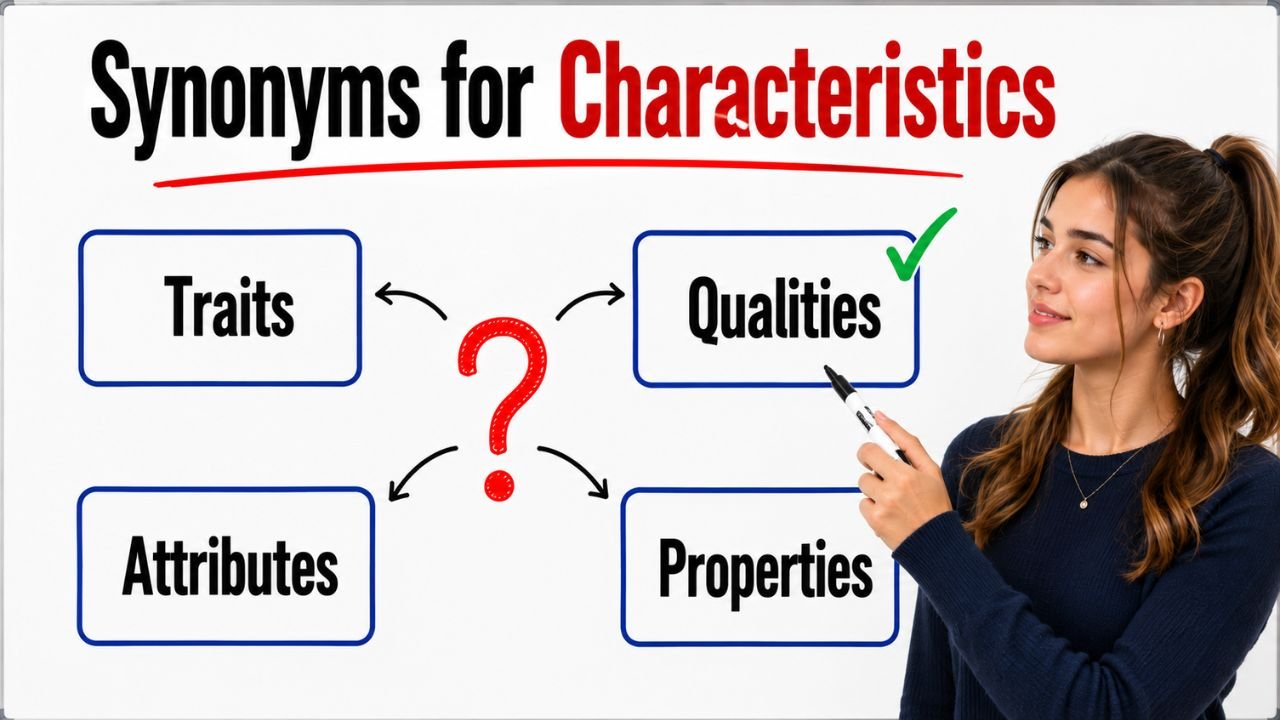
Quick Answer: Common synonyms for characteristics include traits, features, qualities, attributes, properties, aspects, signs, markers, elements, and distinctions. Use traits for personal behavior or personality, features for visible or notable parts, qualities for positive or general standards, and properties for scientific or technical descriptions. Attributes suits formal writing, while signs and markers describe details that help identify a condition, group, object, or pattern. The best synonym depends on whether you are describing a person, product, material, idea, species, culture, or situation.
Pronunciation and Word Details
Word: Characteristics.
Pronunciation: /ˌkærəktəˈrɪstɪks/
Part of Speech: Plural noun.
Meaning: Distinctive qualities, features, or traits that describe and identify a person, thing, group, or idea.
US Pronunciation:
UK Pronunciation:
What Does “Characteristics” Mean?
Characteristics means the qualities, features, or traits that describe what a person or thing is like. It is the plural form of the noun characteristic.
The word can refer to physical appearance, personality, behavior, design, performance, structure, or function. Patience and honesty are personal characteristics, while size, shape, and color are physical characteristics.
In science, characteristics may describe the observable or measurable properties of a material, organism, substance, or process. In business, the word can refer to product features, customer traits, or market qualities.
Characteristics can also identify the common elements of a group. For example, a writer may discuss the characteristics of effective leadership, modern architecture, or persuasive writing.
Meaning, Tone, and Context of “Characteristics”
Characteristics is a neutral and versatile word. It appears naturally in formal writing, everyday conversation, education, science, business, psychology, product descriptions, and research.
The word often has an analytical tone because it helps classify or describe something. It is especially useful when several qualities are being considered together.
In personal descriptions, characteristics may refer to personality traits, habits, values, abilities, or physical details. In technical contexts, it can refer to measurable properties such as strength, weight, temperature, or texture.
Characteristics is usually precise, but a more specific synonym can improve clarity. Traits is better for personality, features for design, properties for materials, and symptoms for medical conditions.
When and How to Use “Characteristics”
For Personality: Use characteristics to describe patterns of behavior, thought, emotion, or attitude.
Example: Patience and reliability are important characteristics of an effective teacher.
For Physical Appearance: Use the word for visible details that help describe or identify a person, animal, or object.
Example: The bird has several distinctive physical characteristics.
For Products: Use characteristics when discussing design, function, quality, performance, or construction.
Example: Customers compared the main characteristics of the two devices.
For Scientific Description: Use characteristics for observable or measurable properties of substances, organisms, and natural processes.
Example: Researchers studied the chemical characteristics of the sample.
For Groups and Cultures: Use the word to explain qualities commonly associated with a community, period, style, or movement.
Example: The lesson explored the main characteristics of ancient architecture.
For Writing and Ideas: Use characteristics when identifying the qualities of a style, argument, genre, or concept.
Example: Clear organization is one of the key characteristics of effective writing.
Best Synonyms for Characteristics
Traits
Synonym: Distinctive qualities of a person, animal, group, or thing.
Example: Confidence and patience are valuable leadership traits.
Features
Synonym: Noticeable or important parts of something.
Example: The building has several unusual design features.
Qualities
Synonym: Elements that describe the nature, condition, or value of something.
Example: Kindness is one of her strongest qualities.
Attributes
Synonym: Qualities or features connected with a person or thing.
Example: Accuracy and speed are important attributes of the system.
Properties
Synonym: Natural, physical, or technical qualities of a substance or object.
Example: Scientists examined the electrical properties of the material.
Aspects
Synonym: Particular parts or sides of a subject, situation, or object.
Example: The report discusses several aspects of employee performance.
Signs
Synonym: Details that indicate the presence or nature of something.
Example: The doctor looked for signs of improvement.
Markers
Synonym: Features that help identify a condition, group, stage, or pattern.
Example: These behaviors are common markers of strong teamwork.
Elements
Synonym: Basic parts that combine to form a complete thing.
Example: Trust is one of the essential elements of a healthy relationship.
Distinctions
Synonym: Qualities that make someone or something different from others.
Example: The study explains the main distinctions between the two methods.
50 Synonyms for Characteristics with Short Meanings
- Traits: Distinctive qualities of a person or thing.
- Features: Noticeable or important parts.
- Qualities: Elements that describe nature or value.
- Attributes: Qualities connected with someone or something.
- Properties: Natural, physical, or technical qualities.
- Aspects: Particular parts or sides of something.
- Elements: Basic parts of a complete whole.
- Signs: Details that indicate a condition or quality.
- Markers: Features that help identify something.
- Distinctions: Qualities that make something different.
- Peculiarities: Unusual or distinctive qualities.
- Individualities: Qualities that create a unique identity.
- Particularities: Specific details or features.
- Specifics: Exact details about something.
- Details: Small pieces of descriptive information.
- Facets: Different sides of a subject or personality.
- Dimensions: Measurable or conceptual aspects.
- Components: Parts that form a larger whole.
- Constituents: Elements that combine to create something.
- Ingredients: Parts that contribute to a result or whole.
- Hallmarks: Distinctive signs of quality or identity.
- Identifiers: Details used to recognize something.
- Indicators: Signs that show a condition or trend.
- Clues: Details that help reveal information.
- Signals: Actions or signs that communicate meaning.
- Patterns: Repeated qualities, forms, or behaviors.
- Tendencies: Common directions in behavior or development.
- Behaviors: Observable ways of acting.
- Habits: Regular and repeated actions.
- Mannerisms: Distinctive ways of speaking or behaving.
- Temperaments: Natural emotional and behavioral styles.
- Dispositions: Usual moods, attitudes, or tendencies.
- Personalities: Combined qualities that shape individuals.
- Virtues: Positive moral qualities.
- Strengths: Valuable abilities or positive qualities.
- Capabilities: Abilities to perform or achieve something.
- Abilities: Skills or powers to do something.
- Functions: Purposes or roles performed by something.
- Capabilities: Functional powers or potential uses.
- Specifications: Exact technical details or requirements.
- Measurements: Quantified dimensions or amounts.
- Variables: Qualities or factors that can change.
- Conditions: States or circumstances affecting something.
- Nature: The essential character of something.
- Character: The combined qualities that define someone or something.
- Profile: A collection of identifying details.
- Identity: Qualities that make something recognizable.
- Structure: The arrangement of connected parts.
- Form: The shape, design, or organization of something.
- Makeup: The qualities or parts that form a whole.
Read Also:
Synonyms for Vibrant
Synonyms for Characteristics by Context
When Characteristics Means Personality Traits
Traits, qualities, dispositions, temperaments, habits, and mannerisms are useful when describing people.
Traits: General patterns in personality or behavior.
Example: Curiosity and discipline are useful academic traits.
Disposition: A person’s usual mood or attitude.
Example: Her cheerful disposition made visitors feel comfortable.
Temperament: A natural emotional style.
Example: The child has a calm and patient temperament.
Mannerisms: Distinctive movements, expressions, or ways of speaking.
Example: His friendly mannerisms made the conversation feel relaxed.
When Characteristics Means Physical Features
Features, details, form, structure, profile, and identifiers work well for physical descriptions.
Features: Visible and noticeable parts.
Example: The animal has several unusual facial features.
Structure: The arrangement of physical parts.
Example: The bridge has a strong and efficient structure.
Form: The shape or visible design of something.
Example: The sculpture has a simple but elegant form.
Identifiers: Details that help recognize a person or object.
Example: Color and shape are useful identifiers for the species.
When Characteristics Means Technical Properties
Properties, specifications, measurements, variables, capabilities, and functions are suitable for scientific or technical writing.
Properties: Natural or measurable qualities.
Example: Heat can change the physical properties of metal.
Specifications: Exact technical requirements or details.
Example: The specifications include weight, size, and operating speed.
Measurements: Numerical descriptions of size, amount, or capacity.
Example: The measurements were recorded during the experiment.
Variables: Factors that may change during a process or study.
Example: Temperature was one of the main variables in the test.
When Characteristics Means Distinctive Signs
Hallmarks, markers, indicators, signs, clues, and signals describe details that reveal identity, condition, or quality.
Hallmarks: Strong and recognizable signs of quality or style.
Example: Careful reasoning is a hallmark of strong academic writing.
Markers: Features used to identify a stage, group, or condition.
Example: Consistent progress is a marker of effective learning.
Indicators: Signs that reveal change, performance, or condition.
Example: Customer satisfaction is an important indicator of service quality.
Clues: Details that help someone understand or identify something.
Example: The pattern provided clues about the cause of the problem.
When Characteristics Means Parts of a Whole
Elements, components, constituents, ingredients, facets, and aspects describe separate parts of something complete.
Elements: Essential parts of a larger subject or system.
Example: Clarity and evidence are key elements of a strong argument.
Components: Functional parts of a system or object.
Example: The machine contains several electronic components.
Facets: Different sides of a complex subject.
Example: The course examines many facets of human communication.
Aspects: Particular parts or areas of a subject.
Example: The report covers the financial and practical aspects of the plan.
Another Word for Characteristics
Traits is often the best general replacement for characteristics when describing people, behavior, or identity. Features is usually better for objects and products, while properties is more accurate in scientific and technical writing.
The correct alternative depends on what is being described.
Original: Patience and honesty are important characteristics of a good leader.
Better Option: Patience and honesty are important traits of a good leader.
Original: The product has several useful characteristics.
Better Option: The product has several useful features.
Original: Researchers examined the characteristics of the substance.
Better Option: Researchers examined the properties of the substance.
Original: The report explains the characteristics of effective communication.
Better Option: The report explains the key elements of effective communication.
When Not to Use “Characteristics”
Characteristics may sound vague when the sentence should identify a more exact type of quality. Use traits for personality, features for visible parts, properties for scientific details, and symptoms for signs of illness.
Avoid repeating characteristics several times in the same paragraph. Specific alternatives make writing clearer and more natural.
Do not use characteristics when referring to one quality. Use the singular characteristic instead.
Weak: One of her best characteristics are patience.
Better: One of her best characteristics is patience.
Weak: The phone has several technical characteristics, and these characteristics improve its performance.
Better: The phone has several technical features, and these capabilities improve its performance.
Weak: The substance has unusual personality characteristics.
Better: The substance has unusual chemical properties.
Weak: Coughing is a characteristic of the illness.
Better: Coughing is a symptom of the illness.
Words Commonly Confused With Characteristics
Characteristics vs Traits: Characteristics is a broad word for distinctive qualities. Traits is more commonly used for personality, behavior, biology, and inherited qualities.
Characteristics vs Features: Characteristics may be visible or invisible. Features usually refers to noticeable parts, functions, or design details.
Characteristics vs Qualities: Characteristics describes identifying details. Qualities often describes the nature, standard, or positive value of something.
Characteristics vs Attributes: Both words describe qualities, but attributes sounds more formal and is common in analytical, professional, and technical writing.
Characteristics vs Properties: Properties usually refers to physical, chemical, mathematical, or technical qualities.
Characteristics vs Aspects: Characteristics describe what something is like. Aspects are the different parts or sides from which it can be considered.
Characteristics vs Symptoms: Characteristics are general identifying qualities. Symptoms are signs of a medical condition, problem, or disorder.
Which Synonym Should You Choose?
Choose traits when describing personality, behavior, inherited qualities, or personal identity.
Choose features when describing appearance, design, functions, products, buildings, or technology.
Choose qualities when discussing value, excellence, character, or general nature.
Choose attributes for formal reports, professional descriptions, evaluation, or analysis.
Choose properties for science, engineering, mathematics, materials, and technical subjects.
Choose aspects when discussing separate parts or viewpoints of a broad subject.
Choose elements or components when describing parts that form a complete system.
Choose hallmarks when referring to strong and recognizable signs of identity or quality.
Choose indicators or markers when describing evidence, progress, trends, stages, or conditions.
Choose specifications when exact technical information is required.
Real Life Examples of “Characteristics” in Sentences
Original: Confidence and patience are valuable characteristics in a manager.
Better Option: Confidence and patience are valuable traits in a manager.
Original: The house has several traditional characteristics.
Better Option: The house has several traditional features.
Original: Scientists studied the characteristics of the new material.
Better Option: Scientists studied the properties of the new material.
Original: The report describes the main characteristics of the program.
Better Option: The report describes the main elements of the program.
Original: These characteristics make the species easy to identify.
Better Option: These identifiers make the species easy to recognize.
Original: Clear structure is one of the characteristics of effective writing.
Better Option: Clear structure is one of the hallmarks of effective writing.
Original: The two products have similar characteristics.
Better Option: The two products have similar specifications.
Original: The teacher discussed the characteristics of persuasive arguments.
Better Option: The teacher discussed the key qualities of persuasive arguments.
Original: Researchers recorded the characteristics of each participant.
Better Option: Researchers recorded the profile of each participant.
Original: Flexibility is one of the system’s most useful characteristics.
Better Option: Flexibility is one of the system’s most useful capabilities.
Synonym Groups and Usage Differences
Personality Group
Traits, qualities, dispositions, temperaments, habits, and mannerisms describe personality and behavior. Traits is the broadest choice, while temperament focuses on emotional nature.
Example: Patience is one of her most noticeable personality traits.
Physical Description Group
Features, form, structure, details, and identifiers describe appearance or physical construction. Features is suitable for visible parts, while structure explains how parts are arranged.
Example: The building combines modern features with a traditional structure.
Scientific Group
Properties, variables, measurements, conditions, and specifications are common in scientific and technical contexts. Properties describes natural qualities, while measurements provides numerical information.
Example: The experiment measured the physical properties of the liquid.
Identity Group
Hallmarks, distinctions, markers, identifiers, and peculiarities explain what makes something recognizable or different.
Example: Simplicity is a hallmark of the designer’s work.
Parts and Aspects Group
Elements, components, constituents, ingredients, facets, and aspects describe the parts of a whole or subject.
Example: Trust is an essential component of a successful partnership.
Antonyms of Characteristics
The opposites of characteristics depend on whether the word refers to identifying qualities, differences, or recognizable details.
Similarity: The state of being alike.
Sameness: A lack of meaningful difference.
Uniformity: Consistency without noticeable variation.
Indistinctness: A lack of clear or recognizable qualities.
Vagueness: A lack of exact details.
Ambiguity: Uncertainty caused by more than one possible meaning.
Anonymity: The absence of identifying information.
Generality: A broad description without specific details.
Ordinariness: A lack of unusual or distinctive qualities.
Featurelessness: The condition of having no noticeable features.
Inconsistency: A lack of stable or repeated qualities.
Difference: A quality that separates one thing from another, although it may oppose shared characteristics rather than all characteristics.
Comparison Characteristics vs Related Words
Characteristics vs Traits
Characteristics is broader and may describe people, objects, ideas, products, or materials. Traits is especially common for personality, behavior, and biology.
Example With Characteristics: The report describes the main characteristics of the new product.
Example With Traits: Patience and honesty are positive personality traits.
Characteristics vs Features
Characteristics refers to identifying qualities in general. Features usually means noticeable parts, functions, or design details.
Example With Characteristics: The material has several unusual characteristics.
Example With Features: The application includes several useful features.
Characteristics vs Qualities
Characteristics identifies what something is like. Qualities can also describe value, excellence, or moral character.
Example With Characteristics: The study compared the characteristics of two groups.
Example With Qualities: Kindness and courage are admirable qualities.
Characteristics vs Properties
Characteristics can be used in many contexts. Properties is more precise for scientific, mathematical, physical, and technical descriptions.
Example With Characteristics: The researchers observed the characteristics of the sample.
Example With Properties: The researchers measured the chemical properties of the sample.
Characteristics vs Attributes
Characteristics is common in general writing. Attributes is slightly more formal and often appears in evaluation, data analysis, and professional descriptions.
Example With Characteristics: The candidate has several useful characteristics.
Example With Attributes: Reliability is a valuable professional attribute.
Characteristics vs Aspects
Characteristics describes qualities that identify something. Aspects describes separate parts or viewpoints of a subject.
Example With Characteristics: The article explains the characteristics of successful teams.
Example With Aspects: The article examines the financial and social aspects of teamwork.
Common Phrases and Expressions With Characteristics
Physical Characteristics: Visible or measurable qualities of a person, animal, or object.
Personal Characteristics: Qualities that describe personality, behavior, values, or identity.
Distinctive Characteristics: Qualities that make someone or something easy to recognize.
Key Characteristics: The most important identifying qualities.
Main Characteristics: The primary qualities or features of something.
Common Characteristics: Qualities shared by several people or things.
Unique Characteristics: Qualities not commonly found elsewhere.
Defining Characteristics: Qualities that strongly establish identity or nature.
Product Characteristics: Features, functions, and properties of a product.
Performance Characteristics: Qualities that describe how effectively something operates.
Common Mistakes to Avoid
A common mistake is using the plural verb after the phrase one of the characteristics. The subject is one, so the verb should usually be singular.
Incorrect: One of the main characteristics are reliability.
Correct: One of the main characteristics is reliability.
Do not confuse characteristics with character. Characteristics are separate qualities, while character can refer to a person’s moral nature or the combined identity of something.
Avoid using personality terms for objects or scientific substances. Materials have properties, while people have traits or dispositions.
Do not assume every synonym is interchangeable. Features usually describes visible or functional parts, while attributes can be abstract. Properties is best for technical qualities, and symptoms is best for medical signs.
Avoid vague sentences that mention characteristics without naming them. Give specific details whenever possible.
Vague: The system has many good characteristics.
Clear: The system offers speed, accuracy, security, and flexibility.
Conclusion
Synonyms for characteristics include traits, features, qualities, attributes, properties, aspects, elements, and hallmarks. Traits is often best for personality, while features suits products, designs, and visible details. Properties is more precise for science and technical writing, and attributes works well in formal descriptions. Markers, signs, and indicators can describe identifying evidence. Choosing the right alternative helps readers understand whether you are discussing behavior, appearance, structure, function, quality, or identity.
FAQs About Synonyms for Characteristics
What Is the Best Synonym for Characteristics?
Traits is a strong general synonym for personal qualities. Features is better for objects, while properties is more suitable for scientific subjects.
Is Features a Synonym for Characteristics?
Yes. Features can replace characteristics when referring to noticeable parts, functions, or design details.
What Is a Formal Synonym for Characteristics?
Attributes, properties, specifications, distinctions, and particularities are useful formal alternatives.
What Is Another Word for Personal Characteristics?
Traits, qualities, attributes, dispositions, habits, and personality features are suitable alternatives.
What Is Another Word for Physical Characteristics?
Physical features, identifiers, details, properties, form, and structure can work depending on the sentence.
What Is the Difference Between Characteristics and Qualities?
Characteristics are identifying details, while qualities may also describe value, excellence, or moral nature.
Can Properties Replace Characteristics?
Properties can replace characteristics in scientific, technical, mathematical, and material descriptions.
