
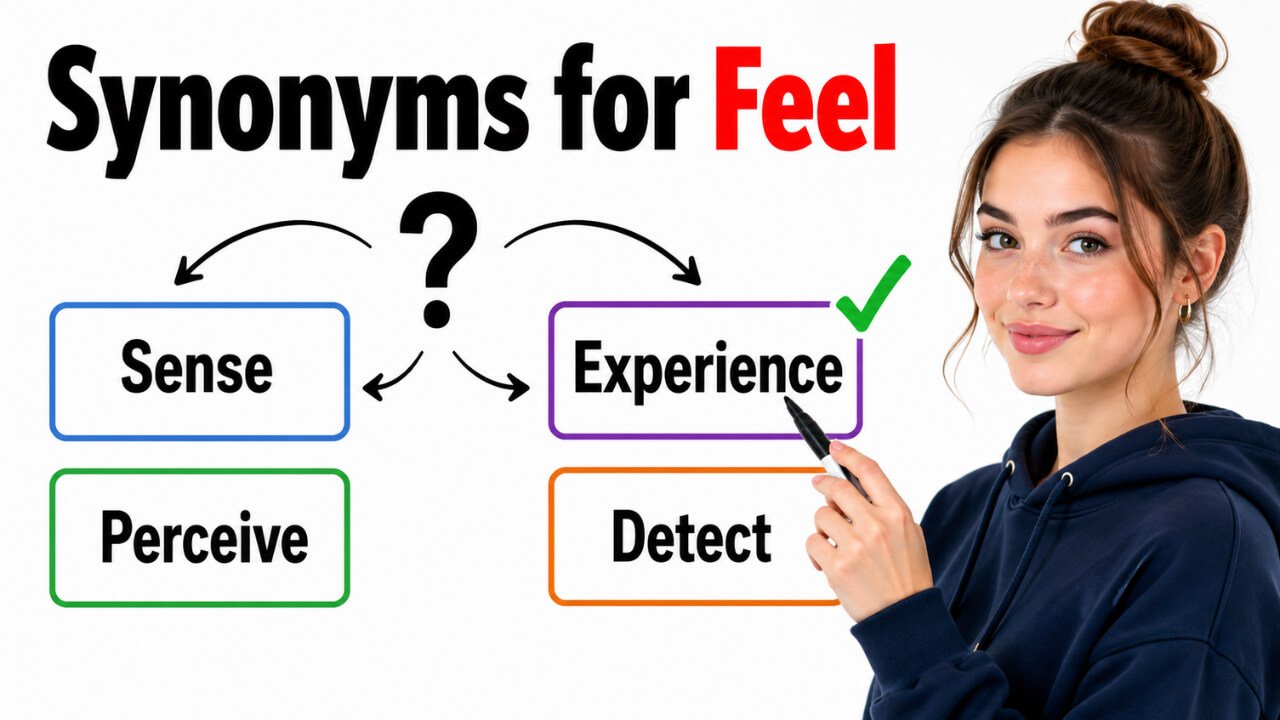
Quick Answer: Common synonyms for feel include sense, experience, perceive, notice, believe, think, touch, impression, atmosphere, and texture. Use sense or perceive for physical awareness, experience for emotions, believe or think for opinions, and touch for physical contact. When feel is a noun, impression describes a general reaction, atmosphere describes the character of a place, and texture describes how a surface seems when touched.
Pronunciation and Word Details
Word: Feel.
Pronunciation: /fiːl/.
Part of Speech: Verb and noun.
Meaning: To experience an emotion or sensation, form an opinion, touch something, or notice the character of something.
US Pronunciation:
UK Pronunciation:
What Does “Feel” Mean?
Feel means to experience a physical sensation, emotion, belief, impression, or desire. It can function as both a verb and a noun.
As a verb, feel may describe physical awareness, as in “I feel warmth on my face.” It can express emotion, as in “She feels happy today.” It may also introduce an opinion, as in “I feel the decision was fair.”
Feel can describe touching something to discover its texture. For example, “Feel the fabric before choosing it.”
As a noun, feel refers to a sensation, texture, atmosphere, or general impression. A room can have a peaceful feel, while a fabric can have a soft feel.
Meaning, Tone, and Context of “Feel”
Feel is a common and neutral word used in casual conversations, personal writing, professional communication, and descriptive language. Its exact tone depends on the sentence.
When discussing emotions, feel often sounds personal and sincere. When introducing an opinion, it can soften a statement and make it sound less forceful. Saying “I feel this plan needs improvement” sounds gentler than directly saying the plan is poor.
In formal reports and academic writing, feel may sometimes sound vague or subjective. Words such as believe, conclude, observe, perceive, or experience may communicate the intended meaning more accurately.
Feel is also common in sensory descriptions, discussions about health, emotional conversations, and descriptions of texture, mood, and atmosphere.
When and How to Use “Feel”
For Physical Sensations: Use feel when describing something the body notices, such as heat, cold, pressure, pain, or movement.
Example: I can feel a cold breeze coming through the window.
For Emotions: Use feel to describe happiness, sadness, fear, excitement, confidence, or another emotional state.
Example: She feels proud of her progress.
For Opinions: Use feel when expressing a personal belief or judgment in a gentle way.
Example: I feel that the second proposal is more practical.
For Physical Contact: Use feel when touching something to learn about its surface, shape, or condition.
Example: Feel the material to see whether it is smooth.
For General Impressions: Use feel when describing the atmosphere or character of a place, event, design, or situation.
Example: The room has a calm and welcoming feel.
For Desires: Use feel like when expressing something a person wants to do, eat, or experience.
Example: I feel like taking a walk after dinner.
For Intuition: Use feel when a belief comes from instinct rather than clear evidence.
Example: I feel that something important is about to happen.
Best Synonyms for Feel
Sense: To become physically or mentally aware of something.
Example: She could sense tension in the meeting.
Experience: To undergo an emotion, event, or physical condition.
Example: Many people experience nervousness before an interview.
Perceive: To notice or understand something through the senses or mind.
Example: He perceived a slight change in her attitude.
Notice: To become aware of something through observation.
Example: I noticed a difference in the room temperature.
Believe: To accept something as true or hold a particular opinion.
Example: I believe the new approach will produce better results.
Think: To have an opinion, idea, or judgment.
Example: She thinks the task will be completed today.
Touch: To make physical contact with something.
Example: Touch the surface carefully because it may still be hot.
Seem: To give a particular impression or appear to be a certain way.
Example: The situation seems more complicated than expected.
Impression: A general idea or reaction formed about someone or something.
Example: The presentation created a positive impression.
Texture: The physical quality of a surface as experienced through touch.
Example: The fabric has a smooth texture.
50 Synonyms for Feel with Short Meanings
- Sense: To become aware of something physically or mentally.
- Perceive: To notice or understand through the senses.
- Notice: To become conscious of something.
- Detect: To discover something that is not immediately obvious.
- Recognize: To identify or become aware of something familiar.
- Discern: To notice or understand something with careful attention.
- Register: To become consciously aware of a sensation or fact.
- Experience: To undergo an emotion, sensation, or event.
- Undergo: To pass through a particular condition or experience.
- Encounter: To meet or experience a situation unexpectedly.
- Endure: To experience something difficult for a period of time.
- Suffer: To experience pain, distress, or discomfort.
- Enjoy: To experience pleasure or satisfaction.
- Believe: To hold something as true or likely.
- Think: To have a particular opinion or judgment.
- Consider: To regard something in a certain way.
- Suppose: To believe something is probably true.
- Suspect: To feel that something may be true without proof.
- Imagine: To form an idea or impression in the mind.
- Judge: To form an opinion after considering information.
- Assume: To accept something as true without complete evidence.
- Hold: To maintain a particular belief or opinion.
- Reckon: To think or suppose, especially in casual speech.
- Intuit: To understand something through instinct.
- Touch: To make physical contact with something.
- Handle: To touch, hold, or move something with the hands.
- Stroke: To move a hand gently across a surface.
- Examine: To inspect something closely, sometimes through touch.
- Seem: To give a particular impression.
- Appear: To seem to have a certain quality.
- Come Across: To create a particular impression.
- Strike: To produce a strong impression on someone.
- Desire: To strongly want something.
- Want: To wish to have or do something.
- Wish: To desire a particular action or result.
- Fancy: To feel a casual desire for something.
- Crave: To have a powerful desire for something.
- Sensation: A physical feeling produced by the senses.
- Emotion: A mental state such as happiness, fear, or anger.
- Sentiment: A personal feeling, attitude, or opinion.
- Impression: A general feeling or idea about something.
- Mood: A temporary emotional state.
- Atmosphere: The emotional character of a place or situation.
- Ambience: The mood or character of a particular environment.
- Texture: The way a surface feels when touched.
- Tone: The general emotional quality of communication or design.
- Character: The distinctive quality of a place, object, or situation.
- Awareness: Knowledge or recognition of a sensation or condition.
- Instinct: A natural feeling that guides judgment without reasoning.
- Sympathy: Understanding and concern for another person’s feelings.
Read Also:
Synonyms for Moreover
Synonyms for Feel by Context
When Feel Means Physical Awareness
Sense, perceive, notice, detect, register, and recognize describe physical or mental awareness.
Sense is the most natural general alternative. Perceive sounds more formal and may include interpretation. Detect is useful when the sensation is weak or difficult to notice.
Example: I could sense a slight movement behind the curtain.
Example: The equipment detected a change in temperature.
When Feel Means Experience an Emotion
Experience, undergo, endure, suffer, and enjoy describe emotions or conditions that affect a person.
Experience is a neutral and flexible choice. Undergo is more formal and often refers to a process. Endure and suffer suggest difficulty, while enjoy describes pleasure.
Example: She experienced great relief after receiving the news.
Example: He endured several weeks of uncertainty.
When Feel Means Believe or Think
Believe, think, consider, suppose, suspect, judge, assume, hold, and reckon can replace feel when it introduces an opinion.
Believe sounds confident and clear. Think is natural in conversation. Consider suggests careful judgment, while suspect expresses uncertainty.
Example: I believe the proposed schedule is realistic.
Example: We consider this option the most reliable.
When Feel Means Touch
Touch, handle, stroke, and examine describe physical contact.
Touch is the closest general replacement. Handle suggests holding or moving something. Stroke describes gentle movement across a surface. Examine suggests careful inspection.
Example: Touch the cloth and compare its texture with the other sample.
When Feel Means Seem
Seem, appear, come across, and strike describe an impression created by a person, place, or situation.
Seem is the most direct alternative. Appear is slightly more formal. Come across often describes how a person communicates. Strike introduces a personal impression.
Example: The room seems smaller after the furniture was added.
Example: He came across as calm and prepared.
When Feel Means Want
Desire, want, wish, fancy, and crave can replace feel like when discussing a desire.
Want is direct and widely used. Desire is stronger and more formal. Fancy is casual, while crave expresses an intense desire.
Example: I want to rest for a few minutes.
Example: She craved something warm after walking in the rain.
When Feel Is Used as a Noun
Sensation, emotion, sentiment, impression, mood, atmosphere, ambience, texture, and tone can replace the noun feel.
Choose sensation for physical awareness, emotion for an inner state, texture for a surface, and atmosphere or ambience for the character of a place.
Example: The café has a relaxed atmosphere.
Example: The material has a rough texture.
Another Word for Feel
Sense is often the best single replacement for feel when the word describes physical or intuitive awareness. However, the strongest alternative depends on whether feel refers to emotion, opinion, touch, desire, texture, or atmosphere.
Original: I could feel a change in the temperature.
Better Option: I could sense a change in the temperature.
Original: I feel that the proposal is reasonable.
Better Option: I believe that the proposal is reasonable.
Original: She felt intense happiness after the announcement.
Better Option: She experienced intense happiness after the announcement.
Original: The room has a peaceful feel.
Better Option: The room has a peaceful atmosphere.
When Not to Use “Feel”
Avoid feel when a more precise word would make the sentence clearer. It can become repetitive in emotional writing, vague in formal reports, or inaccurate when describing objective evidence.
Do not use feel to present a proven fact as a personal opinion. Words such as shows, demonstrates, confirms, or indicates are more suitable when evidence is available.
Weak: I feel that the results show a clear improvement.
Better: The results indicate a clear improvement.
Avoid feel when the specific emotion is known.
Weak: She felt something positive after receiving the message.
Better: She experienced relief after receiving the message.
Avoid feel when describing a clear judgment in formal writing.
Weak: We feel the current process is inefficient.
Better: We conclude that the current process is inefficient.
Avoid feel when touch is the intended action and clarity matters.
Weak: Feel the control to find the correct button.
Better: Touch the control to find the correct button.
Words Commonly Confused With Feel
Feel vs Sense: Feel is broader and can describe emotion, opinion, touch, or physical awareness. Sense mainly describes becoming aware of something physically or intuitively.
Feel vs Experience: Feel commonly names a present emotion or sensation. Experience emphasizes undergoing an emotion, condition, or event.
Feel vs Believe: Feel can introduce a personal opinion gently. Believe expresses a clearer judgment about what is true.
Feel vs Think: Feel may suggest an emotional or intuitive opinion. Think often suggests reasoning or a general personal view.
Feel vs Seem: Feel describes the experience of a person or the impression created by something. Seem describes how something appears.
Feel vs Touch: Feel may involve physical contact and the sensation produced by that contact. Touch refers mainly to the act of making contact.
Feel vs Feeling: Feel is commonly a verb, although it can also be a noun. Feeling is usually a noun referring to an emotion, sensation, opinion, or intuition.
Which Synonym Should You Choose?
For Formal Writing: Choose perceive, experience, consider, conclude, or believe, depending on the intended meaning.
For Casual Speech: Choose think, sense, want, fancy, or seem.
For Physical Awareness: Choose sense, notice, detect, perceive, or register.
For Emotions: Choose experience, enjoy, suffer, endure, or undergo.
For Opinions: Choose believe, think, consider, judge, or hold.
For Uncertain Opinions: Choose suppose, suspect, assume, or reckon.
For Intuition: Choose sense, intuit, instinct, or suspect.
For Physical Contact: Choose touch, handle, stroke, or examine.
For Reports: Choose observe, detect, conclude, indicate, or demonstrate instead of using a vague form of feel.
For Essays: Choose believe or consider for personal arguments and indicate or demonstrate for evidence based claims.
For Emails: Choose believe or think for polite suggestions. Use conclude or recommend when a stronger professional judgment is needed.
For Conversation: Feel is usually natural, but think, want, seem, and sense can prevent repetition.
For Texture: Choose texture, surface, or quality.
For the Mood of a Place: Choose atmosphere, ambience, character, or tone.
Real Life Examples of “Feel” in Sentences
Original: I feel cold whenever the window is open.
Better Option: I sense cold air whenever the window is open.
Original: She felt nervous before the presentation.
Better Option: She experienced nervousness before the presentation.
Original: I feel the first option is more practical.
Better Option: I believe the first option is more practical.
Original: Feel the fabric before making a decision.
Better Option: Touch the fabric before making a decision.
Original: The office feels quiet today.
Better Option: The office seems quiet today.
Original: I feel like drinking something warm.
Better Option: I want to drink something warm.
Original: He felt that the explanation was incomplete.
Better Option: He considered the explanation incomplete.
Original: The house has a traditional feel.
Better Option: The house has a traditional character.
Original: This blanket has a soft feel.
Better Option: This blanket has a soft texture.
Original: I feel something is wrong with the arrangement.
Better Option: I sense that something is wrong with the arrangement.
Synonym Groups and Usage Differences
Physical Awareness Group
Sense, perceive, notice, detect, recognize, discern, and register relate to becoming aware of something.
Sense is broad and natural. Detect emphasizes discovery, while discern suggests careful attention.
Example: She discerned a slight change in his voice.
Emotional Experience Group
Experience, undergo, endure, suffer, and enjoy describe emotional or physical states.
Experience is neutral. Undergo is formal. Endure and suffer describe unpleasant conditions, while enjoy describes pleasure.
Example: The team experienced both excitement and nervousness.
Opinion and Judgment Group
Believe, think, consider, suppose, suspect, judge, assume, hold, and reckon express ideas or conclusions.
Believe and think are common general choices. Consider and judge suggest evaluation. Suppose and suspect communicate uncertainty.
Example: We consider the revised plan more effective.
Touch Group
Touch, handle, stroke, and examine refer to physical contact.
Touch is general. Handle involves holding or moving an object. Stroke suggests gentle contact, while examine suggests careful inspection.
Example: She examined the surface to check for damage.
Appearance Group
Seem, appear, come across, and strike describe the impression something creates.
Seem is neutral. Appear is more formal. Come across often describes behavior, and strike introduces a personal reaction.
Example: The instructions appear clear and complete.
Desire Group
Desire, want, wish, fancy, and crave express different levels of wanting.
Want is direct. Desire is formal or strong. Fancy is casual, while crave expresses an intense need or longing.
Example: He desired a quieter and more comfortable workspace.
Atmosphere and Texture Group
Impression, mood, atmosphere, ambience, texture, tone, and character describe the feel of places, objects, writing, or situations.
Texture describes a physical surface. Atmosphere and ambience describe an environment. Tone describes emotional quality, while impression expresses a personal reaction.
Example: Soft lighting created a relaxing ambience.
Antonyms of Feel
Feel has several meanings, so it does not have one universal opposite. The correct antonym depends on the sentence.
Ignore: To deliberately give no attention to something.
Overlook: To fail to notice something.
Miss: To remain unaware of a detail or sensation.
Disbelieve: To refuse to accept something as true.
Reject: To refuse an idea, opinion, or judgment.
Avoid: To prevent oneself from experiencing something.
Escape: To avoid undergoing an unpleasant situation.
Numbness: A lack of physical sensation.
Indifference: A lack of emotion, interest, or concern.
Certainty: Definite knowledge rather than an uncertain feeling.
Insensitivity: A lack of awareness of physical or emotional effects.
Dislike: A negative reaction rather than a desire or preference.
Comparison: Feel vs Related Words
Feel vs Sense
Feel is broader and can describe emotion, opinion, touch, and sensation. Sense focuses on awareness through the body, mind, or intuition.
Example With Feel: I feel nervous about tomorrow’s meeting.
Example With Sense: I sense some tension among the participants.
Feel vs Experience
Feel often describes a specific emotion or sensation at a particular moment. Experience emphasizes going through a condition, event, or emotional state.
Example With Feel: She feels anxious today.
Example With Experience: She experiences anxiety before major presentations.
Feel vs Believe
Feel introduces a personal or intuitive opinion. Believe communicates a clearer judgment about what is true or likely.
Example With Feel: I feel that we should review the plan again.
Example With Believe: I believe that another review will improve the plan.
Feel vs Think
Feel can suggest emotion or instinct. Think usually suggests an opinion formed through thought or reasoning.
Example With Feel: I feel that he is being sincere.
Example With Think: I think his explanation is logical.
Feel vs Seem
Feel describes a personal experience or the quality something creates. Seem describes how a person, object, or situation appears.
Example With Feel: The room feels cold.
Example With Seem: The room seems colder without the curtains.
Feel vs Touch
Feel can describe both the action of touching and the resulting sensation. Touch refers more directly to physical contact.
Example With Feel: Feel the surface to check whether it is dry.
Example With Touch: Do not touch the surface until it has dried.
Feel vs Perceive
Feel is common and conversational. Perceive is more formal and often includes mental interpretation.
Example With Feel: I feel a change in the atmosphere.
Example With Perceive: She perceived a change in the group’s attitude.
Common Phrases and Expressions With “Feel”
Feel Good: To experience happiness, comfort, or physical wellness.
Feel Bad: To experience sadness, guilt, discomfort, or illness.
Feel Like: To want something or have a desire to do something.
Feel Free: To have permission to act without concern.
Feel at Home: To feel comfortable and accepted in a place.
Feel Sorry For: To experience sympathy for someone.
Feel Strongly About: To have a powerful opinion or emotion concerning something.
Feel the Same Way: To share another person’s opinion or emotion.
Feel Under the Weather: To feel slightly ill or unwell.
Get a Feel For: To develop an understanding of how something works.
Common Mistakes to Avoid
Repeating Feel Too Often: Repeatedly using feel can make emotional or descriptive writing sound limited. Replace some uses with experience, sense, believe, notice, or seem.
Using Feel for Proven Facts: Feel presents information as personal or uncertain. Use indicates, confirms, demonstrates, or shows when evidence supports the statement.
Choosing the Wrong Meaning: A synonym for emotion may not work for physical touch. Check whether feel means sense, believe, experience, touch, desire, seem, or atmosphere.
Writing Feel Badly Incorrectly: Feel bad normally means to experience sadness, guilt, or illness. Feel badly may suggest having a poor sense of touch.
Using Feel Like in Formal Writing: Phrases such as “I feel like this method is better” may sound conversational. Use believe, consider, or conclude in formal contexts.
Confusing Feel and Seem: A person feels an emotion, but a situation may seem unusual. Make sure the subject can logically experience the feeling.
Using Vague Emotional Language: Replace general wording with the exact emotion when possible. Instead of saying someone felt bad, explain whether the person felt disappointed, guilty, anxious, or unwell.
Confusing Feel Myself and Feel Like Myself: “I feel like myself” means returning to one’s normal emotional or physical condition. “I feel myself” can have a different and potentially unclear meaning.
Conclusion
Understanding synonyms for feel helps you describe sensations, emotions, opinions, desires, textures, and impressions more accurately. Choose sense or perceive for awareness, experience for emotions, believe or think for opinions, and touch for physical contact. Seem works well for appearances, while atmosphere, ambience, and texture replace the noun feel in descriptive writing. Because feel has several meanings, always consider the sentence context before selecting an alternative. A precise synonym makes communication clearer, more natural, and more expressive.
FAQs About Synonyms for Feel
What Is the Best Synonym for Feel?
Sense is the best general synonym when feel means becoming physically or intuitively aware of something. Other contexts may require experience, believe, touch, seem, or want.
What Is a Formal Synonym for Feel?
Perceive is formal when discussing awareness. Experience works for emotions, while believe or consider works for opinions.
What Is Another Word for Feeling an Emotion?
Experience is the strongest general alternative. Undergo, endure, suffer, and enjoy may be better for specific emotional situations.
What Is a Synonym for Physically Feeling Something?
Sense, perceive, detect, notice, and register can describe physical awareness. Touch is appropriate when referring to physical contact.
Can Feel Mean Believe?
Yes. In a sentence such as “I feel the plan will work,” feel means believe or think.
What Is the Difference Between Feel and Sense?
Feel has many meanings, including experiencing emotions, expressing opinions, and touching objects. Sense mainly means becoming aware of something physically or intuitively.
What Is Another Word for the Feel of a Place?
Atmosphere, ambience, mood, tone, and character can describe the overall feel of a place.
