
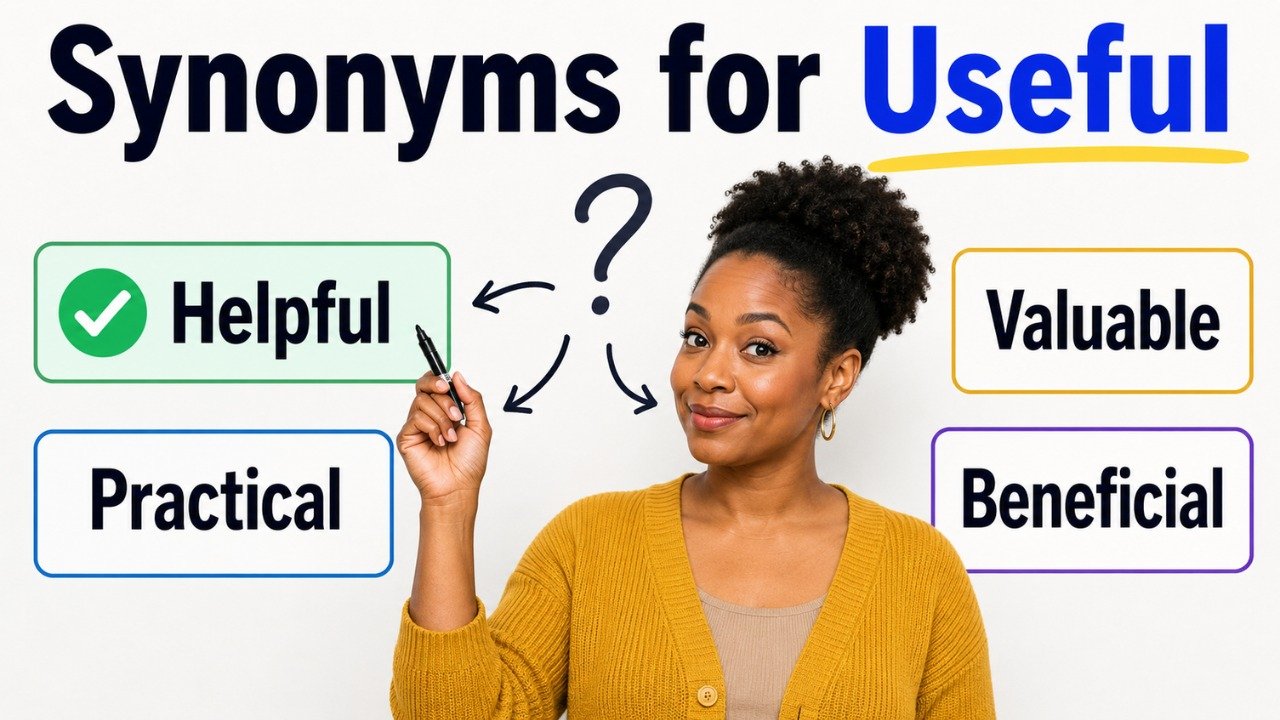
Quick Answer: The best synonyms for useful include helpful, practical, valuable, beneficial, effective, worthwhile, functional, productive, constructive, and advantageous. The keyword synonyms for useful is best understood by context. Use helpful for general support, practical for real life value, valuable for importance, beneficial for positive results, effective for success, functional for working purpose, and constructive for advice or feedback that improves something.
Pronunciation and Word Details
Word: Useful
Pronunciation: /ˈjuːs.fəl/
Part of Speech: Adjective
Meaning: Useful means able to help, serve a purpose, solve a problem, or provide value.
US Pronunciation:
UK Pronunciation:
What Does “Useful” Mean?
Direct Answer: Useful means something gives help, value, purpose, or practical benefit.
Useful is an adjective used to describe a tool, idea, skill, person, method, fact, tip, resource, or action that helps in some way. A useful object serves a purpose. A useful idea solves a problem. A useful skill helps someone perform better. In a sentence, useful can come before a noun, as in useful advice, or after a linking verb, as in this advice is useful.
Meaning, Tone, and Context of “Useful”
Useful has a positive, neutral, and practical tone. It is common in everyday speech, school writing, professional writing, reviews, instructions, essays, and business communication. The word is simple but clear. It does not sound too emotional or too formal. In academic writing, useful can describe evidence, research, methods, or examples. In business writing, it can describe tools, reports, feedback, plans, or strategies. In casual conversation, it means something helps or works well.
When and How to Use “Useful”
For Practical Help: Use useful when something helps someone complete a task or solve a problem.
Example: This checklist is useful for planning daily work.
For Valuable Information: Use useful when advice, facts, or guidance provide clear value.
Example: The teacher gave us useful feedback on our essays.
For Tools and Objects: Use useful when something has a purpose and helps with an action.
Example: A calendar is useful for remembering important dates.
For Skills: Use useful when a skill helps in study, work, or daily life.
Example: Clear communication is a useful skill in every career.
For Positive Results: Use useful when a method or action creates a helpful outcome.
Example: The new method proved useful during the project.
Best Synonyms for Useful
Helpful: Giving support, assistance, or guidance.
Example: Your explanation was helpful for understanding the topic.
Practical: Suitable for real use or daily situations.
Example: The book gives practical advice for better writing.
Valuable: Important because it gives benefit or worth.
Example: Her experience was valuable during the discussion.
Beneficial: Producing a good or positive effect.
Example: Daily reading is beneficial for vocabulary growth.
Effective: Successful in producing the needed result.
Example: This method is effective for improving focus.
Worthwhile: Deserving time, attention, or effort.
Example: Learning grammar is a worthwhile habit for writers.
Functional: Working well and serving a clear purpose.
Example: The design is simple but functional.
Productive: Creating good results or progress.
Example: The meeting was productive and saved time.
Constructive: Helpful because it improves something.
Example: Constructive feedback can make your writing stronger.
Advantageous: Giving an advantage or favorable result.
Example: Strong vocabulary is advantageous in academic writing.
50 Synonyms for Useful with Short Meanings
- Helpful: Giving help or support.
- Practical: Useful in real situations.
- Valuable: Important and worth having.
- Beneficial: Producing good results.
- Effective: Producing the intended result.
- Worthwhile: Worth time or effort.
- Functional: Working for a clear purpose.
- Productive: Creating useful results.
- Constructive: Helping something improve.
- Advantageous: Giving a benefit or advantage.
- Serviceable: Good enough to be used.
- Handy: Easy and useful to have nearby.
- Convenient: Easy to use or suitable.
- Profitable: Giving gain or benefit.
- Rewarding: Giving value, success, or satisfaction.
- Fruitful: Producing good or useful results.
- Effective: Able to create the desired effect.
- Efficient: Working well without waste.
- Applicable: Able to be used in a situation.
- Relevant: Connected and useful to the subject.
- Suitable: Right for a purpose or need.
- Appropriate: Fitting a situation or purpose.
- Purposeful: Having a clear useful aim.
- Meaningful: Having value or importance.
- Important: Having strong value or effect.
- Significant: Important enough to matter.
- Instrumental: Helpful in making something happen.
- Supportive: Giving help or encouragement.
- Assistive: Designed to help.
- Aiding: Helping someone or something.
- Profitable: Bringing useful gain or advantage.
- Resourceful: Able to find useful ways to solve problems.
- Operative: Working or producing an effect.
- Utilitarian: Made for practical use.
- Pragmatic: Focused on practical results.
- Workable: Possible and useful in practice.
- Usable: Able to be used.
- Employable: Able to be used for a purpose.
- Favorable: Helping produce a good result.
- Worthful: Having worth or value.
- Of Use: Having practical value.
- Of Value: Having importance or benefit.
- Fit For Purpose: Suitable for the intended use.
- Good For: Helpful for a specific purpose.
- Helpful To: Giving support to someone or something.
- Useful For: Serving a specific purpose.
- Needed: Important for a purpose.
- Necessary: Required for something to work or happen.
- Essential: Very important and needed.
- Key: Very important for success or usefulness.
Read Also:
Synonyms for I
Synonyms for Useful by Context
When Useful Means Helpful
These words work when useful means giving support, guidance, or assistance.
Synonyms: Helpful, supportive, assistive, aiding, handy.
Example: Her notes were helpful during the exam review.
When Useful Means Practical
These words work when useful means suitable for real life use.
Synonyms: Practical, functional, workable, usable, pragmatic.
Example: The guide offers practical steps for better writing.
When Useful Means Valuable
These words work when useful means important, meaningful, or worth having.
Synonyms: Valuable, worthwhile, meaningful, important, significant.
Example: The report contained valuable information for the team.
When Useful Means Effective
These words work when useful means successful in producing results.
Synonyms: Effective, productive, fruitful, efficient, operative.
Example: The strategy was effective in reducing mistakes.
When Useful Means Advantageous
These words work when useful means giving a benefit or favorable result.
Synonyms: Advantageous, beneficial, favorable, profitable, rewarding.
Example: Learning new vocabulary is beneficial for clear communication.
Another Word for Useful
The best single replacement for useful is helpful because it fits most everyday situations. However, the best alternative depends on the exact meaning. Use practical when something works in real life. Use valuable when something has importance. Use effective when something produces results. Use beneficial when something creates a positive effect.
Original: This guide is useful for beginners.
Better Option: This guide is helpful for beginners.
Original: The plan is useful in real situations.
Better Option: The plan is practical in real situations.
Original: The advice was useful to the students.
Better Option: The advice was valuable to the students.
Original: The method was useful for solving the issue.
Better Option: The method was effective for solving the issue.
When Not to Use “Useful”
Do not use useful when a more exact word gives clearer meaning. Useful can sound plain if the sentence needs a stronger word like essential, effective, valuable, or beneficial. Avoid repeating useful too often in one paragraph. Also, do not use useful for something that only looks good but does not serve a real purpose.
Weak: This useful useful tool is useful for useful work.
Better: This practical tool helps with daily work.
Weak: The medicine was useful for his health.
Better: The treatment was beneficial for his health.
Weak: The strategy was useful and gave results.
Better: The strategy was effective and gave results.
Weak: Her advice was useful and important.
Better: Her advice was valuable and important.
Words Commonly Confused With Useful
Useful vs Helpful: Useful means something has practical value. Helpful means something gives support or assistance.
Useful vs Practical: Useful means able to help. Practical means suitable for real use, not just theory.
Useful vs Valuable: Useful focuses on function or help. Valuable focuses on importance or worth.
Useful vs Effective: Useful means helpful or purposeful. Effective means successful in producing a result.
Useful vs Beneficial: Useful means serving a purpose. Beneficial means producing a positive effect.
Useful vs Functional: Useful means helpful. Functional means working properly for a purpose.
Useful vs Worthwhile: Useful means helpful. Worthwhile means deserving time, effort, or attention.
Which Synonym Should You Choose?
Choose helpful when something gives support, guidance, or assistance.
Choose practical when something works well in real life.
Choose valuable when something has importance or worth.
Choose beneficial when something gives a positive effect.
Choose effective when something creates the intended result.
Choose functional when something works properly and serves its purpose.
Choose productive when something creates progress or useful output.
Choose constructive when advice, feedback, or criticism helps improve something.
Choose advantageous when something gives a clear benefit.
Choose worthwhile when something deserves time, energy, or attention.
Real Life Examples of “Useful” in Sentences
Original: This app is useful for organizing tasks.
Better Option: This tool is practical for organizing tasks.
Original: Her advice was useful during the interview.
Better Option: Her advice was helpful during the interview.
Original: The report was useful for the meeting.
Better Option: The report was valuable for the meeting.
Original: This method is useful for saving time.
Better Option: This method is effective for saving time.
Original: The lesson was useful for students.
Better Option: The lesson was beneficial for students.
Original: The design is useful but simple.
Better Option: The design is functional but simple.
Original: The discussion was useful for the team.
Better Option: The discussion was productive for the team.
Original: His comments were useful for revision.
Better Option: His comments were constructive for revision.
Original: The new rule may be useful for workers.
Better Option: The new rule may be advantageous for workers.
Original: Reading daily is useful for learning.
Better Option: Reading daily is worthwhile for learning.
Synonym Groups and Usage Differences
Help Group
This group includes words that show support or assistance. Use them when someone or something makes a task easier.
Synonyms: Helpful, supportive, assistive, aiding.
Example: The notes were helpful before the test.
Practical Use Group
This group includes words that show real life usefulness. Use them for tools, methods, plans, and advice.
Synonyms: Practical, functional, workable, usable.
Example: The plan is practical for small teams.
Value Group
This group includes words that show worth, importance, or meaning.
Synonyms: Valuable, worthwhile, meaningful, important.
Example: The training gave employees valuable skills.
Result Group
This group includes words that show success, progress, or good outcomes.
Synonyms: Effective, productive, fruitful, efficient.
Example: The new schedule was effective for saving time.
Benefit Group
This group includes words that show advantage or positive effect.
Synonyms: Beneficial, advantageous, favorable, rewarding.
Example: Regular practice is beneficial for language learners.
Antonyms of Useful
Useless: Having no value or purpose.
Unhelpful: Not giving help or support.
Impractical: Not suitable for real use.
Worthless: Having no real value.
Ineffective: Not producing the wanted result.
Pointless: Having no clear purpose.
Unproductive: Not creating useful results.
Fruitless: Producing no good result.
Irrelevant: Not connected or useful to the topic.
Inconvenient: Not easy or suitable to use.
Unsuitable: Not right for a purpose.
Unnecessary: Not needed.
Comparison
Useful vs Helpful
Useful means something has practical value. Helpful means something gives assistance or support.
Example With Useful: This checklist is useful for planning.
Example With Helpful: This checklist is helpful for beginners.
Useful vs Practical
Useful means something helps. Practical means something works well in real life.
Example With Useful: The advice is useful for students.
Example With Practical: The advice is practical for daily study.
Useful vs Valuable
Useful focuses on purpose. Valuable focuses on worth or importance.
Example With Useful: The tool is useful for editing.
Example With Valuable: The tool is valuable for professional writers.
Useful vs Effective
Useful means helpful. Effective means successful in producing a result.
Example With Useful: The method is useful for learning.
Example With Effective: The method is effective for improving memory.
Useful vs Beneficial
Useful means serving a purpose. Beneficial means creating a good effect.
Example With Useful: The habit is useful for staying organized.
Example With Beneficial: The habit is beneficial for mental clarity.
Common Phrases and Expressions With Useful
Useful Advice: Advice that helps someone.
Useful Information: Information that has value or purpose.
Useful Tool: A tool that helps complete a task.
Useful Skill: A skill that helps in work, study, or life.
Useful Tip: A small piece of advice that helps.
Useful Resource: A source that provides help or value.
Useful Method: A way of doing something that works well.
Useful Example: An example that makes something clearer.
Useful Feedback: Feedback that helps improve something.
Useful Knowledge: Knowledge that can be applied in real situations.
Common Mistakes to Avoid
A common mistake is using useful too many times in one paragraph. Repetition can make writing sound weak. Another mistake is using useful when a more exact synonym is better. For results, use effective. For value, use valuable. For positive effects, use beneficial. For real life use, use practical. Avoid weak phrases like very useful when a stronger word can say more. Also, do not use useful for something that only seems nice but does not actually help or serve a purpose.
Conclusion
The keyword synonyms for useful includes many strong choices, but the right word depends on meaning and context. Use helpful for support, practical for real life use, valuable for importance, beneficial for positive effects, effective for results, and functional for purpose. Useful is a clear and flexible word, but stronger synonyms can make your writing more specific, polished, and natural. Choosing the right synonym helps readers understand exactly how something gives help, value, or benefit.
FAQs About Synonyms for Useful
What is the best synonym for useful?
The best synonym for useful is helpful. It works in most general situations where something gives support, value, or assistance.
What is a formal synonym for useful?
Formal synonyms for useful include beneficial, valuable, effective, advantageous, functional, and constructive.
What is another word for useful in writing?
Another word for useful in writing is helpful, practical, valuable, or effective, depending on the sentence.
What is a stronger word than useful?
A stronger word than useful can be essential, valuable, effective, beneficial, or instrumental.
Is useful the same as helpful?
Useful and helpful are very close, but useful focuses more on purpose or value, while helpful focuses more on assistance.
What is the opposite of useful?
The opposite of useful is useless. Other antonyms include unhelpful, ineffective, impractical, worthless, and pointless.
Can I use practical instead of useful?
Yes. Practical is a good replacement when useful means suitable for real life use or action.
