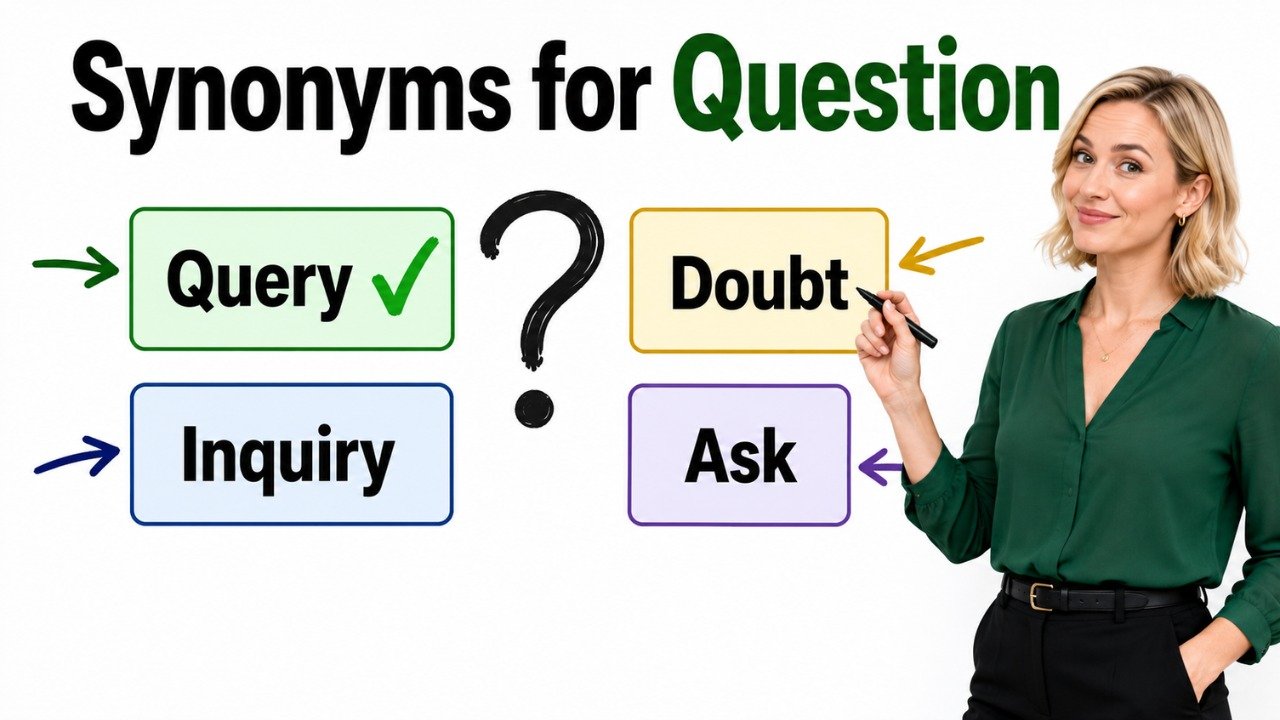
Quick Answer: The best synonyms for question include inquiry, query, request, issue, problem, doubt, challenge, interrogation, examination, and matter. The right synonym depends on context. Use inquiry or query in formal writing, request when asking for something, doubt when showing uncertainty, issue or matter for a topic under discussion, and interrogation or examination for serious or official questioning.
Pronunciation and Word Details
Word: Question.
Pronunciation: /ˈkwes.tʃən/
Part of Speech: Noun and verb.
Meaning: A question is something asked to get information, or the act of asking, doubting, or challenging something.
US Pronunciation:
UK Pronunciation:
What Does “Question” Mean?
Direct Answer: “Question” means a sentence, request, or expression used to ask for information, clarification, confirmation, or explanation.
The word question is commonly used as a noun and a verb. As a noun, it refers to something someone asks. As a verb, it means to ask someone about something, doubt something, or challenge an idea.
As a Noun: She asked a thoughtful question.
As a Verb: The teacher questioned the student about the answer.
As a Topic: The main question is whether the plan will work.
As Doubt: He began to question the accuracy of the report.
Meaning, Tone, and Context of “Question”
Tone: Question is a neutral word. It can sound formal, casual, academic, serious, or conversational depending on how it is used.
Formal Context: Inquiry, query, matter, and issue sound more professional than question.
Casual Context: Ask and question are natural in everyday conversation.
Academic Context: Problem, issue, inquiry, and examination are useful in essays, research, and analysis.
Official Context: Interrogation, investigation, and examination are stronger words used in legal, official, or serious situations.
Emotional Context: Doubt, concern, and uncertainty are better when question means hesitation or lack of confidence.
When and How to Use “Question”
For Asking Information: Use question when someone wants an answer, fact, explanation, or detail.
Example: I have a question about the assignment.
For Clarification: Use question when something is unclear and needs to be explained.
Example: Her question helped the class understand the topic.
For Doubt: Use question when someone is unsure whether something is true, correct, or reliable.
Example: They began to question the decision.
For Challenge: Use question when someone disagrees with an idea or wants stronger proof.
Example: The editor questioned the accuracy of the statement.
For Discussion: Use question when referring to a topic, matter, or issue that needs attention.
Example: The question of cost still needs careful review.
For Formal Questioning: Use question when someone is examined or asked for details in a serious setting.
Example: The officer questioned the witness.
Best Synonyms for Question
Inquiry: A formal request for information.
Example: The office received an inquiry about the new rules.
Query: A question asked to get information or clarification.
Example: Please send your query before the meeting.
Request: An act of asking for something.
Example: Her request for more details was reasonable.
Issue: A topic, problem, or matter that needs attention.
Example: The main issue is the lack of evidence.
Problem: A difficult question or situation that needs a solution.
Example: This problem requires careful thinking.
Doubt: A feeling of uncertainty about something.
Example: He had a doubt about the final answer.
Challenge: A question or objection that tests an idea.
Example: The lawyer raised a challenge to the claim.
Interrogation: Serious or official questioning.
Example: The suspect faced a long interrogation.
Examination: A careful study, check, or formal questioning.
Example: The case needs closer examination.
Matter: A subject or situation being discussed.
Example: The matter is still under review.
50 Synonyms for Question with Short Meanings
- Inquiry: A formal request for information.
- Query: A question asked for clarification.
- Request: An act of asking for something.
- Ask: A simple act of asking.
- Interrogation: Serious or official questioning.
- Examination: Careful checking or formal questioning.
- Investigation: Detailed search for facts.
- Probe: A deep or careful question.
- Issue: A topic or problem needing attention.
- Matter: A subject being considered.
- Problem: A difficult question needing a solution.
- Concern: A worry or point needing attention.
- Doubt: Uncertainty about truth or accuracy.
- Uncertainty: Lack of complete confidence.
- Challenge: An objection or test of an idea.
- Objection: A statement of disagreement.
- Dispute: A disagreement about a fact or point.
- Debate: A discussion with opposing views.
- Topic: A subject being discussed.
- Subject: The main thing being talked about.
- Point: A specific idea or detail.
- Prompt: A question or instruction that invites a response.
- Item: One question or point in a list.
- Quiz: A short test made of questions.
- Test: A set of questions used to check knowledge.
- Exam: A formal test of knowledge.
- Interview: A planned conversation with questions.
- Survey: A set of questions used to collect opinions.
- Poll: A short set of questions for public opinion.
- Questionnaire: A written list of questions.
- Check: A simple act of confirming something.
- Review: A careful look at something.
- Scrutiny: Close and serious examination.
- Inspection: Careful checking of details.
- Research: Careful study to answer a question.
- Analysis: Detailed study of facts or ideas.
- Discussion: Conversation about a question or topic.
- Consultation: A formal discussion to ask for advice.
- Appeal: A serious request or question for help.
- Petition: A formal written request.
- Demand: A strong request or question requiring action.
- Concernment: A matter of importance or interest.
- Puzzle: A confusing question or problem.
- Mystery: A question with an unknown answer.
- Riddle: A question designed to be solved.
- Enigma: A difficult or mysterious question.
- Case: A situation or question under review.
- Point of Inquiry: A specific area needing information.
- Line of Inquiry: A direction of questioning or research.
- Clarification: An explanation that answers confusion.
Read Also:
Synonyms for Obvious
Synonyms for Question by Context
When Question Means Inquiry
Use these synonyms when question means asking for information in a polite, formal, or professional way.
Inquiry: The school received an inquiry about admission.
Query: She sent a query about the payment date.
Request: His request for information was clear.
Consultation: The doctor arranged a consultation to answer her concerns.
When Question Means Doubt
Use these synonyms when question means uncertainty, hesitation, or lack of confidence.
Doubt: I have a doubt about this answer.
Uncertainty: There is uncertainty about the result.
Concern: Her concern was based on missing details.
Suspicion: His suspicion grew after reading the report.
When Question Means Problem
Use these synonyms when question means a difficulty, issue, or matter that needs a solution.
Problem: The biggest problem is the lack of time.
Issue: The main issue is quality control.
Matter: The matter needs urgent attention.
Puzzle: The result created a puzzle for the team.
When Question Means Challenge
Use these synonyms when question means testing, opposing, or challenging an idea.
Challenge: The expert raised a challenge to the claim.
Objection: Her objection was fair and logical.
Dispute: The dispute focused on the final number.
Debate: The debate continued for several hours.
When Question Means Formal Examination
Use these synonyms when question means serious, official, or detailed questioning.
Interrogation: The witness answered questions during the interrogation.
Examination: The case required careful examination.
Investigation: The investigation focused on missing evidence.
Probe: The committee began a deeper probe into the matter.
Another Word for Question
Direct Answer: The best single replacement for question is inquiry when you mean a formal request for information. However, the best alternative depends on the meaning. Use query for clarification, doubt for uncertainty, issue for a topic, and interrogation for official questioning.
Original: I have a question about the report.
Better Option: I have an inquiry about the report.
Original: The question is still not solved.
Better Option: The issue is still not solved.
Original: She began to question his answer.
Better Option: She began to doubt his answer.
Original: The police asked him many questions.
Better Option: The police conducted an interrogation.
When Not to Use “Question”
Avoid using question when a more exact word would make the sentence clearer. Question can sound too general if you mean doubt, issue, request, inquiry, or interrogation. Repeating question too often can also make writing sound simple or weak.
Weak: I have a question about the question in the report.
Better: I have an inquiry about the issue in the report.
Weak: The question is whether his answer is true, and many people question it.
Better: The issue is whether his answer is true, and many people doubt it.
Weak: The officer asked many questions to the suspect.
Better: The officer interrogated the suspect.
Weak: The question of the system is hard.
Better: The problem with the system is hard to solve.
Words Commonly Confused With Question
Question vs Inquiry: Question is general, while inquiry is more formal and often used for polite information requests.
Question vs Query: Query is often used when someone asks for clarification, especially in professional or technical contexts.
Question vs Request: A question asks for information, while a request asks someone to do something or provide something.
Question vs Doubt: A question may ask for an answer, while doubt shows uncertainty or lack of belief.
Question vs Issue: A question asks something, while an issue is a matter or problem being discussed.
Question vs Problem: A question may simply need an answer, while a problem usually needs a solution.
Question vs Interrogation: A question can be casual or formal, while interrogation is serious, official, and intense.
Which Synonym Should You Choose?
Choose inquiry when writing a formal message, professional note, or polite request for information.
Choose query when asking for clarification about a detail, document, rule, or process.
Choose request when you are asking someone to provide, send, approve, or do something.
Choose doubt when question means uncertainty about truth, accuracy, or reliability.
Choose issue when referring to a topic, concern, or matter that needs discussion.
Choose problem when the question involves difficulty, confusion, or a need for a solution.
Choose challenge when someone is testing, opposing, or questioning an idea.
Choose interrogation when the questioning is official, legal, serious, or intense.
Choose examination when writing about careful study, review, or detailed checking.
Choose matter when referring to a subject that is being considered or discussed.
Real Life Examples of “Question” in Sentences
Original: I have a question about the lesson.
Better Option: I have an inquiry about the lesson.
Original: Please answer my question before the meeting.
Better Option: Please respond to my query before the meeting.
Original: The question is whether we can finish on time.
Better Option: The issue is whether we can finish on time.
Original: She started to question his explanation.
Better Option: She started to doubt his explanation.
Original: The officer asked him several questions.
Better Option: The officer interrogated him.
Original: This question is difficult to solve.
Better Option: This problem is difficult to solve.
Original: The report raises a question about safety.
Better Option: The report raises a concern about safety.
Original: The teacher gave us ten questions.
Better Option: The teacher gave us a quiz.
Original: The question of fairness is important.
Better Option: The matter of fairness is important.
Original: They questioned the final decision.
Better Option: They challenged the final decision.
Synonym Groups and Usage Differences
Information Group
This group includes words used when someone asks for facts, details, or clarification.
Synonyms: Inquiry, query, request, ask, prompt.
Example: Her inquiry was answered clearly.
Doubt Group
This group includes words used when someone is unsure or not fully convinced.
Synonyms: Doubt, uncertainty, concern, suspicion.
Example: His doubt grew after seeing the numbers.
Problem Group
This group includes words used when question means a difficulty or issue that needs a solution.
Synonyms: Problem, issue, matter, puzzle, case.
Example: The issue needs more discussion.
Challenge Group
This group includes words used when someone tests, opposes, or disagrees with an idea.
Synonyms: Challenge, objection, dispute, debate.
Example: The expert raised a strong objection.
Formal Questioning Group
This group includes words used in serious, official, academic, or investigative contexts.
Synonyms: Interrogation, examination, investigation, probe, scrutiny.
Example: The evidence was under close scrutiny.
Antonyms of Question
Answer: A response to a question.
Reply: A spoken or written response.
Response: Something said or written after a question.
Solution: An answer to a problem.
Certainty: Complete confidence without doubt.
Belief: Acceptance that something is true.
Statement: A sentence that gives information instead of asking.
Confirmation: Proof that something is true or correct.
Agreement: Acceptance of an idea or answer.
Acceptance: Willingness to believe or approve something.
Comparison: Question vs Related Words
Question vs Inquiry
Question is a general word for anything asked. Inquiry sounds more formal and polite.
Example With Question: I have a question about the schedule.
Example With Inquiry: I have an inquiry about the schedule.
Question vs Query
Question is common in everyday speech. Query is more specific and often used for clarification.
Example With Question: She asked a question about the form.
Example With Query: She sent a query about the form.
Question vs Request
Question asks for information. Request asks for action, permission, or help.
Example With Question: I have a question about your decision.
Example With Request: I have a request for your approval.
Question vs Doubt
Question can mean asking something. Doubt means being unsure about something.
Example With Question: He asked a question about the answer.
Example With Doubt: He had doubt about the answer.
Question vs Issue
Question can be something asked. Issue is a topic, concern, or problem.
Example With Question: The question needs an answer.
Example With Issue: The issue needs a solution.
Question vs Interrogation
Question can be simple and casual. Interrogation is serious, official, and forceful.
Example With Question: The teacher asked a question.
Example With Interrogation: The suspect faced an interrogation.
Common Phrases and Expressions With Question
Ask a Question: To request information.
Answer a Question: To give a reply.
Raise a Question: To bring up a point for discussion.
Question the Decision: To doubt or challenge a choice.
Question the Accuracy: To doubt whether something is correct.
Open Question: A question that has not been answered yet.
Good Question: A useful or thoughtful question.
Difficult Question: A question that is hard to answer.
Serious Question: A question that deserves careful attention.
Question of Time: A matter related to when something will happen.
Common Mistakes to Avoid
Using Question Too Often: Repeating question can make writing sound weak. Use inquiry, issue, doubt, or problem when they fit better.
Wrong Synonym Choice: Do not use interrogation for a simple classroom question. It sounds too serious and official.
Confusing Question and Request: A question asks for information. A request asks someone to do something.
Confusing Question and Doubt: Question can mean ask, but doubt means uncertainty.
Using Issue for Every Question: Issue works when you mean a topic or problem, not when you mean a simple question.
Using Query in Very Casual Speech: Query can sound formal in everyday conversation. Question is usually more natural.
Forgetting Verb Use: Question can also be a verb. For example, “They questioned the result” means they doubted or challenged it.
Conclusion
The keyword synonyms for question can include inquiry, query, request, issue, problem, doubt, challenge, interrogation, examination, and matter. Use inquiry or query for formal writing, request when asking for action, doubt for uncertainty, issue for a topic, and interrogation for serious questioning. The best synonym depends on whether you mean asking, doubting, discussing, challenging, or investigating. Choosing the right word makes your writing clearer, more natural, and more precise.
FAQs About Synonyms for Question
What is the best synonym for question?
Answer: The best synonym for question is inquiry when you mean a formal request for information. Query is also a strong choice when asking for clarification.
What is another word for question in formal writing?
Answer: Inquiry, query, issue, matter, and examination are good formal alternatives to question.
What is another word for question when it means doubt?
Answer: Doubt, uncertainty, concern, and suspicion are good synonyms when question means lack of confidence.
What is another word for question in an exam?
Answer: Item, prompt, problem, quiz question, and test question can be used depending on the context.
What is the difference between question and inquiry?
Answer: Question is general and common. Inquiry is more formal and often means a polite request for information.
Can issue be a synonym for question?
Answer: Yes, issue can be a synonym when question means a topic, matter, or problem being discussed.
Is interrogation a synonym for question?
Answer: Yes, interrogation can be a synonym when question means serious, official, or intense questioning.
