
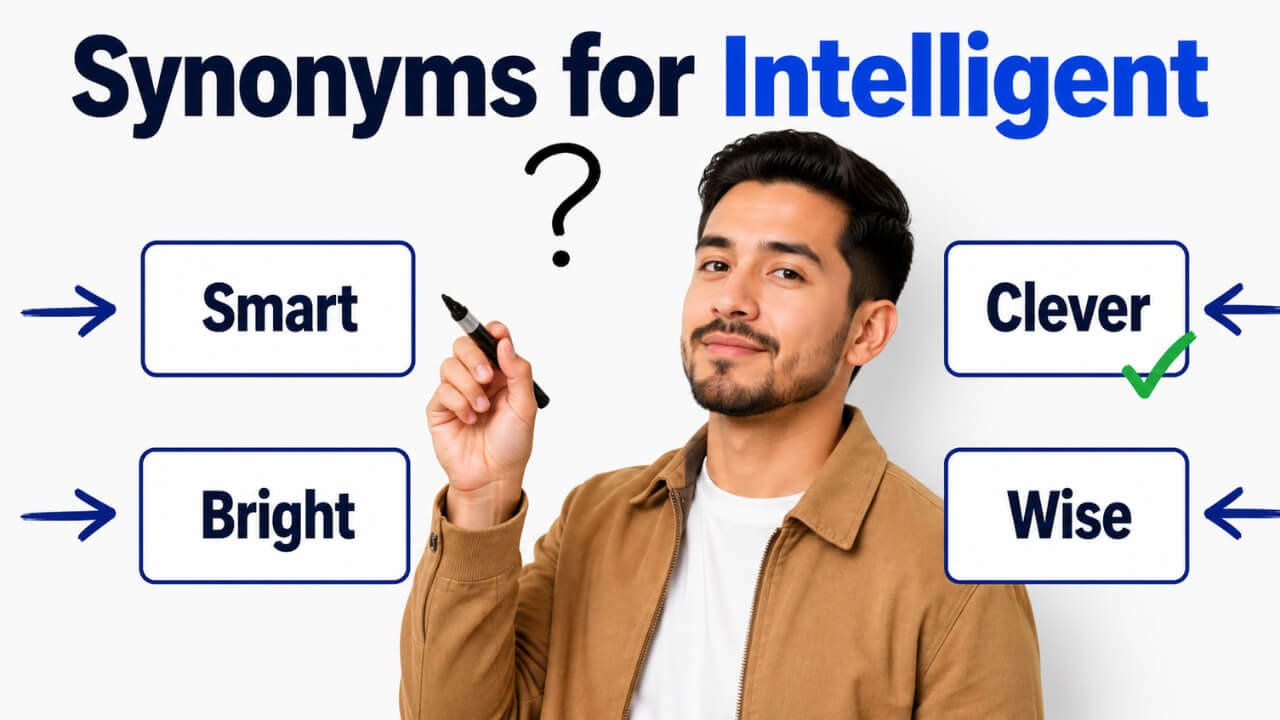
Quick Answer: Synonyms for intelligent include smart, clever, bright, brilliant, wise, knowledgeable, sharp, gifted, insightful, and perceptive. Use smart for general ability, clever for quick thinking, bright for natural learning, brilliant for exceptional ability, wise for good judgment, knowledgeable for expertise, and perceptive for understanding details, emotions, or deeper meaning.
Pronunciation and Word Details
Word: Intelligent
Pronunciation: /ɪnˈtelɪdʒənt/
Part of Speech: Adjective
Meaning: Intelligent means having strong mental ability, quick understanding, good reasoning, or sound judgment.
US Pronunciation:
UK Pronunciation:
What Does “Intelligent” Mean?
Intelligent means able to learn, understand, think clearly, solve problems, and make reasonable decisions. It is an adjective used for people, answers, ideas, actions, animals, systems, and choices that show mental ability or thoughtful judgment.
The word can describe natural ability, learned knowledge, logical thinking, emotional understanding, or careful decision making. An intelligent student learns quickly. An intelligent answer shows clear understanding. An intelligent decision is based on reason rather than guesswork.
Meaning, Tone, and Context of “Intelligent”
Intelligent has a positive, respectful, and mostly neutral tone. It is common in formal writing, academic writing, business communication, essays, reports, and everyday conversation. It sounds more polished than smart and less extreme than brilliant.
The word is often used when describing mental ability, problem solving, learning, analysis, judgment, and thoughtful behavior. In casual speech, smart, clever, or bright may sound more natural. In academic or professional contexts, analytical, knowledgeable, rational, or perceptive may be more exact.
When and How to Use “Intelligent”
For Mental Ability: Use intelligent when describing someone who understands ideas quickly and thinks clearly.
Example: She is an intelligent student who learns difficult concepts easily.
For Problem Solving: Use intelligent when someone finds a practical, thoughtful, or effective solution.
Example: His intelligent approach helped the team solve the issue.
For Good Judgment: Use intelligent when a choice is based on logic, evidence, or careful thought.
Example: It was an intelligent decision to review the details first.
For Clear Communication: Use intelligent when a reply, comment, or explanation shows understanding.
Example: The speaker gave an intelligent answer to a difficult question.
For Learning and Knowledge: Use intelligent when someone shows strong understanding through study or experience.
Example: The teacher gave an intelligent explanation of the grammar rule.
Best Synonyms for Intelligent
Smart: Having quick understanding or good mental ability.
Example: She is smart enough to solve the problem quickly.
Clever: Good at thinking quickly, especially in creative or practical ways.
Example: He found a clever way to explain the idea.
Bright: Naturally quick to learn and understand.
Example: The bright child asked thoughtful questions.
Brilliant: Extremely intelligent, impressive, or talented.
Example: Her brilliant idea improved the whole project.
Wise: Showing intelligence through judgment, patience, and experience.
Example: His wise advice helped everyone stay calm.
Knowledgeable: Having a lot of information or understanding about a subject.
Example: The guide was knowledgeable about history.
Sharp: Quick to notice, understand, and respond.
Example: Her sharp mind made her a strong editor.
Gifted: Naturally talented or highly intelligent.
Example: He is a gifted learner with excellent memory.
Insightful: Able to understand deeper meanings and hidden details.
Example: The essay gave an insightful view of the topic.
Perceptive: Good at noticing and understanding things quickly.
Example: A perceptive reader can identify the writer’s main purpose.
50 Synonyms for Intelligent with Short Meanings
- Smart: Quick to understand or learn.
- Clever: Good at practical or creative thinking.
- Bright: Naturally quick minded and able.
- Brilliant: Exceptionally intelligent or talented.
- Wise: Showing good judgment and experience.
- Sharp: Mentally quick and alert.
- Knowledgeable: Having strong subject understanding.
- Gifted: Naturally talented or mentally able.
- Insightful: Understanding deeper meanings clearly.
- Perceptive: Good at noticing hidden details.
- Astute: Able to judge situations accurately.
- Analytical: Skilled at examining information carefully.
- Rational: Guided by reason and logic.
- Logical: Thinking in a clear and ordered way.
- Thoughtful: Careful and reflective in thinking.
- Intellectual: Connected with deep thinking and learning.
- Educated: Having formal learning or knowledge.
- Learned: Very knowledgeable through study.
- Scholarly: Serious, academic, and well studied.
- Brainy: Informal word for very smart.
- Quick witted: Fast at thinking and replying.
- Resourceful: Good at finding useful solutions.
- Sensible: Showing practical and reasonable judgment.
- Judicious: Careful and wise in decisions.
- Discerning: Able to judge quality or difference well.
- Sophisticated: Showing advanced understanding or taste.
- Ingenious: Very clever and inventive.
- Inventive: Able to create original ideas.
- Creative: Good at producing new ideas.
- Talented: Having strong natural ability.
- Capable: Able to do things well.
- Competent: Skilled and able in a task.
- Skilled: Having ability through practice or training.
- Expert: Having deep skill or knowledge.
- Proficient: Able to do something well.
- Enlightened: Having broad and thoughtful understanding.
- Informed: Having useful knowledge about something.
- Reasonable: Thinking in a fair and sensible way.
- Clear headed: Calm and able to think clearly.
- Level headed: Sensible and calm in judgment.
- Strategic: Good at planning with purpose.
- Prudent: Careful and wise about future results.
- Observant: Good at noticing details.
- Alert: Mentally aware and ready to respond.
- Studious: Serious about learning and study.
- Academic: Related to study, learning, or education.
- Apt: Quick to learn or understand.
- Acute: Sharp in understanding or perception.
- Sagacious: Wise and able to judge well.
- Sapient: Wise, thoughtful, and deeply intelligent.
Read Also:
Synonyms for Leadership
Synonyms for Intelligent by Context
When Intelligent Means Smart
Smart is the best everyday synonym for intelligent. It works well when describing general mental ability, quick learning, or practical understanding.
Synonyms: Smart, bright, sharp, brainy, apt.
Example: She is a smart student who understands complex ideas quickly.
When Intelligent Means Wise
Wise is better when intelligence includes good judgment, life experience, calm thinking, or careful decision making.
Synonyms: Wise, sensible, prudent, judicious, sagacious.
Example: His wise response prevented a small problem from becoming serious.
When Intelligent Means Knowledgeable
Knowledgeable is best when the focus is on facts, education, study, expertise, or subject understanding.
Synonyms: Knowledgeable, educated, learned, scholarly, informed.
Example: The teacher is knowledgeable about grammar and word usage.
When Intelligent Means Clever
Clever works well when someone thinks quickly, solves problems creatively, or finds an original method.
Synonyms: Clever, ingenious, inventive, resourceful, creative.
Example: Her clever solution saved time and reduced confusion.
When Intelligent Means Perceptive
Perceptive is best when someone understands feelings, details, motives, or deeper meanings.
Synonyms: Perceptive, insightful, observant, discerning, acute.
Example: His perceptive comment revealed the real issue.
Another Word for Intelligent
Another word for intelligent is smart. It is the most common and flexible replacement because it works in casual speech, school writing, and general descriptions. However, the best alternative depends on context. Use brilliant for exceptional intelligence, wise for judgment, knowledgeable for learning, and perceptive for deep understanding.
Original: She gave an intelligent answer.
Better Option: She gave a smart answer.
Original: He made an intelligent choice.
Better Option: He made a wise choice.
Original: The article gives an intelligent explanation.
Better Option: The article gives an insightful explanation.
Original: The professor is very intelligent about language.
Better Option: The professor is very knowledgeable about language.
When Not to Use “Intelligent”
Do not use intelligent when a more specific word would express the meaning better. It can sound too general if you actually mean wise, clever, educated, logical, skilled, or knowledgeable. It may also sound repetitive when used many times in one paragraph.
Weak: The intelligent student made an intelligent point in an intelligent essay.
Better: The bright student made an insightful point in a thoughtful essay.
Weak: He is intelligent at fixing machines.
Better: He is skilled at fixing machines.
Weak: That was an intelligent joke.
Better: That was a clever joke.
Weak: She is intelligent about ancient history.
Better: She is knowledgeable about ancient history.
Words Commonly Confused With Intelligent
Intelligent vs Smart: Intelligent often sounds more formal, while smart is more common in everyday speech. Both can describe strong mental ability.
Intelligent vs Clever: Intelligent focuses on general mental ability, while clever often means quick, creative, or practical thinking.
Intelligent vs Wise: Intelligent means mentally able, while wise means able to make good judgments, often through experience.
Intelligent vs Knowledgeable: Intelligent describes thinking ability, while knowledgeable describes having information or learning about a subject.
Intelligent vs Brilliant: Intelligent means mentally strong, while brilliant means extremely intelligent, impressive, or outstanding.
Intelligent vs Perceptive: Intelligent refers to understanding and reasoning, while perceptive means good at noticing and interpreting details.
Which Synonym Should You Choose?
Choose smart when you need a simple, everyday synonym for general mental ability.
Choose clever when describing quick thinking, creative ideas, jokes, or practical solutions.
Choose bright when describing someone who learns quickly, especially a student or young person.
Choose brilliant when a person, idea, answer, or solution is exceptionally impressive.
Choose wise when intelligence is connected with judgment, patience, and experience.
Choose knowledgeable when talking about facts, study, expertise, or subject understanding.
Choose analytical when writing about careful examination, research, data, or reasoning.
Choose perceptive when someone notices details, emotions, motives, or hidden meaning.
Choose rational when the focus is logical thinking instead of emotion.
Choose resourceful when someone uses intelligence to solve problems with limited options.
Real Life Examples of “Intelligent” in Sentences
Original: She is an intelligent student.
Better Option: She is a bright student.
Original: He gave an intelligent answer during the interview.
Better Option: He gave a thoughtful answer during the interview.
Original: The manager made an intelligent decision.
Better Option: The manager made a wise decision.
Original: It was an intelligent way to solve the problem.
Better Option: It was a clever way to solve the problem.
Original: The report includes an intelligent analysis of the results.
Better Option: The report includes an analytical review of the results.
Original: She has an intelligent understanding of literature.
Better Option: She has an insightful understanding of literature.
Original: He is intelligent about world history.
Better Option: He is knowledgeable about world history.
Original: The team created an intelligent plan.
Better Option: The team created a strategic plan.
Original: Her intelligent reply impressed the audience.
Better Option: Her perceptive reply impressed the audience.
Original: The child is intelligent and curious.
Better Option: The child is bright and curious.
Synonym Groups and Usage Differences
General Intelligence Group
Smart, bright, sharp, and brainy describe general mental ability. These words are useful when you want a simple synonym for someone who learns quickly or understands ideas easily.
Example: The bright student understood the lesson before everyone else.
Wisdom and Judgment Group
Wise, sensible, prudent, judicious, and sagacious describe intelligence connected to good judgment. These words are best when decisions, advice, or life experience matter.
Example: Her wise advice helped the team avoid a mistake.
Knowledge and Learning Group
Knowledgeable, educated, learned, scholarly, and informed describe intelligence based on study, facts, or subject knowledge. These words work well in academic and professional writing.
Example: The speaker was knowledgeable about grammar and vocabulary.
Creative Thinking Group
Clever, ingenious, inventive, creative, and resourceful describe intelligence shown through original ideas or problem solving.
Example: His ingenious method made the process much easier.
Perception and Insight Group
Insightful, perceptive, observant, discerning, and acute describe the ability to notice details and understand deeper meaning.
Example: Her perceptive question changed the direction of the discussion.
Antonyms of Intelligent
Unintelligent: Lacking strong mental ability or understanding.
Foolish: Showing poor judgment or lack of sense.
Ignorant: Lacking knowledge or information about something.
Dull: Slow to understand or not mentally sharp.
Stupid: Rude or informal word for lacking sense or intelligence.
Unwise: Not showing good judgment.
Irrational: Not based on reason or logic.
Thoughtless: Acting without careful thinking.
Clueless: Not understanding what is happening.
Incompetent: Lacking the ability or skill to do something well.
Comparison: Intelligent vs Related Words
Intelligent vs Smart
Intelligent is slightly more formal and often sounds more respectful. Smart is more common in daily speech and works in many casual contexts.
Example With Intelligent: She is an intelligent researcher with strong reasoning skills.
Example With Smart: She is a smart person who solves problems quickly.
Intelligent vs Clever
Intelligent describes broad mental ability. Clever often describes quick, creative, or inventive thinking.
Example With Intelligent: He is intelligent enough to understand complex theories.
Example With Clever: He found a clever shortcut to finish the task.
Intelligent vs Wise
Intelligent focuses on learning, reasoning, and understanding. Wise focuses on good judgment, maturity, and experience.
Example With Intelligent: The intelligent student solved the equation quickly.
Example With Wise: The wise teacher gave calm and helpful advice.
Intelligent vs Knowledgeable
Intelligent means able to think and understand well. Knowledgeable means having a lot of information about a subject.
Example With Intelligent: She is intelligent and learns new topics quickly.
Example With Knowledgeable: She is knowledgeable about English grammar.
Intelligent vs Brilliant
Intelligent is strong but general. Brilliant is more powerful and describes exceptional talent, ability, or ideas.
Example With Intelligent: His intelligent answer impressed the class.
Example With Brilliant: His brilliant answer impressed the entire panel.
Common Phrases and Expressions With Intelligent
Intelligent Person: Someone with strong understanding or reasoning ability.
Intelligent Answer: A reply that shows clear thinking.
Intelligent Decision: A choice based on reason and judgment.
Intelligent Conversation: A thoughtful and meaningful discussion.
Intelligent Design: A carefully planned or well structured design.
Intelligent Question: A question that shows understanding and curiosity.
Intelligent Approach: A method based on logic and good planning.
Intelligent Choice: A sensible and well considered option.
Intelligent Analysis: Careful study of information using reason.
Intelligent Mind: A mind that understands, learns, and thinks deeply.
Common Mistakes to Avoid
A common mistake is using intelligent too often when more exact synonyms would improve the sentence. Smart, clever, wise, knowledgeable, and perceptive each express a different type of intelligence.
Another mistake is using intelligent for physical skill when skilled, talented, or capable would be more accurate. Say a skilled driver instead of an intelligent driver unless you are describing judgment, planning, or decision making.
Avoid confusing intelligence with education. A person can be intelligent without formal education, and a person can be educated without always making wise decisions. Also avoid choosing a synonym only because it sounds advanced. The best word is the one that fits the exact meaning.
Conclusion
Synonyms for intelligent help you describe mental ability with more accuracy and variety. Use smart for general ability, clever for quick problem solving, bright for natural learning, brilliant for exceptional talent, wise for good judgment, knowledgeable for subject expertise, and perceptive for deeper understanding. The right synonym depends on whether you mean learning, logic, creativity, wisdom, knowledge, or insight. Choosing carefully makes your writing clearer, stronger, and more natural.
FAQs About Synonyms for Intelligent
What is the best synonym for intelligent?
The best synonym for intelligent is smart because it is simple, natural, and widely used. In formal writing, knowledgeable, analytical, wise, or perceptive may be better depending on the meaning.
What is a formal synonym for intelligent?
A formal synonym for intelligent is intellectual, analytical, knowledgeable, or perceptive. These words work well in essays, reports, professional writing, and academic contexts.
What is a casual synonym for intelligent?
A casual synonym for intelligent is smart, clever, bright, or sharp. These words sound natural in everyday conversation.
Is clever the same as intelligent?
Clever and intelligent are similar, but they are not always the same. Clever often means quick, creative, or practical in thinking, while intelligent describes broader mental ability.
What is a stronger word than intelligent?
Brilliant is a stronger word than intelligent. It suggests exceptional ability, outstanding ideas, or unusually high mental skill.
Can wise be a synonym for intelligent?
Wise can be a synonym for intelligent when the meaning includes good judgment, experience, and careful decision making. It is not always the best choice for academic or technical ability.
What is the opposite of intelligent?
The opposite of intelligent can be unintelligent, foolish, ignorant, dull, irrational, or unwise. The best antonym depends on whether you mean lack of ability, knowledge, judgment, or logic.
