
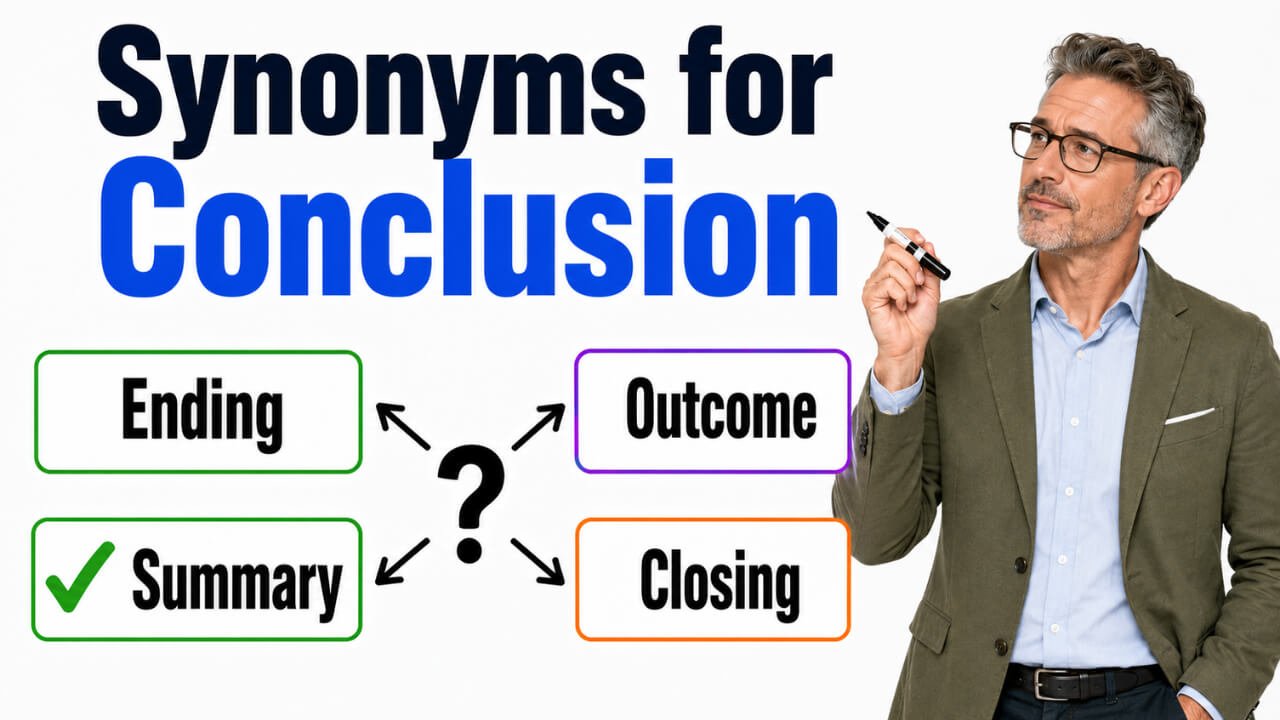
Quick Answer: Synonyms for conclusion include ending, close, finish, finale, summary, result, outcome, decision, inference, and verdict. Use ending or close when talking about the final part of writing, speech, or an event. Use summary when reviewing key ideas. Use result or outcome when showing what happened after an action. Use decision, verdict, or judgment when referring to a final opinion. Use inference when the conclusion comes from evidence or reasoning.
Pronunciation and Word Details
Word: Conclusion
Pronunciation: /kənˈkluːʒən/
Part of Speech: Noun
Meaning: A conclusion is the final part, result, decision, or judgment reached after thinking, discussing, or reviewing information.
US Pronunciation:
UK Pronunciation:
What Does “Conclusion” Mean?
A conclusion means the final part of something or the decision reached after thought, evidence, or discussion. It is a noun used in writing, speaking, reasoning, research, debates, reports, and daily conversation.
In an essay, a conclusion is the closing section that brings the main ideas together. In logic, a conclusion is an idea reached from evidence. In daily speech, it can mean a final decision or the result of a situation.
Example: The conclusion of the essay restated the main argument clearly.
Example: After reviewing the facts, the team reached a conclusion.
Example: The conclusion of the meeting was that more research was needed.
Meaning, Tone, and Context of “Conclusion”
The word conclusion is neutral, clear, and suitable for formal, academic, business, and everyday contexts. It does not sound overly emotional or casual. Because of this, it works well in essays, reports, presentations, research papers, discussions, and professional writing.
In academic writing, conclusion often means the final section of an essay or paper. In reasoning, it means an idea formed from facts. In business, it can mean a final decision, result, or outcome. In conversation, it can simply mean the end of something.
The tone depends on context. In essays, it sounds formal and organized. In speech, it sounds clear and direct. In legal or official contexts, it may suggest judgment, finding, or decision.
When and How to Use “Conclusion”
For Essay Endings: Use conclusion when referring to the final paragraph or final section of an essay, article, or speech.
Example: The conclusion should remind readers of the main point without repeating every detail.
For Final Decisions: Use conclusion when a person or group reaches a decision after discussion or thought.
Example: After a long debate, the committee reached a fair conclusion.
For Logical Reasoning: Use conclusion when an idea is based on evidence, facts, or clues.
Example: Her conclusion was supported by strong evidence.
For Results: Use conclusion when describing what something leads to or how something ends.
Example: The conclusion of the experiment showed that the method was effective.
For Formal Writing: Use conclusion in essays, reports, and research when you need a clear closing word.
Example: The conclusion connects the findings to the original question.
Best Synonyms for Conclusion
Ending: The final part of a story, article, event, or process.
Example: The ending of the speech left the audience thinking.
Close: The final section or final moment of something.
Example: The speaker gave a strong close to the presentation.
Finish: The point where something is completed.
Example: The finish of the project was delayed by one week.
Finale: The last and often dramatic part of a performance or event.
Example: The concert finale was unforgettable.
Summary: A short review of the most important points.
Example: The report ended with a helpful summary.
Result: What happens because of an action, event, or process.
Example: The result of the study changed their opinion.
Outcome: The final effect or consequence of a situation.
Example: The outcome of the discussion was positive.
Decision: A choice or judgment made after thinking.
Example: Their decision came after careful review.
Inference: A conclusion reached from evidence or reasoning.
Example: The detective made an inference from the clues.
Verdict: A final decision or judgment, often in legal or serious contexts.
Example: The verdict was announced after several hours.
50 Synonyms for Conclusion with Short Meanings
- Ending: The final part of something.
- Close: The final section or moment.
- Finish: The point where something is completed.
- End: The last point or final stage.
- Finale: The final part of an event or performance.
- Closing: The act or section that ends something.
- Closure: A sense of completion or final settlement.
- Completion: The state of being finished.
- Culmination: The highest or final point of development.
- Termination: The formal end of something.
- Resolution: A final answer, solution, or settlement.
- Summary: A short review of main points.
- Summation: A formal summary of ideas or evidence.
- Recap: A brief review of key points.
- Synopsis: A short overview of main ideas.
- Review: A look back at important details.
- Wrap up: A final summary or closing part.
- Final statement: The last clear point in writing or speech.
- Closing statement: A final message or argument.
- Final remark: A last comment before ending.
- Result: What happens because of something.
- Outcome: The final effect of a situation.
- Consequence: A result that follows an action.
- Effect: A change caused by something.
- End result: The final result after a process.
- Final outcome: The last result of an action or event.
- Upshot: The final result or main effect.
- Bottom line: The most important final point.
- Finding: A result discovered through study or review.
- Answer: A final response or solution.
- Solution: An answer to a problem.
- Decision: A final choice or judgment.
- Judgment: An opinion or decision after thought.
- Verdict: A final judgment or decision.
- Determination: A firm decision or official finding.
- Ruling: An official decision.
- Settlement: A final agreement or resolution.
- Consensus: A shared final opinion or agreement.
- Inference: An idea reached through evidence.
- Deduction: A conclusion reached by reasoning.
- Interpretation: An explanation based on understanding.
- Assessment: A considered judgment or evaluation.
- Opinion: A personal judgment or belief.
- Takeaway: The main point learned from something.
- Lesson: The useful point learned from an experience.
- Moral: The lesson or message of a story.
- Point: The main idea or purpose.
- Final thought: A last idea before closing.
- Epilogue: A closing section at the end of a story.
- Coda: A final part that completes a work or idea.
Read Also:
Synonyms for Thankful

Synonyms for Conclusion by Context
When Conclusion Means Ending
Use these synonyms when conclusion means the final part of an essay, speech, story, event, or process.
Ending: The final part of something.
Example: The ending of the article gave readers a clear final thought.
Close: A strong final section.
Example: The close of the speech was memorable.
Finish: The point where something is completed.
Example: The finish of the event felt smooth and well planned.
Finale: A dramatic or important final part.
Example: The finale of the show brought the story together.
When Conclusion Means Summary
Use these synonyms when conclusion means a short review of the main ideas.
Summary: A brief explanation of the main points.
Example: The summary helped readers remember the key argument.
Recap: A quick review of important details.
Example: The teacher gave a recap before ending the lesson.
Summation: A formal summary of evidence or ideas.
Example: The lawyer gave a careful summation of the case.
Synopsis: A short overview of the main content.
Example: The synopsis explained the report in simple language.
When Conclusion Means Result
Use these synonyms when conclusion means what happens at the end of a process, action, or situation.
Result: The effect produced by an action.
Example: The result of the test was surprising.
Outcome: The final effect of an event or decision.
Example: The outcome of the meeting was encouraging.
Consequence: A result that follows an action.
Example: The consequence of poor planning was delay.
Upshot: The final result or main effect.
Example: The upshot was that the plan needed more time.
When Conclusion Means Decision
Use these synonyms when conclusion means a final choice, answer, or judgment.
Decision: A choice made after thinking.
Example: The final decision was based on the evidence.
Judgment: An opinion formed after review.
Example: Her judgment was fair and balanced.
Verdict: A formal final decision.
Example: The verdict settled the matter.
Determination: A firm or official decision.
Example: The determination was announced after the review.
When Conclusion Means Inference
Use these synonyms when conclusion means an idea reached through evidence, clues, or reasoning.
Inference: An idea formed from available evidence.
Example: His inference matched the facts.
Deduction: A conclusion reached through logic.
Example: The deduction was based on several clues.
Interpretation: An explanation based on understanding.
Example: Her interpretation of the data was reasonable.
Finding: A conclusion discovered through research or review.
Example: The finding supported the original theory.
Another Word for Conclusion
Another word for conclusion is ending when you mean the final part of writing, speech, or an event. However, the best replacement depends on context. Use summary for a review of key ideas, outcome for a final result, decision for a final choice, and inference for a logical idea based on evidence.
Original: The conclusion of the essay was clear.
Better Option: The ending of the essay was clear.
Original: The conclusion of the meeting was unexpected.
Better Option: The outcome of the meeting was unexpected.
Original: We reached a conclusion after reviewing the facts.
Better Option: We reached a decision after reviewing the facts.
Original: Her conclusion came from the evidence.
Better Option: Her inference came from the evidence.
When Not to Use “Conclusion”
Do not use conclusion when another word gives a more exact meaning. In casual conversation, end or ending may sound more natural. In research, finding may be more precise. In reasoning, inference or deduction may be stronger. In business writing, outcome, decision, or result may sound clearer.
Weak: The conclusion of the party was fun.
Better: The ending of the party was fun.
Weak: The conclusion of the test was high.
Better: The result of the test was high.
Weak: The conclusion of the manager was final.
Better: The decision of the manager was final.
Weak: The conclusion from the clues was clever.
Better: The inference from the clues was clever.
Weak: The article used conclusion too many times in one paragraph.
Better: The article used ending, summary, and final thought to avoid repetition.
Words Commonly Confused With Conclusion
Conclusion vs Summary: A conclusion is the final part or final judgment. A summary is a short review of the main points. A conclusion may include a summary, but it should also give a final thought or closing idea.
Conclusion vs Ending: An ending is simply the final part. A conclusion often sounds more formal and may include final meaning, judgment, or reflection.
Conclusion vs Result: A result is what happens because of an action. A conclusion can be a result, but it can also be a final section or reasoned judgment.
Conclusion vs Outcome: An outcome is the final effect of a situation. A conclusion is broader and can mean an ending, decision, inference, or final paragraph.
Conclusion vs Inference: An inference is a logical idea formed from evidence. A conclusion may be an inference, but conclusion also means the final part of writing or speech.
Conclusion vs Decision: A decision is a choice made after thinking. A conclusion can be a decision, but it can also be the last part of a text or event.
Conclusion vs Verdict: A verdict is a formal judgment, often after a trial or serious review. A conclusion is more general and can be used in many contexts.
Which Synonym Should You Choose?
Choose ending when talking about the final part of a story, essay, article, or event.
Choose close when writing about a strong final section of a speech, message, or presentation.
Choose summary when you want to briefly repeat the main ideas.
Choose result when describing what happened because of an action.
Choose outcome when explaining the final effect of a situation or decision.
Choose decision when referring to a final choice made after discussion or thought.
Choose verdict when the context is legal, official, or strongly judgment based.
Choose inference when the idea is formed from evidence or clues.
Choose deduction when the conclusion comes from logical reasoning.
Choose takeaway when writing about the main lesson or final message.
Real Life Examples of “Conclusion” in Sentences
Original: The conclusion of the essay should connect to the introduction.
Better Option: The ending of the essay should connect to the introduction.
Original: The conclusion of the meeting was that the project needed more time.
Better Option: The outcome of the meeting was that the project needed more time.
Original: She reached the conclusion that the plan was too risky.
Better Option: She reached the decision that the plan was too risky.
Original: His conclusion was based on careful observation.
Better Option: His inference was based on careful observation.
Original: The conclusion of the report included the main findings.
Better Option: The summary of the report included the main findings.
Original: The conclusion of the story was emotional.
Better Option: The ending of the story was emotional.
Original: The conclusion of the research surprised the students.
Better Option: The finding of the research surprised the students.
Original: The conclusion of the discussion was clear.
Better Option: The decision from the discussion was clear.
Original: The conclusion of the performance received loud applause.
Better Option: The finale of the performance received loud applause.
Original: The conclusion from the evidence was simple.
Better Option: The deduction from the evidence was simple.
Synonym Groups and Usage Differences
Ending Group
Words in this group include ending, close, finish, finale, and closing. Use them when conclusion means the final part of something.
Example: The close of the speech was short but powerful.
Summary Group
Words in this group include summary, recap, summation, and synopsis. Use them when conclusion reviews main ideas.
Example: The summary reminded readers of the strongest points.
Result Group
Words in this group include result, outcome, consequence, effect, and upshot. Use them when conclusion means what happened after an action or event.
Example: The outcome of the interview was positive.
Decision Group
Words in this group include decision, judgment, verdict, determination, and ruling. Use them when conclusion means a final choice or official opinion.
Example: The final decision was made after careful discussion.
Reasoning Group
Words in this group include inference, deduction, interpretation, finding, and assessment. Use them when conclusion comes from facts, evidence, or logic.
Example: The inference was reasonable because the evidence was clear.
Lesson Group
Words in this group include takeaway, lesson, moral, point, and final thought. Use them when conclusion means the main message someone should remember.
Example: The main takeaway was that preparation matters.
Antonyms of Conclusion
The opposite of conclusion depends on its meaning. If conclusion means the final part, the opposite may be beginning or start. If it means a final decision, the opposite may be uncertainty or indecision. If it means a result, the opposite may be cause or origin.
Beginning: The first part of something.
Start: The point where something begins.
Opening: The first section of a speech, essay, or event.
Introduction: The first part that presents a topic.
Cause: The reason something happens.
Origin: The source or beginning of something.
Question: An issue that has not been answered.
Uncertainty: A state of not knowing.
Indecision: Difficulty making a final choice.
Doubt: Lack of confidence in an answer or result.
Comparison Between Conclusion and Related Words
Conclusion vs Ending
A conclusion can be the final section, final decision, or logical result. An ending usually means only the last part of something.
Example With Conclusion: The conclusion explained why the argument mattered.
Example With Ending: The ending of the movie was surprising.
Conclusion vs Summary
A conclusion closes the discussion and may give final meaning. A summary repeats the main points briefly.
Example With Conclusion: The conclusion gave readers a final lesson.
Example With Summary: The summary listed the main ideas from the chapter.
Conclusion vs Result
A conclusion may be a final thought or decision. A result is what happens after an action or process.
Example With Conclusion: The conclusion was based on strong evidence.
Example With Result: The result of the experiment was clear.
Conclusion vs Outcome
A conclusion can refer to a final section, decision, or inference. An outcome means the final effect of a situation.
Example With Conclusion: The conclusion of the report was easy to understand.
Example With Outcome: The outcome of the plan was successful.
Conclusion vs Inference
A conclusion is a broad word. An inference is specifically a thought formed from evidence or clues.
Example With Conclusion: Her conclusion was fair and logical.
Example With Inference: Her inference came from the witness statement.
Conclusion vs Verdict
A conclusion can be used in general writing and conversation. A verdict is a formal judgment, often in legal or serious situations.
Example With Conclusion: The conclusion of the discussion was accepted.
Example With Verdict: The verdict ended the trial.
Common Phrases and Expressions With Conclusion
In Conclusion: A phrase used to introduce final thoughts.
Reach a Conclusion: To arrive at a final decision or belief.
Draw a Conclusion: To form an idea based on evidence.
Come to a Conclusion: To decide something after thinking.
Logical Conclusion: A result that follows from reason or facts.
Final Conclusion: A final decision, although this phrase can sound repetitive.
Foregone Conclusion: A result that seems certain before it happens.
At the Conclusion: At the end of something.
Bring to a Conclusion: To finish or complete something.
Conclusion of the Matter: The final decision or final point about an issue.
Common Mistakes to Avoid
One common mistake is using conclusion when a simpler word sounds better. In everyday speech, end or ending often sounds more natural.
Weak: The conclusion of my walk was relaxing.
Better: The end of my walk was relaxing.
Another mistake is using conclusion for numbers, scores, or test data when result is more accurate.
Weak: The conclusion of the exam was 90 percent.
Better: The result of the exam was 90 percent.
A third mistake is repeating conclusion too often in essays. Use related words like summary, final thought, closing section, or takeaway when the meaning fits.
Weak: The conclusion of the conclusion gives a conclusion about the topic.
Better: The final paragraph gives a clear takeaway about the topic.
Another mistake is confusing conclusion with summary. A summary repeats key points. A conclusion closes the discussion and explains the final meaning.
Weak: My conclusion only lists every point again.
Better: My conclusion briefly reviews the main idea and gives a final thought.
Writers also sometimes choose a synonym that is too formal or too casual. Verdict sounds serious and official. Wrap up sounds conversational. Inference sounds logical and evidence based.
Weak: The wrap up of the research paper was accepted by the professor.
Better: The conclusion of the research paper was accepted by the professor.
Conclusion
Learning synonyms for conclusion helps you choose clearer words for essays, reports, speeches, discussions, and everyday writing. Use ending, close, or finish for the final part. Use summary, recap, or summation for reviewing key ideas. Use result or outcome for effects. Use decision, verdict, or judgment for final choices. Use inference or deduction when the idea comes from evidence. The best synonym depends on what you want to express.
FAQs About Synonyms for Conclusion
What is the best synonym for conclusion?
The best synonym for conclusion is ending when you mean the final part. For a final decision, use decision. For a final result, use outcome or result.
What is another word for conclusion in an essay?
Another word for conclusion in an essay is ending, closing section, final paragraph, or summary. Use final thought when you want a softer, more reflective phrase.
What is a formal synonym for conclusion?
Formal synonyms for conclusion include determination, judgment, finding, inference, summation, and resolution. These work well in reports, research, and professional writing.
What is a simple synonym for conclusion?
A simple synonym for conclusion is end or ending. These words are clear, natural, and easy to understand in daily speech.
Is summary the same as conclusion?
A summary is not exactly the same as a conclusion. A summary repeats the main points. A conclusion closes the topic and often gives the final meaning, result, or judgment.
Can I use outcome instead of conclusion?
You can use outcome instead of conclusion when talking about the final result of a situation, meeting, plan, or action. Do not use outcome for the final paragraph of an essay.
What is a better phrase than in conclusion?
Better phrases than in conclusion include to summarize, overall, to close, the main takeaway is, and as a final thought. Choose the phrase that matches the tone of your writing
