
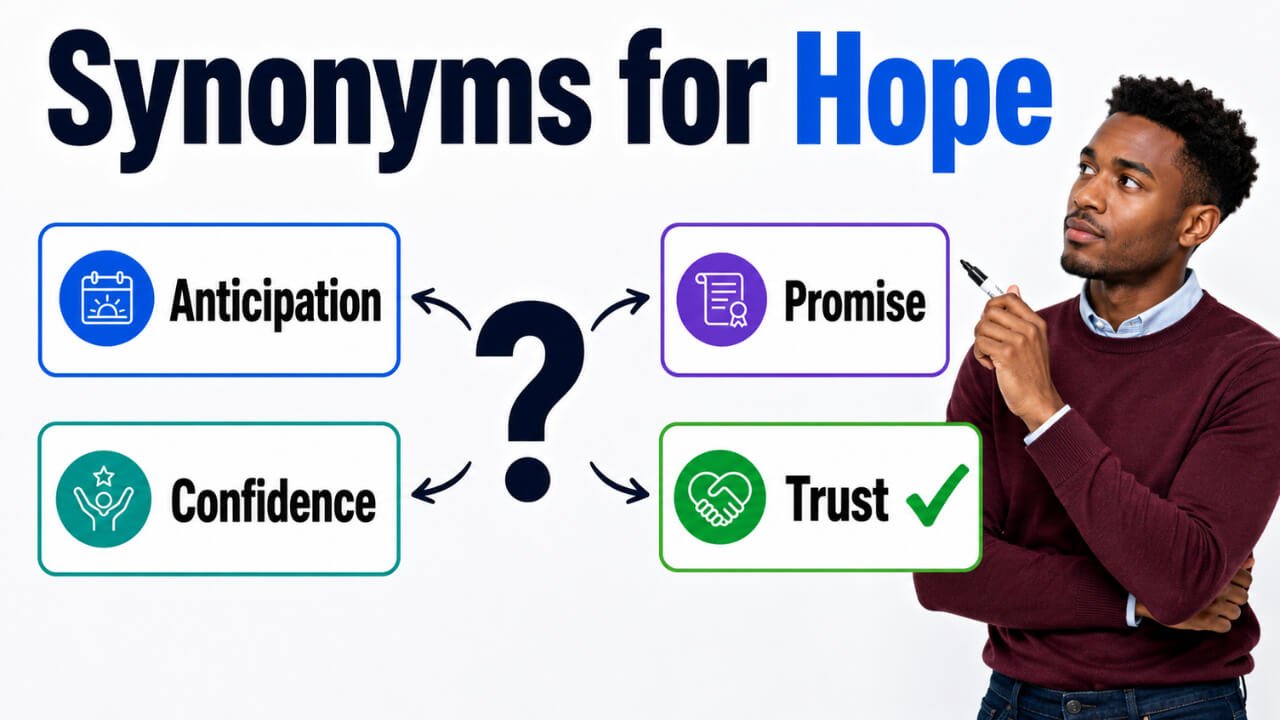
Quick Answer: The best synonyms for hope include optimism, expectation, aspiration, wish, desire, confidence, faith, trust, encouragement, and possibility. Use optimism when you mean a positive attitude, expectation when something is likely to happen, aspiration for a strong goal, wish for a personal desire, confidence for strong belief, and faith when hope includes trust despite uncertainty.
Pronunciation and Word Details
Word: Hope.
Pronunciation: /hoʊp/.
Part of Speech: Noun and verb.
Meaning: Hope means a positive feeling, desire, or belief that something good may happen.
US Pronunciation:
UK Pronunciation:
What Does “Hope” Mean?
Hope means a feeling of wanting something good to happen and believing that it is possible. It can work as a noun when it names the feeling itself, and as a verb when it describes the act of wanting or expecting a good result.
As a noun, hope can mean optimism, possibility, desire, or a source of encouragement. For example, “She has hope for the future” means she believes better days may come.
As a verb, hope means to want something to happen. For example, “I hope you feel better soon” means the speaker wants a good outcome for someone.
Hope is often used in emotional, personal, formal, inspirational, and everyday contexts.
Meaning, Tone, and Context of “Hope”
Hope has a positive, warm, and encouraging tone. It is usually neutral enough for formal writing but emotional enough for personal messages.
In conversation, hope often sounds caring and polite. In essays, speeches, and thoughtful writing, it can express belief, future possibility, motivation, and resilience.
Hope can also be gentle or strong depending on the sentence. “I hope it works” sounds casual and mild. “Hope kept them moving forward” sounds deeper and more emotional.
It is commonly used in contexts involving goals, recovery, success, comfort, future plans, encouragement, dreams, hardship, belief, and possibility.
When and How to Use “Hope”
For Positive Expectation: Use hope when you want to express that something good may happen.
Example: I hope the meeting goes well.
For Encouragement: Use hope when giving comfort or support to someone.
Example: Her kind words gave him hope during a difficult week.
For Personal Desire: Use hope when talking about something you want in the future.
Example: We hope to visit the mountains this year.
For Emotional Strength: Use hope when describing inner courage during uncertainty.
Example: Hope helped the family stay strong through the challenge.
For Future Possibility: Use hope when something is not certain but still possible.
Example: There is hope that the situation will improve soon.
For Polite Communication: Use hope when starting kind, respectful, or thoughtful sentences.
Example: I hope you are doing well.
Best Synonyms for Hope
Optimism: A positive belief that good things can happen.
Example: Her optimism helped everyone stay calm.
Expectation: A belief that something is likely to happen.
Example: There was an expectation that the results would improve.
Aspiration: A strong goal, dream, or ambition for the future.
Example: His aspiration was to become a skilled writer.
Wish: A desire for something to happen.
Example: Her wish was to see her family happy.
Desire: A strong feeling of wanting something.
Example: He had a deep desire to succeed.
Confidence: Strong belief in a good result or ability.
Example: She had confidence that the plan would work.
Faith: Trust or belief even when the result is uncertain.
Example: They kept faith that things would get better.
Trust: A belief that someone or something will be reliable.
Example: His trust in the process gave him peace.
Encouragement: Support that gives someone hope or confidence.
Example: Her encouragement made him try again.
Possibility: A chance that something may happen.
Example: The new treatment offered a possibility of recovery.
50 Synonyms for Hope with Short Meanings
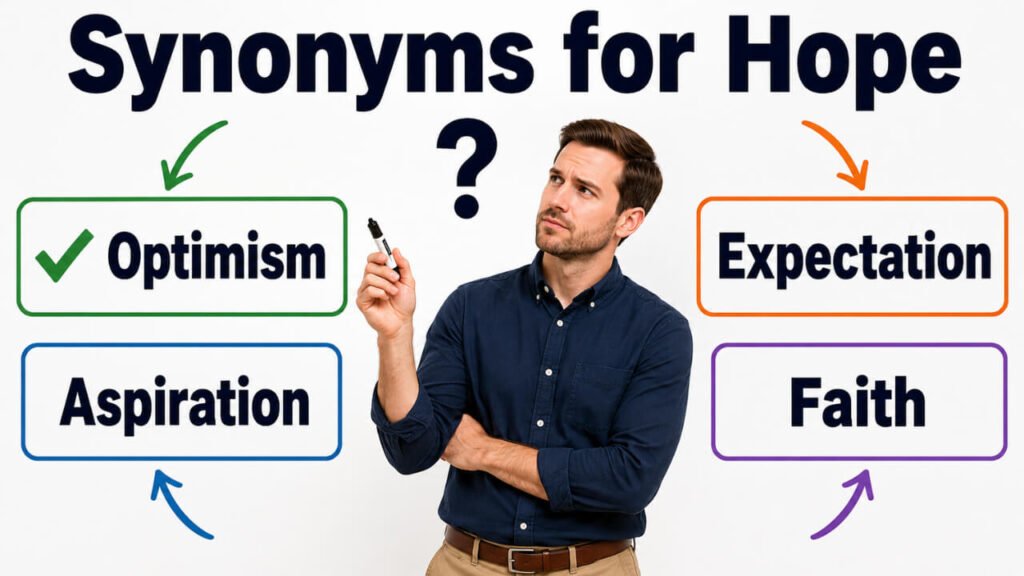
- Optimism: Positive belief about the future.
- Expectation: Belief that something may happen.
- Aspiration: Strong future goal or ambition.
- Wish: Personal desire for something.
- Desire: Strong feeling of wanting.
- Confidence: Firm belief in a good result.
- Faith: Trust despite uncertainty.
- Trust: Belief in reliability or outcome.
- Encouragement: Support that lifts confidence.
- Possibility: Chance of a good result.
- Promise: Sign of future success.
- Prospect: Chance or expected opportunity.
- Dream: Deep personal goal or desire.
- Aim: Purpose or intended result.
- Ambition: Strong drive to achieve.
- Goal: Desired final result.
- Expectation: Anticipated outcome or belief.
- Longing: Deep emotional desire.
- Yearning: Strong wish for something.
- Anticipation: Looking forward to something.
- Assurance: Confidence or certainty.
- Belief: Acceptance that something is true or possible.
- Reliance: Dependence on someone or something.
- Conviction: Strong belief or certainty.
- Positivity: Positive state of mind.
- Brightness: Cheerful sense of future good.
- Comfort: Emotional support or relief.
- Solace: Comfort during sadness or difficulty.
- Reassurance: Words or signs that reduce worry.
- Inspiration: Feeling that motivates hope or action.
- Motivation: Inner drive to continue.
- Support: Help that encourages strength.
- Relief: Feeling that worry may end.
- Chance: Possibility of success or improvement.
- Opportunity: Favorable chance for progress.
- Potential: Ability or possibility for growth.
- Opening: Chance for a better result.
- Light: Symbol of hope or guidance.
- Silver lining: Positive side of a difficult situation.
- Encouraging sign: Indication of possible improvement.
- Expectation of success: Belief that success may come.
- Positive outlook: Hopeful way of seeing life.
- Future belief: Trust in a better future.
- Good prospect: Likely positive possibility.
- Inner strength: Emotional power to continue.
- Resilience: Ability to keep going through difficulty.
- Determination: Firm decision to continue.
- Patience: Calm waiting with belief.
- Cheer: Hopeful emotional lift.
- Confidence in tomorrow: Belief that the future can improve.
Read Also:
Synonyms for Group

Synonyms for Hope by Context
When Hope Means Optimism
Use these synonyms when hope means a positive attitude about the future.
Optimism: She faced the problem with optimism.
Positivity: His positivity made the team feel stronger.
Positive Outlook: A positive outlook helped her keep moving forward.
Brightness: There was brightness in her voice after the good news.
When Hope Means Desire
Use these synonyms when hope means wanting something to happen.
Wish: I have a wish for peace and happiness.
Desire: His desire to improve was clear.
Longing: She felt a longing for home.
Yearning: His yearning for success kept him focused.
When Hope Means Expectation
Use these synonyms when hope means believing something may happen.
Expectation: There is an expectation of better results.
Prospect: The project has a strong prospect of success.
Possibility: There is a possibility that the plan will work.
Chance: They still have a chance to win.
When Hope Means Trust
Use these synonyms when hope means belief, confidence, or reliance.
Faith: She kept faith during uncertain times.
Confidence: He had confidence in the decision.
Trust: Their trust in each other gave them hope.
Assurance: His calm voice gave her assurance.
When Hope Means Encouragement
Use these synonyms when hope means emotional support.
Encouragement: Her encouragement helped him continue.
Comfort: The message brought comfort to the family.
Reassurance: His words offered reassurance.
Solace: The memory gave her solace.
Another Word for Hope
Another word for hope is optimism when you mean a positive belief about the future. However, the best single replacement depends on context. Use wish for personal desire, expectation for a likely result, faith for trust, and aspiration for a future goal.
Original: She still had hope after the setback.
Better Option: She still had optimism after the setback.
Original: His hope was to become a doctor.
Better Option: His aspiration was to become a doctor.
Original: I hope the answer is correct.
Better Option: I expect the answer is correct.
Original: Their hope helped them stay calm.
Better Option: Their faith helped them stay calm.
When Not to Use “Hope”
Do not use hope when a more exact word would make the meaning clearer. Hope can sound weak if you need certainty, proof, or a strong professional statement.
It can also feel repetitive if used many times in the same paragraph. In formal reports, expectation, confidence, prospect, or possibility may sound more precise.
Weak: I hope the data is accurate.
Better: I expect the data is accurate.
Weak: The company has hope for growth.
Better: The company has strong prospects for growth.
Weak: She has hope to become a leader.
Better: She has an aspiration to become a leader.
Weak: There is hope that the answer is true.
Better: There is evidence that the answer is true.
Weak: I hope the results show improvement, and I hope the plan works.
Better: I expect the results to show improvement, and I am confident the plan will work.
Words Commonly Confused With Hope
Hope vs Wish: Hope usually includes some belief that a good result is possible, while wish may express desire without strong expectation.
Hope vs Expectation: Hope means wanting a good result, while expectation means believing something is likely to happen.
Hope vs Optimism: Hope can refer to a specific desired result, while optimism is a general positive attitude.
Hope vs Faith: Hope focuses on a desired future outcome, while faith means deep trust or belief even without full proof.
Hope vs Confidence: Hope can include uncertainty, while confidence is stronger and suggests greater belief in success.
Hope vs Aspiration: Hope can be emotional or general, while aspiration means a strong personal goal or ambition.
Hope vs Possibility: Hope is a feeling or belief, while possibility is a chance that something may happen.
Which Synonym Should You Choose?
Choose optimism when writing about a positive attitude or hopeful mindset.
Choose expectation when something is likely to happen or when the sentence needs more certainty.
Choose aspiration when writing about goals, dreams, education, career, or personal growth.
Choose wish when the meaning is a personal desire or kind thought.
Choose desire when the feeling of wanting something is strong.
Choose confidence when you want to show firm belief in success.
Choose faith when the sentence involves trust during uncertainty.
Choose possibility when you want to focus on chance rather than emotion.
Choose encouragement when hope comes from support, kind words, or motivation.
Choose prospect when writing in formal, academic, business, or analytical contexts.
Real Life Examples of “Hope” in Sentences
Original: I hope the weather improves by tomorrow.
Better Option: I expect the weather to improve by tomorrow.
Original: She never lost hope during the illness.
Better Option: She never lost faith during the illness.
Original: His hope is to study abroad next year.
Better Option: His aspiration is to study abroad next year.
Original: The team has hope after the recent victory.
Better Option: The team has renewed confidence after the recent victory.
Original: There is hope that the problem can be solved.
Better Option: There is a possibility that the problem can be solved.
Original: Her speech gave people hope.
Better Option: Her speech gave people encouragement.
Original: We hope to finish the project soon.
Better Option: We aim to finish the project soon.
Original: The new evidence gave them hope.
Better Option: The new evidence gave them reassurance.
Original: He looked at the future with hope.
Better Option: He looked at the future with optimism.
Original: Their hope for peace remained strong.
Better Option: Their desire for peace remained strong.
Synonym Groups and Usage Differences
Optimism Group
The optimism group includes words that describe a positive mindset. These words are useful when hope refers to attitude, confidence, and emotional brightness.
Example: Her optimism helped her face the challenge with courage.
Desire Group
The desire group includes words that focus on wanting something. Use these when hope is more about a personal wish, goal, or emotional need.
Example: His desire for a better life guided his choices.
Expectation Group
The expectation group works when hope is connected to a likely future result. These words sound clearer in formal writing and planning.
Example: There is an expectation that the new method will improve results.
Trust Group
The trust group includes words like faith, confidence, assurance, and reliance. Use them when hope depends on belief in someone, something, or a process.
Example: Her faith in the plan kept everyone calm.
Encouragement Group
The encouragement group is useful when hope comes from support, comfort, or motivation. These words often appear in emotional or personal writing.
Example: His kind words gave her encouragement when she needed it most.
Possibility Group
The possibility group focuses on chance, opportunity, and potential. Use it when hope means that something may still happen.
Example: The new opening created a possibility for progress.
Antonyms of Hope
The opposite of hope depends on the meaning. If hope means optimism, the antonym may be pessimism. If hope means expectation, the antonym may be doubt. If hope means emotional strength, the antonym may be despair.
Despair: Complete loss of hope.
Pessimism: Belief that bad things are likely to happen.
Doubt: Lack of belief or confidence.
Hopelessness: Feeling that improvement is impossible.
Discouragement: Loss of confidence or motivation.
Fear: Worry about a bad result.
Distrust: Lack of belief in someone or something.
Uncertainty: Lack of clear belief about an outcome.
Disbelief: Refusal or inability to believe something.
Gloom: Sad or negative feeling about the future.
Comparison: Hope vs Related Words
Hope vs Optimism
Hope is often about a specific thing you want to happen. Optimism is a broader positive attitude toward life or the future.
Example With Hope: I hope the interview goes well.
Example With Optimism: Her optimism made her believe better opportunities were coming.
Hope vs Wish
Hope usually suggests that the desired result is possible. Wish can describe a desire that may be unlikely or imaginary.
Example With Hope: I hope you recover soon.
Example With Wish: I wish I could travel the world tomorrow.
Hope vs Expectation
Hope includes desire and possibility. Expectation suggests that something is likely to happen.
Example With Hope: I hope the results improve.
Example With Expectation: I expect the results to improve.
Hope vs Faith
Hope looks toward a desired future outcome. Faith suggests deeper trust or belief, especially when proof is limited.
Example With Hope: They had hope for better days.
Example With Faith: They had faith that better days would come.
Hope vs Confidence
Hope can include uncertainty. Confidence is stronger and shows firmer belief in success.
Example With Hope: I hope I can pass the test.
Example With Confidence: I am confident I can pass the test.
Hope vs Aspiration
Hope can be a general feeling or desire. Aspiration is usually a serious goal or ambition.
Example With Hope: Her hope was to help others.
Example With Aspiration: Her aspiration was to become a teacher.
Common Phrases and Expressions With Hope
Hope for the Best: To expect or want the best possible result.
Lose Hope: To stop believing that something good can happen.
Keep Hope Alive: To continue believing in a positive outcome.
Ray of Hope: A small sign that things may improve.
Full of Hope: Feeling positive about the future.
Hope Against Hope: To keep hoping even when success seems unlikely.
Source of Hope: A person, idea, or sign that gives encouragement.
High Hopes: Strong expectations or positive feelings about success.
Hopeful Sign: Something that suggests a good result may come.
Hope and Confidence: Positive belief combined with trust in success.
Common Mistakes to Avoid
Avoid using hope when the sentence needs certainty. In factual writing, words like expect, confirm, show, or indicate may be more accurate.
Do not repeat hope too often in one paragraph. Repetition can make writing sound simple or weak. Replace some uses with optimism, confidence, possibility, faith, or aspiration.
Avoid confusing hope with wish. A wish can be unrealistic, but hope usually suggests some possibility.
Avoid using hope when you mean a clear plan. For example, “I hope to submit it tomorrow” is softer than “I plan to submit it tomorrow.”
Avoid choosing an overly emotional synonym in formal writing. In reports or essays, prospect, expectation, possibility, and confidence often sound more precise.
Conclusion
The best synonyms for hope depend on meaning and context. Use optimism for a positive outlook, expectation for a likely result, aspiration for a goal, wish for personal desire, confidence for strong belief, and faith for trust during uncertainty. Hope is a useful word because it can express emotion, possibility, encouragement, and future belief. Choosing the right synonym helps your writing sound clearer, stronger, and more natural.
FAQs About Synonyms for Hope
What is the best synonym for hope?
The best synonym for hope is optimism when you mean a positive belief about the future. For goals, aspiration is often better.
What is another word for hope in formal writing?
In formal writing, good alternatives include expectation, prospect, possibility, confidence, and aspiration.
What is a stronger word than hope?
A stronger word than hope is confidence when you believe success is likely. Faith can also be stronger when trust is involved.
What is a synonym for hope in a personal message?
Good personal synonyms include wish, comfort, encouragement, faith, and support, depending on the sentence.
Is hope the same as wish?
No. Hope usually means you want something good to happen and believe it is possible. Wish can express desire even when the result is unlikely.
What is the opposite of hope?
Common opposites of hope include despair, hopelessness, pessimism, doubt, and discouragement.
Can hope be used as both a noun and a verb?
Yes. Hope is a noun in “She has hope,” and a verb in “I hope you succeed.”
