
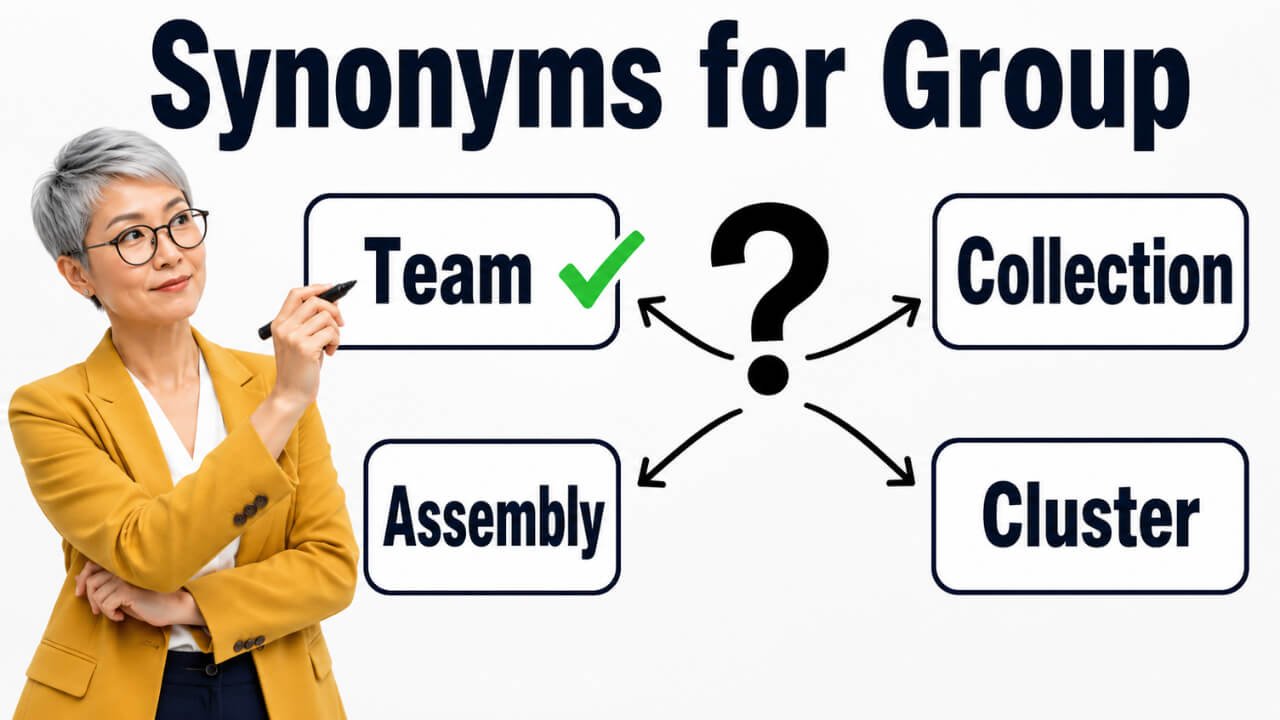
Quick Answer: The best synonyms for group include team, collection, set, cluster, category, class, assembly, gathering, crowd, and circle. Use team for people working together, collection for things kept or placed together, set for related items, cluster for things close together, category for classification, and gathering for people meeting in one place.
Pronunciation and Word Details
Word: Group.
Pronunciation: /ɡruːp/.
Part of Speech: Noun and verb.
Meaning: Group means a number of people, things, or ideas considered together because they share a connection.
US Pronunciation:
UK Pronunciation:
What Does “Group” Mean?
Group means a number of people, objects, animals, ideas, or items that are considered together. It can refer to a team, collection, category, gathering, class, or cluster.
As a noun, group names people or things together. For example, “a group of students” means several students considered as one unit.
As a verb, group means to arrange, classify, or place things together. For example, “Group the words by meaning” means organize the words into connected sets.
The word group is common in everyday speech, school writing, grammar explanations, research, business writing, planning, and descriptions.
Meaning, Tone, and Context of “Group”
Group has a neutral and flexible tone. It is neither too formal nor too casual, which makes it useful in many types of writing.
In conversation, group can describe friends, students, workers, animals, or objects. In academic or technical writing, group can describe categories, classes, data sets, research participants, or classifications.
The word can also change meaning based on context. A group of people may be a team, crowd, committee, or gathering. A group of items may be a collection, set, batch, or cluster. A group based on shared traits may be a category, class, or type.
When and How to Use “Group”
For People Together: Use group when several people are connected by place, purpose, interest, or action.
Example: A group of students waited outside the classroom.
For Things Together: Use group when several objects or items are placed or viewed together.
Example: She arranged a group of books on the table.
For Classification: Use group when people, words, ideas, or items are sorted by shared features.
Example: The teacher asked us to group the words by meaning.
For Teamwork: Use group when people work together on a shared task.
Example: Our group completed the project before the deadline.
For Social Setting: Use group when people meet, gather, or spend time together.
Example: A small group came to discuss the plan.
For Data or Research: Use group when people or results are divided for study, comparison, or analysis.
Example: The results were different in each group.
Best Synonyms for Group
Team: A number of people working together for a shared goal.
Example: The team finished the assignment on time.
Collection: A number of things gathered or kept together.
Example: Her collection of poems was beautifully arranged.
Set: A number of related things considered together.
Example: The teacher gave us a set of grammar exercises.
Cluster: A small group of things close together.
Example: A cluster of stars appeared in the night sky.
Category: A group based on shared qualities or type.
Example: Place each word in the correct category.
Class: A group of people or things with similar features.
Example: These animals belong to the same class.
Assembly: A group of people gathered for a purpose.
Example: The assembly listened carefully to the speaker.
Gathering: A group of people meeting in one place.
Example: The gathering was calm and friendly.
Crowd: A large group of people in one area.
Example: A crowd stood near the entrance.
Circle: A group of people connected by friendship, interest, or trust.
Example: She shared the news with her close circle.
50 Synonyms for Group with Short Meanings
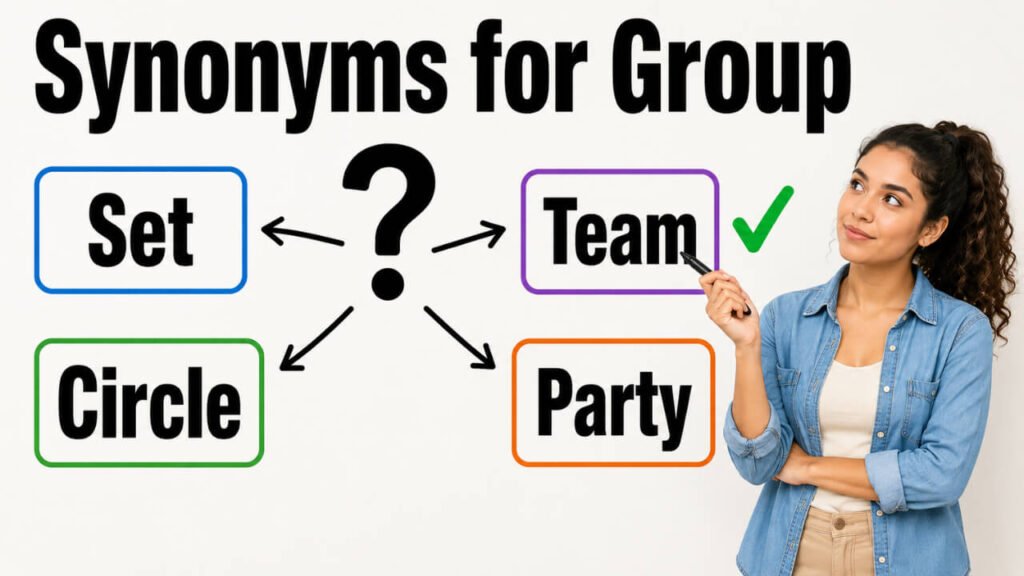
- Team: People working together.
- Collection: Things gathered together.
- Set: Related items considered together.
- Cluster: Things close together.
- Category: Group based on shared type.
- Class: Group with similar features.
- Assembly: People gathered for a purpose.
- Gathering: People meeting in one place.
- Crowd: Large number of people together.
- Circle: Connected group of people.
- Batch: Items handled or produced together.
- Series: Things arranged in order.
- Array: Ordered or impressive group.
- Assortment: Mixed collection of different things.
- Range: Group showing variety.
- Bundle: Items tied or kept together.
- Pack: Group of animals, people, or items.
- Flock: Group of birds, animals, or people.
- Herd: Group of animals moving together.
- Swarm: Large moving group of insects or people.
- Troop: Organized group, often people or animals.
- Band: Group joined by purpose or activity.
- Crew: People working together on a task.
- Squad: Small organized team.
- Unit: Group acting as one part.
- Division: Section of a larger group.
- Section: Smaller part of a larger whole.
- Department: Organized group within a larger body.
- Committee: Group chosen to discuss or decide.
- Panel: Group selected to give opinions or judge.
- Board: Group responsible for decisions.
- Council: Group chosen to advise or govern.
- Party: Group involved in an activity or event.
- Delegation: Group representing others.
- Alliance: Groups or people joined for a purpose.
- Association: Organized group with shared interests.
- Organization: Structured group with a purpose.
- Community: People connected by place or interest.
- Network: Connected group of people or things.
- Circle: Group linked by relationship or interest.
- Clique: Small close group, often exclusive.
- Faction: Group within a larger body with its own views.
- Coalition: Groups joined for a shared goal.
- Congregation: Group gathered for a shared purpose.
- Audience: Group watching or listening.
- Participants: People taking part in something.
- Membership: People belonging to an organization.
- Population: Group of people, animals, or cases being studied.
- Sample: Smaller group used for study or testing.
- Classification: Organized grouping by type or feature.
Read Also:
Synonyms for Hope

Synonyms for Group by Context
When Group Means People Together
Use these synonyms when group refers to people in one place, activity, or situation.
Team: The team prepared a clear presentation.
Gathering: The gathering became larger by evening.
Crowd: A crowd formed near the stage.
Audience: The audience listened with interest.
Assembly: The assembly discussed the new rules.
When Group Means Things Together
Use these synonyms when group refers to objects, items, or things placed together.
Collection: She kept a collection of old letters.
Set: We bought a set of matching cups.
Batch: The bakery prepared a fresh batch of bread.
Bundle: He carried a bundle of papers.
Assortment: The box contained an assortment of tools.
When Group Means Category
Use these synonyms when group means a type, class, or division based on shared features.
Category: Put each phrase in the correct category.
Class: These words belong to the same class.
Type: The chart shows each type of noun.
Section: Read the first section carefully.
Classification: The classification depends on meaning and use.
When Group Means Teamwork
Use these synonyms when group means people working together.
Team: Our team solved the problem quickly.
Crew: The crew repaired the road before sunset.
Squad: The squad followed the instructions.
Unit: The unit worked as one strong system.
Committee: The committee reviewed the proposal.
When Group Means Animals Together
Use these synonyms when group refers to animals or living creatures.
Flock: A flock of birds flew across the sky.
Herd: A herd of cattle moved through the field.
Pack: A pack of wolves traveled together.
Swarm: A swarm of bees gathered near the tree.
Troop: A troop of monkeys climbed through the branches.
Another Word for Group
Another word for group is team when you mean people working together. However, the best alternative depends on context. Use collection for things, category for classification, cluster for things close together, and gathering for people meeting in one place.
Original: A group of workers completed the task.
Better Option: A team of workers completed the task.
Original: She owns a group of rare coins.
Better Option: She owns a collection of rare coins.
Original: Place each word in the right group.
Better Option: Place each word in the right category.
Original: A group of stars appeared above the hill.
Better Option: A cluster of stars appeared above the hill.
When Not to Use “Group”
Do not use group when a more specific word would make the sentence clearer. Group is useful, but it can sound vague if the reader needs to know whether you mean a team, collection, crowd, category, or committee.
In formal writing, words like category, classification, sample, population, or section may be more precise. In everyday writing, team, crowd, set, or collection may sound more natural.
Weak: The group of data was reviewed.
Better: The data set was reviewed.
Weak: A group of people made the decision.
Better: A committee made the decision.
Weak: She bought a group of plates.
Better: She bought a set of plates.
Weak: A group of birds flew over the lake.
Better: A flock of birds flew over the lake.
Weak: The words are in the same group.
Better: The words are in the same category.
Words Commonly Confused With Group
Group vs Team: Group means people or things together, while team usually means people working toward the same goal.
Group vs Crowd: Group can be small or organized, while crowd usually means many people gathered in one place.
Group vs Collection: Group can refer to people, things, or ideas, while collection usually refers to things gathered or kept together.
Group vs Set: Group is general, while set often means related items that belong together.
Group vs Category: Group can be any number of things together, while category means a group based on shared qualities.
Group vs Class: Class often means a formal category, school group, or level, while group is broader.
Group vs Cluster: Group is general, while cluster means things close together in a small area.
Group vs Assembly: Group can be informal, while assembly usually means people gathered for a specific purpose.
Which Synonym Should You Choose?
Choose team when writing about people working together on a task, project, or goal.
Choose collection when writing about objects gathered, saved, or displayed together.
Choose set when the items are related and belong together.
Choose cluster when things are close together in space.
Choose category when sorting words, ideas, people, or things by shared features.
Choose class when writing about formal types, levels, grammar, education, or scientific grouping.
Choose gathering when people meet in one place.
Choose crowd when many people are together in a public place.
Choose committee when people are chosen to discuss, review, or decide something.
Choose sample or population when writing about research, surveys, data, or study results.
Real Life Examples of “Group” in Sentences
Original: The group worked on the science project.
Better Option: The team worked on the science project.
Original: She showed us a group of old photographs.
Better Option: She showed us a collection of old photographs.
Original: A group of birds sat on the roof.
Better Option: A flock of birds sat on the roof.
Original: Put each word into the correct group.
Better Option: Put each word into the correct category.
Original: A large group waited outside the hall.
Better Option: A large crowd waited outside the hall.
Original: We studied a group of results from the survey.
Better Option: We studied a sample of results from the survey.
Original: The group met to discuss the new plan.
Better Option: The committee met to discuss the new plan.
Original: A small group of stars was visible.
Better Option: A small cluster of stars was visible.
Original: He carried a group of papers in his hand.
Better Option: He carried a bundle of papers in his hand.
Original: The group of cups matched the plates.
Better Option: The set of cups matched the plates.
Synonym Groups and Usage Differences
People Group
Words in this group describe people gathered, connected, or working together. Use team, crowd, gathering, assembly, and audience when the sentence is about people.
Example: The audience waited quietly for the speech.
Object Group
Words in this group describe things kept, arranged, or considered together. Use collection, set, batch, bundle, and assortment for objects.
Example: The artist displayed a collection of drawings.
Category Group
Words in this group describe classification and shared qualities. Use category, class, type, section, and classification when sorting information.
Example: Each sentence belongs to a different grammar category.
Work Group
Words in this group describe organized people with a shared role. Use team, crew, committee, panel, and unit for tasks, decisions, or projects.
Example: The panel reviewed every answer carefully.
Animal Group
Words in this group describe animals together. Use flock, herd, pack, swarm, and troop depending on the animal.
Example: A herd of deer crossed the field.
Research Group
Words in this group describe people, items, or results used in study and analysis. Use sample, population, set, category, and classification in research writing.
Example: The sample included students from different age groups.
Antonyms of Group
The opposite of group depends on the meaning. If group means people or things together, the antonym may be individual, single item, or separation. If group means classification, the opposite may be disorder or mixture.
Individual: One person considered separately.
Single: One thing, not part of a set.
Separate Item: One object not grouped with others.
Separation: State of being apart.
Division: Act of splitting into parts.
Isolation: State of being alone or apart.
Solitude: State of being alone, usually by choice.
Disorder: Lack of organized grouping.
Scattering: Spreading things apart.
Mixture: Items combined without clear grouping.
Comparison: Group vs Related Words
Group vs Team
Group is a general word for people or things together. Team is more specific because it usually means people working together for a shared goal.
Example With Group: A group of students entered the room.
Example With Team: The team prepared for the competition.
Group vs Collection
Group can refer to people, things, animals, or ideas. Collection usually refers to things gathered, saved, displayed, or owned together.
Example With Group: A group of children played outside.
Example With Collection: Her collection of stamps filled three albums.
Group vs Set
Group is broader and can be loose or general. Set usually means related items that belong together in a clear way.
Example With Group: A group of tools was on the bench.
Example With Set: He bought a set of tools for the workshop.
Group vs Category
Group can be any number of things together. Category means a group created by shared qualities, meaning, type, or purpose.
Example With Group: We made a group of words.
Example With Category: We placed each word in the correct category.
Group vs Cluster
Group is general. Cluster usually means things close together in one small area.
Example With Group: A group of houses stood near the road.
Example With Cluster: A cluster of houses stood near the hill.
Group vs Crowd
Group can be small, large, organized, or informal. Crowd usually means a large number of people in one place.
Example With Group: A group of friends arrived early.
Example With Crowd: A crowd gathered near the entrance.
Common Phrases and Expressions With Group
Group Work: A task completed by several people together.
Group Project: A project done by more than one person.
Group Discussion: A conversation among several people about one topic.
Group Activity: An activity done with others.
Group Member: A person who belongs to a group.
Group Leader: A person who guides or manages a group.
Group of Friends: Friends considered together.
Age Group: People within a certain age range.
Control Group: A group used for comparison in a study.
Focus Group: A small group asked for opinions or feedback.
Common Mistakes to Avoid
Avoid using group when a specific collective noun is better. For example, use flock for birds, herd for cattle, and pack for wolves.
Do not use group too many times in one paragraph. Repetition can make writing sound basic. Replace some uses with team, collection, set, category, crowd, or committee.
Avoid using group when you mean a formal classification. In grammar, science, and academic writing, category, class, or type may be clearer.
Avoid using group when the items are related as a complete unit. Set is often better for matching or related objects.
Avoid confusing group with crowd. A crowd is usually large and gathered in one place, while a group can be small, planned, or organized.
Conclusion
The best synonyms for group depend on what you are describing. Use team for people working together, collection for things gathered together, set for related items, cluster for things close together, category for classification, and crowd for many people in one place. Group is a useful general word, but choosing a more specific synonym can make your writing clearer, sharper, and more natural.
FAQs About Synonyms for Group
What is the best synonym for group?
The best synonym for group is team when people work together. For things, collection or set is often better.
What is another word for group of people?
Another word for a group of people is team, crowd, gathering, assembly, audience, or committee, depending on context.
What is another word for group of things?
Another word for a group of things is collection, set, batch, bundle, assortment, or array.
What is a formal synonym for group?
Formal synonyms for group include category, class, classification, assembly, committee, panel, and population.
What is a synonym for group in grammar?
In grammar, useful synonyms include category, class, type, and classification, especially when sorting words by function or meaning.
Is team the same as group?
No. A team is a type of group, but it usually works toward a shared goal. A group may simply be people or things together.
What is the opposite of group?
Common opposites of group include individual, single, separation, isolation, and scattering, depending on the sentence.
