
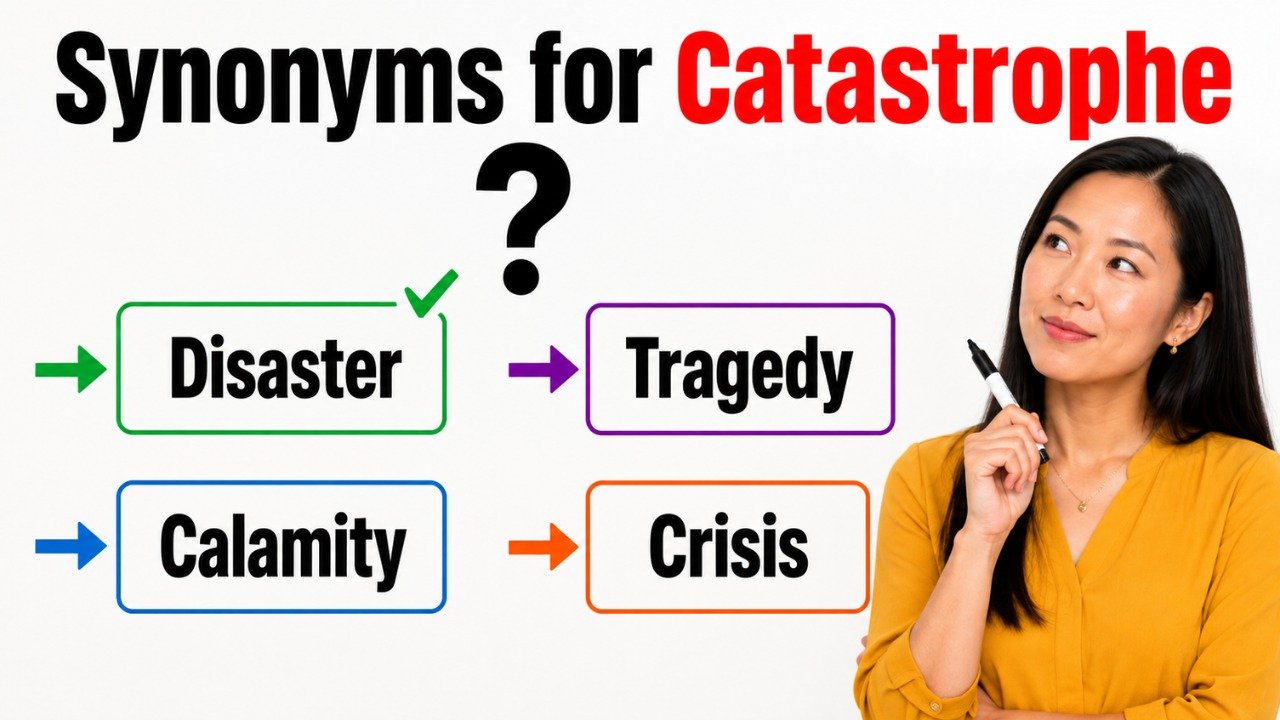
Quick Answer: Synonyms for catastrophe include disaster, calamity, tragedy, devastation, crisis, ruin, destruction, collapse, misfortune, and debacle. The best choice depends on context. Use disaster for a serious harmful event, calamity for large scale suffering, tragedy for events involving deep loss, devastation for severe destruction, crisis for a dangerous turning point, collapse for sudden failure, and debacle for a major embarrassing failure.
Pronunciation and Word Details
Word: Catastrophe
Pronunciation: /kəˈtæstrəfi/
Part of Speech: Noun
Meaning: A sudden or severe event that causes great damage, suffering, failure, or destruction.
US Pronunciation:
UK Pronunciation:
What Does “Catastrophe” Mean?
Catastrophe means a very serious event that causes great damage, loss, suffering, or failure.
As a noun, catastrophe can describe natural disasters, major accidents, social breakdowns, financial failures, personal tragedies, or events with extremely harmful consequences.
For example, a flood may become a catastrophe if it destroys homes and causes widespread loss. A badly managed project may also be called a catastrophe when it ends in complete failure.
The word usually has a strong negative tone. It suggests consequences that are far more serious than a normal problem or inconvenience.
Meaning, Tone, and Context of “Catastrophe”
Catastrophe is a strong, dramatic, and generally formal word.
It is commonly used in news style writing, history, academic discussion, environmental writing, disaster analysis, literature, and serious conversation.
The word often describes events involving destruction, death, economic damage, social disruption, or complete failure.
In casual speech, catastrophe can sometimes be exaggerated for humorous effect.
For example, someone may jokingly describe a ruined dinner as a catastrophe even though the situation is not truly serious.
In formal writing, use catastrophe when the scale or consequences are genuinely severe. For smaller problems, words such as setback, difficulty, problem, or mishap may be more accurate.
When and How to Use “Catastrophe”
For Natural Disasters: Use catastrophe when an event causes widespread destruction or loss.
Example: The earthquake became a national catastrophe.
For Human Tragedy: Catastrophe can describe events involving severe suffering or loss of life.
Example: The accident was a catastrophe for the entire community.
For Economic Failure: Use catastrophe when financial damage is severe and far reaching.
Example: The sudden collapse became an economic catastrophe.
For Project Failure: Catastrophe may describe a plan or event that ends in complete failure.
Example: Poor preparation turned the launch into a catastrophe.
For Environmental Damage: Use catastrophe for extremely serious harm to ecosystems or natural resources.
Example: The oil spill caused an environmental catastrophe.
For Personal Loss: Catastrophe may describe an event that completely changes someone’s life for the worse.
Example: Losing both the home and business felt like a personal catastrophe.
Best Synonyms for Catastrophe
Disaster: A sudden event causing serious damage, loss, or failure.
Example: The storm became a disaster for coastal communities.
Calamity: A serious event causing widespread suffering or damage.
Example: The drought became a national calamity.
Tragedy: An event involving great suffering, loss, or death.
Example: The accident was a terrible tragedy.
Devastation: Severe destruction or emotional damage.
Example: The wildfire left devastation across the region.
Crisis: A dangerous situation requiring urgent action.
Example: The country faced a severe financial crisis.
Ruin: Complete destruction, collapse, or loss.
Example: Years of poor decisions brought the company to ruin.
Destruction: The act or result of severely damaging something.
Example: The storm caused widespread destruction.
Collapse: A sudden failure or breakdown.
Example: The collapse of the system affected thousands of users.
Misfortune: A bad event or difficult situation caused by bad luck.
Example: The family experienced several serious misfortunes.
Debacle: A complete and often embarrassing failure.
Example: Poor planning turned the event into a debacle.
50 Synonyms for Catastrophe with Short Meanings
- Disaster: A serious event causing major damage or loss.
- Calamity: A severe event bringing widespread suffering.
- Tragedy: An event involving great sorrow or loss.
- Devastation: Severe destruction or emotional damage.
- Crisis: A dangerous or unstable situation.
- Ruin: Complete destruction or failure.
- Destruction: Serious damage that destroys something.
- Collapse: Sudden breakdown or complete failure.
- Misfortune: A serious unlucky event or condition.
- Debacle: A major and embarrassing failure.
- Cataclysm: A sudden event causing enormous destruction.
- Havoc: Widespread damage, confusion, or destruction.
- Desolation: Severe destruction leaving emptiness or suffering.
- Wreckage: Destruction resulting from a major accident or failure.
- Breakdown: Failure of a system, plan, or process.
- Downfall: Loss of power, success, or stability.
- Failure: Lack of success in achieving an intended result.
- Fiasco: A complete and often ridiculous failure.
- Emergency: A dangerous situation needing immediate action.
- Adversity: Serious difficulty or hardship.
- Misadventure: An unfortunate event or unsuccessful experience.
- Mishap: An unfortunate accident or mistake.
- Blow: A sudden event causing serious difficulty or loss.
- Setback: An event that delays or damages progress.
- Hardship: Severe difficulty or suffering.
- Affliction: A condition causing pain or suffering.
- Tribulation: A period of serious trouble or suffering.
- Ordeal: A painful or extremely difficult experience.
- Disruption: Serious interruption of normal activity.
- Turmoil: A state of confusion, disorder, or instability.
- Chaos: Complete disorder and confusion.
- Mayhem: Violent or extreme disorder and damage.
- Despair: A state of losing hope after severe difficulty.
- Loss: The experience of losing something valuable.
- Damage: Harm that reduces value, usefulness, or condition.
- Destruction Event: An event causing extreme physical damage.
- Major Failure: A serious lack of success.
- Total Collapse: Complete breakdown of a system or structure.
- Complete Ruin: Total destruction or loss.
- Severe Crisis: A highly dangerous or unstable situation.
- Grave Misfortune: A deeply serious unfortunate event.
- Great Disaster: A disaster involving extensive consequences.
- Mass Destruction: Widespread destruction affecting large areas.
- Systemic Failure: Failure affecting an entire system.
- Fatal Blow: An event causing final or irreversible failure.
- Complete Breakdown: Total failure of normal functioning.
- Serious Calamity: An event causing major suffering or damage.
- Terrible Tragedy: A deeply painful event involving major loss.
- Overwhelming Loss: Loss so severe that recovery is difficult.
- Disastrous Outcome: A result involving severe failure or harm.
Read Also:
Synonyms for Obnoxious

Synonyms for Catastrophe by Context
When Catastrophe Means Disaster
Useful alternatives include disaster, calamity, cataclysm, devastation, destruction, and havoc.
Example: The flood became a catastrophe for the region.
Alternative: The flood became a disaster for the region.
Disaster is one of the most flexible alternatives and works naturally in both formal and everyday writing.
When Catastrophe Means Tragedy
Useful alternatives include tragedy, calamity, loss, affliction, ordeal, and grave misfortune.
Example: The accident was a catastrophe for the family.
Alternative: The accident was a tragedy for the family.
Tragedy is especially appropriate when human suffering, death, or emotional loss is central.
When Catastrophe Means Complete Failure
Useful alternatives include debacle, fiasco, failure, collapse, breakdown, downfall, and ruin.
Example: The poorly organized event became a catastrophe.
Alternative: The poorly organized event became a debacle.
Debacle works especially well when failure is public, obvious, or embarrassing.
When Catastrophe Means Destruction
Useful alternatives include devastation, destruction, havoc, desolation, ruin, and wreckage.
Example: The fire left a scene of catastrophe behind.
Alternative: The fire left a scene of devastation behind.
Devastation emphasizes the severe physical or emotional effects of destruction.
When Catastrophe Means Crisis
Useful alternatives include crisis, emergency, turmoil, chaos, disruption, and systemic failure.
Example: The banking collapse created a financial catastrophe.
Alternative: The banking collapse created a financial crisis.
Crisis works better when the situation is dangerous but has not yet resulted in complete destruction.
Another Word for Catastrophe
Another word for catastrophe is disaster. It is the strongest general replacement because it can describe natural events, accidents, failures, and situations involving serious loss.
However, the best alternative depends on context. Use tragedy for human suffering, calamity for widespread hardship, devastation for destruction, crisis for dangerous instability, and debacle for a major failed plan or event.
Original: The flood became a catastrophe for the town.
Better Option: The flood became a disaster for the town.
Original: The accident was a catastrophe for the family.
Better Option: The accident was a tragedy for the family.
Original: The project turned into a catastrophe.
Better Option: The project turned into a debacle.
Original: The region faced an environmental catastrophe.
Better Option: The region faced widespread environmental devastation.
When Not to Use “Catastrophe”
Catastrophe is a very strong word and should not be used for minor problems unless exaggeration is intentional.
Weak: Forgetting my pen was a catastrophe.
Better: Forgetting my pen was an inconvenience.
Avoid catastrophe when the event causes only a temporary delay.
Weak: The late delivery was a catastrophe.
Better: The late delivery was a setback.
Do not use catastrophe when crisis is more accurate.
Weak: The company faced a catastrophe but had not yet suffered major losses.
Better: The company faced a serious crisis.
Avoid using catastrophe repeatedly in formal writing when more precise alternatives are available.
Weak: The flood was a catastrophe that caused a catastrophe for businesses.
Better: The flood was a disaster that caused severe economic devastation.
Choose a synonym according to whether the main idea is destruction, suffering, failure, instability, or personal hardship.
Words Commonly Confused With Catastrophe
Catastrophe vs Disaster: Both describe serious harmful events, but catastrophe often suggests an especially severe or overwhelming disaster.
Catastrophe vs Tragedy: Tragedy emphasizes human suffering, sorrow, or death. Catastrophe can include physical, financial, environmental, or organizational destruction.
Catastrophe vs Crisis: Crisis is a dangerous turning point or unstable situation. Catastrophe suggests that severe harm or failure has already occurred.
Catastrophe vs Calamity: Calamity is close in meaning to catastrophe and often emphasizes widespread suffering or misfortune.
Catastrophe vs Devastation: Catastrophe is the event itself, while devastation often describes the destruction or emotional damage left behind.
Catastrophe vs Debacle: Debacle usually refers to a complete failure, especially one involving poor planning or public embarrassment.
Catastrophe vs Emergency: An emergency requires immediate action but does not necessarily become a catastrophe.
Which Synonym Should You Choose?
Choose disaster for a broad and natural alternative in general writing.
Choose calamity in formal, literary, or historical writing about widespread suffering.
Choose tragedy when loss of life, grief, or personal suffering is central.
Choose devastation when emphasizing destruction or emotional damage.
Choose crisis when a dangerous situation requires urgent action but has not necessarily caused total destruction.
Choose collapse when a system, organization, economy, or structure suddenly fails.
Choose debacle for a major failed event, project, or public effort.
Choose fiasco in less formal writing for a complete and often embarrassing failure.
Choose cataclysm for extremely large scale or transformative destruction.
Choose ruin when emphasizing complete loss, destruction, or decline.
Real Life Examples of “Catastrophe” in Sentences
Original: The earthquake was a catastrophe for the region.
Better Option: The earthquake was a disaster for the region.
Original: The accident became a catastrophe for the family.
Better Option: The accident became a tragedy for the family.
Original: The project was a complete catastrophe.
Better Option: The project was a complete debacle.
Original: The fire caused an environmental catastrophe.
Better Option: The fire caused severe environmental devastation.
Original: The sudden market fall created a catastrophe.
Better Option: The sudden market fall created a financial crisis.
Original: The system failure became a catastrophe for the company.
Better Option: The system failure became a major operational breakdown.
Original: The storm brought catastrophe to the coastal area.
Better Option: The storm brought widespread destruction to the coastal area.
Original: The event turned into a catastrophe because of poor planning.
Better Option: The event turned into a fiasco because of poor planning.
Original: The drought became a catastrophe for farmers.
Better Option: The drought became a calamity for farmers.
Original: The collapse of the bridge was a catastrophe.
Better Option: The collapse of the bridge was a terrible disaster.
Synonym Groups and Usage Differences
Disaster Group
Disaster, calamity, cataclysm, great disaster, and serious calamity describe events causing severe and widespread harm.
Example: The earthquake became a major disaster for the region.
Tragedy Group
Tragedy, grave misfortune, affliction, ordeal, and overwhelming loss emphasize suffering and personal consequences.
Example: The sudden loss was a tragedy for everyone involved.
Destruction Group
Devastation, destruction, havoc, desolation, wreckage, and ruin emphasize severe physical damage.
Example: The wildfire left devastation across the valley.
Failure Group
Debacle, fiasco, breakdown, collapse, failure, and downfall describe unsuccessful plans, systems, organizations, or events.
Example: Poor organization turned the launch into a debacle.
Crisis Group
Crisis, emergency, disruption, turmoil, chaos, and systemic failure describe dangerous or unstable situations.
Example: The shortage developed into a serious crisis.
Antonyms of Catastrophe
The opposite of catastrophe depends on whether the word refers to failure, destruction, or hardship.
Success: A favorable or intended result.
Triumph: A major or impressive success.
Victory: Successful achievement over opposition or difficulty.
Achievement: Successful completion of a goal.
Recovery: Return to a normal or improved condition.
Restoration: The act of returning something to good condition.
Stability: A condition of being secure and steady.
Prosperity: A state of success or economic well being.
Fortune: Favorable circumstances or good luck.
Blessing: Something bringing benefit or happiness.
Improvement: A change toward a better condition.
Resolution: Successful solution of a problem or crisis.
Comparison: Catastrophe vs Related Words
Catastrophe vs Disaster
Catastrophe often suggests an extremely severe disaster, while disaster can describe a wider range of serious harmful events.
Example With Catastrophe: The earthquake became a national catastrophe.
Example With Disaster: The flood was a serious disaster for several towns.
Catastrophe vs Tragedy
Catastrophe focuses on serious destruction or failure. Tragedy focuses more strongly on suffering, grief, or loss.
Example With Catastrophe: The industrial accident became an environmental catastrophe.
Example With Tragedy: The loss of several lives was a terrible tragedy.
Catastrophe vs Calamity
Both words describe severe misfortune. Calamity often sounds more literary and emphasizes suffering or widespread hardship.
Example With Catastrophe: The collapse caused an economic catastrophe.
Example With Calamity: The prolonged drought became a calamity for rural communities.
Catastrophe vs Crisis
A crisis is a dangerous or unstable situation. A catastrophe usually describes a disastrous outcome or extreme damage.
Example With Catastrophe: The collapse of the system was a catastrophe.
Example With Crisis: The failing system created an urgent crisis.
Catastrophe vs Devastation
Catastrophe usually names the event. Devastation describes the severe destruction or emotional damage caused by it.
Example With Catastrophe: The storm became a regional catastrophe.
Example With Devastation: The storm left widespread devastation.
Catastrophe vs Debacle
Catastrophe can involve physical harm, loss, or failure. Debacle is usually used for an unsuccessful plan, event, or public effort.
Example With Catastrophe: The earthquake was a catastrophe.
Example With Debacle: The poorly planned conference was a debacle.
Common Phrases and Expressions With “Catastrophe”
Natural Catastrophe: A destructive event caused by natural forces.
Example: The earthquake developed into a natural catastrophe.
Environmental Catastrophe: Severe damage to ecosystems or the environment.
Example: The spill created an environmental catastrophe along the coast.
Humanitarian Catastrophe: A situation involving widespread human suffering.
Example: The prolonged conflict created a humanitarian catastrophe.
Economic Catastrophe: Severe and widespread financial or economic damage.
Example: A complete market collapse could create an economic catastrophe.
Financial Catastrophe: A devastating loss of money or financial stability.
Example: Poor planning led to a financial catastrophe for the organization.
Complete Catastrophe: A total failure or extremely damaging event.
Example: Without preparation, the event could have been a complete catastrophe.
Potential Catastrophe: A situation that could become extremely harmful.
Example: Quick action prevented a potential catastrophe.
Major Catastrophe: An event involving especially serious consequences.
Example: The flood was a major catastrophe for nearby communities.
Avoid Catastrophe: Prevent an extremely damaging outcome.
Example: Early repairs helped avoid catastrophe.
Turn Into a Catastrophe: Develop from a manageable problem into a severe disaster.
Example: The small fire could have turned into a catastrophe.
Common Mistakes to Avoid
A common mistake is using catastrophe for ordinary problems. The word implies very serious damage, loss, or failure.
Do not treat catastrophe and inconvenience as similar in strength.
Weak: Missing the bus was a catastrophe.
Better: Missing the bus was an inconvenience.
Another mistake is using tragedy when the sentence is mainly about financial or mechanical failure. Tragedy usually carries stronger emotional or human loss.
Avoid using crisis and catastrophe interchangeably. A crisis can sometimes be resolved before becoming a catastrophe.
Do not use debacle for natural disasters. Debacle normally refers to a badly failed event, plan, or operation.
Writers should also avoid unnecessary repetition. Disaster, calamity, tragedy, devastation, collapse, or crisis may provide greater precision.
In formal writing, identify what makes the event catastrophic. Explain whether it involves loss of life, environmental destruction, economic collapse, institutional failure, or another serious consequence.
Conclusion
Synonyms for catastrophe include disaster, calamity, tragedy, devastation, crisis, ruin, collapse, and debacle. Disaster is the most flexible general alternative, while tragedy fits human loss, devastation emphasizes destruction, and crisis describes dangerous instability. Debacle and fiasco are better for badly failed plans or events, while calamity and cataclysm suit especially severe situations. Choosing the correct synonym helps communicate the scale, type, and consequences of a serious event more accurately.
FAQs About Synonyms for Catastrophe
What Is the Best Synonym for Catastrophe?
Disaster is the best general synonym for catastrophe because it works for natural events, accidents, failures, and other serious harmful situations.
What Is a Stronger Word for Catastrophe?
Cataclysm can sound even more dramatic when describing enormous or transformative destruction. Devastation may also be stronger when focusing on the damage left behind.
What Is Another Word for Catastrophe in Formal Writing?
Calamity, disaster, devastation, crisis, collapse, and cataclysm are useful formal alternatives depending on context.
What Is the Difference Between Catastrophe and Disaster?
Both describe serious harmful events, but catastrophe often suggests especially severe, overwhelming, or far reaching consequences.
Can Tragedy Be Used Instead of Catastrophe?
Yes, when the event involves serious human suffering, death, grief, or emotional loss. It is less suitable when the focus is purely mechanical or organizational failure.
What Is a Synonym for Catastrophe When Something Fails?
Debacle, fiasco, collapse, breakdown, failure, and downfall are useful alternatives for a plan, project, event, or system that fails badly.
What Is the Opposite of Catastrophe?
Success, recovery, stability, prosperity, triumph, restoration, and resolution can function as opposites depending on the context.
