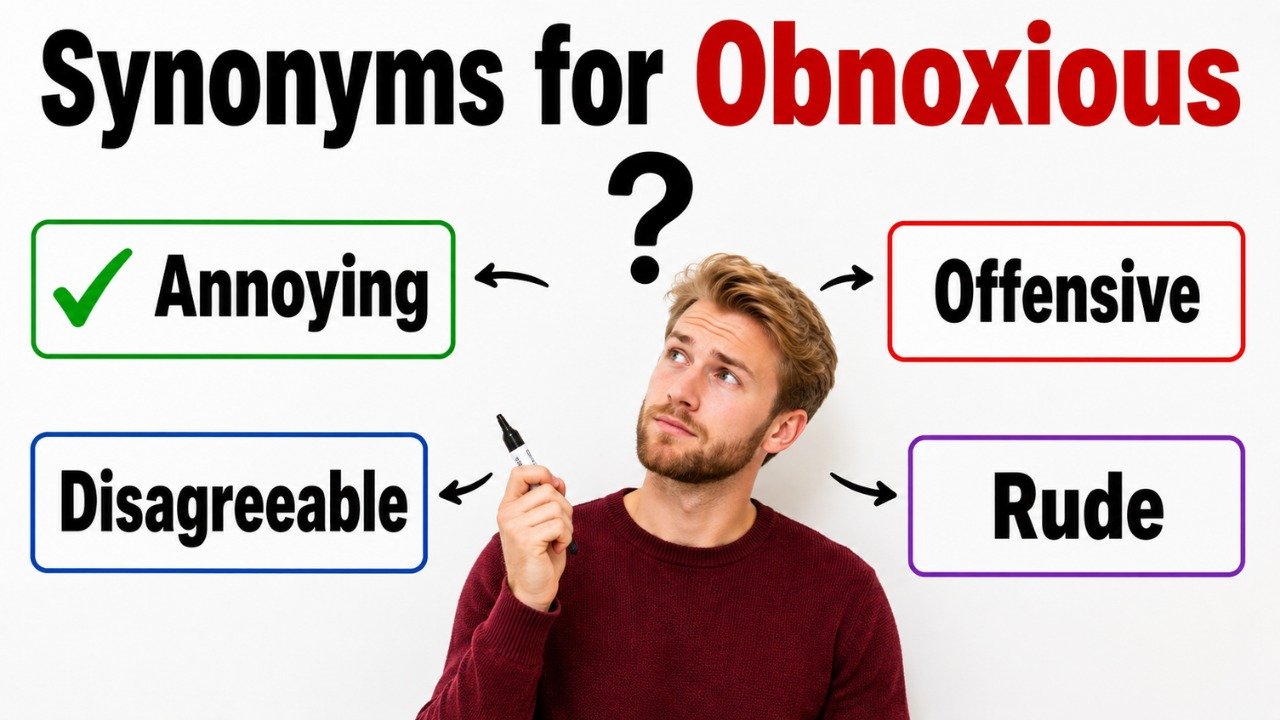
Quick Answer: The best synonyms for obnoxious include annoying, offensive, rude, irritating, unpleasant, arrogant, repulsive, disagreeable, insufferable, and detestable. Use annoying for behavior that repeatedly bothers people, offensive for words or actions that cause insult, rude for impolite conduct, arrogant for excessive self importance, repulsive for something strongly unpleasant, and insufferable for behavior that is extremely difficult to tolerate. The right synonym depends on whether obnoxious describes manners, personality, speech, attitude, smell, behavior, or another unpleasant quality.
Pronunciation and Word Details
Word: Obnoxious
Pronunciation: /əbˈnɒkʃəs/
Part of Speech: Adjective
Meaning: Obnoxious means extremely unpleasant, annoying, offensive, or difficult to tolerate.
US Pronunciation:
UK Pronunciation:
What Does “Obnoxious” Mean?
Obnoxious means very unpleasant, irritating, offensive, or difficult to tolerate.
It is an adjective commonly used to describe a person’s behavior, attitude, speech, habits, smell, noise, or manner.
Example: His obnoxious comments made everyone uncomfortable.
When obnoxious describes a person, it usually suggests that their behavior is rude, arrogant, irritating, or socially unpleasant.
Example: The obnoxious guest kept interrupting every conversation.
The word can also describe something that strongly bothers the senses.
Example: An obnoxious smell filled the room.
Obnoxious is stronger than mildly negative words such as annoying or inconvenient. It usually expresses clear disapproval.
Meaning, Tone, and Context of “Obnoxious”
Obnoxious has a strongly negative tone. It is commonly used when someone or something is not merely unpleasant but actively irritating, offensive, or intolerable.
Conversational Context: Obnoxious often describes rude or irritating people.
Example: His obnoxious behavior ruined the evening.
Emotional Context: The word expresses strong dislike, frustration, or disapproval.
Example: She found his constant boasting obnoxious.
Formal Context: Obnoxious may appear in descriptive or critical writing, although more precise words such as offensive, disruptive, or inappropriate may work better in professional contexts.
Social Context: It often describes poor manners, arrogance, excessive loudness, disrespect, or inconsiderate behavior.
Sensory Context: Obnoxious can describe unpleasant smells, noises, or other strong sensory experiences.
Example: An obnoxious odor came from the drain.
Because the word is strong, it should be used carefully when describing people directly.
When and How to Use “Obnoxious”
For Annoying Behavior: Use obnoxious when someone’s behavior is extremely irritating.
Example: His obnoxious habit of interrupting annoyed everyone.
For Rudeness: Use obnoxious when behavior is disrespectful or impolite.
Example: The customer became obnoxious toward the staff.
For Arrogance: Use obnoxious when someone behaves as though they are superior to others.
Example: His obnoxious bragging made the conversation uncomfortable.
For Offensive Speech: Use obnoxious for remarks that are insulting, inappropriate, or unpleasant.
Example: She objected to his obnoxious comments.
For Loud Behavior: Obnoxious can describe excessive noise or attention seeking conduct.
Example: The obnoxious shouting continued throughout the evening.
For Unpleasant Smells: Use obnoxious when an odor is extremely disagreeable.
Example: An obnoxious smell spread through the hallway.
For Strong Disapproval: Obnoxious works when the speaker wants to express stronger criticism than annoying or unpleasant.
Example: His deliberate teasing was completely obnoxious.
Best Synonyms for Obnoxious
Annoying
Synonym: Annoying means causing irritation or frustration.
Example: His annoying habit of tapping the desk distracted everyone.
Offensive
Synonym: Offensive means causing insult, anger, or strong displeasure.
Example: The remark was offensive and unnecessary.
Rude
Synonym: Rude means impolite, disrespectful, or lacking good manners.
Example: His rude response surprised the group.
Irritating
Synonym: Irritating means causing repeated annoyance or discomfort.
Example: The constant buzzing became irritating.
Unpleasant
Synonym: Unpleasant means disagreeable or not enjoyable.
Example: His unpleasant attitude created tension.
Arrogant
Synonym: Arrogant means behaving with excessive pride or superiority.
Example: Her arrogant comments offended several colleagues.
Repulsive
Synonym: Repulsive means extremely unpleasant or causing strong dislike.
Example: The room contained a repulsive odor.
Disagreeable
Synonym: Disagreeable means unpleasant, unfriendly, or difficult to tolerate.
Example: He became disagreeable whenever anyone challenged him.
Insufferable
Synonym: Insufferable means extremely annoying and difficult to endure.
Example: His constant boasting became insufferable.
Detestable
Synonym: Detestable means deserving strong dislike or disgust.
Example: His detestable behavior shocked everyone present.
50 Synonyms for Obnoxious with Short Meanings
- Annoying: Causing irritation or frustration.
- Offensive: Causing insult or strong displeasure.
- Rude: Lacking politeness or respect.
- Irritating: Repeatedly causing annoyance.
- Unpleasant: Not enjoyable or agreeable.
- Arrogant: Showing excessive pride or superiority.
- Repulsive: Extremely unpleasant or disgusting.
- Disagreeable: Difficult or unpleasant to deal with.
- Insufferable: Extremely difficult to tolerate.
- Detestable: Deserving strong dislike.
- Abhorrent: Inspiring strong disgust or disapproval.
- Loathsome: Causing intense dislike or disgust.
- Hateful: Deserving or causing strong dislike.
- Disgusting: Causing strong revulsion.
- Revolting: Extremely unpleasant or disgusting.
- Nasty: Very unpleasant or unkind.
- Vile: Extremely unpleasant or morally offensive.
- Odious: Deserving intense dislike.
- Intolerable: Impossible or very difficult to endure.
- Unbearable: Too unpleasant to tolerate comfortably.
- Exasperating: Extremely frustrating or irritating.
- Aggravating: Making someone increasingly annoyed.
- Infuriating: Causing intense anger or frustration.
- Bothersome: Causing inconvenience or irritation.
- Troublesome: Causing difficulty or annoyance.
- Pestering: Repeatedly bothering someone.
- Provoking: Causing irritation, anger, or reaction.
- Grating: Irritating because of repeated unpleasantness.
- GallIng: Causing resentment or irritation.
- Irksome: Annoying or tedious.
- Distasteful: Unpleasant or offensive to one’s feelings.
- Objectionable: Likely to cause disapproval or offense.
- Unappealing: Not pleasant or attractive.
- Repellent: Causing strong dislike or aversion.
- Displeasing: Causing dissatisfaction or annoyance.
- Unlikable: Difficult to like.
- Inconsiderate: Showing little concern for others.
- Impolite: Lacking courtesy or good manners.
- Disrespectful: Showing insufficient respect.
- Insolent: Rudely disrespectful or boldly impolite.
- Boastful: Talking excessively about one’s achievements.
- Conceited: Having an overly high opinion of oneself.
- Overbearing: Dominating others in an unpleasant way.
- Pushy: Aggressively trying to control or influence others.
- Loud: Excessively noisy or attention seeking in some contexts.
- Crude: Lacking refinement or good taste.
- Vulgar: Lacking sophistication or good manners.
- Abusive: Harsh, insulting, or cruel in speech or behavior.
- Hostile: Unfriendly or aggressive.
- Antagonistic: Showing opposition, hostility, or aggression.
Read Also:
Synonyms for Operate

Synonyms for Obnoxious by Context
When Obnoxious Means Annoying
Annoying, irritating, aggravating, bothersome, exasperating, irksome, grating, and troublesome work well when obnoxious describes something that repeatedly causes frustration.
Example: His constant interruptions were irritating.
Example: The repetitive noise became exasperating.
Example: Her habit of correcting everyone was annoying.
Annoying is the broadest choice, while exasperating suggests stronger frustration.
When Obnoxious Means Rude
Rude, impolite, disrespectful, insolent, crude, vulgar, and inconsiderate are useful when obnoxious refers to poor manners or disrespectful conduct.
Example: His rude response shocked the group.
Example: The comment was disrespectful and unnecessary.
Example: Her insolent tone upset the manager.
Rude is common and direct. Insolent suggests openly disrespectful behavior, often toward someone in authority.
When Obnoxious Means Offensive
Offensive, objectionable, distasteful, vile, abhorrent, hateful, and repulsive are strong choices when the behavior or language causes insult or disgust.
Example: The offensive remark ended the conversation.
Example: His objectionable behavior was reported immediately.
Example: They condemned the vile treatment of the animals.
Offensive is suitable in many professional situations because it identifies harmful or insulting conduct clearly.
When Obnoxious Means Arrogant
Arrogant, conceited, boastful, overbearing, pushy, and insolent work when obnoxious describes excessive pride or dominating behavior.
Example: His arrogant attitude annoyed his teammates.
Example: She sounded conceited when discussing her achievements.
Example: His overbearing manner made collaboration difficult.
Arrogant focuses on superiority, while overbearing emphasizes controlling behavior.
When Obnoxious Means Disgusting
Disgusting, repulsive, revolting, loathsome, vile, odious, and repellent work when obnoxious describes something that produces strong disgust.
Example: A repulsive odor filled the basement.
Example: The spoiled food had a disgusting smell.
Example: The chemical produced a revolting odor.
Repulsive and revolting are particularly useful for strong sensory reactions.
When Obnoxious Means Difficult to Tolerate
Insufferable, intolerable, unbearable, exasperating, and disagreeable work well when the main idea is that someone or something has become extremely difficult to endure.
Example: His constant complaining became insufferable.
Example: The heat inside the room was unbearable.
Example: Their hostile behavior became intolerable.
These words are stronger than ordinary alternatives such as annoying.
Another Word for Obnoxious
Another word for obnoxious is annoying when the main meaning is irritating behavior. However, the best alternative changes with context.
Use offensive when the behavior insults people, rude for poor manners, arrogant for excessive pride, repulsive for something that causes disgust, and insufferable when the behavior is extremely difficult to tolerate.
Original: His obnoxious behavior annoyed everyone.
Better Option: His irritating behavior annoyed everyone.
Original: She made an obnoxious remark during the meeting.
Better Option: She made an offensive remark during the meeting.
Original: His obnoxious attitude made him difficult to work with.
Better Option: His arrogant attitude made him difficult to work with.
Original: An obnoxious smell came from the container.
Better Option: A repulsive smell came from the container.
When Not to Use “Obnoxious”
Obnoxious is a strong word and may sound unnecessarily harsh when the situation is only mildly irritating.
Weak: The slightly slow service was obnoxious.
Better: The slightly slow service was frustrating.
The better sentence matches the actual level of annoyance.
Avoid using obnoxious in formal writing when a more precise word explains the problem clearly.
Weak: His obnoxious conduct violated workplace expectations.
Better: His disrespectful conduct violated workplace expectations.
Obnoxious can also sound vague when the exact behavior matters.
Weak: She was obnoxious during the discussion.
Better: She was rude and repeatedly interrupted others during the discussion.
Avoid using obnoxious repeatedly in the same paragraph.
Weak: The obnoxious customer made obnoxious comments in an obnoxious tone.
Better: The rude customer made offensive comments in a hostile tone.
Precise synonyms improve clarity and prevent repetitive writing.
Words Commonly Confused With Obnoxious
Obnoxious vs Annoying: Obnoxious usually suggests stronger dislike than annoying. Something annoying may simply bother you, while something obnoxious often seems intensely unpleasant or offensive.
Obnoxious vs Rude: Rude specifically describes a lack of politeness. Obnoxious is broader and may include rudeness, arrogance, loudness, irritation, or offensiveness.
Obnoxious vs Offensive: Offensive emphasizes causing insult or moral displeasure, while obnoxious can refer to anything extremely unpleasant or irritating.
Obnoxious vs Arrogant: Arrogant describes excessive pride or superiority. An arrogant person may seem obnoxious, but not every obnoxious person is arrogant.
Obnoxious vs Irritating: Irritating focuses on annoyance. Obnoxious is usually stronger and can also suggest offensiveness or repulsiveness.
Obnoxious vs Repulsive: Repulsive suggests strong disgust or aversion. Obnoxious more often describes something unpleasant, irritating, or offensive.
Obnoxious vs Insufferable: Insufferable means almost impossible to tolerate. It is especially useful when irritation has become extreme.
Which Synonym Should You Choose?
Choose annoying for general irritation in everyday speech.
Choose irritating when something repeatedly causes frustration.
Choose offensive for insulting remarks, inappropriate language, or behavior that causes strong displeasure.
Choose rude when the main problem is poor manners.
Choose disrespectful in professional or formal writing when someone fails to show proper respect.
Choose arrogant when someone behaves as though they are superior to others.
Choose conceited when someone has an excessive opinion of their own abilities or appearance.
Choose overbearing when someone tries to dominate or control others.
Choose repulsive when something creates strong disgust.
Choose insufferable when behavior is extremely difficult to tolerate.
Choose objectionable in formal writing when something is inappropriate or unacceptable.
Choose exasperating when a person or situation causes intense frustration.
For essays and reports, precise words such as offensive, disrespectful, objectionable, or inappropriate are often stronger choices than the broad word obnoxious.
For casual conversation, annoying, rude, irritating, and unbearable usually sound more natural.
Real Life Examples of “Obnoxious” in Sentences
Original: His obnoxious jokes made everyone uncomfortable.
Better Option: His offensive jokes made everyone uncomfortable.
Original: She found his obnoxious laughter distracting.
Better Option: She found his irritating laughter distracting.
Original: The customer became obnoxious toward the staff.
Better Option: The customer became rude toward the staff.
Original: His obnoxious confidence annoyed his classmates.
Better Option: His arrogant confidence annoyed his classmates.
Original: The obnoxious noise continued all night.
Better Option: The unbearable noise continued all night.
Original: An obnoxious smell came from the kitchen.
Better Option: A repulsive smell came from the kitchen.
Original: His obnoxious habit of interrupting caused arguments.
Better Option: His exasperating habit of interrupting caused arguments.
Original: She became obnoxious whenever someone disagreed with her.
Better Option: She became overbearing whenever someone disagreed with her.
Original: Their obnoxious remarks damaged the conversation.
Better Option: Their disrespectful remarks damaged the conversation.
Original: His obnoxious boasting annoyed everyone at dinner.
Better Option: His boastful behavior annoyed everyone at dinner.
Synonym Groups and Usage Differences
Annoyance Group
Annoying, irritating, aggravating, bothersome, exasperating, irksome, and grating belong to the annoyance group.
These words describe something that repeatedly causes irritation.
Example: The constant tapping became increasingly irritating.
Annoying is general, while exasperating suggests stronger frustration.
Rudeness Group
Rude, impolite, disrespectful, insolent, crude, and vulgar describe unpleasant behavior connected with poor manners.
Example: His disrespectful reply upset the entire group.
Rude is broad, while insolent suggests bold and deliberate disrespect.
Arrogance Group
Arrogant, conceited, boastful, overbearing, and pushy describe unpleasant behavior connected with excessive confidence or control.
Example: His overbearing attitude discouraged other people from contributing.
Arrogant focuses on superiority, while pushy focuses on excessive pressure.
Disgust Group
Repulsive, disgusting, revolting, loathsome, vile, odious, and repellent express strong dislike or disgust.
Example: A repulsive odor came from the abandoned container.
These alternatives are useful when obnoxious describes something physically or emotionally disgusting.
Intolerance Group
Insufferable, unbearable, intolerable, and exasperating describe people or situations that are extremely difficult to endure.
Example: The constant arguing became intolerable.
Insufferable is especially common for irritating behavior, while unbearable also works naturally for pain, heat, noise, and difficult conditions.
Offense Group
Offensive, objectionable, distasteful, hateful, and abusive describe words or actions that cause insult, disapproval, or emotional harm.
Example: His offensive language was inappropriate for the setting.
These words provide greater precision than obnoxious when the specific problem is insulting or harmful behavior.
Antonyms of Obnoxious
The opposite of obnoxious depends on whether the word describes behavior, personality, manners, or general pleasantness.
Pleasant: Enjoyable and agreeable.
Polite: Showing good manners and respect.
Courteous: Respectful and considerate toward others.
Agreeable: Pleasant and easy to deal with.
Charming: Pleasant and attractive in manner.
Likable: Easy to like.
Considerate: Thoughtful about the needs and feelings of others.
Respectful: Showing proper regard for others.
Friendly: Kind, pleasant, and approachable.
Appealing: Attractive or pleasing.
Delightful: Very pleasant and enjoyable.
Gracious: Polite, kind, and considerate.
Tolerable: Acceptable or manageable enough to endure.
Humble: Not excessively proud or arrogant.
Kind: Caring and considerate toward others.
Comparison: Obnoxious vs Related Words
Obnoxious vs Annoying
Obnoxious is usually stronger than annoying. Annoying describes irritation, while obnoxious often suggests extreme unpleasantness, offensiveness, or bad behavior.
Example With Obnoxious: His obnoxious remarks made the entire group uncomfortable.
Example With Annoying: His annoying habit of tapping the table distracted me.
Obnoxious vs Rude
Rude specifically concerns poor manners or disrespect. Obnoxious includes rude behavior but can also refer to arrogance, loudness, irritating habits, or unpleasant smells.
Example With Obnoxious: His obnoxious behavior ruined the celebration.
Example With Rude: It was rude of him to interrupt her.
Obnoxious vs Offensive
Offensive focuses on causing insult or strong displeasure. Obnoxious has a broader meaning involving irritation, unpleasantness, and offensiveness.
Example With Obnoxious: His obnoxious attitude irritated his coworkers.
Example With Offensive: His offensive remark upset several people.
Obnoxious vs Irritating
Irritating mainly describes something that repeatedly annoys. Obnoxious often communicates stronger personal dislike.
Example With Obnoxious: His obnoxious boasting made him difficult to tolerate.
Example With Irritating: The repetitive clicking sound became irritating.
Obnoxious vs Arrogant
Arrogant specifically means overly proud or superior. Someone can be obnoxious without being arrogant.
Example With Obnoxious: The obnoxious guest shouted throughout dinner.
Example With Arrogant: His arrogant attitude made him dismiss other people’s ideas.
Obnoxious vs Repulsive
Repulsive expresses strong disgust or aversion. Obnoxious can mean repulsive, but it more commonly describes irritating behavior.
Example With Obnoxious: His obnoxious behavior annoyed everyone.
Example With Repulsive: The container produced a repulsive smell.
Obnoxious vs Insufferable
Insufferable emphasizes that someone or something is extremely difficult to tolerate.
Example With Obnoxious: His obnoxious comments irritated the group.
Example With Insufferable: His endless boasting became insufferable.
Common Phrases and Expressions With “Obnoxious”
Obnoxious Behavior: Extremely unpleasant or irritating conduct.
Example: The teacher addressed the student’s obnoxious behavior.
Obnoxious Person: Someone who behaves in a highly irritating or offensive way.
Example: He becomes an obnoxious person whenever he starts boasting.
Obnoxious Attitude: An unpleasant, arrogant, or disrespectful manner.
Example: Her obnoxious attitude made cooperation difficult.
Obnoxious Comment: A remark that is offensive, irritating, or inappropriate.
Example: He apologized for the obnoxious comment.
Obnoxious Noise: A sound that is extremely unpleasant or irritating.
Example: An obnoxious noise came from the machine.
Obnoxious Smell: A very unpleasant or offensive odor.
Example: An obnoxious smell filled the storage room.
Obnoxious Habit: A repeated behavior that strongly irritates others.
Example: Interrupting people became his most obnoxious habit.
Obnoxious Manner: An unpleasant way of behaving or speaking.
Example: His obnoxious manner discouraged people from talking to him.
Obnoxious Personality: A personality that others find strongly unpleasant.
Example: His obnoxious personality made teamwork difficult.
Extremely Obnoxious: Intensely irritating or unpleasant.
Example: The repeated shouting became extremely obnoxious.
Common Mistakes to Avoid
Using Obnoxious for Mild Annoyance: Obnoxious is stronger than annoying and may exaggerate a minor problem.
Weak: The pencil was obnoxious because it needed sharpening.
Better: The pencil was inconvenient because it needed sharpening.
Overusing Obnoxious: Repeating the word makes writing sound limited.
Weak: He was obnoxious, his jokes were obnoxious, and his voice was obnoxious.
Better: He was rude, his jokes were offensive, and his loud voice was irritating.
Choosing the Wrong Synonym: Not every synonym describes the same kind of unpleasantness.
Use rude for manners, arrogant for superiority, offensive for insulting behavior, irritating for annoyance, and repulsive for disgust.
Using Arrogant as an Exact Replacement: Arrogant only works when excessive pride or superiority is involved.
Incorrect: The garbage had an arrogant smell.
Better: The garbage had a repulsive smell.
Using Repulsive for Simple Annoyance: Repulsive is much stronger than irritating.
Unnatural: The ticking clock was repulsive.
Natural: The ticking clock was irritating.
Using Obnoxious Without Explaining the Behavior: In formal writing, describe what the person actually did.
Vague: The employee was obnoxious.
Clearer: The employee repeatedly interrupted colleagues and made disrespectful remarks.
Ignoring Tone: Calling a person obnoxious directly can sound harsh. In professional communication, a specific description of the behavior is often more appropriate.
Conclusion
The most useful synonyms for obnoxious depend on the kind of unpleasantness being described. Annoying and irritating work for general frustration, while rude and disrespectful describe poor manners. Offensive suits insulting language or conduct, arrogant describes excessive pride, repulsive expresses strong disgust, and insufferable means extremely difficult to tolerate. Choosing a precise synonym helps readers understand whether the problem involves annoyance, arrogance, offense, disrespect, disgust, or another negative quality.
FAQs About Synonyms for Obnoxious
What Is the Best Synonym for Obnoxious?
Annoying is a common general synonym, but offensive, rude, irritating, arrogant, repulsive, and insufferable may be more precise depending on context.
What Is a Polite Word for Obnoxious?
Unpleasant, difficult, inconsiderate, inappropriate, or disagreeable can sound less harsh when describing someone’s behavior.
What Is a Stronger Word Than Obnoxious?
Insufferable, repulsive, detestable, loathsome, revolting, and intolerable can express stronger dislike in suitable contexts.
What Is Another Word for an Obnoxious Person?
An obnoxious person may be described as rude, irritating, arrogant, overbearing, inconsiderate, insolent, or disagreeable depending on their behavior.
Is Annoying the Same as Obnoxious?
Not exactly. Annoying means irritating, while obnoxious usually suggests a stronger level of unpleasantness, offensiveness, or bad behavior.
What Is the Formal Synonym for Obnoxious?
Offensive, objectionable, disrespectful, inappropriate, disagreeable, and intolerable can work in formal writing depending on the sentence.
What Is the Opposite of Obnoxious?
Common opposites include pleasant, polite, courteous, agreeable, considerate, respectful, charming, and friendly.
