
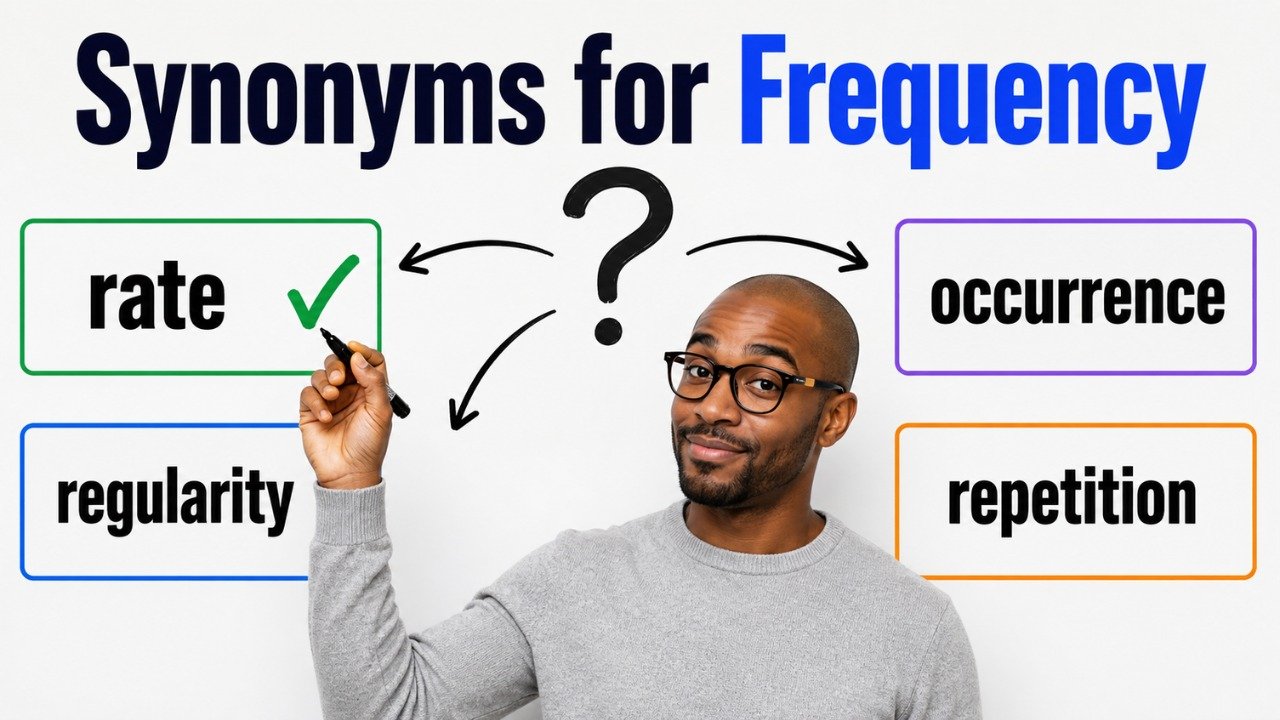
Quick Answer: The best synonyms for frequency include rate, recurrence, regularity, incidence, occurrence, prevalence, repetition, periodicity, number, and commonness. Use rate when describing how often something happens within a period, recurrence for something that happens repeatedly, incidence for events or cases, prevalence for how widespread something is, and periodicity for regularly repeating patterns. The best synonym depends on whether frequency refers to repetition, statistics, everyday events, patterns, or scientific measurements.
Pronunciation and Word Details
Word: Frequency
Pronunciation: /ˈfriːkwənsi/
Part of Speech: Noun
Meaning: The rate or number of times something happens, repeats, or occurs within a particular period.
US Pronunciation:
UK Pronunciation:
What Does “Frequency” Mean?
Frequency means how often something happens, appears, repeats, or occurs.
As a noun, it is commonly used when discussing repeated events, patterns, statistics, communication, sound, waves, habits, and measurements.
Example: The frequency of meetings increased during the project.
In everyday language, frequency often refers to how regularly an event happens.
Example: She reduced the frequency of her visits.
In statistics and research, frequency can describe the number of times a value, event, or category occurs.
Example: The table shows the frequency of each response.
In science, frequency refers to the number of cycles, vibrations, or waves occurring within a given amount of time.
Example: Higher frequency sound waves produce higher pitches.
The exact replacement for frequency therefore depends strongly on the subject being discussed.
Meaning, Tone, and Context of “Frequency”
Frequency has a neutral and fairly formal tone. It appears naturally in everyday communication but is especially common in academic, scientific, statistical, medical, technical, and professional writing.
Everyday Context: Frequency describes how often an action or event occurs.
Example: The frequency of deliveries depends on demand.
Statistical Context: It refers to the number of times a particular result or value appears.
Example: Researchers recorded the frequency of each answer.
Scientific Context: It can describe repeated cycles, waves, vibrations, or signals.
Example: The instrument measures sound frequency.
Professional Context: Frequency is useful when discussing schedules, reports, inspections, communication, or repeated activities.
Example: The company increased the frequency of safety checks.
Because the word is precise and neutral, it works well in both formal and informational writing.
When and How to Use “Frequency”
For Repeated Events: Use frequency to explain how often something happens.
Example: The frequency of storms increases during certain seasons.
For Schedules: Use frequency when describing how regularly an activity takes place.
Example: We changed the frequency of the weekly meetings.
For Statistics: Frequency can show how many times a value or event appears in a data set.
Example: The chart displays the frequency of each response.
For Patterns: Use frequency when discussing repeated behavior or recurring events.
Example: Researchers studied the frequency of customer complaints.
For Science: Frequency describes the number of cycles or vibrations occurring within a set period.
Example: The frequency of the wave determines important properties of the signal.
For Communication: Frequency can describe how often messages, updates, or interactions occur.
Example: Increasing the frequency of updates kept everyone informed.
Best Synonyms for Frequency
Rate: How often something happens during a particular period.
Example: The rate of accidents declined during the month.
Recurrence: The act of happening again repeatedly.
Example: The recurrence of the problem required further investigation.
Regularity: The quality of occurring consistently or at predictable intervals.
Example: The regularity of her practice improved her performance.
Incidence: The occurrence or rate of particular events or cases.
Example: Researchers examined the incidence of errors.
Occurrence: An event or instance of something happening.
Example: The occurrence of delays was carefully recorded.
Prevalence: The degree to which something is widespread or commonly found.
Example: The study measured the prevalence of the behavior.
Repetition: The act of doing or happening again.
Example: Frequent repetition helped reinforce the lesson.
Periodicity: The quality of recurring at regular intervals.
Example: Scientists observed the periodicity of the pattern.
Number: The total count of times something occurs.
Example: The number of complaints declined.
Commonness: The quality of occurring or appearing often.
Example: The commonness of the expression varies by region.
50 Synonyms for Frequency with Short Meanings
Because frequency has several meanings, this list includes direct synonyms and useful close alternatives for rate, repetition, occurrence, regularity, statistics, and recurring patterns.
- Rate: The amount or number occurring within a period.
- Recurrence: The repeated return of an event or condition.
- Regularity: Consistent occurrence at expected intervals.
- Incidence: The occurrence or rate of particular cases or events.
- Occurrence: An instance of something happening.
- Prevalence: The degree to which something is widespread.
- Repetition: The act of happening or being done again.
- Periodicity: Regular recurrence according to a pattern.
- Number: The total count of occurrences.
- Commonness: The quality of occurring frequently.
- Regular Recurrence: Repeated occurrence at consistent intervals.
- Reoccurrence: The act of occurring again.
- Reappearance: The act of appearing again.
- Repetition Rate: The speed or regularity of repeated events.
- Occurrence Rate: How often an event occurs.
- Event Rate: The number of events within a particular period.
- Incidence Rate: The rate at which cases or events occur.
- Recurrence Rate: How often something returns or happens again.
- Regular Occurrence: Something happening consistently.
- Repeated Occurrence: An event happening multiple times.
- Frequency Rate: A measure of how often something occurs.
- Count: The recorded number of occurrences.
- Tally: A total obtained by counting repeated events.
- Total: The complete number of recorded occurrences.
- Abundance: A large quantity or frequent presence.
- Concentration: The amount of something within a particular area or group.
- Distribution: The pattern showing how occurrences are spread.
- Pattern: A repeated or recognizable arrangement of events.
- Cycle: A sequence that repeats over time.
- Rhythm: A regular pattern of repeated activity.
- Interval: The amount of time between repeated events.
- Cadence: A regular pattern or pace of recurrence.
- Tempo: The speed or pace at which something proceeds.
- Pace: The rate at which events or actions occur.
- Regularity Rate: The degree of consistency in repeated occurrence.
- Repetitiveness: The quality of occurring again and again.
- Persistence: Continued occurrence over time.
- Continuity: Uninterrupted or repeated continuation.
- Consistency: Regular and dependable occurrence.
- Constancy: The quality of remaining continuous or regular.
- Multiplicity: The presence of many instances or occurrences.
- Proportion: The comparative amount or share of occurrences.
- Ratio: A relationship between one frequency and another quantity.
- Density: The concentration of occurrences within an area or range.
- Regular Pattern: A sequence that repeats consistently.
- Repeated Pattern: A sequence occurring again and again.
- Rate of Occurrence: How often something happens.
- Number of Occurrences: The total times an event happens.
- Level of Recurrence: The degree to which something happens repeatedly.
- Degree of Repetition: The extent to which an action or event repeats.
Read Also:
Synonyms for Honorable

Synonyms for Frequency by Context
When Frequency Means How Often Something Happens
Useful alternatives include rate, occurrence rate, recurrence rate, regularity, and rate of occurrence.
Example: The frequency of inspections increased.
Alternative: The rate of inspections increased.
Rate is one of the most natural choices when frequency refers to how often an event happens during a particular period.
When Frequency Means Repetition
Useful alternatives include recurrence, repetition, reoccurrence, repetitiveness, and repeated occurrence.
Example: The frequency of the same error became frustrating.
Alternative: The recurrence of the same error became frustrating.
Recurrence works especially well for problems, symptoms, events, and situations that return repeatedly.
When Frequency Means Statistical Count
Useful alternatives include count, tally, number, total, and number of occurrences.
Example: The table shows the frequency of each answer.
Alternative: The table shows the count of each answer.
Count is often clearer when discussing how many times a specific value or response appears.
When Frequency Means Widespread Occurrence
Useful alternatives include prevalence, incidence, abundance, commonness, and concentration.
Example: Researchers studied the frequency of the behavior in the population.
Alternative: Researchers studied the prevalence of the behavior in the population.
Prevalence is useful when focusing on how widespread something is within a group.
When Frequency Means Regular Pattern
Useful alternatives include periodicity, cycle, rhythm, cadence, regularity, and regular pattern.
Example: Scientists observed the frequency of the repeating event.
Alternative: Scientists observed the periodicity of the repeating event.
Periodicity works particularly well for predictable or measurable recurring patterns.
Another Word for Frequency
The best single replacement for frequency is often rate when the sentence describes how often something happens.
However, the strongest alternative depends on context. Recurrence is better for returning events, incidence for cases, prevalence for widespread conditions, and count for statistical data.
Original: The frequency of customer complaints increased.
Better Option: The rate of customer complaints increased.
Original: Doctors monitored the frequency of recurring symptoms.
Better Option: Doctors monitored the recurrence of symptoms.
Original: The frequency of this behavior was measured across the group.
Better Option: The prevalence of this behavior was measured across the group.
Original: The chart shows the frequency of each value.
Better Option: The chart shows the count of each value.
When Not to Use “Frequency”
Avoid frequency when another word describes the intended meaning more precisely.
When discussing the total number of events rather than how often they happen, count or number may be clearer.
Weak: The frequency was 25 complaints.
Better: The number was 25 complaints.
Do not use frequency when prevalence is the intended concept.
Weak: The frequency of the condition across the entire population was high.
Better: The prevalence of the condition across the entire population was high.
Avoid unnecessary repetition of frequency in the same paragraph.
Weak: The frequency of meetings increased because the frequency of updates had increased.
Better: Meetings became more frequent because updates were being issued more regularly.
In casual conversation, simpler wording such as how often may sound more natural.
Weak: What is the frequency of your visits to the gym?
Better: How often do you visit the gym?
Words Commonly Confused With Frequency
Frequency vs Rate: Frequency tells how often something happens, while rate often compares occurrences with a specific amount of time, distance, population, or another unit.
Frequency vs Incidence: Frequency is a general term. Incidence is more specific and often describes the occurrence of new cases or particular events.
Frequency vs Prevalence: Frequency concerns how often something occurs. Prevalence focuses on how widespread something is within a group or population.
Frequency vs Recurrence: Frequency measures how often an event happens. Recurrence emphasizes that something returns after occurring before.
Frequency vs Periodicity: Frequency measures how often cycles occur, while periodicity emphasizes the regular pattern or interval of recurrence.
Frequency vs Count: Frequency may describe occurrence within a period, while count simply gives the number of instances.
Frequency vs Regularity: Frequency concerns how often something happens. Regularity concerns how consistently it happens according to a pattern.
Which Synonym Should You Choose?
Choose rate when describing how often something happens over time.
Choose recurrence when discussing a problem, event, symptom, or condition that returns.
Choose regularity when emphasizing consistent timing or predictable repetition.
Choose incidence for formal discussions of particular cases or events.
Choose prevalence when describing how widespread something is within a group.
Choose count for tables, surveys, statistics, and data sets where the number of instances matters.
Choose periodicity for scientific, mathematical, and technical discussions of regularly repeating patterns.
Choose repetition when emphasizing an action or event happening again and again.
Choose occurrence when referring generally to an event taking place.
Choose number of occurrences when maximum clarity is more important than brevity.
Real Life Examples of “Frequency” in Sentences
Original: The frequency of meetings increased this month.
Better Option: The rate of meetings increased this month.
Original: They monitored the frequency of system errors.
Better Option: They monitored the recurrence of system errors.
Original: The frequency of each response appears in the table.
Better Option: The count of each response appears in the table.
Original: Researchers examined the frequency of the behavior among participants.
Better Option: Researchers examined the prevalence of the behavior among participants.
Original: The frequency of inspections depends on the level of risk.
Better Option: The regularity of inspections depends on the level of risk.
Original: The frequency of the problem concerned the team.
Better Option: The recurrence of the problem concerned the team.
Original: We increased the frequency of communication.
Better Option: We increased the regularity of communication.
Original: Scientists measured the frequency of the repeating signal.
Better Option: Scientists measured the repetition rate of the signal.
Original: The report recorded the frequency of each event.
Better Option: The report recorded the number of occurrences of each event.
Original: The frequency of visits declined during winter.
Better Option: The rate of visits declined during winter.
Synonym Groups and Usage Differences
Rate Group
Rate, occurrence rate, event rate, incidence rate, recurrence rate, and repetition rate describe how often something happens during a given period.
Example: The event rate declined after the new procedure was introduced.
Repetition Group
Recurrence, repetition, reoccurrence, repetitiveness, and repeated occurrence emphasize events happening again.
Example: The recurrence of the issue required a permanent solution.
Statistical Group
Count, tally, number, total, proportion, and distribution are useful when measuring or organizing data.
Example: The count for each response was entered into the table.
Regularity Group
Regularity, periodicity, rhythm, cadence, cycle, and consistency emphasize predictable or repeated patterns.
Example: The regularity of the schedule made planning easier.
Widespread Occurrence Group
Prevalence, incidence, commonness, abundance, and concentration describe how commonly something appears within a particular context.
Example: The prevalence of the behavior varied between groups.
Antonyms of Frequency
The opposite of frequency depends on whether the word refers to repetition, commonness, or regular occurrence.
Rarity: The quality of occurring very infrequently.
Infrequency: The state of not happening often.
Scarcity: Limited occurrence or availability.
Irregularity: Lack of a consistent pattern.
Sporadicity: The quality of occurring occasionally and unpredictably.
Absence: Complete lack of occurrence.
Uncommonness: The quality of being unusual or infrequent.
Interruption: A break in regular recurrence.
Discontinuity: A lack of continuous or regular occurrence.
Randomness: Absence of a predictable recurring pattern.
Comparison: Frequency vs Related Words
Frequency vs Rate
Frequency focuses on how often something happens. Rate often expresses that frequency relative to time or another measurable quantity.
Example With Frequency: The frequency of calls increased.
Example With Rate: The rate of calls reached ten per hour.
Frequency vs Recurrence
Frequency measures repeated occurrence, while recurrence emphasizes something returning after happening previously.
Example With Frequency: The frequency of complaints increased.
Example With Recurrence: The recurrence of the same complaint suggested a deeper problem.
Frequency vs Incidence
Frequency is broad and can describe almost any repeated event. Incidence is more specialized and often appears in statistical or research contexts.
Example With Frequency: The frequency of errors was recorded.
Example With Incidence: The incidence of errors declined after training.
Frequency vs Prevalence
Frequency describes how often something occurs. Prevalence describes how widespread something is in a particular group.
Example With Frequency: The frequency of the behavior increased.
Example With Prevalence: The prevalence of the behavior was higher among younger participants.
Frequency vs Periodicity
Frequency measures how often a repeating event occurs. Periodicity refers to the regular pattern with which it repeats.
Example With Frequency: Scientists measured the frequency of the signal.
Example With Periodicity: Scientists studied the periodicity of the recurring signal.
Common Phrases and Expressions With Frequency
High Frequency: Occurring very often or involving many cycles in a given period.
Low Frequency: Occurring less often or involving fewer cycles in a given period.
Frequency Rate: The measured rate at which something occurs.
Frequency Distribution: An arrangement showing how often different values occur.
Frequency Count: The number of times a particular value or event appears.
Frequency Range: The span between lower and higher frequencies.
Frequency of Occurrence: The rate at which an event happens.
Frequency of Use: How often something is used.
Frequency of Visits: How often someone visits a place or person.
Frequency of Communication: How regularly communication takes place.
Common Mistakes to Avoid
A common mistake is treating frequency, prevalence, incidence, and rate as completely interchangeable. Their meanings overlap, but each emphasizes a different aspect of occurrence.
Use rate when a time period or measurable unit is important.
Use recurrence when something repeatedly returns.
Use prevalence when describing how widespread something is within a group.
Use count when you simply mean the total number of times something appears.
Another mistake is using frequency when ordinary wording would be more natural.
Awkward: What is the frequency with which you exercise?
Better: How often do you exercise?
Avoid repeating frequency too many times in formal writing. Alternatives such as rate, recurrence, occurrence, regularity, and count can improve readability when they accurately match the meaning.
Be careful with scientific usage. In that context, frequency has a precise meaning related to the number of cycles or repetitions within a given period, so a general synonym may not preserve the technical meaning.
Conclusion
Synonyms for frequency include rate, recurrence, regularity, incidence, occurrence, prevalence, repetition, periodicity, and count. The right choice depends on the meaning you want to express. Use rate for how often something happens, recurrence for returning events, prevalence for widespread conditions, count for statistical totals, and periodicity for repeating patterns. Choosing a context specific alternative makes sentences clearer, avoids unnecessary repetition, and preserves the precise meaning of frequency in everyday, academic, statistical, and scientific writing.
FAQs About Synonyms for Frequency
What Is the Best Synonym for Frequency?
Rate is one of the best general synonyms when frequency means how often something happens within a particular period.
What Is Another Word for Frequency in Statistics?
Count, occurrence, number, tally, and frequency count can work depending on how the data is being presented.
Is Recurrence a Synonym for Frequency?
Recurrence is a close synonym when discussing something that happens repeatedly or returns over time.
What Is a Formal Synonym for Frequency?
Incidence, recurrence, prevalence, periodicity, and rate are useful formal alternatives depending on context.
What Is the Difference Between Frequency and Rate?
Frequency describes how often something occurs, while rate often relates that occurrence to a specific unit such as time, population, or distance.
Can Prevalence Replace Frequency?
Sometimes. Prevalence is better when describing how widespread a condition, behavior, or characteristic is within a group.
What Synonym for Frequency Works Best in Scientific Writing?
Rate, periodicity, repetition rate, and recurrence may work in some contexts, but frequency should be retained when it has a precise scientific meaning involving cycles or repeated events per unit of time.
