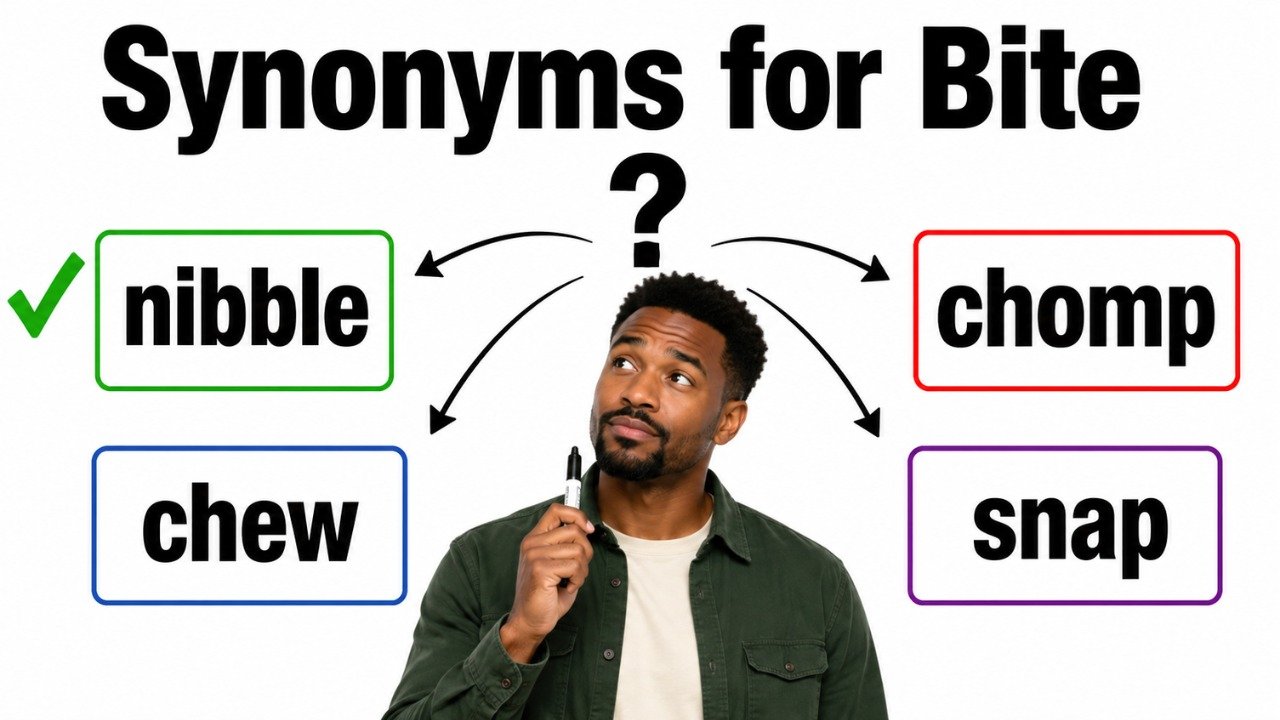
Quick Answer: Common synonyms for bite include nibble, nip, chomp, chew, gnaw, snap, sting, puncture, mouthful, and tang. Use nibble for eating a small amount, chomp for a strong or noisy action, gnaw for repeated biting, nip for a quick light bite, and puncture for a wound caused by teeth. Mouthful describes an amount of food, tang describes a sharp flavor, and sting works for pain, criticism, or certain insect injuries.
Pronunciation and Word Details
Word: Bite.
Pronunciation: /baɪt/
Part of Speech: Noun and verb.
Meaning: To cut, grip, or wound something with the teeth, or a small amount of food, a sharp sensation, or a strong effect.
US Pronunciation:
UK Pronunciation:
What Does “Bite” Mean?
Bite means to press, cut, grip, or tear something with the teeth.
As a verb, bite describes the action of using the teeth on food, a person, an animal, or an object. It may refer to eating, attacking, holding, or causing an injury.
As a noun, a bite can mean a small amount of food, a wound caused by teeth, a sharp taste, a painful sensation, or a forceful quality.
The word also appears in figurative expressions. A cold wind may have a bite, a critical comment may contain bite, and an effective argument may have enough bite to influence an audience.
Eating Action: She bit into the crisp apple.
Animal Attack: The frightened dog tried to bite the stranger.
Small Portion: He took one bite of the sandwich.
Injury: The bite left a small mark on her hand.
Sharp Flavor: The sauce had a pleasant bite.
Strong Effect: The new rule gave the warning more bite.
Meaning, Tone, and Context of “Bite”
Bite is a common and generally neutral word, but its tone changes with the context.
In everyday conversation, bite often refers to eating a small amount of food. Expressions such as take a bite, have a bite, and grab a bite sound casual and natural.
When bite describes an animal attack or physical injury, the tone becomes more serious. In medical or formal writing, more precise terms such as puncture wound, tooth mark, or animal attack may be clearer.
In food writing, bite can describe sharpness, acidity, heat, or a strong flavor. A cheese, sauce, spice, or drink may have a noticeable bite.
In figurative writing, bite suggests force, harshness, effectiveness, or emotional sharpness. A sarcastic remark may have bite, while a law without enforcement may lack bite.
Casual Tone: Let us stop and have a bite to eat.
Physical Tone: The animal bite required immediate care.
Descriptive Tone: The lemon added a fresh bite to the sauce.
Emotional Tone: Her reply had an unexpected bite.
Figurative Tone: The revised policy gave the rules more bite.
When and How to Use “Bite”
For Eating Food
Use bite when someone cuts into food with the teeth or eats a small portion.
Example: She took a bite of the warm bread.
For a Small Amount of Food
Use bite as a noun when referring to a small snack or mouthful.
Example: He had a quick bite before leaving for work.
For an Animal Attack
Use bite when an animal closes its teeth on a person, another animal, or an object.
Example: The frightened dog may bite if approached too quickly.
For a Physical Injury
Use bite for a mark, wound, or injury caused by teeth or certain insects.
Example: The bite caused redness around the injured area.
For Repeated Biting
Use gnaw instead of bite when the action is repeated slowly over time.
Example: The puppy continued to gnaw the wooden toy.
For Strong Flavor
Use bite when food has a sharp, spicy, acidic, or pungent quality.
Example: Fresh ginger gave the soup an extra bite.
For Cold Weather
Use bite to describe the sharp and uncomfortable effect of cold air.
Example: There was a bitter bite in the morning wind.
For Criticism
Use bite when a remark, joke, or response sounds sharp, harsh, or sarcastic.
Example: His criticism had more bite than he intended.
For Force or Effectiveness
Use bite when an argument, rule, warning, or statement has power and influence.
Example: The new penalties gave the regulation real bite.
For Gripping a Surface
Use bite when a tool, blade, wheel, or mechanical part grips firmly.
Example: The tires could not bite into the loose surface.
Best Synonyms for Bite
Nibble
Synonym: Nibble means to take small and gentle bites.
Example: She nibbled a biscuit while reading.
Nip
Synonym: Nip means to give a quick, small, or light bite.
Example: The playful puppy nipped his sleeve.
Chomp
Synonym: Chomp means to bite or chew something strongly and often noisily.
Example: He chomped through the crunchy vegetables.
Chew
Synonym: Chew means to crush food repeatedly with the teeth before swallowing.
Example: Chew each mouthful carefully before swallowing.
Gnaw
Synonym: Gnaw means to bite something repeatedly, usually over a longer period.
Example: The rabbit gnawed the edge of the cardboard box.
Snap
Synonym: Snap means to make a sudden attempt to bite.
Example: The frightened animal snapped at the handler.
Sting
Synonym: Sting means to cause a sharp pain, especially through an insect injury or harsh remark.
Example: The insect sting caused a burning sensation.
Puncture
Synonym: Puncture means to make a small hole in something with a sharp object or tooth.
Example: The animal’s tooth punctured the thick fabric.
Mouthful
Synonym: Mouthful means an amount of food or drink that fills the mouth.
Example: He swallowed a mouthful of water.
Tang
Synonym: Tang means a strong, sharp, and often pleasant flavor.
Example: The citrus juice added a refreshing tang.
50 Synonyms for Bite with Short Meanings
- Nibble: To eat something using small, gentle bites.
- Nip: To give a quick or light bite.
- Chomp: To bite or chew strongly and noisily.
- Chew: To crush food repeatedly with the teeth.
- Gnaw: To bite something repeatedly over time.
- Munch: To eat steadily, often with noticeable chewing.
- Crunch: To bite hard food with a crisp sound.
- Snap: To make a sudden attempt to bite.
- Clamp: To close tightly around something.
- Grip: To hold something firmly.
- Seize: To take or hold something suddenly and forcefully.
- Sink One’s Teeth Into: To bite deeply or begin something eagerly.
- Tear: To pull or cut something apart.
- Pierce: To pass through something and make a hole.
- Puncture: To create a small hole with a tooth or sharp point.
- Sting: To cause a sudden sharp pain.
- Prick: To make a tiny hole or cause slight sharp pain.
- Pinch: To press or squeeze sharply.
- Wound: To cause physical injury.
- Cut: To break or damage a surface with something sharp.
- Tooth Mark: A visible impression left by teeth.
- Puncture Wound: A narrow and deep injury caused by a pointed object or tooth.
- Mouthful: An amount that can be held in the mouth.
- Morsel: A small piece of food.
- Piece: A small portion of something larger.
- Taste: A small amount eaten or sampled.
- Sample: A small portion used for testing or trying.
- Snack: A small amount of food eaten between meals.
- Sharpness: A strong or intense quality in taste or tone.
- Tang: A sharp and lively flavor.
- Zest: A fresh, exciting, or sharp flavor.
- Piquancy: A pleasantly sharp or spicy quality.
- Pungency: A strong taste or smell.
- Acidity: A sour or sharp quality in food or drink.
- Heat: A burning quality produced by spicy food.
- Kick: A sudden strong flavor or effect.
- Edge: A sharp, forceful, or critical quality.
- Force: Strength or power behind an action.
- Impact: A strong effect or influence.
- Severity: The quality of being harsh or intense.
- Harshness: An unpleasantly sharp or severe quality.
- Criticism: An expression of disapproval or judgment.
- Attack: An aggressive action against someone or something.
- Jab: A quick, sharp action or critical remark.
- Insult: A disrespectful or offensive comment.
- Sarcasm: Sharp language that mocks or criticizes.
- Frost: A cold condition that can feel sharp or damaging.
- Chill: An uncomfortable feeling of coldness.
- Hold: A firm grip on something.
- Purchase: A secure grip or firm contact with a surface.
Read Also:
Synonyms for Also in an Essay
Synonyms for Bite by Context
When Bite Means Eating a Small Amount
Nibble, taste, sample, mouthful, morsel, piece, and snack work when bite refers to eating food.
Nibble: She nibbled a piece of toast before the meeting.
Taste: He tasted the soup before adding more salt.
Sample: Guests sampled several dishes from the menu.
Mouthful: She took a mouthful of rice.
Morsel: The child ate every morsel on the plate.
When Bite Means Chewing Strongly
Chomp, chew, munch, crunch, and gnaw describe different ways of using the teeth.
Chomp: He chomped into the thick sandwich.
Chew: She chewed the vegetables slowly.
Munch: The children munched popcorn during the film.
Crunch: He crunched the crisp apple.
Gnaw: The dog gnawed the bone for several minutes.
When Bite Means a Quick Animal Action
Nip, snap, seize, clamp, and grip describe quick or forceful biting actions.
Nip: The nervous horse nipped at the rope.
Snap: The dog snapped at the moving object.
Seize: The animal seized the food with its teeth.
Clamp: The creature clamped its jaws around the branch.
Grip: Its teeth gripped the fabric firmly.
When Bite Means an Injury
Puncture, pierce, wound, cut, prick, tooth mark, and puncture wound describe the physical result of a bite.
Puncture: The tooth punctured the skin.
Pierce: The sharp fang pierced the protective glove.
Wound: The animal wounded the handler’s hand.
Tooth Mark: A clear tooth mark remained on the fruit.
Puncture Wound: The doctor examined the small puncture wound.
When Bite Means an Insect Injury
Sting, prick, pinch, wound, and irritation can describe the painful effect of an insect encounter.
Sting: The bee sting caused immediate pain.
Prick: The bite felt like a sudden prick.
Pinch: The insect bite produced a brief pinching sensation.
Wound: The small wound became red and swollen.
When Bite Means Sharp Flavor
Tang, zest, piquancy, pungency, acidity, heat, kick, and sharpness describe strong flavors.
Tang: The yogurt added a pleasant tang.
Zest: The fresh herbs gave the dish more zest.
Piquancy: The mustard added mild piquancy.
Pungency: The garlic had a noticeable pungency.
Kick: The pepper gave the sauce a powerful kick.
When Bite Means Sharp Criticism
Edge, jab, criticism, insult, sarcasm, severity, and harshness work for forceful or painful language.
Edge: Her reply carried a sharp edge.
Jab: His comment sounded like a personal jab.
Criticism: The article contained strong criticism.
Sarcasm: There was clear sarcasm in her response.
Harshness: The harshness of his words surprised everyone.
When Bite Means Power or Effectiveness
Force, impact, edge, severity, strength, and power may replace bite when discussing influence.
Force: The speaker delivered the message with force.
Impact: The final example gave the argument greater impact.
Edge: The new evidence gave the report an additional edge.
Severity: Increased penalties added severity to the warning.
When Bite Means Coldness
Frost, chill, coldness, sharpness, and sting describe the uncomfortable effect of cold weather.
Frost: Early frost covered the grass.
Chill: A sudden chill filled the evening air.
Sharpness: The sharpness of the wind made walking difficult.
Sting: The cold air stung her face.
Another Word for Bite
Nibble is often the best single replacement for bite when someone eats a small amount gently. However, the strongest alternative depends on the intended meaning.
Use chomp for forceful eating, gnaw for repeated biting, nip for a quick animal bite, puncture for a wound, tang for sharp flavor, and sting for pain or harsh criticism.
Original: She took a small bite of the cake.
Better Option: She nibbled a small piece of the cake.
Original: The dog continued to bite the toy.
Better Option: The dog continued to gnaw the toy.
Original: The sauce has a pleasant bite.
Better Option: The sauce has a pleasant tang.
Original: His reply had an unpleasant bite.
Better Option: His reply had a harsh edge.
When Not to Use “Bite”
Bite may sound vague when a more precise word can explain how someone ate, how an injury occurred, or what kind of sharpness was present.
When Describing Gentle Eating
Nibble is more accurate when someone takes several small bites.
Weak: She bit the cracker slowly for several minutes.
Better: She nibbled the cracker slowly.
When Describing Repeated Chewing
Gnaw is better when an animal repeatedly bites a hard object.
Weak: The puppy bit the bone all afternoon.
Better: The puppy gnawed the bone all afternoon.
When Describing an Insect Injury
Not every insect bites. Some insects sting by injecting venom through a stinger.
Weak: The bee gave him a painful bite.
Better: The bee gave him a painful sting.
When Describing a Medical Injury
Bite may be too general in a formal medical description.
Weak: The patient had a bite on the hand.
Better: The patient had a puncture wound on the hand.
When Describing Flavor
Tang, acidity, heat, or pungency may give the reader a clearer picture.
Weak: The lemon sauce had a strong bite.
Better: The lemon sauce had a refreshing acidity.
When Describing Criticism
Edge, sting, jab, or harshness may communicate the emotional tone more precisely.
Weak: Her answer contained a lot of bite.
Better: Her answer contained a sharp edge.
When Describing Mechanical Grip
Grip, hold, or purchase may be clearer in technical writing.
Weak: The wheels had enough bite on the surface.
Better: The wheels had enough grip on the surface.
Words Commonly Confused With Bite
Bite vs Nibble: Bite is a general action involving the teeth. Nibble means taking several small and gentle bites.
Bite vs Nip: Bite can be light or severe. Nip usually refers to a quick, small, and sometimes playful bite.
Bite vs Chomp: Bite is neutral. Chomp suggests a strong, energetic, or noisy biting action.
Bite vs Chew: Bite means closing the teeth on something. Chew means repeatedly crushing food with the teeth before swallowing.
Bite vs Gnaw: Bite may happen once. Gnaw describes repeated biting, especially on something hard.
Bite vs Sting: A bite is normally caused by teeth or mouthparts. A sting is caused by a stinger or describes a sharp painful sensation.
Bite vs Mouthful: Bite describes an action or a small piece removed with the teeth. Mouthful describes the amount held in the mouth.
Bite vs Puncture: Bite describes the cause or action. Puncture describes the hole or injury created by a tooth or pointed object.
Bite vs Tang: Bite can describe strong flavor generally. Tang specifically suggests a sharp, lively, and often acidic taste.
Bite vs Edge: Bite can describe sharp force figuratively. Edge emphasizes a harsh, forceful, or competitive quality.
Which Synonym Should You Choose?
Choose nibble when someone eats slowly using several small bites.
Choose nip when an animal gives a quick, light, or warning bite.
Choose chomp in casual speech when someone bites or chews strongly.
Choose chew when the focus is on crushing food before swallowing.
Choose gnaw when someone or an animal repeatedly bites a hard object.
Choose crunch when the food is crisp and makes a noticeable sound.
Choose snap when an animal makes a sudden attempt to bite.
Choose puncture in formal or medical writing when a tooth creates a small hole.
Choose tooth mark when describing the visible impression left by teeth.
Choose mouthful when referring to the amount of food held in the mouth.
Choose morsel when describing a very small piece of food.
Choose tang when a food has a sharp and lively flavor.
Choose acidity when discussing a sour quality in food or drink.
Choose heat or kick when spicy ingredients create a burning effect.
Choose sting when describing sudden pain, an insect injury, or painful criticism.
Choose edge when writing about harsh language, competitiveness, or force.
Choose impact when describing the strength of an argument, warning, or message.
Choose grip or purchase in technical writing when something holds a surface firmly.
Choose sarcasm when the figurative bite comes from mocking or cutting language.
Real Life Examples of “Bite” in Sentences
Original: She took a small bite of the biscuit.
Better Option: She nibbled the biscuit.
Original: The dog continued to bite the wooden toy.
Better Option: The dog continued to gnaw the wooden toy.
Original: He bit loudly into the crisp apple.
Better Option: He crunched loudly into the crisp apple.
Original: The puppy gave her sleeve a quick bite.
Better Option: The puppy gave her sleeve a quick nip.
Original: The animal tried to bite the approaching stranger.
Better Option: The animal snapped at the approaching stranger.
Original: The bite created a small hole in the glove.
Better Option: The tooth punctured the glove.
Original: She ate one bite of the dessert.
Better Option: She ate one morsel of the dessert.
Original: The mustard gave the sandwich a strong bite.
Better Option: The mustard gave the sandwich a sharp tang.
Original: His reply had a surprising bite.
Better Option: His reply had a surprising edge.
Original: The cold wind had a painful bite.
Better Option: The cold wind had a painful sting.
Synonym Groups and Usage Differences
Eating Group
Nibble, chomp, chew, munch, crunch, and gnaw all describe actions involving food or the teeth.
Nibble suggests small and gentle bites. Chomp suggests forceful eating. Chew focuses on repeated jaw movement. Munch suggests steady and casual eating. Crunch emphasizes a crisp sound. Gnaw describes repeated biting over time.
Example: The child nibbled the toast while his brother chomped through an apple.
Animal Action Group
Nip, snap, clamp, grip, seize, and attack describe animal biting behavior.
Nip is usually quick and light. Snap is a sudden biting attempt. Clamp suggests tightly closed jaws. Grip emphasizes holding firmly. Seize suggests a sudden forceful action. Attack describes broader aggression.
Example: The frightened dog snapped at the stranger but did not make contact.
Injury Group
Puncture, pierce, wound, cut, tooth mark, and puncture wound describe physical damage.
Puncture and pierce focus on making a hole. Wound is a broad injury term. Cut usually describes a break in the skin. Tooth mark refers to the visible impression. Puncture wound is a more precise medical description.
Example: The bite left two small puncture wounds.
Food Portion Group
Mouthful, morsel, piece, taste, sample, and snack describe amounts of food.
Mouthful is enough to fill the mouth. Morsel is a very small piece. Taste and sample refer to trying a limited amount. Snack describes a small informal meal.
Example: She sampled one small morsel of the dessert.
Flavor Group
Tang, zest, piquancy, pungency, acidity, heat, kick, and sharpness describe strong tastes.
Tang often refers to a lively acidic taste. Piquancy suggests pleasant spiciness. Pungency can describe a powerful taste or smell. Heat refers to burning spice. Kick suggests a sudden strong effect.
Example: The fresh lime gave the sauce a bright tang.
Criticism Group
Edge, criticism, jab, insult, sarcasm, harshness, and severity describe figurative bite in language.
Edge suggests controlled sharpness. Jab is a brief critical remark. Sarcasm uses mocking language. Harshness describes an unpleasant tone. Severity emphasizes seriousness or strictness.
Example: Her polite words still carried a critical edge.
Power Group
Force, impact, edge, severity, and strength describe the effectiveness of a message, policy, or argument.
Force refers to power. Impact describes the effect on an audience. Edge suggests an advantage or sharp quality. Severity describes strictness or intensity.
Example: The final statistic gave the argument greater impact.
Grip Group
Clamp, grip, hold, seize, and purchase describe firm contact.
Clamp suggests pressure from two sides. Grip and hold are general terms. Seize suggests sudden movement. Purchase refers to secure contact with a surface.
Example: The tires found enough purchase on the wet road.
Antonyms of Bite
The opposite of bite depends on whether the word refers to teeth, injury, flavor, criticism, coldness, or grip.
Release: To stop holding or gripping something.
Let Go: To free something from a hold.
Loosen: To make a grip less tight.
Soothe: To reduce pain, irritation, or emotional sharpness.
Heal: To recover from a wound or injury.
Comfort: To reduce distress or unpleasantness.
Gentleness: A soft and mild quality.
Mildness: A lack of sharpness, heat, or severity.
Blandness: A lack of strong or noticeable flavor.
Softness: A quality without harshness or sharp force.
Warmth: A comfortable absence of coldness.
Kindness: A considerate quality without verbal harshness.
Praise: An expression of approval rather than criticism.
Protection: The act of preventing injury or attack.
Smoothness: A quality without sharp edges, roughness, or sudden force.
Comparison: Bite vs Related Words
Bite vs Nibble
Bite is the general term for using the teeth. Nibble describes eating with several small and gentle bites.
Example With Bite: She took a bite of the apple.
Example With Nibble: She nibbled the corner of the cracker.
Bite vs Nip
Bite may be gentle or severe. Nip usually refers to a quick and relatively light bite.
Example With Bite: The dog bit the intruder’s shoe.
Example With Nip: The puppy nipped playfully at his sleeve.
Bite vs Chomp
Bite is neutral and broad. Chomp suggests strong, enthusiastic, or noisy biting.
Example With Bite: He bit into the sandwich.
Example With Chomp: He chomped through the sandwich quickly.
Bite vs Chew
Bite refers to closing the teeth on something. Chew refers to repeatedly crushing food in the mouth.
Example With Bite: She bit off a piece of bread.
Example With Chew: She chewed the bread carefully.
Bite vs Gnaw
Bite may describe one action. Gnaw describes repeated biting, usually on something firm.
Example With Bite: The dog bit the toy once.
Example With Gnaw: The dog gnawed the toy for an hour.
Bite vs Sting
A bite is commonly caused by teeth or mouthparts. A sting is caused by a stinger or describes sudden sharp pain.
Example With Bite: The spider bite caused redness.
Example With Sting: The bee sting caused immediate pain.
Bite vs Puncture
Bite describes the action or injury caused by teeth. Puncture focuses on the hole created in a surface.
Example With Bite: The animal bite injured his hand.
Example With Puncture: The tooth punctured his glove.
Bite vs Mouthful
Bite can refer to the action or piece taken with the teeth. Mouthful describes the amount placed inside the mouth.
Example With Bite: She took one bite of the pie.
Example With Mouthful: She swallowed a mouthful of pie.
Bite vs Tang
Bite can describe any sharp or strong flavor. Tang usually describes a lively and pleasantly acidic flavor.
Example With Bite: The sauce had a strong bite.
Example With Tang: The lemon gave the sauce a fresh tang.
Bite vs Edge
Bite may describe force or sharpness figuratively. Edge emphasizes harshness, competitiveness, or effectiveness.
Example With Bite: His criticism had real bite.
Example With Edge: His criticism had a harsh edge.
Common Phrases and Expressions With Bite
Take a Bite: Eat a small piece of food using the teeth.
Have a Bite: Eat a small amount of food.
A Bite to Eat: A small meal or snack.
Bite Into: Cut into food or another object with the teeth.
Bite Off: Remove a piece using the teeth.
Bite Down: Press the upper and lower teeth together firmly.
Bite Back: Stop oneself from expressing a reaction or respond forcefully.
Bite One’s Tongue: Prevent oneself from saying something.
Bite the Bullet: Face a difficult or unpleasant situation bravely.
Bite Someone’s Head Off: Respond to someone with sudden anger.
Common Mistakes to Avoid
Confusing Bite, Bit, and Bitten
Bite is the base form. Bit is the simple past form. Bitten is the past participle.
Incorrect: The dog has bit the toy.
Correct: The dog has bitten the toy.
Incorrect: The dog bite the toy yesterday.
Correct: The dog bit the toy yesterday.
Using Bite and Chew as Exact Synonyms
Biting and chewing are related but different actions. A person bites to cut into food and chews to crush it repeatedly.
Unclear: Bite the food thoroughly before swallowing.
Better: Chew the food thoroughly before swallowing.
Calling Every Insect Injury a Bite
Some insects bite, while others sting. Use the correct word when the cause is known.
Incorrect: The bee bite caused swelling.
Correct: The bee sting caused swelling.
Repeating Bite Too Often
Using bite repeatedly can make a paragraph sound dull or unclear.
Repetitive: He took a bite, chewed the bite, and swallowed the bite.
Improved: He took a bite, chewed the mouthful, and swallowed it.
Choosing an Overly Casual Synonym
Chomp and munch may sound too informal in medical, scientific, or professional writing.
Too Casual: The animal chomped the patient’s hand.
Better: The animal bit the patient’s hand and caused a puncture wound.
Using Bite Vaguely for Flavor
Explain whether the food tastes acidic, spicy, pungent, or sharp.
Vague: The dish had a lot of bite.
Clear: The dish had a sharp acidity and mild heat.
Confusing a Bite With a Mouthful
A bite is the action or piece removed with the teeth. A mouthful is the amount held inside the mouth.
Incorrect: She drank a bite of water.
Correct: She drank a mouthful of water.
Misusing Figurative Expressions
Common expressions with bite should not always be interpreted literally.
Literal Meaning: He bit his tongue while eating.
Figurative Meaning: He bit his tongue to avoid criticizing the decision.
Conclusion
Synonyms for bite include nibble, nip, chomp, chew, gnaw, sting, puncture, mouthful, tang, and edge. Choose nibble for gentle eating, gnaw for repeated biting, nip for a quick animal action, and puncture for a physical wound. Tang and kick describe strong flavors, while edge and sting suit criticism or emotional pain. Selecting the right alternative makes your sentence more precise by showing whether bite refers to eating, injury, flavor, coldness, grip, or force.
FAQs About Synonyms for Bite
What Is the Best Synonym for Bite?
Nibble is a useful synonym when bite refers to eating a small amount. Nip, chomp, gnaw, puncture, tang, and sting work in other contexts.
What Is Another Word for a Small Bite?
Nibble, morsel, mouthful, taste, and sample can describe a small bite or small amount of food.
What Is a Stronger Word for Bite?
Chomp suggests a strong bite, while gnaw suggests repeated biting. Puncture is stronger when describing an injury.
What Is Another Word for an Animal Bite?
Nip, snap, attack, puncture, wound, and tooth mark may work depending on the severity and action.
What Is Another Word for Bite in Food?
Tang, kick, heat, sharpness, piquancy, pungency, and acidity can describe a strong or sharp flavor.
What Is Another Word for Bite in Criticism?
Edge, sting, jab, sarcasm, harshness, and severity can describe sharp or painful criticism.
What Is the Opposite of Bite?
Release, loosen, soothe, mildness, blandness, gentleness, and kindness are possible opposites depending on the meaning.
