
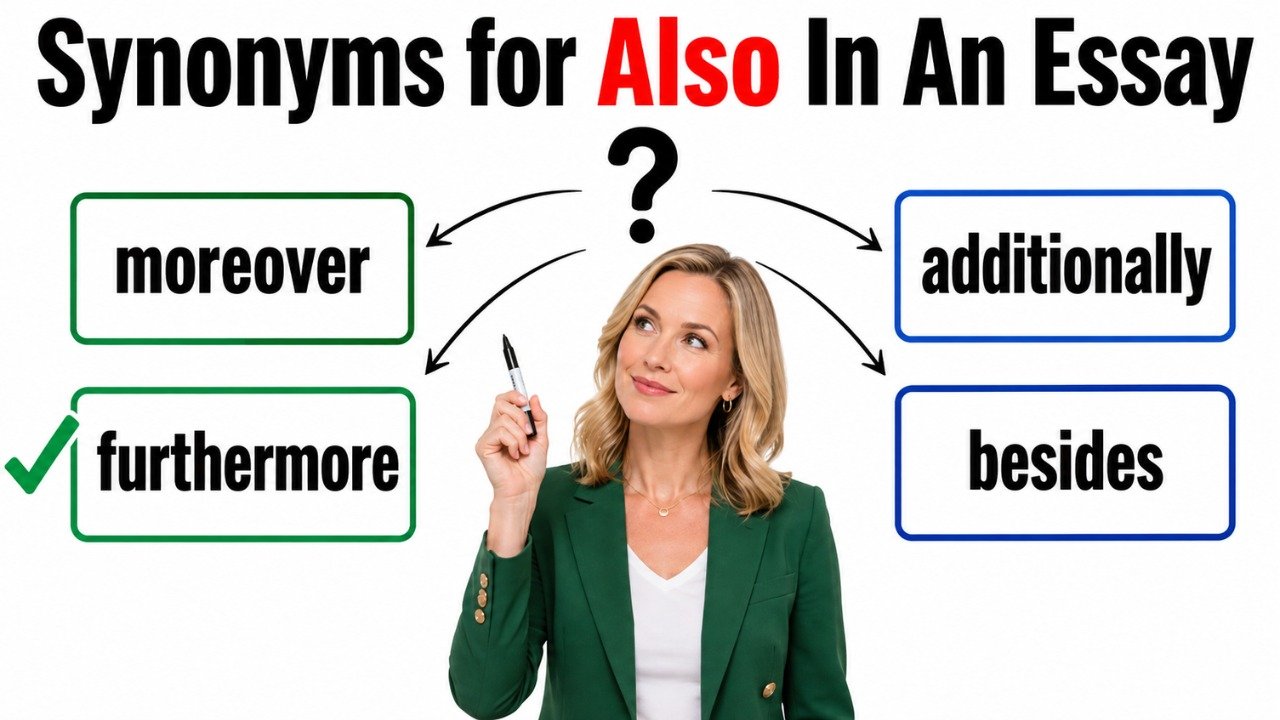
Quick Answer: The best synonyms for also in an essay include additionally, furthermore, moreover, in addition, as well, likewise, similarly, what is more, another point is, and equally important. Use additionally or in addition to introduce another fact. Choose furthermore or moreover to develop a formal argument. Use likewise or similarly when connecting comparable ideas. As well works naturally within a sentence, while another point is helps introduce a separate supporting idea. Equally important is best when the added point deserves the same level of attention.
Pronunciation and Word Details
Word: Also
Pronunciation: /ˈɔːl.soʊ/
Part of Speech: Adverb
Meaning: In addition to something already mentioned.
US Pronunciation:
UK Pronunciation:
What Does “Also” Mean?
Also means in addition to a person, thing, action, fact, or idea that has already been mentioned.
It is an adverb commonly used to connect related information. In an essay, also can add evidence, introduce another reason, extend an argument, mention an extra example, or show that two statements are both true.
The word can appear in several sentence positions.
At the Beginning: Also, the results reveal a significant improvement in accuracy.
Before a Main Verb: The study also identifies several environmental risks.
After a Helping Verb: The policy has also increased public awareness.
After the Verb Be: Education is also an important economic factor.
Also is clear and grammatically correct, but frequent repetition can make academic writing sound basic or mechanical. Stronger transitions can show the exact relationship between ideas more clearly.
Meaning, Tone, and Context of “Also”
Also has a neutral and versatile tone. It is suitable for essays, reports, emails, conversations, explanations, and general academic writing.
Neutral Tone: Also adds information without expressing a strong emotional attitude.
Academic Tone: It is acceptable in essays, although additionally, furthermore, and moreover may sound more formal.
Conversational Tone: Also is common in everyday speech because it is simple and direct.
Explanatory Context: Writers use it to add another fact, feature, effect, or example.
Argumentative Context: It may introduce another reason that supports a claim.
Analytical Context: It can connect findings, causes, consequences, or interpretations.
Comparative Context: It can indicate that a similar condition applies to another subject.
Although also is flexible, it does not explain whether the next idea is an example, contrast, result, cause, or conclusion. A more specific transition may improve clarity when the logical relationship matters.
When and How to Use “Also”
For Adding Information: Use also when introducing a related fact or detail.
Example: The program reduces costs and also improves efficiency.
For Adding Evidence: Use also to present another fact that supports an argument.
Example: The survey also shows that public confidence has increased.
For Adding a Reason: Use also when a second reason strengthens the main claim.
Example: The proposal is affordable and also responds to community needs.
For Adding an Example: Use also when presenting another illustration of a broader idea.
Example: The author also uses imagery to develop the central theme.
For Describing an Additional Effect: Use also to introduce another result or consequence.
Example: Air pollution damages human health and also affects wildlife.
For Connecting Similar Subjects: Use also when the same statement applies to another person, object, or group.
Example: The policy affects private institutions and also applies to public organizations.
For Academic Analysis: Place also before the main verb to maintain smooth sentence flow.
Example: The data also indicates a relationship between sleep and concentration.
For Formal Transitions: Replace also with additionally, furthermore, or moreover when beginning an important new supporting sentence.
Example: Furthermore, the evidence challenges the earlier interpretation.
Best Synonyms for Also
Additionally
Synonym: In addition to what has already been stated.
Example: Additionally, the research identifies several long term benefits.
Furthermore
Synonym: Used to add information that develops or strengthens an argument.
Example: Furthermore, the proposed system requires fewer resources.
Moreover
Synonym: Used to introduce another important point supporting the previous statement.
Example: Moreover, the evidence comes from several independent studies.
In Addition
Synonym: As another fact, reason, quality, or example.
Example: In addition, the policy could improve access to education.
As Well
Synonym: In addition, usually placed near the end of a clause.
Example: The reform benefits small businesses as well.
Likewise
Synonym: In the same or a comparable way.
Example: Rural communities require reliable transportation. Likewise, urban neighborhoods need accessible public services.
Similarly
Synonym: In a way that resembles what has already been described.
Example: The first group experienced rapid improvement. Similarly, the second group reported better results.
What Is More
Synonym: Used to introduce another notable or persuasive point.
Example: What is more, the solution can be implemented without major expense.
Another Point Is
Synonym: A phrase used to introduce a separate supporting idea.
Example: Another point is that the new process reduces unnecessary delays.
Equally Important
Synonym: Used to add a point that deserves the same amount of attention.
Example: Equally important, the plan protects the interests of vulnerable groups.
50 Synonyms for Also With Short Meanings
- Additionally: As another fact or piece of information.
- Furthermore: In addition, especially when developing an argument.
- Moreover: Used to add another important supporting point.
- In Addition: As an extra fact, reason, or example.
- As Well: In addition to something already mentioned.
- Too: In addition, usually placed at the end of a clause.
- Likewise: In the same or a comparable way.
- Similarly: In a way resembling the previous idea.
- Equally: To the same degree or in the same way.
- Correspondingly: In a way that matches or relates to another situation.
- Besides: In addition to the point already stated.
- What Is More: Used to introduce another notable fact.
- Added to This: Combined with the information already presented.
- Along With This: Together with the previous point.
- Together With This: Accompanying the idea already mentioned.
- Coupled With This: Connected with another factor or condition.
- Combined With This: Joined with the previous fact or argument.
- In Conjunction With This: Operating or occurring together with another factor.
- Beyond This: Used to introduce an additional consideration.
- On Top of This: In addition to an existing situation.
- Not Only That: Used to add another surprising or important point.
- At the Same Time: Additionally or during the same period.
- Simultaneously: At the same time as another action or event.
- Concurrently: Existing or happening during the same period.
- In Parallel: Occurring alongside another process or development.
- In the Same Way: Similarly or by the same method.
- By the Same Token: For the same reason or according to the same principle.
- In a Similar Manner: In a way comparable to the previous example.
- Comparably: In a similar or equivalent way.
- Of Equal Importance: Deserving the same level of attention.
- Equally Important: Having the same significance as another point.
- More Importantly: Used to add a point with greater significance.
- Another Point Is: Introduces a separate supporting idea.
- Another Factor Is: Introduces an additional influence or condition.
- Another Reason Is: Presents an extra reason supporting a claim.
- Another Consideration Is: Adds an issue that should be examined.
- Another Example Is: Introduces an additional illustration.
- Another Benefit Is: Presents an extra advantage.
- Another Consequence Is: Introduces an additional result or effect.
- A Further Point Is: Adds another point to an explanation or argument.
- A Further Factor Is: Introduces another relevant influence.
- A Further Reason Is: Adds another justification or cause.
- A Further Consideration Is: Presents another matter requiring attention.
- An Additional Point Is: Introduces one more relevant idea.
- An Additional Factor Is: Adds another condition affecting a result.
- An Additional Reason Is: Presents one more supporting reason.
- An Additional Example Is: Gives one more illustration of an idea.
- To Add to This: Introduces information that extends the previous point.
- Adding to This: Connects a new detail with an existing argument.
- In Support of This: Introduces further evidence for a claim.
Read Also:
Synonyms for Maintained

Synonyms for Also by Context
When Also Adds Another Fact
Additionally, in addition, furthermore, moreover, besides, and what is more can introduce another related fact.
Example: Additionally, the updated system provides better protection against data loss.
In addition is neutral and direct. Additionally sounds formal, while moreover often signals that the added fact strengthens an argument.
When Also Develops an Argument
Furthermore, moreover, another point is, a further point is, and an additional reason is can extend a structured argument.
Example: Furthermore, the proposed approach addresses the main weaknesses of the previous model.
Furthermore usually develops the existing argument. Moreover adds a point that is often persuasive or especially important.
When Also Adds Evidence
In support of this, additionally, added to this, and what is more can introduce supporting evidence.
Example: In support of this, recent observations reveal a consistent improvement in performance.
In support of this is more precise than also because it clearly tells the reader that evidence will follow.
When Also Shows Similarity
Likewise, similarly, in the same way, in a similar manner, and comparably connect comparable ideas.
Example: The northern region experienced a decline in rainfall. Similarly, the southern region recorded unusually dry conditions.
These alternatives should only be used when the ideas are genuinely similar.
When Also Shows Equal Importance
Equally important, of equal importance, and equally are useful when two points deserve similar attention.
Example: Equally important, students need sufficient time to apply the concepts they learn.
These phrases do more than add information. They tell the reader that the new point has comparable significance.
When Also Introduces Another Reason
Another reason is, a further reason is, and an additional reason is make the purpose of the new sentence immediately clear.
Example: Another reason is that the program can operate with limited funding.
These phrases are especially useful in argumentative and persuasive essays.
When Also Adds Another Example
Another example is and an additional example is clearly introduce further illustrations.
Example: Another example is the use of renewable materials in modern construction.
Use these phrases instead of also when readers need a clear signal that an example will follow.
When Also Describes Parallel Actions
At the same time, simultaneously, concurrently, and in parallel describe events or processes occurring together.
Example: The organization reduced operating costs while simultaneously improving service quality.
These words are appropriate only when timing or parallel development is important.
Another Word for Also
Additionally is usually the best single replacement for also in a formal essay. It has a clear academic tone and introduces another related fact, reason, or piece of evidence.
However, the best alternative depends on the relationship between ideas. Use furthermore to develop an argument, moreover to add a persuasive point, similarly to show resemblance, and likewise to show that the same principle applies elsewhere.
Original: The policy also protects local communities.
Better Option: Additionally, the policy protects local communities.
Original: The evidence also supports the main argument.
Better Option: Furthermore, the evidence supports the main argument.
Original: The second experiment also produced comparable results.
Better Option: Similarly, the second experiment produced comparable results.
Original: Cost is also an important consideration.
Better Option: Equally important, cost must be considered.
When Not to Use “Also”
Do not use also repeatedly at the beginning of several consecutive sentences. This makes the paragraph sound mechanical and limits the clarity of the connections between ideas.
Weak: Also, the policy saves money. Also, it reduces delays. Also, it improves access.
Better: The policy saves money. Furthermore, it reduces delays and improves access.
Do not use also when the relationship is actually contrast, cause, result, or conclusion.
Weak: Also, the cost increased because demand fell.
Better: As a result, the cost increased when demand fell.
Avoid placing also where it creates ambiguity about which word or phrase it modifies.
Weak: The researcher interviewed also teachers from rural schools.
Better: The researcher also interviewed teachers from rural schools.
Do not combine also with another additive transition unnecessarily.
Weak: Furthermore, the study also additionally reveals a significant difference.
Better: Furthermore, the study reveals a significant difference.
Avoid also when a more specific phrase would help readers understand the purpose of the sentence.
Weak: The project also has another benefit.
Better: Another benefit is that the project creates local employment.
Do not use highly conversational alternatives such as on top of this in a formal academic paper unless the writing style permits informal language.
Weak: On top of this, the evidence proves the theory.
Better: Moreover, the evidence supports the theory.
Words Commonly Confused With Also
Also vs Additionally: Both add information. Also is neutral and flexible, while additionally sounds more formal and often begins a new sentence.
Also vs Furthermore: Also simply introduces another detail. Furthermore usually develops or strengthens an existing argument.
Also vs Moreover: Also adds information without indicating importance. Moreover often introduces a persuasive or significant supporting point.
Also vs Likewise: Also means in addition. Likewise means that something happens or applies in a similar way.
Also vs Similarly: Also introduces another idea, while similarly specifically identifies a resemblance between ideas.
Also vs As Well: Both express addition. Also usually appears before a main verb, while as well commonly appears near the end of a clause.
Also vs Too: Too is a concise alternative commonly placed at the end of a sentence. It is often more conversational than additionally or furthermore.
Also vs Besides: Besides can mean in addition, but it may sometimes suggest that the new point is secondary or that the previous point was already sufficient.
Also vs Simultaneously: Also adds information. Simultaneously means that two actions or events occur at the same time.
Also vs And: And grammatically joins words, phrases, or clauses. Also emphasizes that an extra fact or quality is being added.
Which Synonym Should You Choose?
Choose additionally when adding another fact in a formal essay, report, or academic explanation.
Choose furthermore when the new sentence develops or reinforces the existing argument.
Choose moreover when adding a particularly important or persuasive supporting point.
Choose in addition when you need a clear, neutral transition between related ideas.
Choose as well when adding information naturally near the end of a sentence.
Choose too for concise and relatively conversational writing.
Choose likewise when the same principle, result, or condition applies to another subject.
Choose similarly when comparing two ideas, examples, results, or situations.
Choose another reason is when introducing an additional justification for a claim.
Choose another example is when providing a new illustration.
Choose equally important when the added point deserves the same attention as the previous point.
Choose more importantly when the new point has greater significance.
Choose simultaneously or concurrently when discussing events occurring at the same time.
Choose in support of this when introducing evidence that directly supports an argument.
Choose another consequence is when adding a separate result or effect.
Real Life Examples of “Also” in Sentences
Original: The new library also provides quiet spaces for students.
Better Option: In addition, the new library provides quiet spaces for students.
Original: The policy also reduces administrative costs.
Better Option: Furthermore, the policy reduces administrative costs.
Original: The findings also support the original hypothesis.
Better Option: Moreover, the findings support the original hypothesis.
Original: The second group also experienced improved results.
Better Option: Similarly, the second group experienced improved results.
Original: The northern region also requires additional resources.
Better Option: Likewise, the northern region requires additional resources.
Original: The project also creates employment opportunities.
Better Option: Another benefit is that the project creates employment opportunities.
Original: The author also uses symbolism to communicate uncertainty.
Better Option: Additionally, the author uses symbolism to communicate uncertainty.
Original: Public safety is also an important concern.
Better Option: Equally important, public safety remains a major concern.
Original: The program also failed because it lacked sufficient funding.
Better Option: Another reason for the program’s failure was insufficient funding.
Original: The chemical also affects water quality.
Better Option: What is more, the chemical affects water quality.
Synonym Groups and Usage Differences
Formal Addition Group
Additionally, furthermore, moreover, and in addition are strong options for academic and professional writing.
Additionally introduces another related fact. Furthermore develops an argument. Moreover adds a significant supporting point. In addition is clear and neutral.
Example: Moreover, the proposed strategy offers measurable environmental benefits.
Simple Addition Group
As well, too, besides, and along with this add information without creating a highly formal tone.
As well and too usually fit within or at the end of a sentence. Besides can introduce an extra reason, while along with this connects related details.
Example: The new system improves accuracy as well.
Similarity Group
Likewise, similarly, comparably, in the same way, and in a similar manner indicate resemblance.
These words should not be used merely to add an unrelated point. They require a meaningful similarity between subjects, actions, or results.
Example: The first treatment improved memory. Similarly, the second treatment increased concentration.
Argument Development Group
Another point is, a further point is, another reason is, and in support of this help organize complex arguments.
These phrases are useful when readers need an explicit signal about the role of the next sentence.
Example: Another reason is that the method can be applied in several different environments.
Equal Importance Group
Equally important, of equal importance, and equally show that the new idea deserves comparable attention.
Example: Equally important, the proposal must remain accessible to low income households.
Parallel Action Group
At the same time, simultaneously, concurrently, and in parallel describe developments that happen together.
These words add information while also communicating a relationship in time or process.
Example: The researchers collected survey data while simultaneously observing participant behavior.
Additional Example Group
Another example is, an additional example is, and to add to this introduce further illustrations or supporting details.
Example: Another example is the increasing use of recycled materials in public buildings.
Antonyms of Also
Also does not have one exact antonym in every sentence. Its opposites depend on whether the writer wants to exclude, replace, separate, or contrast an idea.
Only: Indicates that nothing or no one else is included.
Solely: Limits an action, cause, or responsibility to one thing.
Exclusively: Applies only to a particular person, group, or purpose.
Instead: Replaces one action, idea, or option with another.
Rather: Expresses preference or correction instead of addition.
Alternatively: Introduces a different possible choice.
Except: Excludes a person or thing from a general statement.
Excluding: Deliberately leaving something out.
Otherwise: Refers to a different condition or possible outcome.
Separately: Apart from something else rather than together with it.
Conversely: Introduces an opposite or reversed relationship.
Independently: Without being connected to another action, factor, or idea.
Comparison: Also vs Related Words
Also vs Additionally
Also is neutral and can appear in different sentence positions. Additionally is more formal and frequently introduces a new sentence or clause.
Example With Also: The program also provides financial support.
Example With Additionally: Additionally, the program provides financial support.
Also vs Furthermore
Also adds another fact. Furthermore signals that the new point develops or strengthens the argument.
Example With Also: The process also reduces waste.
Example With Furthermore: Furthermore, the process reduces waste and conserves energy.
Also vs Moreover
Also presents additional information. Moreover generally introduces a point that is important or persuasive.
Example With Also: The solution is also affordable.
Example With Moreover: Moreover, the solution is affordable enough for widespread adoption.
Also vs Likewise
Also simply adds information. Likewise indicates that a similar statement applies to another subject.
Example With Also: The eastern region also received additional funding.
Example With Likewise: The western region received additional funding. Likewise, the eastern region gained new resources.
Also vs Similarly
Also means in addition. Similarly means in a comparable way.
Example With Also: The second method also improved performance.
Example With Similarly: The first method reduced errors. Similarly, the second method improved overall accuracy.
Also vs As Well
Also usually appears before the main verb or after a helping verb. As well normally appears near the end of a clause.
Example With Also: The research also considers economic factors.
Example With As Well: The research considers economic factors as well.
Also vs Too
Also and too have nearly the same additive meaning, but too is more common at the end of a sentence and may sound more conversational.
Example With Also: The policy also affects local businesses.
Example With Too: The policy affects local businesses too.
Common Phrases and Expressions With “Also”
Also Important: Introduces another matter that deserves attention.
Also Includes: Shows that an additional item belongs to a group or category.
Also Shows: Adds another finding, observation, or visible result.
Also Suggests: Introduces another possible interpretation or conclusion.
Also Indicates: Adds further evidence or information pointing toward a conclusion.
Also Demonstrates: Presents another fact that clearly illustrates an idea.
Also Applies To: Shows that the same rule or principle affects another subject.
Also Contributes To: Identifies another cause or influence.
Also Affects: Shows that an additional person, group, or condition experiences an effect.
Also Known As: Introduces another name for a person, object, concept, or place.
Common Mistakes to Avoid
Repeating Also Too Often: Using also in every sentence makes writing sound repetitive. Replace some uses with additionally, furthermore, in addition, or more specific transitions.
Using Multiple Additive Words Together: Avoid combinations such as also additionally or furthermore also when one transition is sufficient.
Choosing Similarity Words for Unrelated Ideas: Likewise and similarly require a meaningful resemblance. Do not use them merely because another fact is being added.
Using Moreover for a Weak Detail: Moreover should introduce a relevant and reasonably important supporting point.
Confusing Addition With Contrast: Do not use also when however, nevertheless, or in contrast expresses the intended relationship.
Confusing Addition With Results: Use therefore, consequently, or as a result when the second statement follows logically from the first.
Misplacing Also: Place also near the word or action it modifies so the sentence remains clear.
Incorrect: The researcher tested also the second sample.
Correct: The researcher also tested the second sample.
Starting Every Paragraph With a Transition: Not every paragraph needs additionally or furthermore. A direct topic sentence may create stronger writing.
Using Informal Alternatives in Formal Essays: Phrases such as on top of this and not only that may sound conversational. Use additionally or moreover in formal academic work.
Ignoring the Exact Relationship: Select a transition that shows whether the new idea is evidence, an example, a reason, a similar case, or an equally important point.
Conclusion
The most effective synonyms for also in an essay depend on the connection between ideas. Additionally and in addition introduce related information, while furthermore and moreover strengthen an argument. Likewise and similarly connect comparable points, and equally important highlights shared significance. Phrases such as another reason is or another example is make the purpose of a sentence especially clear. By selecting transitions according to meaning rather than simply replacing words, writers can create smoother paragraphs, clearer arguments, and more professional academic writing.
FAQs About Synonyms for Also
What Is the Best Synonym for Also in an Essay?
Additionally is one of the best general alternatives because it is clear, formal, and suitable for adding facts, reasons, or evidence.
Can I Use Also in a Formal Essay?
Yes. Also is grammatically correct in formal writing, but repeating it too often can make an essay sound basic or mechanical.
What Can I Use Instead of Also at the Beginning of a Sentence?
You can use additionally, furthermore, moreover, in addition, similarly, or likewise, depending on the relationship between ideas.
What Is a Formal Alternative to Also?
Additionally, furthermore, moreover, and in addition are strong formal alternatives.
What Is the Difference Between Furthermore and Moreover?
Both add supporting information. Furthermore develops an argument, while moreover often introduces a particularly important or persuasive point.
Can Similarly Replace Also?
Similarly can replace also only when the new statement resembles the previous one. It should not introduce an unrelated additional fact.
How Can I Avoid Repeating Also in an Essay?
Use transitions that express the exact purpose of each sentence, such as another reason is, in support of this, another example is, likewise, furthermore, or equally important.
