
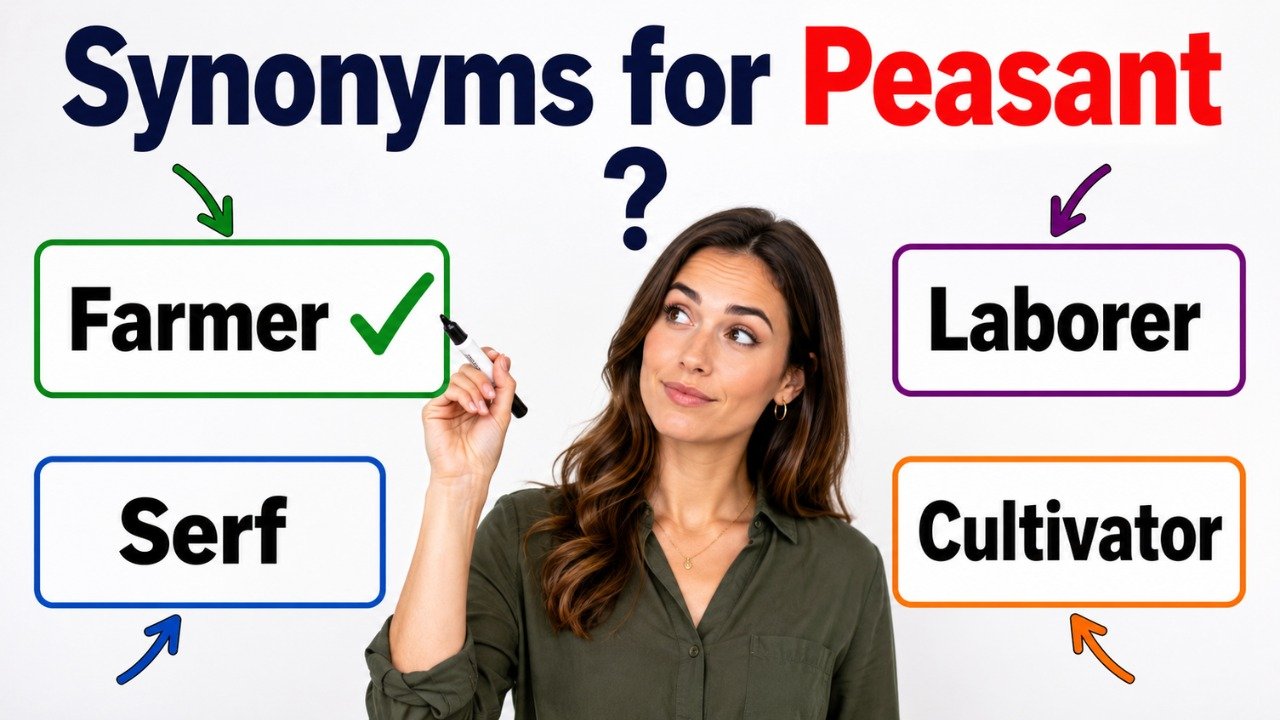
Quick Answer: The best synonyms for peasant include farmer, smallholder, tenant farmer, farmworker, agricultural laborer, cultivator, villager, commoner, serf, and rustic. Use farmer or cultivator for someone who works the land. Smallholder is suitable for someone who manages a small farm, while tenant farmer describes a person who farms rented land. In historical writing, commoner, serf, or villein may be more accurate. Rustic can describe a rural person, but it may sound judgmental. Avoid using peasant as an insult because it can suggest that someone is uneducated, poor, or socially inferior.
Pronunciation and Word Details
Word: Peasant
Pronunciation: /ˈpez.ənt/
Part of Speech: Noun and attributive adjective
Meaning: A person who traditionally lives in the countryside and earns a living by farming or agricultural labor.
US Pronunciation:
UK Pronunciation:
What Does “Peasant” Mean?
Peasant means a person from a traditional rural community who works on a small farm or performs agricultural labor.
The word is mainly a noun. It is commonly used when discussing historical farming communities, social classes, rural economies, and traditional village life.
In historical contexts, a peasant was often a poor farmer, tenant, laborer, or commoner who had limited land, wealth, or political power. Some peasants owned small pieces of land, while others worked land belonging to a landlord.
In modern conversation, the word can sound old fashioned or disrespectful when applied directly to a living person. Neutral expressions such as farmer, farmworker, smallholder, agricultural worker, or rural resident are usually more appropriate.
The word can also appear before another noun.
Example: The museum displayed traditional peasant clothing.
In this sentence, peasant describes clothing associated with rural farming communities.
Meaning, Tone, and Context of “Peasant”
Peasant has a neutral and academic tone when it is used in historical, economic, cultural, or sociological discussions.
Historians may use the word when explaining rural societies, feudal systems, agricultural production, class structures, revolts, and village communities.
Historical Tone: The word is common in descriptions of traditional farming societies and earlier social systems.
Academic Tone: It may appear in essays about economics, history, agriculture, politics, and social class.
Cultural Tone: It can describe traditional clothing, food, customs, music, or architecture associated with rural communities.
Modern Tone: It may sound outdated when used for present day farmers or agricultural workers.
Insulting Tone: When directed at someone, peasant can imply that the person is poor, uneducated, uncultured, or socially inferior. This use is disrespectful and should normally be avoided.
The most suitable replacement depends on whether the sentence refers to farming, land ownership, village residence, historical status, or insulting behavior.
When and How to Use “Peasant”
For Historical Farming Communities: Use peasant when describing people who lived in traditional agricultural societies.
Example: Most peasants in the region depended on small plots of land.
For Social History: Use the word when discussing traditional class divisions between rural workers, landowners, nobles, and rulers.
Example: The law placed heavy taxes on the peasant population.
For Agricultural Systems: Peasant can describe farmers who mainly produce food for their families or local communities.
Example: Peasant agriculture remained important to the local economy.
For Cultural Traditions: The word may describe traditional rural clothing, food, customs, art, or music.
Example: The exhibition featured peasant costumes from several villages.
For Political History: Use peasant when discussing rural protests, revolutions, land reforms, or organized movements.
Example: The peasant uprising demanded fairer access to farmland.
For Modern Farmers: Choose farmer, smallholder, farmworker, or agricultural worker instead of peasant.
Example: Smallholders grow vegetables and grain on the surrounding land.
For Respectful Communication: Avoid calling a person a peasant in casual conversation.
Example: She comes from a family of farmers.
For Figurative Use: Be cautious because peasant may become a class based insult.
Example: Describing someone as a peasant because of their clothing is offensive.
Best Synonyms for Peasant
Farmer
Synonym: A person who owns, manages, or works on a farm.
Example: The farmer grows wheat, corn, and vegetables.
Smallholder
Synonym: A person who owns or manages a small area of agricultural land.
Example: The smallholder sells fresh produce at the village market.
Tenant Farmer
Synonym: A farmer who works land rented from another person.
Example: The tenant farmer paid part of the harvest to the landowner.
Farmworker
Synonym: A person employed to perform practical work on a farm.
Example: Each farmworker helped gather the fruit before the rain arrived.
Agricultural Laborer
Synonym: A worker who performs physical tasks connected with farming.
Example: The agricultural laborer spent the morning preparing the fields.
Cultivator
Synonym: A person who prepares land and grows crops.
Example: The cultivator improved the soil before planting rice.
Villager
Synonym: A person who lives in a village.
Example: Every villager contributed food to the community celebration.
Commoner
Synonym: A person who does not belong to the nobility or ruling class.
Example: The law treated a commoner differently from a noble.
Serf
Synonym: A farm laborer in a feudal system who was legally tied to an estate.
Example: The serf worked the lord’s land in exchange for protection.
Rustic
Synonym: A rural person, especially one associated with simple country life.
Example: The story follows a rustic who leaves his village for the city.
50 Synonyms for Peasant With Short Meanings
- Farmer: A person who owns, manages, or works on a farm.
- Smallholder: Someone who farms a relatively small piece of land.
- Tenant Farmer: A farmer who rents land from its owner.
- Farmworker: A person employed to perform work on a farm.
- Agricultural Laborer: A worker who carries out physical farming tasks.
- Cultivator: Someone who prepares land and grows crops.
- Tiller: A person who prepares and works the soil.
- Field Hand: A laborer who works directly in agricultural fields.
- Plowman: A person who plows and prepares farmland.
- Husbandman: An old word for a farmer or cultivator.
- Yeoman: A historical farmer who owned or worked a modest area of land.
- Crofter: A person who farms a small rented area of land.
- Sharecropper: A farmer who gives the landowner part of the harvest as rent.
- Cottager: A rural resident who lives in a small cottage, sometimes with limited land.
- Villager: A person who lives in a village.
- Countryman: A man who lives in or comes from the countryside.
- Rural Worker: A person employed in a countryside occupation.
- Farm Laborer: Someone hired to complete physical work on a farm.
- Agricultural Worker: A general term for someone employed in agriculture.
- Land Worker: A person who works directly with agricultural land.
- Rural Laborer: A manual worker living or employed in the countryside.
- Subsistence Farmer: A farmer who grows mainly enough food for personal or family use.
- Family Farmer: Someone who owns or works on a family operated farm.
- Village Farmer: A farmer who lives and works within a village community.
- Small Farmer: A person who operates a farm with limited land or resources.
- Land Cultivator: Someone who prepares and uses land to grow crops.
- Soil Tiller: A worker who breaks up and prepares soil for planting.
- Field Worker: A person who performs manual tasks in crop fields.
- Commoner: A person outside the nobility or ruling class.
- Rural Commoner: An ordinary person from a countryside community.
- Village Commoner: A nonnoble member of a traditional village society.
- Person of Humble Birth: Someone born into a family with limited wealth or social status.
- Lowborn Person: A historical term for someone from a lower social class.
- Member of the Rural Poor: A person belonging to an economically disadvantaged countryside population.
- Serf: A feudal worker who was legally bound to an estate.
- Villein: A feudal tenant who owed labor or services to a lord.
- Bondsman: A historical laborer who was legally bound to serve another person.
- Feudal Tenant: Someone who occupied land under obligations to a feudal lord.
- Manorial Laborer: A worker who performed agricultural duties on a manor.
- Peon: A poorly paid laborer or dependent worker in certain historical and regional contexts.
- Rustic: A person associated with simple rural life.
- Yokel: An insulting word for a supposedly unsophisticated rural person.
- Country Bumpkin: An informal and insulting term for an inexperienced rural person.
- Hayseed: An informal insult for someone considered rural or unsophisticated.
- Clodhopper: An old insulting term for a clumsy or unrefined country person.
- Boor: A rude or socially insensitive person.
- Churl: An old word for a rude person or a person of low social rank.
- Provincial: A person considered limited by rural or regional experience.
- Uncultured Person: Someone considered to lack education or social refinement.
- Rural Inhabitant: A person who lives in the countryside.
Read Also:
Synonyms for Misery

Synonyms for Peasant by Context
When Peasant Means Farmer
Farmer, cultivator, smallholder, tiller, plowman, husbandman, and land cultivator are appropriate when the main idea is growing crops or working the soil.
Example: The smallholder grew enough rice to support the family.
Farmer is the broadest modern alternative. Cultivator emphasizes growing crops, while tiller and plowman emphasize preparing the soil.
When Peasant Means Agricultural Worker
Farmworker, agricultural laborer, field hand, field worker, farm laborer, and rural laborer describe people who perform physical agricultural work.
Example: The farmworker harvested fruit throughout the morning.
These words are useful when the person is employed by a farm owner rather than operating an independent farm.
When Peasant Means a Small Landholder
Smallholder, small farmer, crofter, family farmer, and subsistence farmer describe people working limited areas of land.
Example: The smallholder used traditional methods to cultivate vegetables.
Smallholder is particularly useful in formal writing because it describes farm size without making a judgment about social class.
When Peasant Means a Historical Rural Commoner
Commoner, rural commoner, village commoner, villein, serf, feudal tenant, and manorial laborer may fit historical discussions.
Example: The commoner had few political rights under the old system.
The exact word depends on the person’s legal status. A commoner was not necessarily a farmer, while a serf or villein had specific obligations within a feudal system.
When Peasant Means a Village Resident
Villager, rural inhabitant, countryman, cottager, and village farmer focus on where a person lives.
Example: Each villager helped repair the road after the storm.
Villager is more neutral than peasant when farming or social status is not important.
When Peasant Is Used as an Insult
Rustic, yokel, hayseed, clodhopper, country bumpkin, boor, and uncultured person can express a similar insulting meaning.
Example: Calling him a yokel because of his accent was unfair.
These words are judgmental and may offend people. Use them only when explaining insulting language, describing a fictional character’s attitude, or quoting a historical viewpoint.
Another Word for Peasant
Farmer is usually the best single modern replacement for peasant when the sentence refers to agriculture.
However, the best alternative depends on the person’s role, land ownership, legal status, and historical period. Smallholder is more precise for someone farming a small property. Farmworker describes an employee, while serf applies only to a particular historical system.
Original: The peasant grew vegetables on a small piece of land.
Better Option: The smallholder grew vegetables on a small piece of land.
Original: The peasants gathered the crops for the estate owner.
Better Option: The farmworkers gathered the crops for the estate owner.
Original: The peasant was legally tied to the lord’s estate.
Better Option: The serf was legally tied to the lord’s estate.
Original: Every peasant attended the village meeting.
Better Option: Every villager attended the village meeting.
When Not to Use “Peasant”
Do not use peasant for every person who lives in the countryside. A rural resident may be a teacher, shopkeeper, craftsperson, doctor, business owner, or farmer.
Weak: Every person in the village was a peasant.
Better: Every person in the village was invited to the celebration.
Avoid the word when describing modern agricultural professionals unless the historical or economic meaning is important.
Weak: The peasant uses advanced equipment to manage a large commercial farm.
Better: The farmer uses advanced equipment to manage a large commercial farm.
Do not use peasant as a casual insult for someone’s clothing, accent, income, education, or manners.
Weak: He looks like a peasant in those old clothes.
Better: His clothes have a simple and traditional style.
Do not replace serf with peasant when legal dependence is an important part of the sentence.
Weak: Every peasant was legally bound to the estate.
Better: Every serf was legally bound to the estate.
Avoid using peasant when the sentence only refers to manual labor.
Weak: The factory employed hundreds of peasants.
Better: The factory employed hundreds of laborers.
Words Commonly Confused With Peasant
Peasant vs Farmer: Peasant usually refers to a member of a traditional rural social class, while farmer is a broad and neutral term for someone who operates or works on a farm.
Peasant vs Farmworker: A peasant may farm personal, family, rented, or communal land. A farmworker is generally employed to work for someone else.
Peasant vs Smallholder: A peasant is defined partly by historical and social context. A smallholder is defined mainly by the limited size of the farm.
Peasant vs Serf: A peasant was not always legally bound to a landowner. A serf had specific legal and labor obligations within a feudal system.
Peasant vs Commoner: A commoner is anyone outside the nobility. A peasant is more specifically connected with rural life and agriculture.
Peasant vs Villager: Villager describes residence in a village. Peasant traditionally suggests agricultural work and a particular social position.
Peasant vs Rustic: Peasant has a historical and economic meaning. Rustic may describe rural character, appearance, manners, or lifestyle.
Peasant vs Laborer: Laborer is a broad term for someone who performs physical work. Peasant is more closely associated with rural farming communities.
Which Synonym Should You Choose?
Choose farmer when referring generally to someone who grows crops, raises animals, or manages agricultural land.
Choose smallholder when the person owns or manages a relatively small farm.
Choose tenant farmer when the farmer rents land from someone else.
Choose farmworker when the person is employed to perform agricultural tasks.
Choose agricultural laborer for formal writing about manual work in farming.
Choose cultivator when emphasizing the preparation of land and production of crops.
Choose villager when the sentence focuses on residence rather than occupation or social status.
Choose commoner when contrasting an ordinary person with nobles, royalty, or a ruling class.
Choose serf when discussing a person who was legally tied to a feudal estate.
Choose villein when writing specifically about certain forms of feudal tenancy.
Choose subsistence farmer when the farmer produces mainly enough food for personal or family needs.
Choose rustic only when rural simplicity is the intended meaning. Be aware that it can sound dismissive when applied to a person.
Avoid yokel, hayseed, clodhopper, and country bumpkin in respectful writing because these words are insulting.
Real Life Examples of “Peasant” in Sentences
Original: The peasant cultivated a small area beside the river.
Better Option: The smallholder cultivated a small area beside the river.
Original: The peasants worked together during the harvest.
Better Option: The farmworkers worked together during the harvest.
Original: The peasant rented land from a wealthy owner.
Better Option: The tenant farmer rented land from a wealthy owner.
Original: The peasant was required to work on the lord’s estate.
Better Option: The serf was required to work on the lord’s estate.
Original: The peasant used a wooden plow to prepare the field.
Better Option: The cultivator used a wooden plow to prepare the field.
Original: Every peasant gathered in the village square.
Better Option: Every villager gathered in the village square.
Original: The king imposed a new tax on each peasant.
Better Option: The king imposed a new tax on each rural commoner.
Original: She came from a family of poor peasants.
Better Option: She came from a family of small farmers with limited resources.
Original: The peasants demanded greater access to agricultural land.
Better Option: The rural workers demanded greater access to agricultural land.
Original: He insulted the man by calling him a peasant.
Better Option: He insulted the man by describing him as uncultured.
Synonym Groups and Usage Differences
Farming Group
Farmer, cultivator, tiller, plowman, husbandman, and land cultivator focus on agricultural activity.
Farmer is the most general and modern word. Cultivator emphasizes growing crops, while tiller and plowman focus on preparing the soil.
Example: The cultivator planted rice after preparing the field.
Small Farm Group
Smallholder, small farmer, family farmer, crofter, and subsistence farmer describe people working farms of limited size.
Smallholder is neutral and formal. Subsistence farmer specifically describes someone producing food mainly for personal or family consumption.
Example: The subsistence farmer stored enough grain for the winter.
Agricultural Employment Group
Farmworker, farm laborer, agricultural laborer, field hand, and field worker describe people employed to carry out farming tasks.
These words do not automatically suggest land ownership.
Example: The farm laborer repaired the fence before feeding the animals.
Historical Social Group
Commoner, rural commoner, serf, villein, bondsman, and feudal tenant are useful in historical discussions.
Commoner refers broadly to someone outside the nobility. Serf and villein describe more specific legal positions.
Example: The villein owed labor and agricultural produce to the lord.
Rural Community Group
Villager, cottager, countryman, rural inhabitant, and village farmer focus on countryside residence and community membership.
These terms are often more neutral than peasant.
Example: The villagers cooperated to repair the damaged bridge.
Insulting Group
Yokel, hayseed, clodhopper, country bumpkin, boor, and uncultured person express negative judgments about education, manners, or sophistication.
These words should not be used as neutral descriptions.
Example: The character arrogantly dismissed the villagers as yokels.
Antonyms of Peasant
The opposite of peasant changes according to whether the word refers to occupation, social rank, wealth, land ownership, or rural residence.
Noble: A person belonging to a privileged hereditary social class.
Aristocrat: A member of a wealthy or powerful upper class.
Landowner: A person who owns land that others may farm or occupy.
Lord: A historical landholder with authority over an estate or territory.
Ruler: A person who governs a country, region, or community.
Royal: A member of a ruling family.
Elite: A member of a socially, politically, or economically powerful group.
Urbanite: A person who lives in a city.
Industrialist: A person who owns or manages industrial businesses.
Wealthy Proprietor: A person who owns valuable property or productive land.
Estate Owner: Someone who owns a large area of land or a major agricultural property.
Courtier: A person who serves or attends a royal court.
Comparison: Peasant vs Related Words
Peasant vs Farmer
Peasant carries historical, social, and economic associations. Farmer is a modern and neutral occupational term.
Example With Peasant: The peasant family depended on a small plot controlled by the estate.
Example With Farmer: The farmer manages a successful agricultural business.
Peasant vs Smallholder
Peasant may describe a broad rural social class. Smallholder refers more precisely to someone managing a small farm.
Example With Peasant: The reform changed the lives of thousands of peasants.
Example With Smallholder: The smallholder grows fruit on three acres of land.
Peasant vs Farmworker
Peasant may own, rent, or work a piece of land. Farmworker normally describes someone employed by a farm owner or agricultural company.
Example With Peasant: The peasant produced food for the household and local market.
Example With Farmworker: The farmworker received payment for harvesting the crop.
Peasant vs Serf
Peasant is a broad historical category. Serf refers to someone legally bound to an estate under a feudal arrangement.
Example With Peasant: The peasant sold vegetables in the nearby town.
Example With Serf: The serf was required to provide labor to the lord.
Peasant vs Commoner
A peasant is normally associated with agriculture and village life. A commoner is any person who does not belong to the nobility.
Example With Peasant: The peasant worked a narrow strip of farmland.
Example With Commoner: A commoner could become a merchant, craftsperson, soldier, or farmer.
Peasant vs Villager
Peasant suggests occupation and social position. Villager only identifies a person as a resident of a village.
Example With Peasant: The peasant depended on the harvest for survival.
Example With Villager: The villager operated a small shop near the square.
Peasant vs Rustic
Peasant has a historical social meaning. Rustic describes something or someone associated with simple countryside life.
Example With Peasant: The peasant paid taxes through grain and labor.
Example With Rustic: The rustic character was unfamiliar with city customs.
Common Phrases and Expressions With Peasant
Peasant Farmer: A traditional farmer who works a small area of land.
Peasant Family: A household belonging to a traditional rural farming community.
Peasant Class: A historical social group made up largely of small farmers and agricultural workers.
Peasant Society: A community whose economy and daily life depend strongly on small scale farming.
Peasant Community: A rural population connected through farming, village traditions, and shared labor.
Peasant Agriculture: Farming carried out mainly by small rural producers.
Peasant Economy: An economic system based largely on household or village agricultural production.
Peasant Uprising: A protest or rebellion organized by rural workers or farmers.
Peasant Clothing: Traditional clothing associated with rural communities.
Peasant Culture: The customs, beliefs, food, music, and traditions of historical farming communities.
Common Mistakes to Avoid
Using Peasant for Every Farmer: Not every farmer is a peasant. Farmer is usually the better word for modern agricultural professionals.
Ignoring Historical Context: Peasant often describes a social and economic position within a particular historical society. Explain the period and system when necessary.
Confusing Peasant With Serf: Some peasants were free farmers or tenants. Serfs had specific legal obligations and restrictions.
Using the Word as an Insult: Calling someone a peasant can express contempt for their income, education, clothing, accent, or background.
Assuming Every Villager Is a Farmer: A villager may have any occupation. Use villager when residence is the only relevant detail.
Choosing an Inaccurate Synonym: Commoner focuses on social rank, farmworker focuses on employment, and smallholder focuses on farm size.
Repeating Peasant Too Often: Vary the wording with farmer, rural worker, smallholder, villager, or agricultural laborer when the meaning remains clear.
Using Archaic Words Without Explanation: Husbandman, villein, churl, and bondsman may be unfamiliar to modern readers. Provide context when using them.
Using Derogatory Alternatives Casually: Yokel, hayseed, clodhopper, and country bumpkin are insults rather than respectful occupational terms.
Making Broad Assumptions: Do not assume that rural people lack education, wealth, culture, or modern knowledge.
Conclusion
The most useful synonyms for peasant depend on occupation, land ownership, historical status, and tone. Farmer is the safest general replacement, while smallholder suits a person managing limited land. Farmworker and agricultural laborer describe paid agricultural work. Commoner, serf, and villein are useful in historical writing, while villager focuses on rural residence. When using synonyms for peasant, choose a precise and respectful term instead of language that makes unfair assumptions about class, education, or culture.
FAQs About Synonyms for Peasant
What Is the Best Synonym for Peasant?
Farmer is the best general synonym when referring to someone who works agricultural land. Smallholder, tenant farmer, or farmworker may be more precise in particular contexts.
Is Farmer the Same as Peasant?
Not exactly. Farmer is a neutral occupational term, while peasant often refers to a member of a traditional rural social class.
Is Peasant an Offensive Word?
It can be offensive when directed at someone as an insult. It is usually neutral in accurate historical or academic discussions.
What Is a Respectful Modern Alternative to Peasant?
Farmer, smallholder, agricultural worker, farmworker, rural resident, and villager are respectful alternatives, depending on the intended meaning.
What Is the Historical Synonym for Peasant?
Commoner, serf, villein, tenant farmer, husbandman, and feudal tenant may work in historical writing. Each word describes a different social or legal position.
What Is the Difference Between a Peasant and a Serf?
Peasant is a broad term for a traditional rural farmer or laborer. A serf was legally tied to an estate and owed labor or services to a lord.
Can Villager Be Used Instead of Peasant?
Villager can replace peasant when the sentence only means someone who lives in a village. It does not necessarily mean that the person works in agriculture.
