
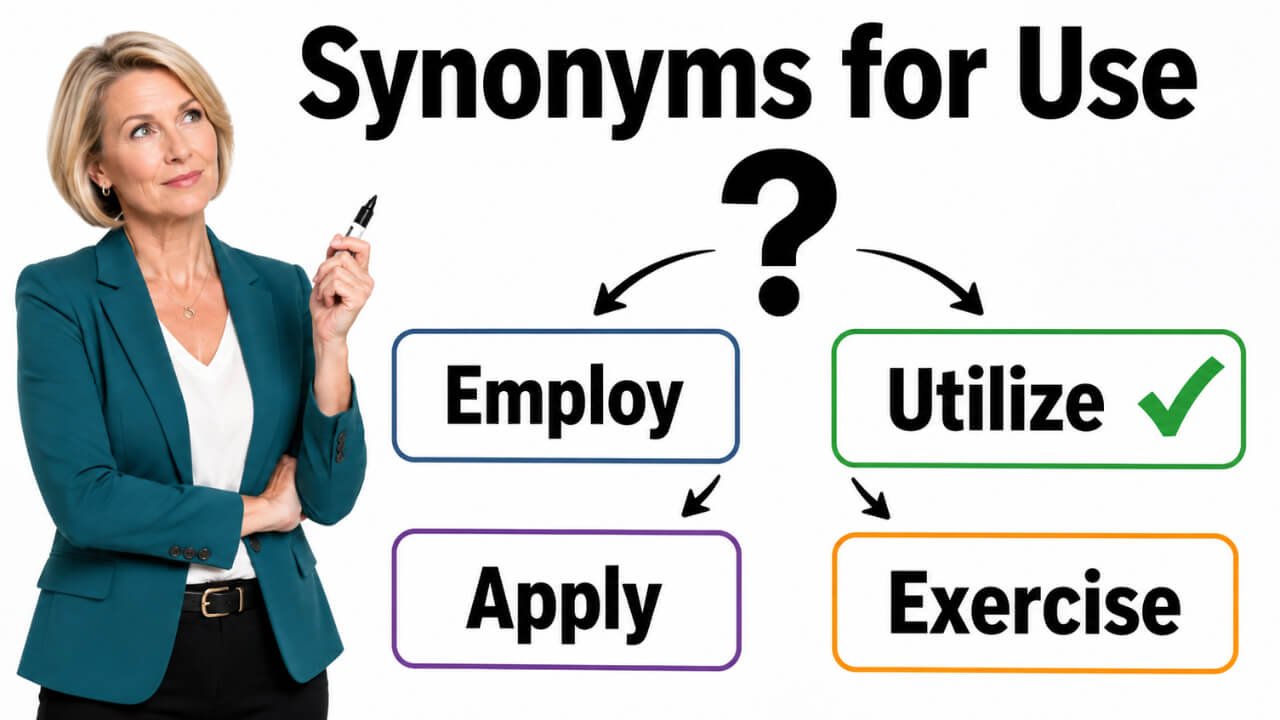
Quick Answer: The best synonyms for use include utilize, employ, apply, operate, handle, implement, practice, exercise, deploy, and make use of. Use utilize in formal or technical writing, employ when describing a method or strategy, apply when putting knowledge or rules into action, operate for machines or tools, and make use of for clear everyday speech.
Pronunciation and Word Details
Word: Use.
Pronunciation: Verb: /juːz/. Noun: /juːs/.
Part of Speech: Verb and noun.
Meaning: To use means to take, apply, operate, or benefit from something for a purpose.
US Pronunciation:
UK Pronunciation:
What Does “Use” Mean?
Direct Answer: “Use” means to take something and put it into action for a purpose.
As a verb, use means to apply, operate, handle, or make something helpful. You can use a tool, use a word, use a method, use time wisely, or use evidence in writing.
As a noun, use means purpose, function, benefit, or practical value. For example, a chair has a use, a rule has a use, and a skill has many uses.
The word works in daily speech, academic writing, instructions, grammar explanations, business communication, and technical descriptions. Because it is simple and flexible, it can fit many sentence contexts.
Meaning, Tone, and Context of “Use”
Tone: “Use” is neutral, simple, and widely accepted.
Formality: It works in both casual and formal writing, but some synonyms sound stronger in professional contexts.
Common Context: The word appears in instructions, essays, reports, conversations, definitions, tutorials, grammar examples, and practical advice.
Emotional Force: “Use” is usually not emotional. It becomes negative when it means taking unfair advantage of someone.
Technical Context: In technical writing, “use” can refer to operating a device, applying a tool, running a process, or selecting a method.
Grammar Context: “Use” can describe how a word, phrase, tense, punctuation mark, or sentence pattern works.
When and How to Use “Use”
For Practical Action: Use “use” when something is being taken or applied for a purpose.
Example: Students use dictionaries to understand difficult words.
For Tools and Equipment: Use “use” when talking about objects, devices, materials, or instruments.
Example: The carpenter used a measuring tape before cutting the wood.
For Knowledge and Skills: Use “use” when someone applies learning, ability, or experience.
Example: She used her grammar knowledge to improve the sentence.
For Rules and Methods: Use “use” when a person follows a technique, process, or system.
Example: Writers use outlines to organize their ideas.
For Time and Resources: Use “use” when someone spends or manages something available.
Example: He used his free time to revise the lesson.
For Purpose or Function: Use “use” as a noun when explaining what something is for.
Example: The main use of a thermometer is to measure temperature.
Best Synonyms for Use
Utilize: To use something in a practical or effective way.
Example: The team utilized the data to improve the report.
Employ: To use a method, tool, skill, or strategy.
Example: The writer employed a clear structure in the essay.
Apply: To put knowledge, rules, or methods into action.
Example: You can apply this grammar rule to similar sentences.
Operate: To control or run a machine, system, or device.
Example: Only trained staff should operate the equipment.
Handle: To use, manage, or deal with something carefully.
Example: She handled the software with confidence.
Implement: To put a plan, system, or method into use.
Example: The school implemented a new reading program.
Practice: To use a skill repeatedly to improve it.
Example: Learners should practice new vocabulary in sentences.
Exercise: To use a right, power, choice, or ability.
Example: Citizens may exercise their right to vote.
Deploy: To use resources, tools, or people for a specific task.
Example: The manager deployed extra staff during the busy period.
Make use of: To use something that is available.
Example: You should make use of clear examples in your answer.
50 Synonyms for Use with Short Meanings
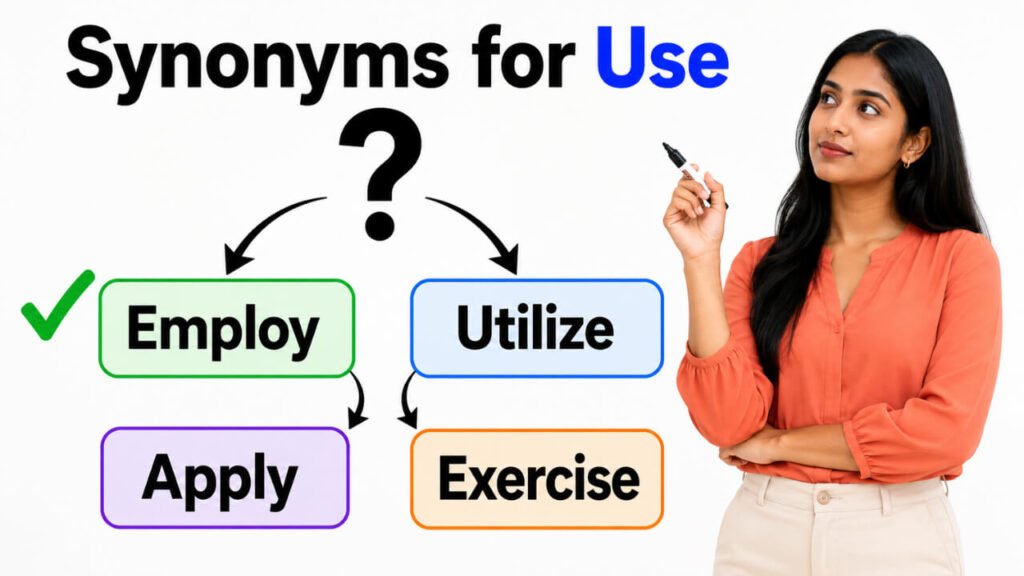
- Utilize: Use effectively for a purpose.
- Employ: Use a method, skill, or tool.
- Apply: Put something into practical action.
- Operate: Control or run a device or system.
- Handle: Use or manage with care.
- Implement: Put a plan or method into action.
- Practice: Use a skill repeatedly.
- Exercise: Use a right, choice, or ability.
- Deploy: Use resources for a specific task.
- Make use of: Take advantage of something available.
- Put to use: Begin using something practically.
- Take advantage of: Use an opportunity or benefit.
- Harness: Use power, energy, or ability effectively.
- Leverage: Use something to gain an advantage.
- Exploit: Use fully, sometimes unfairly.
- Consume: Use up food, energy, time, or resources.
- Spend: Use money, time, or effort.
- Expend: Use energy, effort, or resources.
- Draw on: Use knowledge, experience, or support.
- Rely on: Use something as support or help.
- Resort to: Use something because other choices are limited.
- Adopt: Begin using a method, habit, or system.
- Follow: Use instructions, rules, or guidance.
- Work with: Use a tool, material, or person in a task.
- Run: Use or operate a machine, program, or system.
- Control: Use power over a device, process, or situation.
- Manage: Use and organize resources or tasks.
- Manipulate: Use or control skillfully, sometimes unfairly.
- Administer: Use or give treatment, medicine, or rules.
- Execute: Carry out or perform a plan or command.
- Perform: Use skill to complete an action.
- Engage: Use attention, effort, or involvement.
- Access: Use or reach a system, file, or service.
- Avail oneself of: Use an opportunity or service formally.
- Benefit from: Use something and gain value from it.
- Profit from: Use something for gain or advantage.
- Tap into: Use a source of energy, knowledge, or support.
- Call on: Use help, strength, or knowledge when needed.
- Invoke: Use a rule, law, reason, or authority.
- Refer to: Use information, notes, or examples for help.
- Consult: Use a person, book, or source for advice.
- Activate: Make something start working.
- Employ oneself in: Spend effort or time doing something.
- Put into service: Start using something for work.
- Bring into play: Use a quality, skill, or resource.
- Bring to bear: Use influence, pressure, or knowledge.
- Turn to: Use someone or something for help.
- Carry out: Use a plan by completing it.
- Use up: Consume completely.
- Reuse: Use again after previous use.
Read Also:
Synonyms for Hope

Synonyms for Use by Context
When Use Means Apply
Apply: Use a rule, idea, method, or skill in a real situation.
Example: You can apply this formula to the next problem.
Implement: Use a plan, policy, or system.
Example: The office implemented a better filing method.
Practice: Use a skill often to improve it.
Example: Writers practice sentence variety to improve style.
When Use Means Operate
Operate: Use a machine, tool, or system.
Example: He learned to operate the printer safely.
Run: Use a program, machine, or process.
Example: The technician ran the test twice.
Handle: Use equipment or materials carefully.
Example: Always handle sharp tools with care.
When Use Means Benefit From
Utilize: Use something effectively.
Example: The students utilized extra study time before the exam.
Make use of: Use something available in a practical way.
Example: Make use of clear examples when explaining grammar.
Benefit from: Gain value by using something.
Example: New learners benefit from simple definitions.
When Use Means Spend or Consume
Consume: Use up resources, energy, or material.
Example: The machine consumes less electricity than before.
Spend: Use time, money, or effort.
Example: She spent two hours editing the paragraph.
Expend: Use effort, energy, or resources.
Example: The team expended great effort on the project.
When Use Means Take Advantage Of
Exploit: Use something fully, sometimes in a negative way.
Example: The writer exploited every detail to build suspense.
Leverage: Use something to gain a stronger result.
Example: He leveraged his experience to solve the problem.
Harness: Use power, skill, or energy effectively.
Example: Good teachers harness curiosity to support learning.
Another Word for Use
Direct Answer: The best single word for “use” is usually utilize, especially in formal or practical writing.
The best alternative depends on context. Choose apply for rules and knowledge, operate for machines, employ for methods, and consume when something is used up.
Original: Please use this rule in your sentence.
Better Option: Please apply this rule in your sentence.
Original: The worker used the machine carefully.
Better Option: The worker operated the machine carefully.
Original: The author used a simple writing style.
Better Option: The author employed a simple writing style.
Original: The system uses too much power.
Better Option: The system consumes too much power.
When Not to Use “Use”
Avoid “use” when a more exact word would make your sentence clearer. Because “use” is broad, it can sometimes sound weak, repetitive, or less precise.
Weak: The teacher used a rule to explain the sentence.
Better: The teacher applied a rule to explain the sentence.
Weak: The driver used the machine for hours.
Better: The driver operated the machine for hours.
Weak: The company used a new plan.
Better: The company implemented a new plan.
Weak: The report uses many facts.
Better: The report includes many facts.
Weak: The device uses a lot of energy.
Better: The device consumes a lot of energy.
Weak: She used her right to speak.
Better: She exercised her right to speak.
Words Commonly Confused With Use
Use vs Utilize: “Use” is simple and general, while “utilize” sounds more formal and means using something effectively.
Use vs Apply: “Use” can fit many actions, but “apply” is better for rules, knowledge, skills, methods, and principles.
Use vs Employ: “Use” is common in everyday language, while “employ” is better for strategies, methods, techniques, and writing choices.
Use vs Operate: “Use” can describe almost anything, but “operate” is best for machines, tools, systems, or devices.
Use vs Consume: “Use” means take for a purpose, while “consume” means use up completely or gradually.
Use vs Exploit: “Use” is neutral, while “exploit” can mean use fully or use unfairly.
Use vs Leverage: “Use” is broad, while “leverage” means use something to gain a stronger result or advantage.
Which Synonym Should You Choose?
Choose utilize: Use it when writing formally about making practical or effective use of something.
Choose apply: Use it for rules, grammar, knowledge, methods, skills, and principles.
Choose employ: Use it for techniques, strategies, writing choices, and planned methods.
Choose operate: Use it for machines, tools, equipment, systems, and devices.
Choose handle: Use it when careful control or management is important.
Choose implement: Use it when a plan, policy, rule, or system is put into action.
Choose practice: Use it when a skill is repeated for improvement.
Choose exercise: Use it for rights, authority, judgment, power, or choice.
Choose deploy: Use it when resources, staff, tools, or support are sent or arranged for a task.
Choose consume: Use it when time, money, food, energy, or resources are used up.
Choose make use of: Use it in clear everyday writing when something available is being used.
Real Life Examples of “Use” in Sentences
Original: Please use a clear example in your answer.
Better Option: Please include a clear example in your answer.
Original: Students use grammar rules to build better sentences.
Better Option: Students apply grammar rules to build better sentences.
Original: The manager used a new system for attendance.
Better Option: The manager implemented a new system for attendance.
Original: She used her experience to solve the issue.
Better Option: She drew on her experience to solve the issue.
Original: The technician used the machine carefully.
Better Option: The technician operated the machine carefully.
Original: The writer used strong verbs in the paragraph.
Better Option: The writer employed strong verbs in the paragraph.
Original: The phone uses too much battery power.
Better Option: The phone consumes too much battery power.
Original: We used the available time wisely.
Better Option: We utilized the available time wisely.
Original: The lawyer used the rule in court.
Better Option: The lawyer invoked the rule in court.
Original: The team used extra workers during the rush.
Better Option: The team deployed extra workers during the rush.
Synonym Groups and Usage Differences
Action Group
This group includes synonyms that show something being put into action.
Useful Synonyms: Apply, implement, execute, carry out, practice.
Example: The teacher applied the new method during the lesson.
Tool and Machine Group
This group is best for equipment, devices, systems, and technical tasks.
Useful Synonyms: Operate, run, handle, control, activate.
Example: The engineer operated the system with care.
Resource Group
This group works when using time, energy, money, staff, or materials.
Useful Synonyms: Utilize, deploy, expend, spend, consume.
Example: The team deployed its resources carefully.
Advantage Group
This group shows using something to gain benefit or stronger results.
Useful Synonyms: Leverage, harness, exploit, take advantage of, benefit from.
Example: The student leveraged feedback to improve the essay.
Support Group
This group works when using information, help, experience, or guidance.
Useful Synonyms: Draw on, rely on, refer to, consult, call on.
Example: She drew on past experience during the interview.
Function Group
This group connects to the noun meaning of “use,” meaning purpose or value.
Useful Synonyms: Purpose, function, application, utility, benefit.
Example: The main function of the tool is to measure distance.
Antonyms of Use
The opposite of “use” depends on the meaning. If use means apply, the opposite may be ignore. If it means consume, the opposite may be save. If it means operate, the opposite may be stop or disable.
Ignore: To not use or pay attention to something.
Neglect: To fail to use or care for something properly.
Avoid: To stay away from using something.
Misuse: To use something wrongly or improperly.
Waste: To use something carelessly with little benefit.
Save: To keep resources instead of using them.
Preserve: To protect something instead of using it up.
Store: To keep something for later use.
Abandon: To stop using or supporting something.
Disable: To stop a tool, machine, or system from being used.
Comparison: Use vs Related Words
Use vs Utilize
“Use” is simple and suitable for most sentences. “Utilize” sounds more formal and often suggests effective or practical use.
Example With Use: We use simple words for clear writing.
Example With Utilize: We utilize simple words to improve reader understanding.
Use vs Apply
“Use” is general. “Apply” is more specific when putting knowledge, rules, or methods into action.
Example With Use: You can use this rule in your answer.
Example With Apply: You can apply this rule in your answer.
Use vs Employ
“Use” is common and direct. “Employ” is better when discussing methods, techniques, or deliberate choices.
Example With Use: The poet used repetition in the line.
Example With Employ: The poet employed repetition in the line.
Use vs Operate
“Use” can refer to any object or tool. “Operate” is stronger for machines, systems, and equipment.
Example With Use: She used the printer.
Example With Operate: She operated the printer.
Use vs Consume
“Use” means take something for a purpose. “Consume” means use something up, often energy, food, fuel, time, or resources.
Example With Use: The heater uses electricity.
Example With Consume: The heater consumes electricity.
Use vs Exploit
“Use” is neutral. “Exploit” can be positive when something is used fully, but negative when someone is treated unfairly.
Example With Use: The company used the available data.
Example With Exploit: The company exploited the available data to identify patterns.
Use vs Leverage
“Use” is broad. “Leverage” means use something to create a better result, stronger position, or advantage.
Example With Use: He used his experience to lead the team.
Example With Leverage: He leveraged his experience to lead the team.
Common Phrases and Expressions With Use
Use Carefully: Handle or apply something with attention.
Use Wisely: Apply time, money, or resources in a smart way.
Use Properly: Apply something in the correct manner.
Use Correctly: Follow the right method or rule.
Use Again: Take something and apply it another time.
Use Up: Consume all of something.
Make Use Of: Take practical advantage of something available.
Put To Use: Start using something for a purpose.
In Use: Currently being used.
Of Use: Helpful or useful.
Common Mistakes to Avoid
Repeating Use Too Often: Do not use “use” again and again in the same paragraph when a more exact synonym would improve flow.
Weak Example: Writers use words, use examples, and use rules to improve writing.
Better Example: Writers choose words, include examples, and apply rules to improve writing.
Choosing Too Formal a Synonym: Do not replace every “use” with “utilize.” In simple writing, “use” is often better.
Weak Example: Children utilize pencils at school.
Better Example: Children use pencils at school.
Using Apply With Machines: “Apply” is not usually the best choice for operating devices.
Weak Example: She applied the computer for work.
Better Example: She used the computer for work.
Confusing Use and Consume: Use “consume” only when something is used up or reduced.
Weak Example: He consumed a pen to write the note.
Better Example: He used a pen to write the note.
Using Exploit Carelessly: “Exploit” can sound negative when people are involved.
Weak Example: The manager exploited the workers’ skills.
Better Example: The manager used the workers’ skills effectively.
Making Sentences Vague: Replace “use” when the reader needs to know exactly how something is being used.
Weak Example: The report uses many things.
Better Example: The report includes statistics, examples, and expert observations.
Conclusion
Learning synonyms for use helps you choose clearer words for action, tools, methods, resources, and purpose. Utilize works well in formal writing, apply fits rules and knowledge, operate suits machines, employ improves style in essays, and consume is best when something is used up. Since “use” has many meanings, the strongest synonym depends on context. Choose the word that shows the exact action, tone, and meaning your sentence needs.
FAQs About Synonyms for Use
What is the best synonym for use?
Answer: The best synonym for “use” is often utilize in formal writing, but apply, employ, and operate may be better depending on context.
What are simple synonyms for use?
Answer: Simple synonyms include apply, work with, make use of, handle, run, and put to use.
What is a formal synonym for use?
Answer: Formal synonyms for “use” include utilize, employ, implement, exercise, deploy, and avail oneself of.
What is another word for use in grammar?
Answer: In grammar, good alternatives include apply, place, include, choose, form, and construct, depending on the sentence.
What is another word for use a machine?
Answer: The best synonym for using a machine is operate. You can also use run, handle, or control.
What is another word for use something fully?
Answer: Good choices include utilize, harness, leverage, exploit, and take advantage of.
Is utilize always better than use?
Answer: No. “Utilize” sounds formal and can be useful in professional writing, but “use” is often clearer and more natural in everyday sentences.
