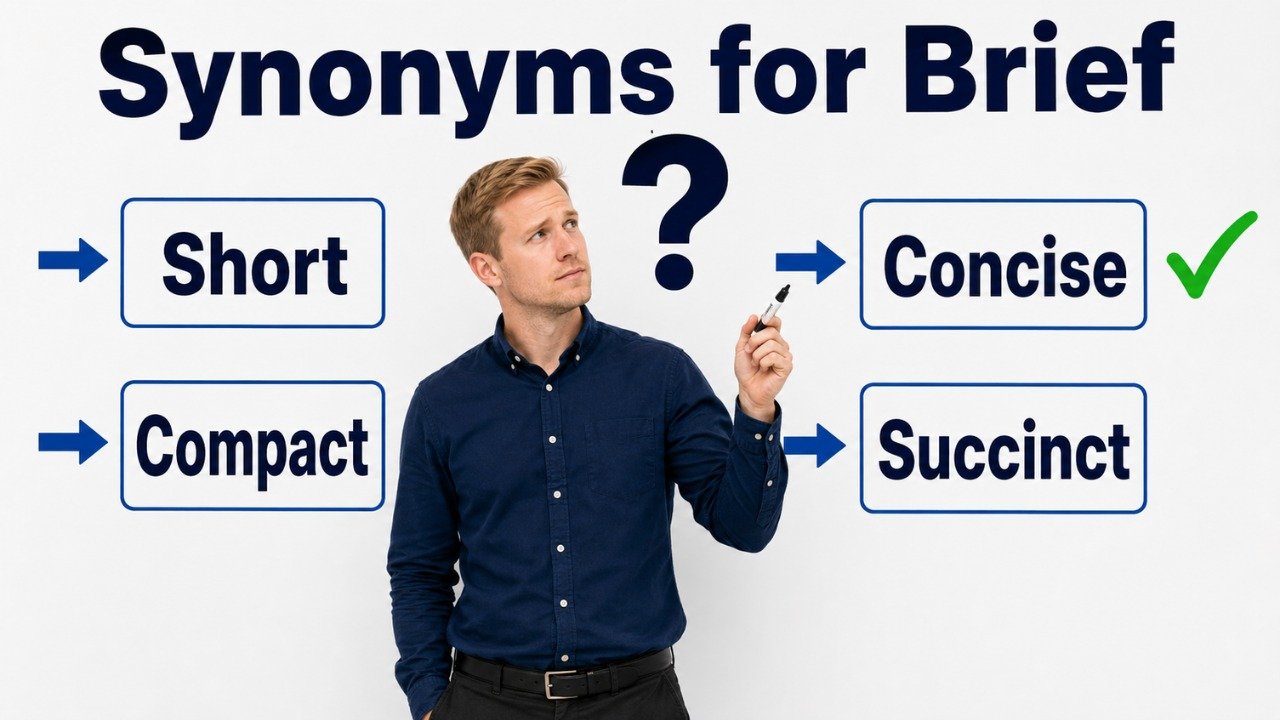
Quick Answer: The best synonyms for brief include short, concise, succinct, compact, condensed, summary, outline, synopsis, fleeting, and quick. Use short for limited length or duration, concise for clear writing with few words, succinct for polished formal communication, and fleeting for something lasting only a moment. Summary, outline, and synopsis are suitable when brief is a noun referring to a shortened account. When brief is a verb, inform, instruct, and apprise are suitable alternatives.
Pronunciation and Word Details
Word: Brief.
Pronunciation: /briːf/
Part of Speech: Adjective, noun, and verb.
Meaning: Short in length or duration, a concise summary, or the act of giving essential information.
US Pronunciation:
UK Pronunciation:
What Does “Brief” Mean?
Brief means short in length, limited in duration, or expressed using only the most important information.
As an adjective, brief describes something that does not last long or does not contain many words.
Example: She gave a brief explanation of the problem.
As a noun, a brief is a short written or spoken summary containing essential information.
Example: The manager reviewed the project brief.
In legal contexts, a brief can be a formal written argument submitted to a court.
Example: The lawyer prepared a detailed legal brief.
As a verb, brief means to inform or instruct someone before an activity, meeting, assignment, or event.
Example: The supervisor briefed the team before the inspection.
The correct synonym depends on whether brief refers to length, duration, communication, a document, or an act of instruction.
Meaning, Tone, and Context of “Brief”
Brief usually has a neutral and professional tone. It is common in conversation, business communication, academic writing, reports, instructions, journalism, and legal writing.
When brief describes writing or speech, it suggests that unnecessary details have been removed.
Example: Please provide a brief answer.
When brief describes time, it means that something lasts for only a short period.
Example: We had a brief conversation before the meeting.
In professional communication, brief often suggests efficiency and clarity.
Example: The director requested a brief overview of the results.
As a noun, brief is more formal. It commonly refers to instructions, a summary, a project document, or a legal argument.
Example: The designer followed the client brief carefully.
As a verb, brief is professional and practical. It means giving someone the information needed to complete a task or understand a situation.
Example: The officer briefed the staff on the new procedure.
When and How to Use “Brief”
For Short Writing
Use brief when a message, explanation, answer, or report contains only essential information.
Example: The teacher requested a brief response.
For Limited Duration
Use brief when an event, visit, pause, meeting, or conversation lasts only a short time.
Example: They had a brief meeting after lunch.
For a Summary
Use brief as a noun when referring to a document that presents the main goals, facts, or instructions.
Example: The project brief explained the objectives clearly.
For Professional Instructions
Use brief as a verb when someone gives necessary information before a task or event.
Example: The manager briefed the employees before the presentation.
For Legal Writing
Use brief for a formal document that presents legal facts and arguments.
Example: The attorney submitted a brief to the court.
For Concise Communication
Use brief when you want someone to communicate directly without unnecessary explanation.
Example: Keep your introduction brief and relevant.
Best Synonyms for Brief
Short: Limited in length, distance, or duration.
Example: We had a short discussion about the schedule.
Concise: Clear and complete while using few words.
Example: Her concise explanation answered every important question.
Succinct: Expressed clearly and effectively in very few words.
Example: He gave a succinct summary of the findings.
Compact: Small, efficiently arranged, or containing information in a limited form.
Example: The guide provides a compact overview of the topic.
Condensed: Shortened while preserving the main information.
Example: We read a condensed version of the report.
Summary: A shortened account of the main points.
Example: The document begins with a summary of the proposal.
Outline: A structured list of the main ideas or stages.
Example: She prepared an outline before writing the article.
Synopsis: A short account of the main events or ideas.
Example: The synopsis explains the central plot clearly.
Fleeting: Lasting for only a very short time.
Example: He caught a fleeting glimpse of the bird.
Inform: To give someone facts or necessary information.
Example: The coordinator informed the volunteers about their duties.
50 Synonyms for Brief with Short Meanings
- Short: Limited in length, size, or duration.
- Concise: Clear and complete without unnecessary words.
- Succinct: Expressed effectively using very few words.
- Compact: Containing much information in a small form.
- Terse: Very short and sometimes unfriendly in tone.
- Pithy: Short, meaningful, and strongly expressed.
- Crisp: Clear, direct, and neatly expressed.
- Direct: Clear and focused without unnecessary explanation.
- Economical: Using no more words than necessary.
- Laconic: Using very few words.
- Condensed: Reduced to a shorter form.
- Abbreviated: Shortened by removing some details.
- Abridged: Shortened while keeping the main meaning.
- Compressed: Fitted into a smaller or shorter form.
- Shortened: Made less lengthy or less time consuming.
- Summarized: Presented through the most important points.
- Limited: Restricted in length, scope, or duration.
- Quick: Taking or lasting only a short time.
- Fleeting: Lasting for only a moment.
- Momentary: Continuing for a very short period.
- Passing: Temporary and quickly disappearing.
- Temporary: Existing for a limited time.
- Cursory: Quick and lacking extensive detail.
- Rapid: Happening within a short amount of time.
- Summary: A shortened account of the main information.
- Outline: A structured presentation of main points.
- Synopsis: A short description of a longer work.
- Abstract: A concise summary of a document or study.
- Digest: A shortened collection of important information.
- Précis: A clear and accurate summary of a text.
- Overview: A general explanation of the main features.
- Rundown: A quick explanation of important details.
- Recap: A short review of what happened.
- Sketch: A general description without extensive detail.
- Capsule: A very compact summary or description.
- Gist: The central meaning or main point.
- Essence: The most important quality or idea.
- Memorandum: A written note containing important information.
- Note: A short written record or message.
- Report: An organized account of facts or events.
- Statement: A clear expression of information or opinion.
- Account: A description of an event or situation.
- Submission: A formal document presented for consideration.
- Pleading: A formal written legal statement.
- Briefing: A meeting or document that provides essential information.
- Instructions: Information explaining what someone should do.
- Directions: Guidance about how to complete a task.
- Inform: To provide someone with necessary information.
- Instruct: To tell someone what to do or how to do it.
- Apprise: To formally inform someone about a situation.
Read Also:
Synonyms for Comprehend
Synonyms for Brief by Context
When Brief Means Short in Length
Short, abbreviated, abridged, shortened, condensed, and compressed describe something that has limited length.
Short: The most common and natural alternative.
Example: She wrote a short description of the event.
Abbreviated: Suitable when part of the original content has been removed.
Example: We used an abbreviated version of the company name.
Abridged: Often describes shortened books, documents, and written works.
Example: The students read an abridged version of the novel.
Condensed: Suggests that the main ideas remain after details have been removed.
Example: The booklet contains a condensed history of the region.
When Brief Means Concise in Wording
Concise, succinct, pithy, crisp, direct, economical, terse, and laconic describe communication that uses few words.
Concise: Clear, complete, and free from unnecessary details.
Example: Her answer was concise but informative.
Succinct: Polished and effective, making it useful in formal writing.
Example: The conclusion offers a succinct explanation of the results.
Pithy: Short but full of meaning or force.
Example: The speaker ended with a pithy observation.
Terse: Extremely short and possibly unfriendly.
Example: His terse response suggested that he was annoyed.
When Brief Means Short in Duration
Quick, fleeting, momentary, passing, temporary, and short describe something that does not last long.
Quick: Common in casual and professional communication.
Example: We had a quick conversation before class.
Fleeting: Describes something that disappears almost immediately.
Example: She experienced a fleeting feeling of doubt.
Momentary: Lasting for only a moment.
Example: A momentary delay interrupted the service.
Passing: Temporary and not likely to continue.
Example: It was only a passing concern.
When Brief Means a Summary
Summary, outline, synopsis, abstract, digest, précis, overview, recap, and rundown describe shortened presentations of information.
Summary: The most general replacement for a brief account.
Example: Please send me a summary of the meeting.
Outline: Best when information is organized into main points.
Example: The outline lists every stage of the project.
Synopsis: Often used for stories, films, reports, and longer works.
Example: The publisher requested a synopsis of the book.
Abstract: Common in academic and research writing.
Example: The abstract presents the purpose and results of the study.
When Brief Means to Inform or Instruct
Inform, instruct, apprise, update, advise, and prepare can replace brief as a verb in certain contexts.
Inform: Best for giving facts or news.
Example: Please inform the staff about the schedule change.
Instruct: Best for explaining what someone must do.
Example: The supervisor instructed the workers to wear protective equipment.
Apprise: A formal word meaning to make someone aware of a situation.
Example: The director apprised the board of the latest developments.
When Brief Refers to a Legal Document
Submission, pleading, memorandum, statement, and argument may replace brief in legal contexts.
Submission: A document formally presented to a court or authority.
Example: The legal team prepared a written submission.
Pleading: A formal document stating a party’s claims or defenses.
Example: The attorney reviewed the pleading before filing it.
Memorandum: A formal written analysis of legal issues.
Example: The lawyer prepared a legal memorandum for the client.
Another Word for Brief
The best general replacement for brief is short. However, the strongest alternative depends on the intended meaning.
Use concise when describing clear communication, summary when referring to a shortened account, fleeting when discussing a very short experience, and inform when brief is used as a verb.
Original: She gave a brief answer.
Better Option: She gave a concise answer.
Original: We had a brief meeting.
Better Option: We had a short meeting.
Original: The editor requested a brief of the article.
Better Option: The editor requested a summary of the article.
Original: The manager will brief the staff tomorrow.
Better Option: The manager will inform the staff tomorrow.
When Not to Use “Brief”
Do not use brief when another word can communicate the intended meaning more precisely.
When Describing Detailed Information
Brief may sound inaccurate when a document contains extensive facts, explanations, or evidence.
Weak: She prepared a brief analysis covering every stage of the ten year project.
Better: She prepared a comprehensive analysis covering every stage of the ten year project.
When the Tone Seems Unfriendly
Replacing brief with terse can change the emotional meaning. Terse often suggests irritation or impatience.
Weak: His brief answer showed that he was angry.
Better: His terse answer showed that he was angry.
When Academic Precision Is Needed
In research writing, abstract may be more specific than brief or summary.
Weak: The brief explains the study’s purpose and findings.
Better: The abstract explains the study’s purpose and findings.
When Describing a Temporary Feeling
Fleeting or momentary may sound more natural than brief.
Weak: She felt brief anxiety before the interview.
Better: She felt momentary anxiety before the interview.
When Giving Instructions
Use instruct when the focus is on directions rather than general information.
Weak: The trainer briefed the participants to complete the form.
Better: The trainer instructed the participants to complete the form.
When Repetition Reduces Clarity
Repeated use of brief can make writing sound mechanical.
Weak: The brief meeting included a brief report and a brief discussion.
Better: The short meeting included a concise report and a quick discussion.
Words Commonly Confused With Brief
Brief vs Short: Brief and short can both describe limited length or duration. Brief often sounds more formal, while short is more common in everyday language.
Brief vs Concise: Brief focuses on length. Concise means clear and complete despite using few words.
Brief vs Succinct: Brief simply means short. Succinct suggests that an idea has been expressed clearly and skillfully.
Brief vs Terse: Brief is neutral. Terse often suggests that the speaker is impatient, unfriendly, or unwilling to explain.
Brief vs Summary: Brief can be an adjective, noun, or verb. Summary is mainly a noun describing a shortened account.
Brief vs Abstract: A brief may contain general instructions or information. An abstract is a specific summary of an academic paper, report, or study.
Brief vs Outline: A brief may include complete sentences and explanations. An outline presents ideas in an organized structure.
Brief vs Briefing: A brief is often a document or set of instructions. A briefing is the act, meeting, or session in which essential information is presented.
Which Synonym Should You Choose?
Choose short when describing limited length, duration, distance, or size.
Choose concise when writing answers, explanations, emails, reports, and paragraphs that must be clear without unnecessary words.
Choose succinct when you need a polished and formal synonym for efficient communication.
Choose pithy when a short statement is meaningful, memorable, or forceful.
Choose terse when a short response sounds impatient, unfriendly, or emotionally cold.
Choose condensed when a longer document has been reduced while retaining its essential information.
Choose abridged when referring to a shortened book, story, speech, or written work.
Choose fleeting when an experience, emotion, thought, or opportunity lasts for only a moment.
Choose summary when referring to the main information from a longer discussion or document.
Choose outline when information is arranged into main headings, ideas, or stages.
Choose synopsis when summarizing the content or events of a story or longer work.
Choose abstract when summarizing an academic paper, experiment, or research study.
Choose briefing when referring to an organized session that provides essential information.
Choose inform when describing the act of giving someone facts or news.
Choose instruct when describing the act of giving orders, steps, or directions.
Choose apprise in formal writing when someone is made aware of important developments.
Real Life Examples of “Brief” in Sentences
Original: The teacher gave a brief explanation of the rule.
Better Option: The teacher gave a concise explanation of the rule.
Original: We had a brief conversation in the hallway.
Better Option: We had a quick conversation in the hallway.
Original: He experienced a brief feeling of relief.
Better Option: He experienced a fleeting feeling of relief.
Original: Please write a brief account of the incident.
Better Option: Please write a summary of the incident.
Original: The article provides a brief description of the process.
Better Option: The article provides a compact description of the process.
Original: The manager briefed the new employees.
Better Option: The manager informed the new employees.
Original: She prepared a brief for the upcoming campaign.
Better Option: She prepared an outline for the upcoming campaign.
Original: The meeting began with a brief of recent developments.
Better Option: The meeting began with a rundown of recent developments.
Original: His brief reply surprised everyone.
Better Option: His terse reply surprised everyone.
Original: They made a brief visit to the museum.
Better Option: They made a short visit to the museum.
Synonym Groups and Usage Differences
Shortness Group
Short, limited, abbreviated, shortened, abridged, and condensed describe limited length or scope.
Short is the broadest and most natural word. Abridged is suitable for written works, while condensed suggests that important information has been preserved.
Example: The students read a condensed version of the report.
Clear Communication Group
Concise, succinct, crisp, direct, economical, and pithy describe language that avoids unnecessary words.
Concise emphasizes clarity. Succinct sounds more formal, while pithy suggests that the message is meaningful or memorable.
Example: Her succinct response addressed the main concern.
Extremely Short Communication Group
Terse and laconic describe communication that uses very few words.
Terse can imply irritation. Laconic usually describes a person’s habitual way of speaking.
Example: His laconic reply contained only three words.
Short Duration Group
Quick, fleeting, momentary, passing, and temporary describe experiences or events that do not last long.
Quick is general. Fleeting emphasizes how rapidly something disappears, while temporary may describe something lasting days or months but not permanently.
Example: She noticed a fleeting expression of concern.
Summary Group
Summary, synopsis, précis, digest, overview, recap, rundown, and sketch present the main information in a shortened form.
Summary is general. Synopsis often describes a story, while précis refers to a carefully written condensed version of a text.
Example: The report begins with an overview of the findings.
Planning Document Group
Brief, outline, memorandum, note, and instructions can provide guidance before a project or task begins.
An outline organizes ideas. A memorandum communicates professional information, while instructions explain required actions.
Example: The project outline identifies the main goals and deadlines.
Information Group
Inform, apprise, instruct, and advise describe different ways of giving someone information.
Inform means providing facts. Instruct means providing directions. Apprise is more formal and usually relates to important developments.
Example: The manager apprised the employees of the policy change.
Legal Group
Brief, submission, pleading, memorandum, and statement can refer to formal legal documents.
A brief presents legal arguments. A pleading states claims or defenses, while a legal memorandum analyzes an issue.
Example: The attorney reviewed the written submission before the hearing.
Antonyms of Brief
The opposite of brief depends on whether the word refers to length, duration, detail, or knowledge.
Long: Continuing for a considerable length or time.
Lengthy: Taking more time or space than expected.
Extended: Made longer in time, length, or scope.
Prolonged: Continuing for an unusually long period.
Detailed: Containing many facts, features, or explanations.
Elaborate: Developed with extensive detail or complexity.
Comprehensive: Covering all or nearly all relevant information.
Extensive: Large in amount, range, or degree.
Thorough: Complete and careful in treatment.
Wordy: Using more words than necessary.
Verbose: Expressed with excessive wording.
Permanent: Intended to continue without ending.
Enduring: Lasting for a long time.
Unabridged: Complete and not shortened.
Uninformed: Lacking necessary knowledge or information.
Comparison Between Brief and Related Words
Brief vs Short
Brief and short both describe limited length or duration. Brief usually sounds slightly more formal and often refers to communication or events.
Example With Brief: The director gave a brief introduction.
Example With Short: The director gave a short introduction.
Brief vs Concise
Brief describes limited length. Concise describes language that communicates all necessary information without extra words.
Example With Brief: She wrote a brief paragraph.
Example With Concise: She wrote a concise explanation of the problem.
Brief vs Succinct
Brief focuses on being short. Succinct emphasizes clarity, control, and efficient expression.
Example With Brief: His answer was brief.
Example With Succinct: His answer was succinct and informative.
Brief vs Terse
Brief is usually neutral. Terse often carries a negative tone and suggests impatience or annoyance.
Example With Brief: She sent a brief reply.
Example With Terse: She sent a terse reply that sounded unfriendly.
Brief vs Fleeting
Brief can describe any short period. Fleeting describes something that passes or disappears almost immediately.
Example With Brief: They had a brief meeting.
Example With Fleeting: He experienced a fleeting moment of doubt.
Brief vs Summary
Brief can describe something short, refer to a document, or mean to inform someone. Summary specifically refers to the main information from something longer.
Example With Brief: The team reviewed the project brief.
Example With Summary: The team reviewed the meeting summary.
Brief vs Outline
A brief provides important information or instructions. An outline organizes the main ideas or stages without fully explaining them.
Example With Brief: The client approved the design brief.
Example With Outline: The writer prepared an outline for the article.
Brief vs Abstract
A brief is a general short account or instructional document. An abstract is a formal summary of academic or research work.
Example With Brief: She prepared a brief for the committee.
Example With Abstract: She wrote an abstract for the research paper.
Brief vs Briefing
A brief is often the information or document itself. A briefing is the meeting or process through which that information is delivered.
Example With Brief: The officer read the security brief.
Example With Briefing: The officer attended the security briefing.
Common Phrases and Expressions With Brief
Brief Explanation: A short description that covers the essential points.
Brief Summary: A condensed presentation of the main information.
Brief Overview: A general and limited introduction to a subject.
Brief Introduction: A short opening that presents a person or topic.
Brief Description: A short account of the main characteristics.
Brief Pause: A short break in speech, movement, or activity.
Brief Visit: A visit that lasts for only a short period.
Brief Moment: A very short amount of time.
Brief Encounter: A meeting that lasts only a short time.
Brief Conversation: A short exchange between people.
Project Brief: A document explaining the goals, requirements, and scope of a project.
Legal Brief: A formal written document presenting legal arguments.
Creative Brief: A document outlining the purpose, audience, message, and requirements of a creative project.
Brief Someone On Something: To provide someone with essential information about a subject.
Common Mistakes to Avoid
Using Brief and Concise as Exact Equals
Brief means short, but concise means short and clearly expressed. A brief answer may still be incomplete, while a concise answer communicates the necessary information efficiently.
Incorrect: His one word answer was concise, although it explained nothing.
Better: His one word answer was brief, although it explained nothing.
Using Terse Without Considering Tone
Terse can imply annoyance or unfriendliness. Do not use it as a neutral synonym unless that emotional meaning is intended.
Incorrect: The receptionist gave a helpful and terse explanation.
Better: The receptionist gave a helpful and concise explanation.
Using Fleeting for Documents
Fleeting refers to time, experiences, thoughts, opportunities, and emotions. It does not normally describe short writing.
Incorrect: She wrote a fleeting report.
Better: She wrote a brief report.
Confusing Brief With Briefing
A brief is usually a document or collection of essential information. A briefing is the act or meeting in which information is delivered.
Incorrect: We attended a project brief at nine o’clock.
Better: We attended a project briefing at nine o’clock.
Repeating Brief Too Often
Using the same word repeatedly can make a paragraph sound dull or mechanical.
Repetitive: The brief meeting included a brief introduction and a brief report.
Better: The short meeting included a concise introduction and a compact report.
Choosing a Word From the Wrong Meaning
Brief has several meanings, so its synonyms are not interchangeable.
Incorrect: The manager condensed the workers before the event.
Better: The manager briefed the workers before the event.
Using Cursory as a Positive Synonym
Cursory means quick and lacking careful attention. It often suggests that something was not examined properly.
Incorrect: She completed a careful and cursory review.
Better: She completed a careful and concise review.
Using Abbreviated for Every Short Event
Abbreviated usually describes words, names, documents, or processes that have been deliberately shortened.
Unnatural: We had an abbreviated conversation outside.
Better: We had a brief conversation outside.
Conclusion
Synonyms for brief vary according to meaning and context. Short is the most flexible choice for limited length or duration, while concise and succinct are stronger for clear communication. Fleeting and momentary describe experiences that last only a short time. Summary, outline, synopsis, and abstract work when brief refers to a shortened account or document. When brief is a verb, inform, instruct, and apprise are suitable alternatives. Choosing the correct synonym makes your writing clearer, more natural, and more precise.
FAQs About Synonyms for Brief
What Is the Best Synonym for Brief?
Short is the best general synonym for brief. Concise is better when describing clear writing or speech that uses few words.
What Is a Formal Synonym for Brief?
Succinct is a formal synonym when brief describes communication. Précis, memorandum, and synopsis are formal choices when brief is used as a noun.
Can Concise Replace Brief?
Concise can replace brief when describing clear and efficient language. It may not work when brief refers to a short event or period.
What Is a Synonym for a Brief Meeting?
Short meeting and quick meeting are the most natural alternatives. A momentary meeting is usually less natural.
What Is Another Word for a Written Brief?
Summary, outline, memorandum, synopsis, report, and overview can replace written brief, depending on the document’s purpose.
What Is a Synonym for Brief as a Verb?
Inform, instruct, apprise, advise, and update can replace brief as a verb. The correct choice depends on whether facts, directions, or new developments are being communicated.
What Is the Difference Between Brief and Terse?
Brief is neutral and simply means short. Terse describes communication that is extremely short and may sound impatient, cold, or unfriendly.
