
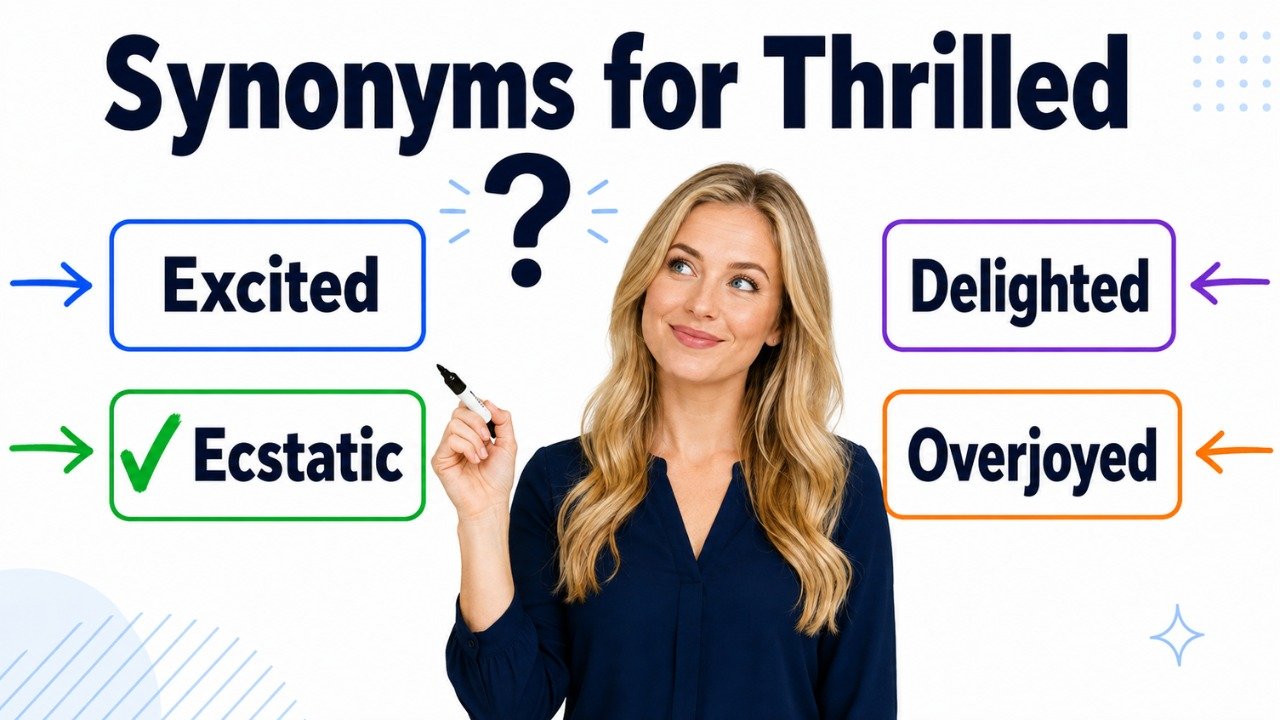
Quick Answer: Synonyms for thrilled include delighted, excited, overjoyed, ecstatic, elated, exhilarated, euphoric, jubilant, pleased, and over the moon. Use delighted for warm happiness, excited for strong anticipation, overjoyed for intense personal joy, and ecstatic for overwhelming happiness. Elated suits formal writing about success, exhilarated describes energized excitement, and over the moon works best in friendly conversation.
Pronunciation and Word Details
Word: Thrilled.
Pronunciation: /θrɪld/
Part of Speech: Adjective and past participle of the verb thrill.
Meaning: Feeling extremely happy, excited, pleased, or emotionally energized.
US Pronunciation:
UK Pronunciation:
What Does “Thrilled” Mean?
Thrilled means extremely happy, excited, or pleased about something.
It is commonly used as an adjective to describe a strong positive emotional reaction.
Example: She was thrilled to receive the award.
Thrilled is also the past participle of the verb thrill, which means to cause intense excitement, pleasure, or emotional energy.
Example: The performance thrilled the audience.
The word can describe happiness about good news, excitement before an event, pride in an achievement, relief after uncertainty, or pleasure caused by an unexpected opportunity.
Good News: We were thrilled by the announcement.
Achievement: He felt thrilled after completing the difficult project.
Anticipation: The children were thrilled about the upcoming trip.
Surprise: She was thrilled to discover the hidden gift.
Opportunity: I am thrilled to join the team.
Thrilled expresses stronger emotion than happy or pleased. However, it is usually less extreme than ecstatic or euphoric.
Meaning, Tone, and Context of “Thrilled”
Thrilled has a positive, enthusiastic, emotional, and energetic tone.
It is suitable for casual conversation, personal messages, professional communication, announcements, interviews, speeches, reviews, and descriptive writing.
Casual Tone: I am thrilled that you can come.
Professional Tone: We are thrilled to announce the new program.
Emotional Tone: She was thrilled to see her family again.
Celebratory Tone: The team was thrilled with the final result.
Polite Tone: I would be thrilled to assist with the event.
Thrilled is often used to show sincere enthusiasm. It sounds warmer and stronger than pleased.
Pleased: I am pleased with the decision.
Thrilled: I am thrilled with the decision.
The second sentence communicates much greater excitement.
In formal writing, delighted, elated, gratified, or extremely pleased may be appropriate alternatives. In casual speech, excited, pumped, stoked, or over the moon can sound more natural.
When and How to Use “Thrilled”
For Receiving Good News
Use thrilled when someone reacts with intense happiness to positive information.
Example: She was thrilled to learn that her application had been accepted.
Alternative: She was delighted to learn that her application had been accepted.
For an Achievement
Use thrilled when a person feels excited and proud after reaching a goal.
Example: The students were thrilled with their excellent results.
Alternative: The students were elated by their excellent results.
For an Upcoming Event
Use thrilled when someone feels strong anticipation about something enjoyable.
Example: We are thrilled about the upcoming celebration.
Alternative: We are excited about the upcoming celebration.
For an Unexpected Surprise
Use thrilled when a pleasant surprise creates strong happiness.
Example: He was thrilled by the unexpected gift.
Alternative: He was overjoyed by the unexpected gift.
For a New Opportunity
Use thrilled when accepting a role, invitation, project, or responsibility with enthusiasm.
Example: I am thrilled to begin this new position.
Alternative: I am delighted to begin this new position.
For a Successful Result
Use thrilled when a person feels strongly pleased with an outcome.
Example: The organizers were thrilled with the response.
Alternative: The organizers were extremely pleased with the response.
For Emotional Excitement
Use thrilled when an experience creates energy, pleasure, and strong emotion.
Example: The audience was thrilled by the final performance.
Alternative: The audience was exhilarated by the final performance.
For Relief and Happiness
Use thrilled when uncertainty ends with a positive result.
Example: Her family was thrilled to hear that she was safe.
Alternative: Her family was overjoyed to hear that she was safe.
Best Synonyms for Thrilled
Delighted
Synonym: Feeling great pleasure, satisfaction, or happiness.
Example: We were delighted to welcome the new members.
Excited
Synonym: Feeling enthusiastic and eager about something.
Example: She is excited about beginning her course.
Overjoyed
Synonym: Feeling an extremely high level of happiness.
Example: His parents were overjoyed by the wonderful news.
Ecstatic
Synonym: Experiencing overwhelming happiness or excitement.
Example: The players were ecstatic after winning the final match.
Elated
Synonym: Feeling proudly and intensely happy after success.
Example: She felt elated when her work received recognition.
Exhilarated
Synonym: Feeling energized, joyful, and highly excited.
Example: He felt exhilarated after reaching the mountain summit.
Euphoric
Synonym: Experiencing an unusually powerful feeling of happiness.
Example: The crowd was euphoric after the victory.
Jubilant
Synonym: Expressing great happiness because of success or celebration.
Example: Jubilant supporters filled the streets.
Pleased
Synonym: Feeling satisfied or happy about a result.
Example: The manager was pleased with the team’s progress.
Over the Moon
Synonym: Extremely happy and excited in an informal context.
Example: She was over the moon about her new opportunity.
50 Synonyms for Thrilled with Short Meanings
- Delighted: Filled with warm pleasure and happiness.
- Excited: Feeling enthusiastic and eager.
- Overjoyed: Experiencing extremely strong happiness.
- Ecstatic: Overwhelmed with happiness or excitement.
- Elated: Feeling proudly and intensely happy.
- Exhilarated: Filled with energetic excitement and joy.
- Euphoric: Experiencing powerful and almost overwhelming happiness.
- Jubilant: Joyful because of victory or success.
- Joyous: Full of happiness and celebration.
- Joyful: Feeling or expressing sincere happiness.
- Gleeful: Showing lively and playful delight.
- Pleased: Satisfied and happy about something.
- Happy: Feeling pleasure, joy, or contentment.
- Thrilled to Bits: Extremely pleased and excited.
- Over the Moon: Very happy about good news or success.
- On Cloud Nine: Experiencing a state of great happiness.
- Walking on Air: Feeling light and joyful because of happiness.
- In High Spirits: Feeling cheerful, energetic, and positive.
- Beside Oneself with Joy: Overwhelmed by intense happiness.
- Beaming: Showing happiness through a bright smile.
- Radiant: Visibly glowing with happiness.
- Glowing: Showing clear pride, happiness, or satisfaction.
- Buoyant: Cheerful, confident, and emotionally light.
- Uplifted: Made happier, more hopeful, or more positive.
- Animated: Lively and visibly excited.
- Electrified: Filled with sudden and powerful excitement.
- Energized: Filled with enthusiasm and renewed energy.
- Enthusiastic: Showing strong interest and excitement.
- Enthused: Feeling highly interested and pleased.
- Eager: Strongly interested in what will happen next.
- Pumped: Very excited and ready for action.
- Stoked: Extremely excited in casual speech.
- Fired Up: Strongly energized and enthusiastic.
- Tickled: Amused and pleasantly delighted.
- Charmed: Deeply pleased or attracted by something delightful.
- Enchanted: Filled with pleasure, admiration, or fascination.
- Gratified: Pleased because expectations or efforts were rewarded.
- Satisfied: Pleased because a need or expectation was met.
- Contented: Peacefully happy and satisfied.
- Rejoicing: Actively expressing great happiness.
- Triumphant: Joyful and proud after success.
- Exultant: Showing intense happiness after an achievement.
- Rapturous: Expressing overwhelming delight or admiration.
- Blissful: Experiencing complete and peaceful happiness.
- Exuberant: Energetic and openly joyful.
- Ebullient: Cheerful, lively, and full of excitement.
- Cheered: Made happier or more hopeful.
- Heartened: Encouraged and emotionally strengthened.
- Overcome with Happiness: Unable to contain intense joy.
- Wild with Excitement: Extremely enthusiastic and emotionally energized.
Read Also:
Synonyms for Successfully
Synonyms for Thrilled by Context
When Thrilled Means Extremely Happy
Overjoyed, ecstatic, elated, euphoric, blissful, and joyous express intense happiness.
Example With Thrilled: She was thrilled when she received the scholarship.
Example With a Synonym: She was overjoyed when she received the scholarship.
Ecstatic and euphoric express a stronger emotional reaction than thrilled.
Example: The team was ecstatic after the announcement.
Example: Supporters felt euphoric after the historic success.
Elated often describes happiness connected to achievement, recognition, or victory.
Example: He was elated by the excellent result.
When Thrilled Means Excited About the Future
Excited, eager, enthusiastic, pumped, stoked, and fired up describe anticipation and readiness.
Example With Thrilled: We are thrilled about the upcoming journey.
Example With a Synonym: We are excited about the upcoming journey.
Eager emphasizes desire and anticipation rather than happiness alone.
Example: The students were eager to begin the activity.
Pumped and stoked are casual expressions and are more suitable for friendly conversation.
Example: The players were pumped for the competition.
When Thrilled Means Pleased
Delighted, pleased, gratified, satisfied, contented, and charmed describe pleasure or approval.
Example With Thrilled: The client was thrilled with the final design.
Example With a Synonym: The client was delighted with the final design.
Pleased is milder and more formal than thrilled.
Example: The director was pleased with the progress.
Gratified often suggests that effort, expectations, or values have been rewarded.
Example: She was gratified to see her advice had helped.
When Thrilled Means Energized
Exhilarated, electrified, energized, animated, exuberant, and ebullient communicate lively excitement.
Example With Thrilled: The audience was thrilled by the performance.
Example With a Synonym: The audience was electrified by the performance.
Exhilarated often describes excitement created by adventure, speed, success, or physical activity.
Example: The climbers felt exhilarated after reaching the top.
Animated describes visible excitement in speech, movement, or expression.
Example: He became animated while describing the experience.
When Thrilled Means Proud After Success
Elated, jubilant, triumphant, exultant, rejoicing, and glowing are suitable after achievements.
Example With Thrilled: The athletes were thrilled by their victory.
Example With a Synonym: The athletes were jubilant after their victory.
Triumphant combines happiness with pride and success.
Example: She gave a triumphant smile after completing the challenge.
Glowing often describes visible pride or satisfaction.
Example: His parents were glowing with pride.
When Thrilled Means Visibly Happy
Beaming, radiant, glowing, joyous, gleeful, and exuberant describe happiness that can be seen.
Example With Thrilled: She looked thrilled when she opened the letter.
Example With a Synonym: She was beaming when she opened the letter.
Radiant suggests that happiness brightens a person’s expression or appearance.
Example: The winner looked radiant during the ceremony.
Gleeful may suggest playful or lively delight.
Example: The children were gleeful as they opened their gifts.
When Thrilled Means Emotionally Encouraged
Uplifted, heartened, cheered, inspired, buoyant, and energized describe improved mood or hope.
Example With Thrilled: She was thrilled by the support she received.
Example With a Synonym: She was heartened by the support she received.
Heartened emphasizes encouragement rather than intense excitement.
Example: The positive response heartened the volunteers.
Uplifted describes a more hopeful and emotionally positive state.
Example: The audience felt uplifted by the message.
Another Word for Thrilled
Delighted is the best general replacement for thrilled because it expresses strong happiness without sounding overly dramatic. It works naturally in professional writing, polite communication, announcements, and conversation.
The best alternative still depends on the strength and cause of the emotion. Use excited for anticipation, overjoyed for personal happiness, elated for achievement, and ecstatic for an overwhelming reaction.
Original: I am thrilled to accept the invitation.
Better Option: I am delighted to accept the invitation.
Original: She was thrilled about her upcoming journey.
Better Option: She was excited about her upcoming journey.
Original: His family was thrilled by the good news.
Better Option: His family was overjoyed by the good news.
Original: The team was thrilled after winning the award.
Better Option: The team was elated after winning the award.
When Not to Use “Thrilled”
Do not use thrilled when the emotion is mild. Pleased, satisfied, or glad may be more accurate.
Weak: He was thrilled that the meeting began on time.
Better: He was pleased that the meeting began on time.
Avoid thrilled when the person simply feels calm satisfaction.
Weak: She felt thrilled after completing her ordinary routine.
Better: She felt satisfied after completing her ordinary routine.
Do not use thrilled in serious or sad situations unless the positive emotion is clearly appropriate.
Weak: He was thrilled that the difficult discussion had ended.
Better: He was relieved that the difficult discussion had ended.
Avoid repeating thrilled several times in one paragraph.
Weak: We were thrilled by the invitation, thrilled by the welcome, and thrilled by the event.
Better: We were delighted by the invitation, touched by the welcome, and excited about the event.
Do not use casual words such as pumped or stoked in formal reports, professional announcements, or academic writing.
Too Casual: The committee was stoked by the results.
Better: The committee was delighted by the results.
Avoid using ecstatic when the reaction is not extremely strong.
Weak: She was ecstatic that the bus arrived on time.
Better: She was pleased that the bus arrived on time.
Words Commonly Confused With Thrilled
Thrilled vs Excited: Thrilled combines strong happiness and excitement. Excited may describe anticipation even when the outcome is uncertain.
Thrilled vs Delighted: Thrilled is energetic and intense. Delighted sounds warm, polished, and slightly more controlled.
Thrilled vs Happy: Happy is broad and can describe mild or lasting pleasure. Thrilled describes a stronger and more immediate reaction.
Thrilled vs Pleased: Pleased expresses satisfaction or approval. Thrilled communicates much greater enthusiasm.
Thrilled vs Overjoyed: Thrilled is strongly positive, while overjoyed suggests overwhelming personal happiness.
Thrilled vs Ecstatic: Ecstatic is more intense than thrilled and should be used for exceptional emotional reactions.
Thrilled vs Elated: Thrilled may result from any positive event. Elated often follows achievement, recognition, victory, or relief.
Thrilled vs Exhilarated: Thrilled focuses on happiness and excitement. Exhilarated adds a sense of energy, movement, or emotional stimulation.
Thrilled vs Relieved: Thrilled expresses happiness and excitement. Relieved describes the removal of worry, fear, or pressure.
Which Synonym Should You Choose?
Choose delighted for polite, professional, and warmly positive communication.
Choose excited when someone eagerly anticipates an event, opportunity, or experience.
Choose overjoyed for deeply personal and intense happiness.
Choose ecstatic when happiness is overwhelming and unusually strong.
Choose elated after success, recognition, victory, or an important achievement.
Choose exhilarated when excitement feels energetic, adventurous, or physically stimulating.
Choose euphoric for a powerful state of emotional happiness.
Choose jubilant for public celebration after success or victory.
Choose pleased when the emotional reaction is positive but controlled.
Choose gratified when effort, expectations, or values have been rewarded.
Choose thrilled to bits, over the moon, or on cloud nine in friendly and informal speech.
Choose pumped, stoked, or fired up for casual excitement before an activity.
Choose beaming, radiant, or glowing when happiness is visible in a person’s face.
Choose uplifted, heartened, or cheered when someone feels encouraged and emotionally stronger.
Choose triumphant or exultant when joy follows an important victory.
Choose rapturous when describing extremely enthusiastic admiration or delight.
Real Life Examples of “Thrilled” in Sentences
Original: She was thrilled to receive the promotion.
Better Option: She was elated to receive the promotion.
Original: We are thrilled about the upcoming celebration.
Better Option: We are excited about the upcoming celebration.
Original: His parents were thrilled by the wonderful news.
Better Option: His parents were overjoyed by the wonderful news.
Original: The audience was thrilled by the energetic performance.
Better Option: The audience was exhilarated by the energetic performance.
Original: I am thrilled to welcome you to the program.
Better Option: I am delighted to welcome you to the program.
Original: The players were thrilled after winning the competition.
Better Option: The players were jubilant after winning the competition.
Original: She looked thrilled when she opened the gift.
Better Option: She was beaming when she opened the gift.
Original: The organizers were thrilled with the attendance.
Better Option: The organizers were gratified by the attendance.
Original: He was thrilled about starting the new project.
Better Option: He was enthusiastic about starting the new project.
Original: The children were thrilled by the surprise visit.
Better Option: The children were gleeful during the surprise visit.
Synonym Groups and Usage Differences
Strong Happiness Group
Overjoyed, ecstatic, euphoric, blissful, joyous, and elated describe powerful happiness.
Overjoyed is personal and emotional. Ecstatic and euphoric communicate the greatest intensity.
Example: She was overjoyed to see her family again.
Anticipation Group
Excited, eager, enthusiastic, pumped, stoked, and fired up describe readiness and anticipation.
Excited is neutral and widely useful. Pumped and stoked are strongly casual.
Example: The students were eager to begin the competition.
Satisfaction Group
Delighted, pleased, gratified, satisfied, contented, and charmed describe pleasure or approval.
Delighted is warmer than pleased. Gratified often follows a meaningful result or reward.
Example: The teacher was gratified by the students’ improvement.
Energy Group
Exhilarated, electrified, energized, animated, exuberant, and ebullient describe lively emotional energy.
Exhilarated often follows adventure or success. Animated is visible through speech and movement.
Example: The crowd was electrified by the final performance.
Celebration Group
Jubilant, triumphant, exultant, rejoicing, joyous, and gleeful describe open celebration.
Jubilant and triumphant are especially useful after victory or achievement.
Example: Jubilant supporters celebrated the result.
Visible Happiness Group
Beaming, radiant, glowing, buoyant, and in high spirits describe outward signs of happiness.
Beaming focuses on a bright smile, while radiant suggests the whole appearance reflects joy.
Example: She was radiant after hearing the announcement.
Encouragement Group
Uplifted, heartened, cheered, buoyant, inspired, and energized describe emotional improvement.
Heartened suggests renewed confidence. Uplifted communicates hope and positivity.
Example: The kind response left him feeling uplifted.
Antonyms of Thrilled
The opposite of thrilled depends on whether the word describes happiness, excitement, satisfaction, or emotional energy.
Disappointed: Unhappy because expectations were not met.
Unhappy: Feeling sadness or displeasure.
Miserable: Experiencing intense unhappiness.
Devastated: Overwhelmed by sadness or disappointment.
Displeased: Feeling dissatisfaction or annoyance.
Dissatisfied: Not pleased with a result or experience.
Unimpressed: Not affected by excitement or admiration.
Bored: Lacking interest, excitement, or engagement.
Indifferent: Feeling no strong interest or emotion.
Unenthusiastic: Showing little excitement or interest.
Discouraged: Having lost confidence or hope.
Disheartened: Feeling less hopeful or positive.
Dejected: Sad and emotionally lowered.
Gloomy: Feeling unhappy and lacking optimism.
Apprehensive: Nervous or worried about what may happen.
Comparison Between Thrilled and Related Words
Thrilled vs Delighted
Thrilled expresses energetic excitement and happiness. Delighted sounds warm, polished, and slightly more controlled.
Example With Thrilled: I am thrilled about the opportunity.
Example With Delighted: I am delighted to accept the opportunity.
Thrilled vs Excited
Thrilled usually includes happiness about a positive result. Excited can refer to anticipation before the result is known.
Example With Thrilled: She was thrilled that she had been selected.
Example With Excited: She was excited to attend the interview.
Thrilled vs Overjoyed
Thrilled expresses strong pleasure and excitement. Overjoyed communicates deeper and more overwhelming happiness.
Example With Thrilled: He was thrilled with the gift.
Example With Overjoyed: He was overjoyed to see his family again.
Thrilled vs Ecstatic
Ecstatic is more intense than thrilled and suits exceptional moments.
Example With Thrilled: The students were thrilled with their results.
Example With Ecstatic: The winners were ecstatic after receiving the grand prize.
Thrilled vs Elated
Thrilled is a broad response to good news or enjoyable experiences. Elated often follows success, achievement, or recognition.
Example With Thrilled: She was thrilled by the invitation.
Example With Elated: She was elated after winning the award.
Thrilled vs Exhilarated
Thrilled focuses on strong happiness. Exhilarated includes energy, stimulation, and excitement.
Example With Thrilled: We were thrilled by the experience.
Example With Exhilarated: We felt exhilarated after the fast ride.
Thrilled vs Pleased
Thrilled is intense and enthusiastic. Pleased is milder, calmer, and more formal.
Example With Thrilled: The director was thrilled with the response.
Example With Pleased: The director was pleased with the progress.
Thrilled vs Relieved
Thrilled expresses positive excitement. Relieved describes happiness caused by the end of worry or uncertainty.
Example With Thrilled: She was thrilled to receive the offer.
Example With Relieved: She was relieved that the delay had ended.
Common Phrases and Expressions With “Thrilled”
Absolutely Thrilled: Extremely happy and excited.
Thrilled to Bits: Completely delighted in informal speech.
Thrilled About: Excited and pleased about a future event or idea.
Thrilled With: Highly satisfied with a result, object, or experience.
Thrilled By: Strongly excited because of something seen, heard, or experienced.
Thrilled to Hear: Very happy after receiving good news.
Thrilled to Announce: Excited to share important positive information.
Thrilled to Welcome: Delighted to receive or introduce someone.
Thrilled at the Opportunity: Highly excited about a new possibility.
Beyond Thrilled: More excited and happy than ordinary words can express.
Common Mistakes to Avoid
A common mistake is using thrilled for every positive feeling. The word communicates strong excitement, so pleased or satisfied may be better for milder reactions.
Exaggerated: I was thrilled that the document had no spelling errors.
Natural: I was pleased that the document had no spelling errors.
Avoid confusing thrilled with excited. Excited may describe anticipation, while thrilled often follows good news or a positive outcome.
Anticipation: She is excited about tomorrow’s interview.
Positive Result: She is thrilled that she got the position.
Do not use ecstatic when the situation does not justify extreme emotion.
Too Strong: He was ecstatic that his meal arrived.
Better: He was pleased that his meal arrived.
Avoid overly casual synonyms in formal writing.
Too Casual: We are stoked to present the annual report.
Better: We are delighted to present the annual report.
Use the correct preposition after thrilled.
Thrilled About: Used for an event, plan, or idea.
Thrilled With: Used for a result, product, or performance.
Thrilled By: Used for the cause of excitement.
Thrilled to: Used before a verb.
Do not repeat thrilled throughout a message.
Repetitive: I am thrilled to attend, thrilled to participate, and thrilled to meet everyone.
Better: I am delighted to attend, eager to participate, and excited to meet everyone.
Remember that thrilled can also be a past participle.
Adjective: She was thrilled about the news.
Verb: The unexpected ending thrilled the audience.
Conclusion
Synonyms for thrilled include delighted, excited, overjoyed, ecstatic, elated, exhilarated, jubilant, and pleased. Delighted works well in polite and professional writing, while excited suits anticipation. Use overjoyed for personal happiness, elated for achievement, and ecstatic for an overwhelming reaction. Exhilarated adds energy, while over the moon suits friendly conversation. Choosing the right alternative helps communicate the exact strength, cause, and tone of a joyful emotional response.
FAQs About Synonyms for Thrilled
What Is the Best Synonym for Thrilled?
Delighted is the best general synonym because it expresses strong happiness and works in both formal and everyday writing.
What Is a Stronger Word for Thrilled?
Ecstatic, euphoric, overjoyed, rapturous, and beside oneself with joy are stronger alternatives.
What Is a Formal Synonym for Thrilled?
Delighted, elated, gratified, jubilant, and exhilarated are suitable formal alternatives.
What Is a Casual Synonym for Thrilled?
Excited, pumped, stoked, fired up, over the moon, and on cloud nine work well in casual speech.
What Is the Difference Between Thrilled and Excited?
Thrilled usually expresses strong happiness about a positive result. Excited often describes anticipation before an event occurs.
Can Delighted Replace Thrilled?
Yes. Delighted is a natural replacement when the tone should be warm, polite, enthusiastic, and slightly more controlled.
What Is the Opposite of Thrilled?
Disappointed is the most direct opposite. Other antonyms include unhappy, displeased, bored, discouraged, dejected, and unenthusiastic.
