
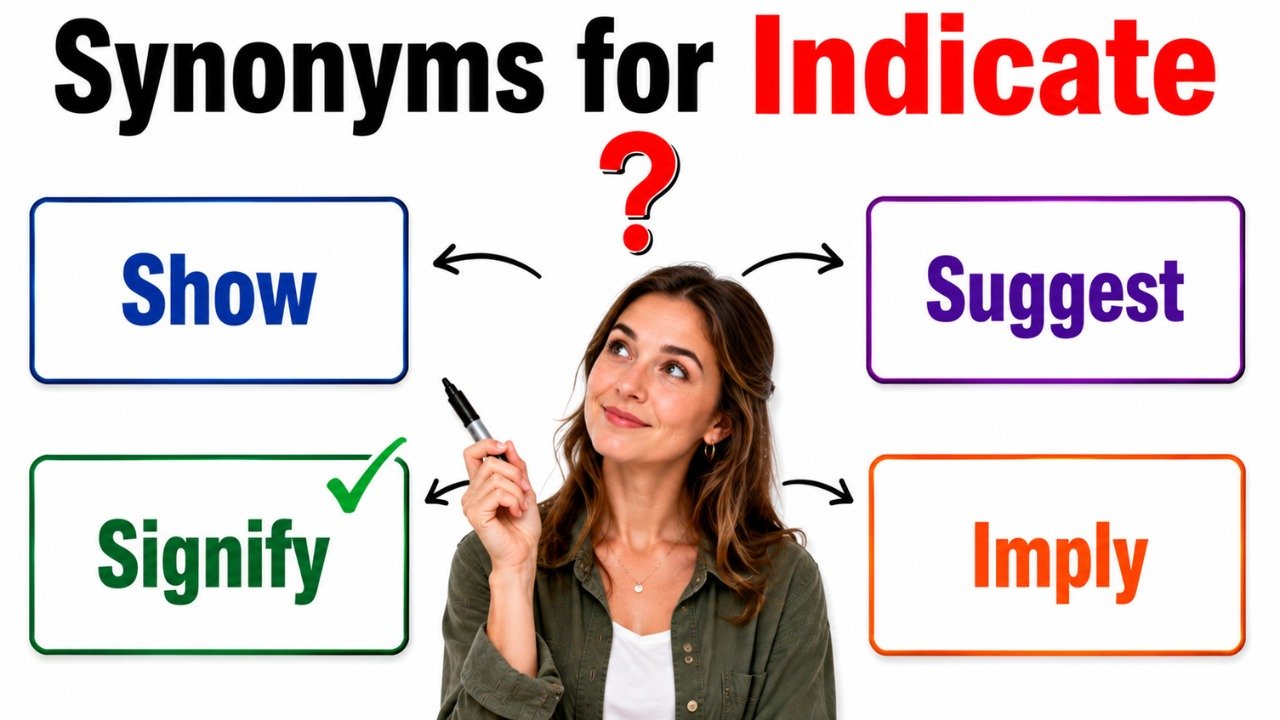
Quick Answer: The best synonyms for indicate are show, signal, suggest, reveal, demonstrate, signify, denote, imply, specify, and point to. Use show as the most natural general replacement. Choose demonstrate when evidence makes something clear, signal for warnings or actions, and suggest when the meaning is indirect. Denote works for symbols and definitions, while specify is best for exact details. Reveal suits hidden information, and imply communicates an unstated meaning.
Pronunciation and Word Details
Word: Indicate.
Pronunciation: /ˈɪn.də.keɪt/
Part of Speech: Verb.
Meaning: To show, suggest, point out, or communicate that something exists, is true, or should receive attention.
US Pronunciation:
UK Pronunciation:
What Does “Indicate” Mean?
Indicate means to show, suggest, identify, or communicate something. It is a verb commonly used when a sign, action, statement, result, or piece of evidence provides information.
The word may describe direct communication.
Example: Please indicate your preferred appointment time.
It can also describe evidence that suggests a conclusion.
Example: The results indicate that the new method is effective.
Indicate may refer to physical direction.
Example: The arrow indicates the nearest exit.
It can describe a gesture or signal.
Example: She indicated that the visitor should enter.
The word is also common in reports, instructions, forms, research, medicine, data analysis, and formal explanations.
Direct Meaning: To state or show something clearly.
Indirect Meaning: To suggest something without proving it completely.
Directional Meaning: To point toward a place, person, or object.
Symbolic Meaning: To represent a particular idea, value, or condition.
The best synonym depends on whether indicate means show, suggest, signal, specify, reveal, represent, or prove.
Meaning, Tone, and Context of “Indicate”
Indicate has a neutral and slightly formal tone. It appears frequently in professional, academic, technical, medical, scientific, and instructional writing.
Formal Context: Indicate is useful in reports, essays, studies, instructions, and official forms.
Academic Context: Writers use it when evidence supports a claim without proving it with complete certainty.
Technical Context: It may describe what a symbol, measurement, display, or instrument communicates.
Medical Context: Symptoms or test results may indicate a condition that requires further examination.
Conversational Context: The word is understandable in daily speech, although show, point, or signal may sound more natural.
Indirect Context: Indicate often communicates that something provides a clue rather than absolute proof.
The word is useful because it can express both direct and indirect meaning. However, writers should choose more precise alternatives when they need to distinguish between showing, suggesting, proving, identifying, or revealing.
When and How to Use “Indicate”
For Showing Information
Use indicate when a result, sign, document, or display communicates information.
Example: The chart indicates a steady increase in demand.
For Suggesting a Conclusion
Use indicate when available evidence supports an idea but does not prove it completely.
Example: Her response may indicate that she needs more time.
For Giving Direction
Indicate can describe pointing toward a place, object, or person.
Example: The guide indicated the path leading to the entrance.
For Expressing a Preference
Use indicate when someone selects or communicates a choice.
Example: Please indicate which option you prefer.
For Signaling an Action
The word can describe a gesture, sound, light, or movement that communicates what should happen.
Example: The green light indicates that drivers may continue.
For Identifying a Detail
Use indicate when a form, label, statement, or instruction requires exact information.
Example: Indicate your full name in the space provided.
For Revealing a Condition
Medical signs, physical symptoms, or measurements may indicate a particular condition.
Example: A high temperature can indicate an infection.
For Representing Meaning
A word, symbol, color, or mark may indicate a particular idea.
Example: A red symbol indicates an urgent warning.
Best Synonyms for Indicate
Show
Synonym: To make something visible, understandable, or clear.
Example: The figures show that costs have decreased.
Signal
Synonym: To communicate a warning, action, intention, or change through a sign.
Example: The flashing light signals that the machine requires attention.
Suggest
Synonym: To provide an indirect reason for believing something.
Example: His expression suggests that he is concerned.
Reveal
Synonym: To make hidden or unknown information clear.
Example: The investigation revealed several important details.
Demonstrate
Synonym: To show something clearly through evidence, action, or explanation.
Example: The experiment demonstrates how temperature affects pressure.
Signify
Synonym: To represent or communicate a particular meaning.
Example: The raised flag signifies that the building is open.
Denote
Synonym: To have a specific literal, technical, or symbolic meaning.
Example: The letter denotes the unknown value in the equation.
Imply
Synonym: To communicate an idea indirectly without stating it openly.
Example: Her question implied that she already knew the answer.
Specify
Synonym: To state an exact detail, condition, requirement, or choice.
Example: Please specify the quantity you need.
Point To
Synonym: To provide evidence or direction toward a conclusion, place, or object.
Example: Several clues point to a simple explanation.
50 Synonyms for Indicate with Short Meanings
- Show: To make something clear or visible.
- Signal: To communicate through a sign or action.
- Suggest: To communicate an idea indirectly.
- Reveal: To make hidden information known.
- Demonstrate: To establish something through evidence or action.
- Signify: To represent a particular meaning.
- Denote: To have a precise or literal meaning.
- Imply: To express something without stating it directly.
- Express: To communicate a thought, feeling, or meaning.
- Convey: To communicate information or an impression.
- Point To: To direct attention toward something.
- Mark: To identify or show a position, event, or change.
- Identify: To name or recognize something clearly.
- Specify: To provide an exact detail.
- State: To express information clearly in words.
- Mention: To refer to something briefly.
- Declare: To announce something clearly or formally.
- Announce: To make information publicly known.
- Report: To communicate facts or findings.
- Communicate: To share information, meaning, or intention.
- Display: To present information where it can be seen.
- Exhibit: To show a quality, feature, or behavior.
- Present: To show or provide something for attention.
- Illustrate: To make an idea clear through an example.
- Represent: To stand for or symbolize something.
- Reflect: To show the nature or condition of something.
- Highlight: To draw special attention to something.
- Emphasize: To give particular importance to a point.
- Confirm: To show that something is correct or true.
- Prove: To establish something as true through evidence.
- Evidence: To provide signs or proof of something.
- Attest: To provide evidence that something is true.
- Testify: To serve as evidence of a fact or quality.
- Manifest: To show a quality, feeling, or condition clearly.
- Disclose: To make private or unknown information known.
- Expose: To reveal something previously hidden.
- Betray: To reveal a feeling or fact unintentionally.
- Register: To show a measurement, response, or change.
- Record: To display or preserve measured information.
- Designate: To identify something for a particular role or purpose.
- Name: To identify a person, object, or category.
- Label: To identify or describe something with a word or mark.
- Direct: To point someone toward a place or action.
- Guide: To show the correct direction or course.
- Gesture: To communicate through physical movement.
- Nod: To indicate agreement or permission with head movement.
- Foreshadow: To suggest that something will happen later.
- Portend: To indicate that an important event may occur.
- Betoken: To serve as a sign of something.
- Evince: To show a quality or feeling clearly.
Read Also:
Synonyms for Intelligence

Synonyms for Indicate by Context
When Indicate Means Show Clearly
Show, demonstrate, reveal, display, exhibit, illustrate, and present work when something becomes visible or understandable.
Example: The report shows a clear improvement in performance.
Example: Her actions demonstrated genuine concern.
When Indicate Means Suggest Indirectly
Suggest, imply, point to, reflect, foreshadow, and portend are useful when evidence supports an interpretation without directly proving it.
Example: His silence suggests that he remains uncertain.
Example: The early results point to a positive outcome.
When Indicate Means Signal
Signal, gesture, nod, direct, guide, and mark describe signs or movements that communicate an action, direction, or intention.
Example: She gestured toward the available chair.
Example: The sign directs visitors toward the main entrance.
When Indicate Means Specify
Specify, state, identify, name, designate, label, and mention work when precise information must be provided.
Example: Please specify the date when you will arrive.
Example: The document identifies the person responsible for approval.
When Indicate Means Represent
Signify, denote, represent, symbolize, express, and convey describe words, colors, symbols, or actions that carry meaning.
Example: The dark color signifies caution.
Example: In this formula, the letter denotes distance.
When Indicate Means Reveal Evidence
Reveal, demonstrate, confirm, prove, attest, evidence, and testify are useful when facts or results support a conclusion.
Example: The records confirm that the payment was received.
Example: These details attest to the accuracy of the account.
Another Word for Indicate
The best general replacement for indicate is show. It is natural, clear, and suitable in both formal and casual contexts. However, the best choice depends on what the sentence communicates.
Choose suggest when the evidence is indirect. Use signal for warnings, intentions, and actions. Choose specify when exact information is required. Use reveal when something hidden becomes known.
Original: The results indicate that customers prefer the simpler design.
Better Option: The results show that customers prefer the simpler design.
Original: Her expression indicated that she was disappointed.
Better Option: Her expression suggested that she was disappointed.
Original: Please indicate your preferred delivery date.
Better Option: Please specify your preferred delivery date.
Original: The alarm indicates a possible safety problem.
Better Option: The alarm signals a possible safety problem.
When Not to Use “Indicate”
Indicate may sound vague when the sentence requires a more precise verb. It can mean show, suggest, signal, specify, point, reveal, or represent, so readers may not always know which meaning is intended.
Use show when information is clear. Use suggest when the conclusion is uncertain. Use prove when evidence establishes something beyond reasonable doubt. Use specify when requesting an exact detail.
Weak: The research indicates the theory.
Better: The research supports the theory.
Weak: She indicated the door.
Better: She pointed toward the door.
Weak: The form indicates your contact details.
Better: The form requests your contact details.
Weak: His face indicated anger.
Better: His expression revealed his anger.
Avoid indicate when a simpler word improves natural conversation.
Weak: Can you indicate where the kitchen is?
Better: Can you show me where the kitchen is?
Do not use indicate as a replacement for infer. A speaker or piece of evidence indicates something, while a reader or observer infers a meaning from it.
Words Commonly Confused With Indicate
Indicate vs Show: Indicate may communicate information directly or indirectly. Show usually makes something clearer, more visible, or easier to understand.
Indicate vs Suggest: Indicate may provide strong evidence, while suggest usually expresses a possibility rather than certainty.
Indicate vs Imply: Indicate can be direct or indirect. Imply normally communicates an unstated meaning.
Indicate vs Infer: A person or sign indicates information. Another person infers a conclusion from that information.
Indicate vs Demonstrate: Indicate provides a sign or clue. Demonstrate shows something clearly through evidence, explanation, or action.
Indicate vs Prove: Indicate may support a conclusion without establishing complete certainty. Prove presents sufficient evidence that something is true.
Indicate vs Reveal: Indicate communicates or suggests information. Reveal makes something hidden or unknown clear.
Indicate vs Specify: Indicate can be broad, while specify provides exact information or requirements.
Indicate vs Signify: Indicate often shows a fact, direction, or condition. Signify emphasizes the meaning represented by a symbol or action.
Indicate vs Denote: Indicate has many general uses. Denote is more precise and often describes the literal or technical meaning of a word, symbol, or sign.
Which Synonym Should You Choose?
Choose show for a clear and natural general replacement.
Choose suggest when the evidence supports a possibility but does not establish certainty.
Choose demonstrate when examples, actions, or evidence clearly establish a point.
Choose signal when referring to warnings, intentions, changes, or instructions.
Choose reveal when hidden information, feelings, or facts become known.
Choose imply when a message is communicated indirectly.
Choose specify when requesting or providing exact information.
Choose denote when explaining the literal or technical meaning of a symbol.
Choose signify when a gesture, symbol, color, or event represents a broader meaning.
Choose point to when several clues support a likely conclusion.
Choose identify when naming a person, object, issue, or detail.
Choose confirm when new information verifies an earlier belief.
Choose prove when evidence establishes a fact conclusively.
Choose display when information appears on a screen, sign, chart, or instrument.
Choose gesture or nod when physical movement communicates meaning.
In reports and essays, show, demonstrate, suggest, reveal, and confirm usually create clear sentences. In instructions and forms, specify, select, identify, and state are often more precise.
Real Life Examples of “Indicate” in Sentences
Original: The graph indicates a rise in monthly expenses.
Better Option: The graph shows a rise in monthly expenses.
Original: His quiet response indicated that he was uncertain.
Better Option: His quiet response suggested that he was uncertain.
Original: The red light indicates that the door is locked.
Better Option: The red light signals that the door is locked.
Original: Please indicate the number of people attending.
Better Option: Please specify the number of people attending.
Original: The evidence indicates that the document was changed.
Better Option: The evidence demonstrates that the document was changed.
Original: The arrow indicates the correct path.
Better Option: The arrow points to the correct path.
Original: Her smile indicated her satisfaction.
Better Option: Her smile revealed her satisfaction.
Original: The symbol indicates strength and unity.
Better Option: The symbol signifies strength and unity.
Original: The label indicates the product category.
Better Option: The label identifies the product category.
Original: The results indicate that the earlier estimate was correct.
Better Option: The results confirm that the earlier estimate was correct.
Synonym Groups and Usage Differences
Showing Group
Show, reveal, display, exhibit, present, and manifest communicate that something becomes visible or understandable.
Show is the broadest option. Reveal emphasizes previously hidden information, while display focuses on visible presentation.
Example: The screen displays the current temperature.
Suggestion Group
Suggest, imply, point to, reflect, foreshadow, and portend communicate indirect meaning or possibility.
Suggest is neutral and common. Imply refers to an unstated message, while foreshadow and portend concern future events.
Example: The change in tone suggests that the discussion became serious.
Signaling Group
Signal, gesture, nod, direct, guide, and mark communicate instructions, direction, agreement, or change.
Signal often involves a visual or audible sign. Gesture and nod involve physical movement.
Example: He nodded to signal his agreement.
Identification Group
Identify, specify, state, name, label, designate, and mention provide particular information.
Identify establishes what something is. Specify gives exact details, while designate assigns a role or purpose.
Example: The report identifies three areas that require improvement.
Meaning Group
Signify, denote, represent, express, and convey describe how words, signs, colors, or actions communicate meaning.
Denote is precise and literal. Signify may carry cultural or symbolic meaning, while convey focuses on communication.
Example: The symbol denotes equality in the equation.
Evidence Group
Demonstrate, confirm, prove, evidence, attest, and testify describe different strengths of support.
Demonstrate shows something clearly. Confirm verifies an earlier belief, while prove establishes a conclusion more strongly.
Example: The final test confirmed the earlier results.
Antonyms of Indicate
The opposite of indicate depends on whether the word means show, reveal, communicate, identify, or provide evidence.
Conceal: To prevent information from becoming known.
Hide: To keep something out of sight or understanding.
Obscure: To make meaning difficult to see or understand.
Suppress: To prevent information or evidence from being expressed.
Withhold: To refuse to provide information.
Mask: To cover or disguise the true nature of something.
Disguise: To change the appearance of something to hide its identity.
Deny: To state that something is not true.
Contradict: To provide information that conflicts with another claim.
Mislead: To cause someone to form an incorrect belief.
Confuse: To make information difficult to understand.
Distort: To present information in an inaccurate form.
Concealment: The act of keeping something hidden.
Silence: To prevent communication or expression.
Comparison Between Indicate and Related Words
Indicate vs Show
Indicate may provide a sign, suggestion, or direction. Show generally makes something visible or clear.
Example With Indicate: The data indicates a possible change in behavior.
Example With Show: The data shows a clear change in behavior.
Indicate vs Suggest
Indicate may communicate stronger evidence than suggest. Suggest usually leaves more uncertainty.
Example With Indicate: The test results indicate an improvement.
Example With Suggest: Her comments suggest that she supports the proposal.
Indicate vs Imply
Indicate can communicate directly. Imply communicates an unstated meaning that the listener must understand.
Example With Indicate: The notice indicates that the office closes early.
Example With Imply: His wording implies that the decision has already been made.
Indicate vs Demonstrate
Indicate provides a sign or clue. Demonstrate makes a point clear through evidence, examples, or action.
Example With Indicate: The marks indicate frequent use.
Example With Demonstrate: The experiment demonstrates the effect of heat.
Indicate vs Reveal
Indicate may suggest information that is already partly visible. Reveal uncovers something previously unknown or hidden.
Example With Indicate: His voice indicated concern.
Example With Reveal: His final statement revealed the reason for his concern.
Indicate vs Signify
Indicate can show facts, conditions, choices, or directions. Signify focuses on what something symbolizes or means.
Example With Indicate: The arrow indicates the correct entrance.
Example With Signify: The white flower signifies peace.
Indicate vs Denote
Indicate is broad and flexible. Denote is usually used for exact meanings, definitions, signs, and symbols.
Example With Indicate: The number indicates the room location.
Example With Denote: In this chart, circles denote completed tasks.
Indicate vs Prove
Indicate suggests that evidence supports a conclusion. Prove means that the evidence establishes the conclusion as true.
Example With Indicate: The early findings indicate that the treatment may help.
Example With Prove: The records prove that the payment was completed.
Common Phrases and Expressions With “Indicate”
Clearly Indicate: To show something in an obvious way.
Indicate That: To communicate or suggest a particular conclusion.
Indicate a Need: To show that something is required.
Indicate a Change: To signal that a condition has become different.
Indicate a Preference: To express which option someone favors.
Indicate Direction: To point toward a particular route or location.
Indicate the Presence Of: To show that something exists in a place or condition.
Indicate Support: To communicate approval or agreement.
Indicate Willingness: To show readiness to do something.
Indicate a Problem: To signal that something may be wrong.
Indicate the Cause: To identify the reason something happened.
Indicate Otherwise: To provide information that supports a different conclusion.
Common Mistakes to Avoid
One common mistake is using indicate when a clearer and simpler verb is available. Show, point, state, specify, or reveal may communicate the exact meaning more effectively.
Avoid treating indicate and prove as perfect synonyms. A result may indicate a possibility without proving it conclusively.
Do not confuse imply and infer. A speaker implies meaning, while a listener infers meaning. A sign or statement may indicate something.
Avoid incorrect phrasing such as indicate about.
Incorrect: The report indicates about several problems.
Correct: The report indicates several problems.
Do not combine indicate with another verb that repeats the same meaning.
Repetitive: The results indicate and suggest that demand is rising.
Improved: The results suggest that demand is rising.
Be careful with vague pronouns.
Vague: This indicates that it is wrong.
Clear: The missing information indicates that the calculation is incorrect.
Avoid overusing indicates in reports and essays. Rotate natural alternatives such as shows, suggests, demonstrates, reveals, confirms, identifies, and reflects.
Choose the strength of the verb carefully. Suggest expresses uncertainty, confirm verifies a claim, and prove communicates a much stronger conclusion.
Conclusion
The most useful synonyms for indicate include show, signal, suggest, reveal, demonstrate, signify, denote, imply, specify, and point to. Show is the strongest general alternative, while suggest works for uncertain conclusions and demonstrate suits clear evidence. Use signal for warnings or actions, specify for exact information, and signify for symbolic meaning. Understanding these differences helps you use synonyms for indicate accurately in reports, essays, instructions, descriptions, forms, and everyday communication.
FAQs About Synonyms for Indicate
What Is the Best Synonym for Indicate?
Show is the best general synonym for indicate. Suggest, signal, reveal, demonstrate, and specify may be more precise in particular contexts.
What Is a Formal Synonym for Indicate?
Demonstrate, signify, denote, specify, establish, reveal, and communicate are suitable formal alternatives.
What Is Another Word for Indicate in an Essay?
Show, suggest, demonstrate, reveal, reflect, confirm, and illustrate work well in essays, depending on the strength of the evidence.
Are Indicate and Suggest the Same?
They are similar, but suggest usually communicates more uncertainty. Indicate may describe stronger evidence or a more direct sign.
What Is Another Word for Indicate on a Form?
Specify, state, select, identify, enter, and provide are useful alternatives for instructions on a form.
Can Indicate Mean Point?
Yes. Indicate can mean to point toward a person, object, place, or direction through a gesture, sign, or movement.
What Is the Opposite of Indicate?
Conceal, hide, obscure, suppress, withhold, disguise, and mislead are common opposites, depending on the context.
