
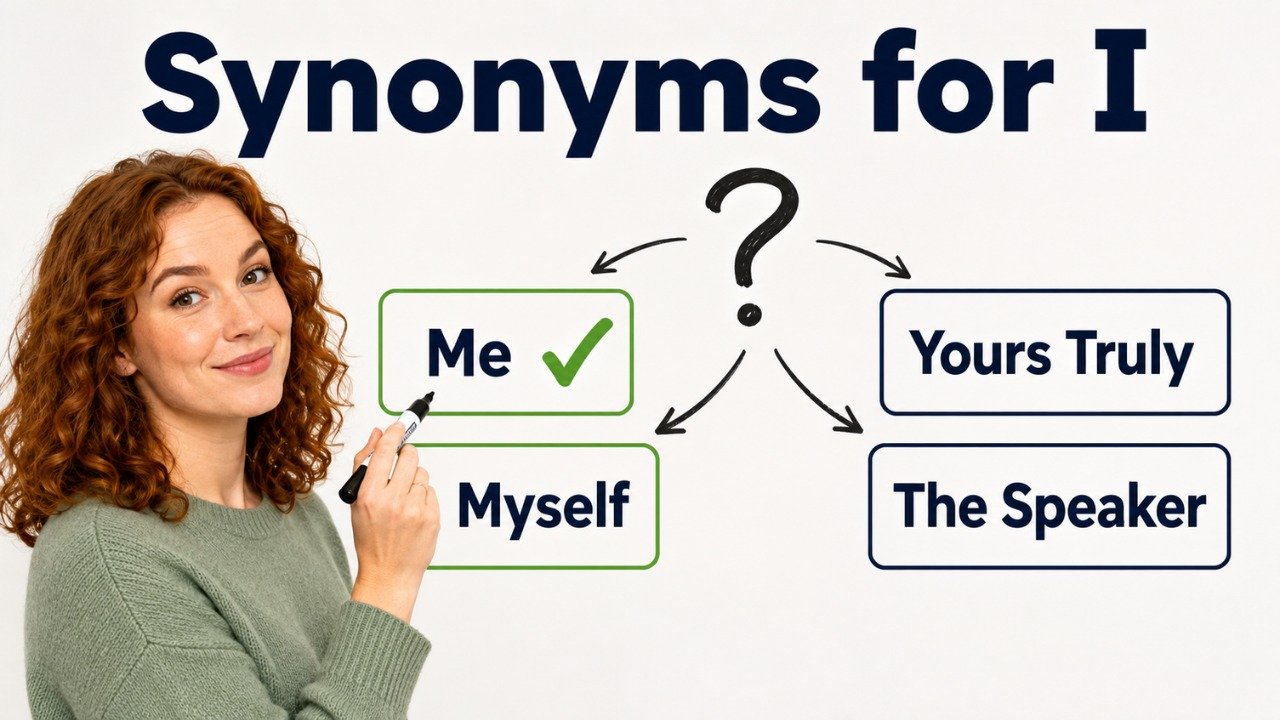
Quick Answer: The best synonyms for I include me, myself, the speaker, the writer, this writer, the narrator, one, we, the undersigned, and yours truly. The keyword synonyms for I is usually about first person self reference, not perfect word replacement. Use the speaker for spoken context, the writer for formal writing, myself for emphasis, one for general statements, we for shared ideas, and the undersigned for official documents.
Table of Contents
TogglePronunciation and Word Details
Word: I
Pronunciation: /aɪ/
Part of Speech: Pronoun
Meaning: I is a first person singular subject pronoun used by a speaker or writer to refer to himself or herself.
US Pronunciation:
UK Pronunciation:
What Does “I” Mean?
Direct Answer: I means the person who is speaking or writing.
I is a pronoun, more specifically a first person singular subject pronoun. It is used when someone talks about their own action, thought, feeling, opinion, or identity. In grammar, I usually comes before a verb, as in I think, I know, I agree, or I wrote. It works as the subject of a sentence, while me works as the object. In formal, casual, academic, and creative writing, I can show personal voice, direct experience, or individual responsibility.
Meaning, Tone, and Context of “I”
I has a neutral and personal tone. It is common in conversation, personal writing, essays, stories, emails, speeches, and reflective writing. It feels direct because it clearly shows who is speaking. In formal academic writing, I may be accepted when the writer needs to explain personal argument, method, or position. In business writing, I can sound polite and responsible when used carefully. In creative writing, I helps build voice, emotion, and connection with the reader.
When and How to Use “I”
For Personal Opinion: Use I when sharing your own thought, belief, or judgment.
Example: I believe this solution is clear and practical.
For Personal Action: Use I when you are the person doing the action.
Example: I completed the report before the meeting.
For Personal Experience: Use I when describing something you saw, felt, learned, or did.
Example: I learned an important lesson from that mistake.
For Responsibility: Use I when accepting ownership of a decision or action.
Example: I will correct the error and send the updated version.
For Storytelling: Use I when the narrator is speaking from personal experience.
Example: I walked into the room and noticed the silence.
Best Synonyms for I
Me: The object form of I, used when the speaker receives an action.
Example: Please send the details to me.
Myself: A reflexive or emphatic form used to stress personal action.
Example: I prepared the notes myself.
The Speaker: A formal way to refer to the person who is speaking.
Example: The speaker believes the point needs more explanation.
The Writer: A formal way to refer to the person who is writing.
Example: The writer suggests a simpler sentence structure.
This Writer: A more formal self reference in essays, commentary, or analysis.
Example: This writer considers the second option more effective.
The Narrator: The voice telling a story, especially in fiction or personal narrative.
Example: The narrator remembers the event clearly.
One: A general pronoun used when making a broad statement.
Example: One should choose words carefully in formal writing.
We: An inclusive or authorial alternative used when speaking with the reader or group.
Example: We can see how the sentence becomes stronger.
The Undersigned: A formal document phrase for the person signing.
Example: The undersigned agrees to the stated conditions.
Yours Truly: A light, casual, or playful way to refer to oneself.
Example: Yours truly forgot the keys again.
50 Synonyms for I with Short Meanings
- Me: Object form of the first person pronoun.
- Myself: Reflexive or emphatic first person form.
- I Myself: Stronger form used for personal emphasis.
- Me Personally: Casual phrase showing personal opinion.
- Personally: Word used to show the speaker’s own view.
- As For Me: Phrase introducing a personal response.
- For My Part: Phrase showing personal position.
- From My View: Personal way of seeing something.
- From My Perspective: Personal angle or viewpoint.
- In My Opinion: Phrase showing personal belief.
- My View: Personal judgment or opinion.
- My Position: Personal stance on a matter.
- My Side: Personal version of a situation.
- My Role: Personal part in an action or event.
- My Experience: Personal knowledge from life or work.
- My Case: Personal situation or example.
- My End: Casual phrase for the speaker’s side.
- This Person: Neutral way to refer to oneself.
- This Individual: Formal way to refer to oneself.
- The Speaker: Person who is speaking.
- This Speaker: Formal phrase for the current speaker.
- The Writer: Person who is writing.
- This Writer: Formal phrase for the current writer.
- The Author: Person who wrote a text.
- This Author: Formal self reference by an author.
- The Narrator: Voice telling a story.
- This Narrator: Self reference in storytelling.
- The Storyteller: Person telling a story.
- The Voice: Speaking presence in a text.
- The Presenter: Person giving information.
- The Sender: Person sending a message.
- The Signer: Person signing a document.
- The Undersigned: Formal phrase for the person signing.
- The Applicant: Person applying for a role or place.
- The Candidate: Person being considered for selection.
- The Student: Learner referring to self in academic context.
- The Employee: Worker referring to self in workplace context.
- The Customer: Buyer or service user referring to self.
- The User: Person using a service, tool, or system.
- The Respondent: Person answering a question or survey.
- The Witness: Person giving a personal account.
- The Participant: Person taking part in something.
- The Observer: Person watching or noticing something.
- The Reporting Person: Person giving a report.
- The Present Writer: Formal phrase for this writer.
- The Present Speaker: Formal phrase for this speaker.
- One: General pronoun for any person.
- We: Inclusive or authorial alternative to I.
- Self: The person as an individual.
- Yours Truly: Casual or humorous self reference.
Read Also:
Synonyms for Forced
Synonyms for I by Context
When I Means The Speaker
Use these alternatives when the person is speaking directly or giving an oral statement.
Useful Synonyms: The speaker, this speaker, the presenter, the person speaking.
Example: The speaker agrees that the topic needs more detail.
When I Means The Writer
Use these alternatives when the person is writing an essay, article, report, or personal note.
Useful Synonyms: The writer, this writer, the author, the present writer.
Example: This writer believes the shorter sentence is clearer.
When I Means Personal Opinion
Use these alternatives when showing a personal belief or viewpoint.
Useful Synonyms: Personally, in my opinion, from my perspective, my view.
Example: From my perspective, the second option sounds more natural.
When I Means Formal Self Reference
Use formal alternatives in documents, applications, statements, or official writing.
Useful Synonyms: The undersigned, the applicant, the candidate, the signer.
Example: The undersigned confirms that the information is correct.
When I Means A General Person
Use general alternatives when the sentence should not sound too personal.
Useful Synonyms: One, we, the individual, a person.
Example: One should avoid repeating the same pronoun too often.
Another Word for I
The best single replacement for I depends on context. In normal grammar, I has no perfect synonym because it is a subject pronoun. In formal writing, the writer or this writer can replace I. In general advice, one may work better. In spoken context, the speaker can be useful.
Original: I think this sentence needs more detail.
Better Option: This writer thinks this sentence needs more detail.
Original: I should choose a stronger word here.
Better Option: One should choose a stronger word here.
Original: I agree with the main point.
Better Option: The speaker agrees with the main point.
Original: I confirm that the details are correct.
Better Option: The undersigned confirms that the details are correct.
When Not to Use “I”
Do not use I too often when it makes writing sound repetitive, overly personal, or informal. Avoid I in sentences where the object pronoun me is required. Do not replace I with myself unless the sentence needs reflexive meaning or emphasis. In formal writing, too many I statements can weaken the tone if the focus should be on facts, evidence, or results.
Weak: Me finished the assignment yesterday.
Better: I finished the assignment yesterday.
Weak: I myself went to the office myself.
Better: I went to the office myself.
Weak: I think I feel I can say I understand the problem.
Better: The problem is clear, and the solution is practical.
Weak: I, the writer, personally think in my opinion this is correct.
Better: This writer considers this correct.
Words Commonly Confused With I
I vs Me: I is used as the subject of a sentence, while me is used as the object.
I vs Myself: Myself is used when the speaker receives the action or when extra emphasis is needed.
I vs My: I is a pronoun, while my is a possessive word that shows ownership.
I vs Mine: I names the speaker as the subject, while mine shows something belongs to the speaker.
I vs We: I refers to one speaker or writer, while we refers to a group or includes the reader.
I vs One: I is personal and direct, while one is general and more formal.
I vs The Writer: I is direct self reference, while the writer sounds more formal and distant.
Which Synonym Should You Choose?
Choose the speaker when referring to someone talking in a speech, discussion, or presentation.
Choose the writer when you want a formal alternative in essays, articles, or analysis.
Choose this writer when you need a polished and formal self reference.
Choose myself when you want to emphasize that the speaker did something personally.
Choose me when the pronoun receives the action in a sentence.
Choose one when writing general advice or formal statements.
Choose we when including the reader or speaking for a group.
Choose the undersigned when writing legal, official, or signed documents.
Choose the narrator when discussing stories, novels, memories, or personal narratives.
Choose personally when the sentence is about opinion, taste, or preference.
Real Life Examples of “I” in Sentences
Original: I believe the answer is correct.
Better Option: This writer believes the answer is correct.
Original: I completed the task before noon.
Better Option: The employee completed the task before noon.
Original: I will explain the rule again.
Better Option: The speaker will explain the rule again.
Original: I remember the day clearly.
Better Option: The narrator remembers the day clearly.
Original: I think the sentence sounds too casual.
Better Option: In my opinion, the sentence sounds too casual.
Original: I signed the form today.
Better Option: The undersigned signed the form today.
Original: I can learn from this mistake.
Better Option: One can learn from this mistake.
Original: I found the example helpful.
Better Option: From my perspective, the example was helpful.
Original: I wrote the paragraph in a simpler style.
Better Option: The writer wrote the paragraph in a simpler style.
Original: I agree with your suggestion.
Better Option: The speaker agrees with your suggestion.
Synonym Groups and Usage Differences
Grammar Group
This group includes words connected to first person grammar. Use them when explaining pronoun function.
Synonyms: I, me, myself, my, mine.
Example: I is the subject, while me is the object.
Speaking Group
This group is useful when someone is giving a speech, presentation, or spoken answer.
Synonyms: The speaker, this speaker, the presenter, the person speaking.
Example: The speaker supports the main idea.
Writing Group
This group works well in essays, articles, reports, and formal writing.
Synonyms: The writer, this writer, the author, the present writer.
Example: This writer recommends a clearer word choice.
Formal Document Group
This group fits official statements, forms, applications, and signed documents.
Synonyms: The undersigned, the signer, the applicant, the candidate.
Example: The undersigned confirms the accuracy of the statement.
Opinion Group
This group helps express personal thoughts without repeating I too much.
Synonyms: Personally, in my opinion, from my perspective, my view.
Example: From my perspective, the phrase sounds natural.
General Person Group
This group removes the personal focus and makes the sentence broader.
Synonyms: One, we, the individual, a person.
Example: One should use I carefully in formal writing.
Antonyms of I
The word I does not have a true opposite like many descriptive words. Its antonyms depend on grammar and point of view. The opposite idea is usually another person or group instead of the speaker.
You: The person being spoken to.
He: A male person being discussed.
She: A female person being discussed.
They: Other people being discussed.
We: A group that includes the speaker and others.
Them: Other people as the object of an action.
Others: People besides the speaker.
Another Person: Someone who is not the speaker.
Comparison
I vs Me
I is the subject form. Me is the object form. Use I before the action and me after an action or preposition.
Example With I: I wrote the sentence.
Example With Me: The teacher helped me with the sentence.
I vs Myself
Myself is not a simple replacement for I. Use myself when the subject and object are the same person or when adding emphasis.
Example With I: I solved the problem.
Example With Myself: I solved the problem myself.
I vs We
I means one person speaking or writing. We means the speaker plus another person or group. We can also include the reader in instructional writing.
Example With I: I will explain the rule.
Example With We: We will review the rule together.
I vs One
I sounds personal and direct. One sounds general, formal, and less personal.
Example With I: I should choose clearer words.
Example With One: One should choose clearer words.
I vs The Writer
I is simple and direct. The writer is more formal and can make an article, essay, or analysis sound less personal.
Example With I: I believe the point is valid.
Example With The Writer: The writer believes the point is valid.
Common Phrases and Expressions With I
I Think: Used to share an opinion.
I Believe: Used to express belief or judgment.
I Agree: Used to show agreement.
I Mean: Used to clarify meaning.
I Feel: Used to express emotion or opinion.
I Am: Used to describe identity, condition, or state.
I Can: Used to show ability.
I Have: Used to show possession or experience.
I Would: Used to express choice, preference, or possibility.
I Remember: Used to introduce memory or past experience.
Common Mistakes to Avoid
A common mistake is using me instead of I as the subject. Another mistake is using myself when I or me is correct. Writers also repeat I too often, which can make a paragraph sound narrow or weak. In formal writing, avoid using casual phrases like yours truly unless the tone allows it. Do not switch between I and we without a reason. Also, remember that I is always capitalized, even when it appears in the middle of a sentence.
Conclusion
The keyword synonyms for I needs careful grammar understanding because I is a pronoun, not a descriptive word with many exact replacements. The best choice depends on context. Use the speaker for spoken situations, the writer for formal writing, the narrator for stories, one for general advice, we for shared ideas, and myself for emphasis. For clear writing, choose the alternative that fits the sentence role, tone, and purpose without making the sentence sound unnatural.
FAQs About Synonyms for I
What is the best synonym for I?
The best synonym for I depends on context. The writer works well in formal writing, while the speaker works well in spoken context.
Is me a synonym for I?
Me is related to I, but it is not used the same way. I is the subject form, and me is the object form.
Can I use myself instead of I?
You should not use myself as a direct replacement for I. Use myself for emphasis or when the same person receives the action.
What is a formal way to say I?
Formal alternatives include the writer, this writer, the speaker, the undersigned, and the applicant, depending on context.
What can I use instead of I in an essay?
You can use the writer, this writer, one, or a sentence without personal pronouns. The best choice depends on the essay style.
Is I always capitalized?
Yes. I is always capitalized in standard English, even when it appears in the middle of a sentence.
Why does I have fewer true synonyms?
I has fewer true synonyms because it is a grammar word. Most alternatives are context based phrases, not exact replacements.
