
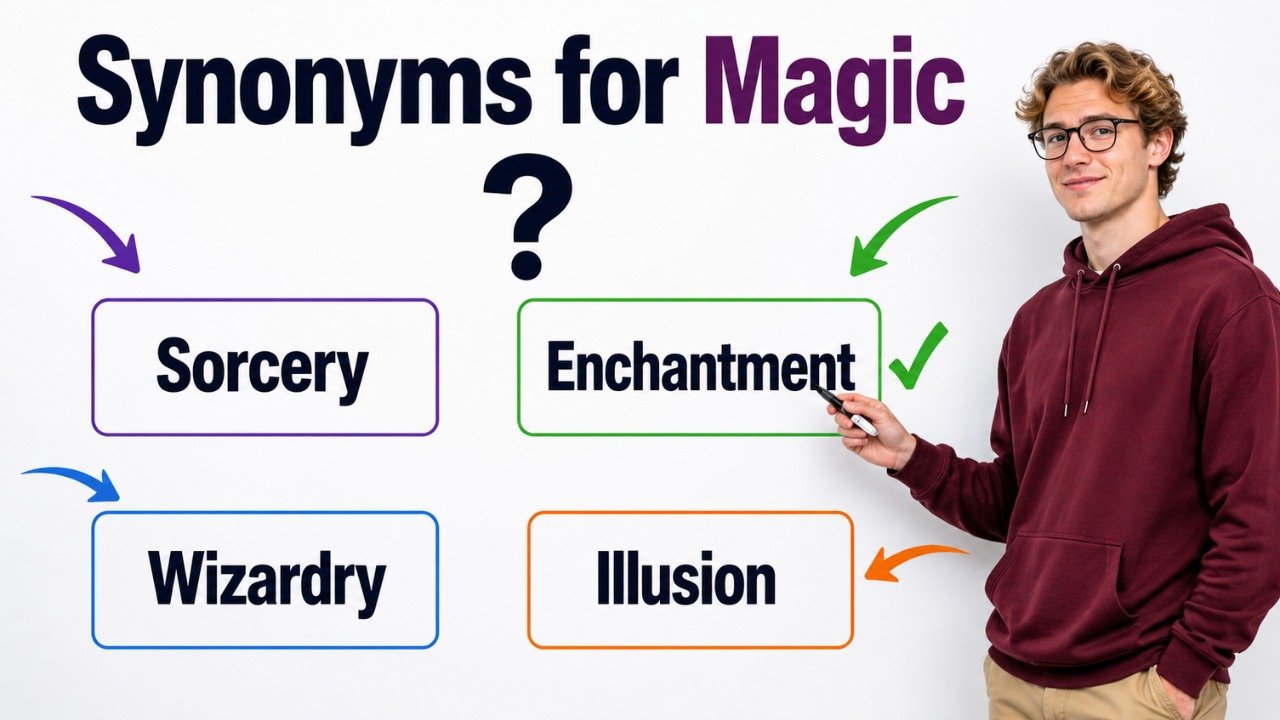
Quick Answer: The best synonyms for magic include enchantment, sorcery, wizardry, witchcraft, spell, charm, illusion, wonder, miracle, and mystery. The keyword synonyms for magic can describe supernatural power, a special feeling, a clever trick, strong attraction, or something amazing. Use enchantment for a beautiful magical feeling, sorcery for supernatural power, illusion for stage tricks or false appearances, wonder for amazement, charm for attraction, and miracle for something that feels impossible or extraordinary.
Pronunciation and Word Details
Word: Magic.
Pronunciation: /ˈmædʒ.ɪk/.
Part of Speech: Noun and adjective.
Meaning: Magic means supernatural power, a mysterious effect, a special charm, or something that feels wonderful and hard to explain.
US Pronunciation:
UK Pronunciation:
What Does “Magic” Mean?
Magic means the power, feeling, or effect of something that seems mysterious, supernatural, wonderful, or impossible to explain. As a noun, it can refer to spells, enchantment, stage tricks, or a special quality that creates amazement. As an adjective, it describes something that feels wonderful, mysterious, or unusually effective.
In Fantasy: Magic can mean supernatural power used by witches, wizards, or magical beings.
In Entertainment: Magic can mean illusion, tricks, or sleight of hand.
In Everyday Speech: Magic can describe a special moment, beautiful feeling, or amazing result.
In Emotion: Magic can mean charm, wonder, attraction, or delight.
Meaning, Tone, and Context of “Magic”
Magic has a flexible tone. It can be mysterious, emotional, playful, poetic, dramatic, or imaginative. In fantasy writing, it often refers to supernatural power. In casual speech, it often means something wonderful or surprising. In entertainment, it can refer to tricks and illusions.
Tone: Imaginative, positive, mysterious, emotional, or dramatic.
Context: Fantasy, stories, entertainment, beauty, wonder, charm, attraction, and surprising success.
Common Use: Magic is often used to describe things that feel special, powerful, beautiful, or difficult to explain.
Careful Use: In formal writing, choose a more exact synonym like illusion, enchantment, charm, mystery, or extraordinary effect depending on the meaning.
When and How to Use “Magic”
For Supernatural Power: Use magic when talking about spells, fantasy worlds, witches, wizards, or mystical forces.
Example: The old book was filled with secrets of magic.
For Wonder: Use magic when something creates amazement or delight.
Example: There was magic in the way the sunset filled the sky.
For Attraction: Use magic when describing charm, beauty, or emotional appeal.
Example: Her voice had a quiet magic that held everyone’s attention.
For Illusion: Use magic when talking about tricks, performance, or something that appears impossible.
Example: The magician used magic to make the coin disappear.
For Special Effect: Use magic when something works surprisingly well.
Example: A kind word can work magic in a difficult moment.
Best Synonyms for Magic
Enchantment: A magical, beautiful, or charming feeling.
Example: The garden had an enchantment that made visitors feel peaceful.
Sorcery: Supernatural power used through spells or dark magic.
Example: The story described ancient sorcery hidden in the mountains.
Wizardry: Magical skill, often linked with wizards or clever ability.
Example: His technical wizardry solved the problem quickly.
Witchcraft: Magic connected with witches, spells, or mystical practices.
Example: The villagers feared the old tales of witchcraft.
Spell: Magical words or power used to create an effect.
Example: The prince was placed under a spell.
Charm: A magical object, attractive quality, or pleasing effect.
Example: The small town had a charm that visitors loved.
Illusion: Something that appears real but is not.
Example: The floating ring was only an illusion.
Wonder: A feeling of amazement and admiration.
Example: The night sky filled the children with wonder.
Miracle: An amazing event that seems impossible or divine.
Example: Their recovery felt like a miracle.
Mystery: Something strange, hidden, or hard to explain.
Example: The old castle was full of mystery.
50 Synonyms for Magic with Short Meanings
- Enchantment: A magical or charming effect.
- Sorcery: Supernatural power through spells.
- Wizardry: Magical skill or remarkable ability.
- Witchcraft: Magic linked with witches or spells.
- Spell: Magical words or power.
- Charm: Attractive power or magical object.
- Illusion: A false or magical appearance.
- Wonder: A feeling of amazement.
- Miracle: An amazing impossible seeming event.
- Mystery: Something strange or unexplained.
- Glamour: Magical beauty or attractive charm.
- Mystique: Mysterious attraction or appeal.
- Fascination: Strong interest or attraction.
- Allure: Powerful charm or attraction.
- Appeal: Attractive or pleasing quality.
- Charisma: Personal charm and magnetic presence.
- Magnetism: Strong attractive quality.
- Awe: Deep wonder and respect.
- Amazement: Great surprise or wonder.
- Marvel: Something wonderful or surprising.
- Wonderment: A deep feeling of wonder.
- Delight: Great pleasure or joy.
- Splendor: Great beauty or impressive quality.
- Radiance: Bright beauty or glowing charm.
- Fantasy: Imaginative or unreal magical world.
- Mysticism: Belief in spiritual mystery.
- Occultism: Study or practice of hidden powers.
- Supernatural Power: Power beyond natural explanation.
- Mystical Power: Spiritual or mysterious force.
- Enigma: Something puzzling or mysterious.
- Conjuring: Performing tricks or calling something forth.
- Conjuration: The act of creating a magical effect.
- Sleight of Hand: Skillful hand movement used in tricks.
- Trickery: Clever deception or illusion.
- Prestidigitation: Skillful performance of magic tricks.
- Legerdemain: Clever hand skill in magic tricks.
- Alchemy: Magical or mysterious transformation.
- Transformation: A dramatic or magical change.
- Transfiguration: A complete magical change in form.
- Incantation: Spoken words used as a spell.
- Hex: A harmful magical spell.
- Curse: A spell meant to bring harm.
- Blessing: A positive spiritual or protective power.
- Talisman: An object believed to bring power or protection.
- Amulet: A small object believed to protect.
- Potion: A magical drink or mixture.
- Elixir: A magical or powerful liquid.
- Thaumaturgy: The working of wonders or miracles.
- Marvelousness: The quality of being wonderful.
- Special Quality: A unique pleasing effect.
Read Also:
Synonyms for According
Synonyms for Magic by Context
When Magic Means Supernatural Power
Use these synonyms when magic refers to spells, fantasy powers, mystical forces, or powers beyond normal explanation.
Sorcery: Supernatural power, often serious or dark in tone.
Example: The king feared the sorcery hidden in the forest.
Wizardry: Magic linked with wizards or amazing skill.
Example: The wizardry in the old tale shaped the kingdom’s fate.
Witchcraft: Magic connected with witches or spell based power.
Example: The villagers whispered about witchcraft near the old cottage.
Mystical Power: A spiritual or mysterious force.
Example: The stone was said to hold mystical power.
When Magic Means Wonder
Use these synonyms when magic describes amazement, beauty, delight, or emotional surprise.
Wonder: A feeling of amazement.
Example: The glowing stars filled her with wonder.
Awe: Deep wonder mixed with respect.
Example: The mountain view created a sense of awe.
Marvel: Something amazing or impressive.
Example: The ancient temple was a marvel of design.
Wonderment: A strong feeling of surprise and admiration.
Example: The child stared in wonderment at the fireworks.
When Magic Means Charm or Attraction
Use these synonyms when magic describes beauty, appeal, attraction, or emotional power.
Charm: A pleasing or attractive quality.
Example: The village had a quiet charm in the morning light.
Allure: A strong attractive pull.
Example: The song had an allure that was hard to resist.
Glamour: Attractive beauty with a magical feeling.
Example: The ballroom glowed with old glamour.
Charisma: Personal charm that attracts attention.
Example: The speaker had charisma that held the room.
When Magic Means Illusion or Trick
Use these synonyms when magic means performance, stage tricks, or clever deception.
Illusion: Something that appears real but is not.
Example: The disappearing card was an illusion.
Conjuring: The act of performing magic tricks.
Example: His conjuring made the audience gasp.
Sleight of Hand: Fast hand skill used in tricks.
Example: The coin trick depended on sleight of hand.
Prestidigitation: Skilled hand movement in magic performance.
Example: The show included impressive prestidigitation.
When Magic Means Special Result
Use these synonyms when magic describes a surprisingly good result or powerful effect.
Miracle: Something that seems impossible or extraordinary.
Example: The team’s comeback felt like a miracle.
Transformation: A strong change that feels almost magical.
Example: The new paint created a beautiful transformation.
Alchemy: A mysterious or impressive process of change.
Example: The chef’s alchemy turned simple food into a feast.
Special Quality: A unique effect that makes something memorable.
Example: The story had a special quality that stayed with readers.
Another Word for Magic
Another word for magic is enchantment when you mean a beautiful, mysterious, or charming effect. However, the best replacement depends on context. Use sorcery for supernatural power, illusion for stage tricks, wonder for amazement, and charm for attraction.
Original: The old forest was full of magic.
Better Option: The old forest was full of enchantment.
Original: The performer amazed the crowd with magic.
Better Option: The performer amazed the crowd with illusion.
Original: There was magic in her smile.
Better Option: There was charm in her smile.
Original: Their success felt like magic.
Better Option: Their success felt like a miracle.
When Not to Use “Magic”
Do not use magic when you need a more exact, formal, or technical word. It can sound vague if the reader needs to know whether you mean a trick, a feeling, a special effect, or supernatural power.
Weak: The data system worked like magic.
Better: The data system worked with impressive efficiency.
Weak: The performer used magic on stage.
Better: The performer used illusion on stage.
Weak: The old story was about magic.
Better: The old story was about sorcery and ancient spells.
Weak: The room had magic.
Better: The room had charm and warmth.
Avoid using magic as a lazy word for anything impressive. A more exact synonym often gives your sentence stronger meaning.
Words Commonly Confused With Magic
Magic vs Enchantment: Magic is a broad word for supernatural power, tricks, wonder, or special charm. Enchantment usually means a magical or beautiful feeling.
Magic vs Sorcery: Magic can be positive, neutral, playful, or mysterious. Sorcery often sounds darker, stronger, or more connected to spells.
Magic vs Illusion: Magic can mean supernatural power or wonder. Illusion means something appears real but is false or created by trick.
Magic vs Miracle: Magic suggests mystery, charm, or supernatural effect. Miracle suggests an amazing event that seems impossible or spiritually meaningful.
Magic vs Charm: Magic is broader. Charm focuses on attraction, pleasantness, or a pleasing personal quality.
Magic vs Mystery: Magic can be a power or effect. Mystery means something hidden, strange, or unexplained.
Which Synonym Should You Choose?
Choose enchantment when describing a beautiful, dreamy, or magical feeling.
Choose sorcery when writing about supernatural power, spells, or darker fantasy.
Choose wizardry when describing magical skill or impressive clever ability.
Choose witchcraft when the context involves witches, spells, or old magical practices.
Choose illusion when writing about stage tricks, false appearances, or visual deception.
Choose wonder when describing amazement, beauty, or emotional surprise.
Choose charm when describing attraction, warmth, or pleasing appeal.
Choose miracle when something feels impossible, extraordinary, or deeply fortunate.
Choose mystery when something is strange, hidden, or difficult to explain.
Choose allure when something has a strong emotional or attractive pull.
Real Life Examples of “Magic” in Sentences
Original: The garden was full of magic at sunrise.
Better Option: The garden was full of enchantment at sunrise.
Original: The magician performed magic for the children.
Better Option: The magician performed illusions for the children.
Original: There was magic in the singer’s voice.
Better Option: There was charm in the singer’s voice.
Original: The rescue felt like magic after so much fear.
Better Option: The rescue felt like a miracle after so much fear.
Original: The old castle had magic in every hallway.
Better Option: The old castle had mystery in every hallway.
Original: The story used magic to create excitement.
Better Option: The story used sorcery to create excitement.
Original: His quick solution seemed like magic.
Better Option: His quick solution seemed like wizardry.
Original: The lights added magic to the evening.
Better Option: The lights added wonder to the evening.
Original: Her presence brought magic to the celebration.
Better Option: Her presence brought charisma to the celebration.
Original: The simple design had a quiet magic.
Better Option: The simple design had a quiet allure.
Synonym Groups and Usage Differences
Supernatural Group
This group includes words connected to powers beyond normal reality. Use them in fantasy, myths, legends, and mystical descriptions.
Synonyms: Sorcery, wizardry, witchcraft, spell, incantation, mystical power.
Example: The legend spoke of sorcery that protected the hidden valley.
Wonder Group
This group focuses on amazement, beauty, surprise, and emotional delight.
Synonyms: Wonder, awe, amazement, marvel, wonderment, delight.
Example: The first snowfall filled the village with wonder.
Charm Group
This group describes attraction, beauty, emotional pull, or a special pleasing quality.
Synonyms: Charm, glamour, allure, appeal, fascination, charisma.
Example: The old street had a charm that made visitors slow down.
Illusion Group
This group is best for performance, tricks, clever hand movement, and false appearances.
Synonyms: Illusion, conjuring, sleight of hand, trickery, prestidigitation, legerdemain.
Example: The card trick worked through sleight of hand.
Transformation Group
This group describes dramatic change, special effect, or something that feels almost impossible.
Synonyms: Miracle, transformation, alchemy, transfiguration, marvelousness, special quality.
Example: The renovation created a complete transformation of the room.
Antonyms of Magic
Reality: The actual state of things.
Truth: What is real or correct.
Logic: Clear reasoning based on facts.
Reason: Sensible thought or explanation.
Science: Knowledge based on evidence and testing.
Ordinariness: The quality of being normal or plain.
Dullness: Lack of excitement, charm, or wonder.
Blandness: Lack of strong feeling or special quality.
Plainness: Simple quality without mystery or decoration.
Naturalness: Quality of happening without supernatural force.
Explanation: A clear reason for something.
Fact: Something known to be true.
Comparison of Magic and Related Words
Magic vs Enchantment
Difference: Magic is a broad word that can mean supernatural power, illusion, wonder, or charm. Enchantment usually means a beautiful magical feeling or a spell like effect.
Example With Magic: The mountain lake seemed full of magic.
Example With Enchantment: The mountain lake seemed full of enchantment.
Magic vs Sorcery
Difference: Magic can sound neutral, playful, or positive. Sorcery often sounds darker, stronger, or more connected to serious supernatural power.
Example With Magic: The story was about magic in a hidden kingdom.
Example With Sorcery: The story was about sorcery in a hidden kingdom.
Magic vs Illusion
Difference: Magic may suggest something mysterious or supernatural. Illusion means something that appears real but is created by trick, error, or performance.
Example With Magic: The performer showed magic on stage.
Example With Illusion: The performer created an illusion on stage.
Magic vs Miracle
Difference: Magic suggests mystery, wonder, or supernatural effect. Miracle suggests an extraordinary event that seems impossible or spiritually meaningful.
Example With Magic: Their escape felt like magic.
Example With Miracle: Their escape felt like a miracle.
Magic vs Charm
Difference: Magic can refer to power, wonder, or mystery. Charm refers more to attraction, sweetness, beauty, or pleasing personality.
Example With Magic: The cottage had magic in its quiet rooms.
Example With Charm: The cottage had charm in its quiet rooms.
Common Phrases and Expressions With Magic
Magic Spell: Words or power used to create a magical effect.
Magic Trick: A performance that creates an impossible looking effect.
Magic Wand: A wand used as a symbol of magical power.
Magic Touch: A special ability to make things work well.
Magic Moment: A beautiful or unforgettable moment.
Magic Power: Supernatural or mysterious force.
Magic Show: A performance based on illusions and tricks.
Work Magic: To create an impressive or surprising result.
Like Magic: In a way that seems sudden, easy, or amazing.
The Magic of: The special beauty, charm, or wonder of something.
Common Mistakes to Avoid
A common mistake is using magic when the meaning is too vague. If you mean a stage trick, use illusion. If you mean beauty or emotional attraction, use charm or enchantment. If you mean an amazing event, use miracle.
Another mistake is using magic too often in the same paragraph. Repetition can make writing sound weak. Replace it with wonder, mystery, allure, sorcery, or wizardry when the context fits.
Also avoid mixing unrelated meanings. Magic in a fantasy story is not the same as magic in a business result or a romantic description. Match the synonym to the real meaning of the sentence.
Conclusion
The keyword synonyms for magic includes words for supernatural power, wonder, charm, illusion, mystery, and amazing results. Use enchantment for a beautiful magical feeling, sorcery for spell based power, illusion for tricks, wonder for amazement, charm for attraction, and miracle for an extraordinary event. The strongest synonym depends on the sentence. When you choose the right word, your writing becomes clearer, richer, and more precise.
FAQs About Synonyms for Magic
What are the best synonyms for magic?
The best synonyms for magic are enchantment, sorcery, wizardry, witchcraft, spell, charm, illusion, wonder, miracle, and mystery.
What is another word for magic in fantasy writing?
Another word for magic in fantasy writing is sorcery. You can also use wizardry, witchcraft, spellcraft, enchantment, or mystical power.
What is a formal synonym for magic?
A formal synonym for magic depends on context. Use illusion for tricks, enchantment for magical feeling, mysticism for spiritual mystery, and supernatural power for unseen force.
What is a synonym for magic as a feeling?
Good synonyms for magic as a feeling include wonder, enchantment, awe, delight, allure, charm, and fascination.
What is a synonym for magic trick?
Good synonyms for magic trick include illusion, conjuring, sleight of hand, trickery, prestidigitation, and legerdemain.
Is miracle a synonym for magic?
Miracle can be a synonym for magic when something feels impossible or extraordinary. However, miracle often has a stronger emotional or spiritual meaning.
What is the opposite of magic?
The opposite of magic can be reality, logic, truth, science, ordinary life, or natural explanation, depending on the sentence.
