
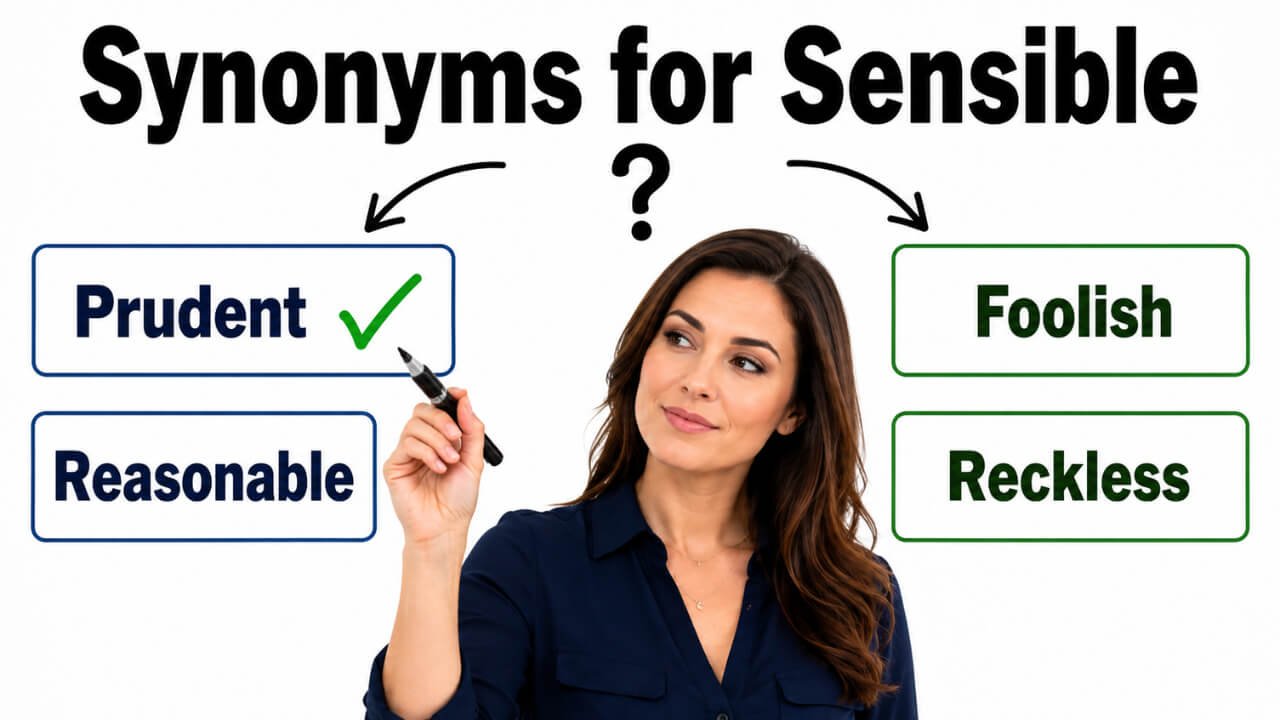
Quick Answer: Synonyms for sensible include reasonable, practical, wise, prudent, rational, logical, sound, judicious, thoughtful, and level headed. Use reasonable when something is fair and based on good judgment. Use practical when the idea works in real life. Use prudent or judicious in formal writing when you mean careful and wise. Use rational or logical when focusing on clear thinking.
Pronunciation and Word Details
Word: Sensible.
Pronunciation: /ˈsensəbəl/
Part of Speech: Adjective.
Meaning: Sensible means showing good judgment, clear thinking, and practical understanding.
US Pronunciation:
UK Pronunciation:
What Does “Sensible” Mean?
Direct Answer: Sensible means reasonable, practical, and based on good judgment.
The word sensible is an adjective. It describes a person, idea, choice, plan, decision, action, or attitude that is wise, realistic, and not careless. A sensible person thinks before acting. A sensible decision is useful, safe, fair, and suited to the situation.
In sentences, sensible often comes before a noun, as in a sensible answer, a sensible plan, or a sensible choice. It can also come after linking verbs, as in That seems sensible or Her advice was sensible.
Meaning, Tone, and Context of “Sensible”
Tone: Sensible has a positive, neutral, and practical tone.
Context: It is commonly used in everyday conversation, advice, essays, reports, workplace writing, personal decisions, and discussions about behavior.
Formality: Sensible works in both casual and formal writing. It is less technical than rational and less formal than judicious, but it still sounds clear and respectable.
Emotional Use: Sensible is not strongly emotional. It usually suggests calm thinking, maturity, responsibility, and common sense.
Common Use: People use sensible to describe choices about money, health, safety, planning, communication, problem solving, and behavior.
When and How to Use “Sensible”
For Good Judgment: Use sensible when someone makes a wise and fair decision.
Example: Choosing to save some money each month is a sensible habit.
For Practical Decisions: Use sensible when an idea works well in real life.
Example: Wearing comfortable shoes for a long walk is sensible.
For Responsible Behavior: Use sensible when someone acts with maturity and care.
Example: She gave a sensible answer during the discussion.
For Balanced Thinking: Use sensible when an opinion is not extreme or careless.
Example: His suggestion was sensible because it considered everyone’s needs.
For Safe Choices: Use sensible when a decision helps avoid risk or trouble.
Example: It is sensible to check the weather before leaving.
Best Synonyms for Sensible
Reasonable: Fair, balanced, and based on good judgment.
Example: Her request was reasonable and easy to understand.
Practical: Useful and suitable for real life.
Example: We need a practical solution that saves time.
Wise: Showing experience, knowledge, and good judgment.
Example: It was wise to ask for advice before deciding.
Prudent: Careful and sensible, especially about risk.
Example: A prudent investor studies the market before spending money.
Rational: Based on clear thinking and reason.
Example: His response was rational, not emotional.
Logical: Following clear reason and sense.
Example: That is a logical way to solve the problem.
Sound: Reliable, strong, and based on good judgment.
Example: The teacher gave sound advice before the exam.
Judicious: Careful, wise, and suitable for the situation.
Example: A judicious leader listens before making a decision.
Thoughtful: Showing careful consideration.
Example: Her thoughtful reply helped calm the situation.
Level headed: Calm and sensible in difficult situations.
Example: He stayed level headed during the emergency.
50 Synonyms for Sensible with Short Meanings
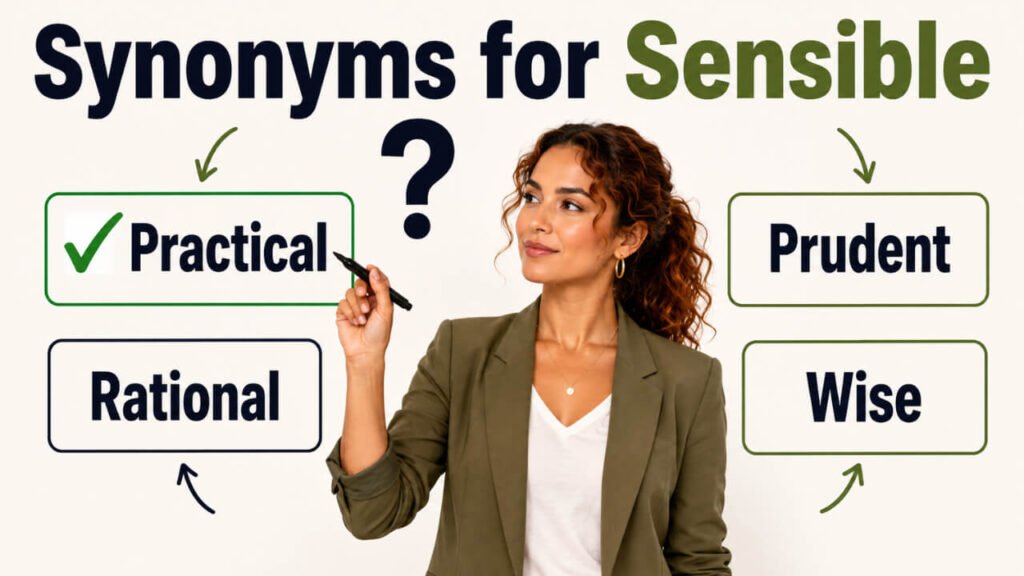
- Reasonable: Fair and based on good judgment.
- Practical: Useful in real situations.
- Wise: Showing good judgment and understanding.
- Prudent: Careful and thoughtful about risks.
- Rational: Based on reason, not emotion.
- Logical: Clear and sensible in thought.
- Sound: Reliable and well judged.
- Judicious: Wise and careful in choice.
- Thoughtful: Carefully considered.
- Level headed: Calm and sensible.
- Realistic: Based on what is possible.
- Responsible: Showing care and duty.
- Mature: Showing grown and steady judgment.
- Careful: Taking attention to avoid mistakes.
- Balanced: Fair and not extreme.
- Reasoned: Based on careful thinking.
- Intelligent: Showing smart understanding.
- Clear headed: Able to think clearly.
- Discerning: Able to judge well.
- Shrewd: Good at making smart decisions.
- Astute: Sharp and intelligent in judgment.
- Sober: Serious and realistic.
- Sane: Reasonable and mentally balanced.
- Moderate: Avoiding extremes.
- Sensible minded: Guided by practical judgment.
- Common sense: Based on everyday wisdom.
- Well advised: Carefully chosen after thought.
- Carefully considered: Thought about before action.
- Grounded: Realistic and steady.
- Clear thinking: Showing direct and careful thought.
- Responsible minded: Guided by duty and care.
- Thought out: Planned with attention.
- Measured: Calm, careful, and controlled.
- Reason based: Guided by logic and facts.
- Fit: Suitable for the situation.
- Proper: Correct and suitable.
- Suitable: Right for the purpose.
- Appropriate: Fitting the context.
- Useful: Helpful and practical.
- Workable: Able to succeed in practice.
- Efficient: Producing good results without waste.
- Safe: Avoiding danger or unnecessary risk.
- Cautious: Careful before acting.
- Mindful: Aware and careful.
- Deliberate: Done with careful thought.
- Strategic: Planned for a good result.
- Sensible sounding: Appearing reasonable and wise.
- Well planned: Arranged with care.
- Care wise: Guided by caution and judgment.
- Dependable: Reliable and trustworthy in judgment.
Read Also:
Synonyms for Connection

Synonyms for Sensible by Context
When Sensible Means Reasonable
Use these words when sensible means fair, balanced, and not extreme.
Reasonable: Her answer was reasonable and easy to accept.
Balanced: We need a balanced view before making a final decision.
Moderate: His moderate opinion helped reduce the argument.
Fair: The manager made a fair and sensible choice.
When Sensible Means Practical
Use these words when sensible means useful, realistic, and workable.
Practical: A practical plan is better than a complicated one.
Realistic: It is realistic to finish the work by Friday.
Workable: The team suggested a workable solution.
Useful: Her advice was useful for solving the problem.
When Sensible Means Wise
Use these words when sensible means guided by experience, maturity, or careful judgment.
Wise: It was wise to wait before replying.
Prudent: A prudent person prepares before taking action.
Judicious: His judicious decision protected the whole team.
Thoughtful: Her thoughtful choice showed care and maturity.
When Sensible Means Rational
Use these words when sensible means based on logic, facts, and clear thinking.
Rational: We need a rational response, not a rushed reaction.
Logical: His explanation was logical and easy to follow.
Reasoned: The report gave a reasoned conclusion.
Clear headed: She stayed clear headed under pressure.
When Sensible Means Safe or Careful
Use these words when sensible means avoiding unnecessary danger or mistakes.
Careful: It is careful to read the instructions first.
Cautious: A cautious driver avoids sudden risks.
Safe: Taking the main road was the safe choice.
Mindful: Be mindful of how your words affect others.
Another Word for Sensible
Direct Answer: Another word for sensible is reasonable.
The best single replacement depends on context. Use reasonable for fair judgment, practical for useful choices, wise for mature thinking, and prudent for careful decisions.
Original: It was a sensible suggestion.
Better Option: It was a reasonable suggestion.
Original: She made a sensible choice about money.
Better Option: She made a prudent choice about money.
Original: We need a sensible plan for the project.
Better Option: We need a practical plan for the project.
Original: His answer sounded sensible.
Better Option: His answer sounded logical.
When Not to Use “Sensible”
Do not use sensible when a more exact word gives clearer meaning. If you mean numbers, measurements, or proof, accurate may be better. If you mean deep wisdom, wise may be stronger. If you mean logical thinking, rational may be more precise.
Avoid repeating sensible too often in the same paragraph. It can sound plain if every decision, answer, and idea is called sensible.
Weak: She gave a sensible plan and a sensible answer to a sensible question.
Better: She gave a practical plan and a thoughtful answer to a reasonable question.
Weak: The data looks sensible.
Better: The data looks accurate.
Weak: His emotional reaction was sensible.
Better: His emotional reaction was understandable.
Weak: That is a sensible measurement.
Better: That is an accurate measurement.
Words Commonly Confused With Sensible
Sensible vs Sensitive: Sensible means showing good judgment. Sensitive means easily affected by feelings, criticism, pain, or small changes.
Sensible vs Reasonable: Sensible often means practical and wise. Reasonable means fair, acceptable, or based on good judgment.
Sensible vs Practical: Sensible focuses on judgment. Practical focuses on usefulness in real life.
Sensible vs Rational: Sensible can include common sense and maturity. Rational focuses more strongly on logic and reason.
Sensible vs Wise: Sensible is usually practical and everyday. Wise suggests deeper judgment, experience, or life understanding.
Sensible vs Logical: Sensible may include practical awareness. Logical means following clear reasoning.
Sensible vs Prudent: Sensible is general. Prudent is more formal and often means careful about risk.
Which Synonym Should You Choose?
Choose reasonable when writing about fair decisions, acceptable ideas, balanced opinions, or polite requests.
Choose practical when writing about plans, solutions, routines, advice, tools, or actions that work in real life.
Choose wise when writing about mature choices, life advice, experience, or careful personal judgment.
Choose prudent when writing about money, safety, risk, planning, or formal decision making.
Choose rational when writing about logic, facts, arguments, clear thinking, or calm judgment.
Choose logical when writing about reasoning, explanations, processes, or conclusions.
Choose sound when writing about advice, judgment, policy, reasoning, or reliable decisions.
Choose judicious when you need a formal word for careful and well judged action.
Choose level headed when describing someone who stays calm and sensible under pressure.
Real Life Examples of “Sensible” in Sentences
Original: It is sensible to plan your budget before spending.
Better Option: It is prudent to plan your budget before spending.
Original: Her sensible advice helped me avoid a mistake.
Better Option: Her wise advice helped me avoid a mistake.
Original: We need a sensible answer to this problem.
Better Option: We need a practical answer to this problem.
Original: His sensible attitude made the meeting easier.
Better Option: His reasonable attitude made the meeting easier.
Original: That sounds like a sensible explanation.
Better Option: That sounds like a logical explanation.
Original: A sensible student prepares before the exam.
Better Option: A responsible student prepares before the exam.
Original: The team made a sensible decision.
Better Option: The team made a sound decision.
Original: She remained sensible during the crisis.
Better Option: She remained level headed during the crisis.
Original: Wearing a coat in cold weather is sensible.
Better Option: Wearing a coat in cold weather is practical.
Original: His sensible plan saved time and effort.
Better Option: His efficient plan saved time and effort.
Synonym Groups and Usage Differences
Accuracy Group
These words focus on correct thinking, facts, and careful judgment.
Use: Choose accurate, logical, rational, or reasoned when truth, facts, or clear reasoning matter.
Example: Her reasoned answer explained the issue clearly.
Practicality Group
These words focus on real life usefulness.
Use: Choose practical, workable, useful, or realistic when the idea can be applied successfully.
Example: The plan is workable because it uses the resources we already have.
Wisdom Group
These words focus on maturity and good judgment.
Use: Choose wise, prudent, judicious, or thoughtful when the decision shows care and experience.
Example: His prudent choice helped him avoid unnecessary risk.
Balance Group
These words focus on fairness and calm judgment.
Use: Choose reasonable, balanced, moderate, or fair when the idea avoids extremes.
Example: Her balanced opinion made the discussion more helpful.
Calm Judgment Group
These words describe people who think clearly under pressure.
Use: Choose level headed, clear headed, sober, or measured when someone stays calm and thoughtful.
Example: The leader gave a measured response during the problem.
Antonyms of Sensible
Foolish: Lacking good judgment.
Unwise: Not showing wisdom or care.
Irrational: Not based on reason or logic.
Impractical: Not useful or workable in real life.
Careless: Acting without enough attention.
Reckless: Taking risks without thinking.
Unreasonable: Not fair, balanced, or sensible.
Illogical: Not following clear reason.
Thoughtless: Acting without care for results or people.
Extreme: Going too far beyond balance or moderation.
Comparison: Sensible vs Related Words
Sensible vs Reasonable
Sensible means practical and guided by good judgment. Reasonable means fair, acceptable, and not extreme.
Example With Sensible: It is sensible to rest before a long journey.
Example With Reasonable: Her request for more time was reasonable.
Sensible vs Practical
Sensible focuses on good judgment. Practical focuses on whether something works in real life.
Example With Sensible: A sensible person checks the facts first.
Example With Practical: A practical solution should be simple to use.
Sensible vs Wise
Sensible is often about everyday judgment. Wise suggests deeper understanding, experience, and maturity.
Example With Sensible: It was sensible to carry an umbrella.
Example With Wise: It was wise to forgive and move forward.
Sensible vs Rational
Sensible can include common sense, care, and practicality. Rational is more focused on reason and logic.
Example With Sensible: Her sensible plan helped everyone stay organized.
Example With Rational: His rational argument was based on facts.
Sensible vs Prudent
Sensible is a common word for good judgment. Prudent is more formal and often relates to risk, money, or safety.
Example With Sensible: It is sensible to leave early for the meeting.
Example With Prudent: It is prudent to save money for emergencies.
Sensible vs Logical
Sensible means wise and practical. Logical means following a clear pattern of reasoning.
Example With Sensible: The sensible choice was to wait.
Example With Logical: The logical conclusion was based on evidence.
Common Phrases and Expressions With Sensible
Sensible Choice: A decision based on good judgment.
Sensible Decision: A wise and practical decision.
Sensible Advice: Helpful guidance based on reason.
Sensible Plan: A realistic and useful plan.
Sensible Person: Someone who thinks and acts carefully.
Sensible Approach: A balanced way of handling something.
Sensible Solution: A practical answer to a problem.
Sensible Answer: A reasonable and clear response.
Sensible Precaution: A careful step taken to avoid risk.
Sensible Use: Careful and practical use of something.
Common Mistakes to Avoid
Repeating the Word Too Often: Avoid using sensible again and again when synonyms can make writing smoother. Use reasonable, practical, wise, or sound where they fit better.
Choosing a Weak Synonym: Do not use a synonym only because it sounds similar. Sensitive is not a synonym for sensible. It has a different meaning.
Ignoring Context: Use practical for real life usefulness, rational for logic, prudent for careful risk decisions, and wise for mature judgment.
Using Sensible for Exact Facts: Sensible does not always mean accurate. A sentence, answer, or idea can be sensible, but data, numbers, and measurements are usually accurate or precise.
Sounding Too Casual in Formal Writing: Sensible is acceptable in formal writing, but prudent, judicious, rational, or sound may sound stronger in essays, reports, and professional documents.
Confusing Sensible and Sensitive: Sensible means having good judgment. Sensitive means easily affected or emotionally aware. These words should not be used as replacements for each other.
Conclusion
Synonyms for sensible help you choose clearer words for different situations. Use reasonable for fair judgment, practical for useful ideas, wise for mature decisions, prudent for careful risk, and rational for logical thinking. The word sensible is useful because it is simple, positive, and flexible. Still, stronger alternatives can improve accuracy, tone, and variety. When choosing a synonym, always match the word to the meaning, sentence context, and level of formality.
FAQs About Synonyms for Sensible
What are the best synonyms for sensible?
The best synonyms for sensible are reasonable, practical, wise, prudent, rational, logical, sound, judicious, thoughtful, and level headed.
What is another word for sensible?
Another word for sensible is reasonable. In other contexts, practical, wise, prudent, or logical may be better.
Is sensible the same as practical?
Sensible and practical are close, but they are not always the same. Sensible means based on good judgment, while practical means useful and workable in real life.
Is sensible a positive word?
Yes, sensible is usually positive. It suggests maturity, clear thinking, responsibility, and good judgment.
What is the opposite of sensible?
The opposite of sensible can be foolish, unwise, irrational, impractical, careless, reckless, or unreasonable, depending on the context.
Can I use sensible in formal writing?
Yes, sensible can be used in formal writing. However, words like prudent, judicious, rational, and sound may sound more precise in essays, reports, and professional writing.
What is the difference between sensible and sensitive?
Sensible means showing good judgment. Sensitive means easily affected by feelings, criticism, pain, or small changes. They are different words and should not be used as synonyms.
