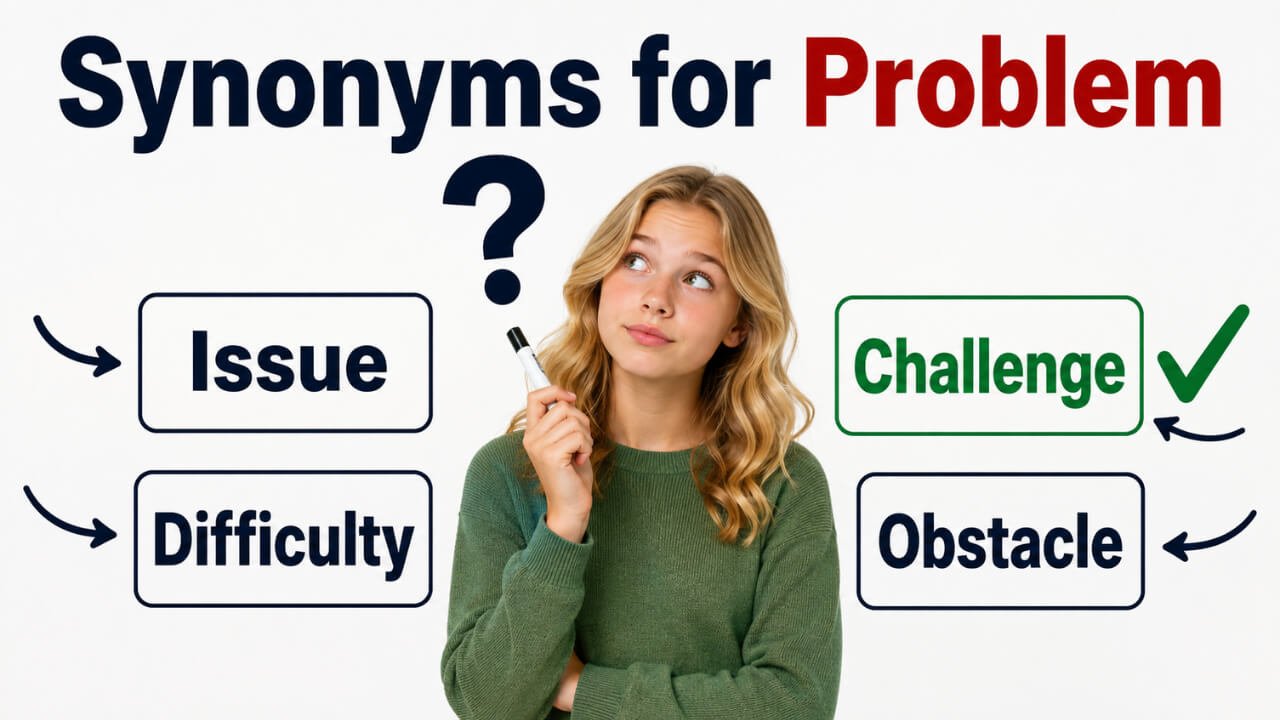
Quick Answer: The best synonyms for problem include issue, challenge, difficulty, trouble, obstacle, complication, concern, setback, dilemma, and matter. Use issue for a neutral topic that needs attention, challenge for something difficult but possible to solve, difficulty for hardship, trouble for casual speech, obstacle for something blocking progress, and dilemma when a person must choose between difficult options.
Pronunciation and Word Details
Word: Problem.
Pronunciation: /ˈprɑː.bləm/ or /ˈprɒb.ləm/.
Part of Speech: Noun.
Meaning: A problem is a situation, question, difficulty, or matter that needs attention, thought, or a solution.
US Pronunciation:
UK Pronunciation:
What Does “Problem” Mean?
A problem means something that is difficult, unclear, unwanted, or in need of a solution. It is most commonly used as a noun in everyday speech, academic writing, business communication, and problem based discussion.
The word can describe a small issue, a serious difficulty, a question to solve, or a barrier to progress. For example, a math question can be a problem, a broken machine can be a problem, and a misunderstanding between people can also be a problem.
Meaning, Tone, and Context of “Problem”
The word problem has a neutral tone, but its strength changes by context. In casual speech, it can mean something small or annoying. In formal writing, it can describe a serious situation that requires analysis, planning, or action.
It is common in education, work, health, relationships, grammar, vocabulary, decision making, and daily conversation. The word is clear and easy to understand, but using it too often can make writing sound repetitive. Choosing a more specific synonym can make your sentence sharper and more natural.
When and How to Use “Problem”
For General Issues: Use problem when you mean a matter that needs attention or a solution.
Example: The main problem is that the instructions are unclear.
For Difficult Situations: Use problem when something creates stress, delay, or confusion.
Example: Heavy rain caused a serious problem for the outdoor event.
For Questions to Solve: Use problem in learning, logic, math, or analysis.
Example: The students solved the problem step by step.
For Personal Concerns: Use problem when talking about something that worries or affects someone.
Example: She has a problem with noisy neighbors.
For Work and Planning: Use problem when discussing delays, errors, risks, or missing information.
Example: The team found a problem in the report before the meeting.
Best Synonyms for Problem
Issue: A matter or situation that needs attention.
Example: The main issue is the lack of clear communication.
Challenge: A difficult task or situation that requires effort.
Example: Finishing the project on time will be a challenge.
Difficulty: Something hard to do, understand, or manage.
Example: He had difficulty explaining the rule clearly.
Trouble: A problem, especially in casual speech.
Example: We had trouble opening the file.
Obstacle: Something that blocks progress or success.
Example: Lack of funding became a major obstacle.
Complication: Something that makes a situation more difficult.
Example: A late delivery created a complication for the plan.
Concern: A problem that causes worry or needs attention.
Example: Safety is the biggest concern in this situation.
Setback: A problem that delays progress.
Example: The mistake was a setback, but the team recovered quickly.
Dilemma: A difficult choice between options.
Example: She faced a dilemma about whether to stay or leave.
Matter: A situation, subject, or problem that needs discussion.
Example: We need to discuss this matter before making a decision.
50 Synonyms for Problem with Short Meanings
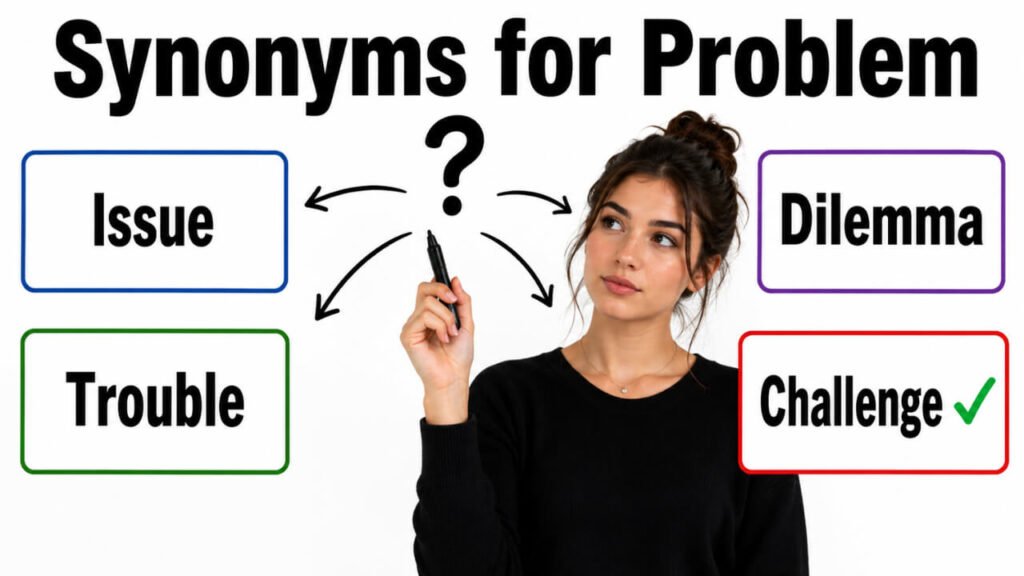
- Issue: A matter that needs attention.
- Challenge: A difficult task or situation.
- Difficulty: Something hard to do or manage.
- Trouble: A problem or unwanted situation.
- Obstacle: Something that blocks progress.
- Complication: Something that makes a situation harder.
- Concern: A matter that causes worry.
- Setback: A delay or difficulty in progress.
- Dilemma: A difficult choice between options.
- Matter: A subject or situation needing attention.
- Question: A point that needs an answer.
- Puzzle: Something confusing that needs solving.
- Barrier: Something that prevents progress.
- Hurdle: A difficulty that must be overcome.
- Burden: A heavy responsibility or difficulty.
- Struggle: A difficult effort or situation.
- Crisis: A serious and urgent problem.
- Predicament: A difficult or unpleasant situation.
- Mess: A confused or troublesome situation.
- Snag: A small problem or delay.
- Fault: A defect or mistake.
- Flaw: A weakness or imperfection.
- Defect: Something wrong or damaged.
- Error: A mistake in action or judgment.
- Mistake: Something done incorrectly.
- Dispute: A disagreement or conflict.
- Conflict: A serious disagreement or clash.
- Tension: Strain or unease between people or ideas.
- Risk: A possible danger or problem.
- Threat: Something that may cause harm.
- Concernment: A matter of importance or worry.
- Obstacle course: A series of difficulties.
- Drawback: A disadvantage or weakness.
- Downside: A negative part of something.
- Weakness: A limitation or area of trouble.
- Limitation: Something that restricts success or action.
- Constraint: A restriction that causes difficulty.
- Impediment: Something that slows or blocks progress.
- Hindrance: Something that makes progress difficult.
- Roadblock: Something that stops progress.
- Stumbling block: A difficulty that prevents success.
- Complication: An added difficulty.
- Concern: A serious point needing attention.
- Emergency: A sudden serious problem.
- Troublesome matter: A situation that creates difficulty.
- Uncertainty: A lack of clarity that creates concern.
- Difficulty point: A specific area of trouble.
- Pain point: A specific problem people experience.
- Weak spot: A vulnerable or problematic area.
- Sticking point: A detail that prevents agreement or progress.
Read Also:
Synonyms for Grateful
Synonyms for Problem by Context
When Problem Means Issue
Use issue when the problem is a subject, topic, or matter that needs attention.
Example: The issue is not the price, but the quality.
Other useful choices include matter, concern, question, and point of difficulty.
Example: The main concern is whether the plan is safe.
When Problem Means Challenge
Use challenge when the problem is difficult but possible to solve with effort.
Example: Learning a new language can be a challenge.
Other useful choices include hurdle, obstacle, struggle, and barrier.
Example: The biggest hurdle is finding enough time.
When Problem Means Trouble
Use trouble when speaking casually about something that is not working well.
Example: I had trouble understanding the instructions.
Other useful choices include difficulty, snag, mess, and complication.
Example: A small snag delayed the final step.
When Problem Means Serious Situation
Use crisis when the problem is urgent, serious, or dangerous.
Example: The sudden shortage became a crisis.
Other useful choices include emergency, threat, risk, and predicament.
Example: The company faced a serious predicament after the error.
When Problem Means Mistake or Fault
Use error when the problem is caused by something incorrect.
Example: The report had an error in the final calculation.
Other useful choices include mistake, fault, flaw, and defect.
Example: The design flaw made the product harder to use.
Another Word for Problem
Another word for problem is issue. It is the best single replacement in many situations because it is neutral, clear, and suitable for both formal and casual writing. However, the best alternative depends on the exact meaning. Use challenge for difficulty, obstacle for blockage, concern for worry, and dilemma for a hard choice.
Original: The problem is that we do not have enough time.
Better Option: The issue is that we do not have enough time.
Original: The problem with the plan is the high cost.
Better Option: The concern with the plan is the high cost.
Original: Finishing this task is a problem for the team.
Better Option: Finishing this task is a challenge for the team.
Original: The problem stopped us from moving forward.
Better Option: The obstacle stopped us from moving forward.
When Not to Use “Problem”
Do not use problem when another word gives a more exact meaning. The word can sound too general if the situation involves a mistake, delay, disagreement, danger, or difficult choice.
Weak: The problem in the document is on page five.
Better: The error in the document is on page five.
Weak: The problem between the two workers became worse.
Better: The conflict between the two workers became worse.
Weak: The problem with the plan is that it may fail.
Better: The risk with the plan is that it may fail.
Weak: She had a problem choosing between the two offers.
Better: She faced a dilemma choosing between the two offers.
Words Commonly Confused With Problem
Problem vs Issue: A problem often suggests something unwanted or difficult, while an issue can be a neutral matter that needs discussion.
Problem vs Challenge: A problem may sound negative, while a challenge can sound more positive and growth focused.
Problem vs Difficulty: A difficulty is usually something hard to do or understand, while a problem can be broader.
Problem vs Obstacle: An obstacle blocks progress, while a problem may or may not block progress directly.
Problem vs Concern: A concern focuses on worry or importance, while a problem focuses on something that needs a solution.
Problem vs Dilemma: A dilemma means a difficult choice, while a problem can be any difficult situation.
Problem vs Error: An error is a mistake, while a problem may be caused by many things.
Which Synonym Should You Choose?
Choose issue when writing about a topic, matter, or situation that needs attention.
Choose challenge when the situation is difficult but can lead to improvement or learning.
Choose difficulty when something is hard to do, complete, understand, or manage.
Choose trouble when writing in a casual or conversational style.
Choose obstacle when something blocks progress, success, movement, or action.
Choose concern when the problem causes worry or needs serious attention.
Choose complication when something makes a plan or situation harder.
Choose setback when a problem delays progress after earlier success.
Choose dilemma when someone must choose between two difficult options.
Choose error when the problem is a mistake in writing, data, calculation, or judgment.
Real Life Examples of “Problem” in Sentences
Original: The problem is that the answer is not clear.
Better Option: The issue is that the answer is not clear.
Original: We found a problem in the final report.
Better Option: We found an error in the final report.
Original: Lack of time is the biggest problem.
Better Option: Lack of time is the biggest obstacle.
Original: She has a problem with public speaking.
Better Option: She has difficulty with public speaking.
Original: The problem delayed the whole project.
Better Option: The setback delayed the whole project.
Original: Their problem is poor communication.
Better Option: Their concern is poor communication.
Original: Choosing one offer was a problem for him.
Better Option: Choosing one offer was a dilemma for him.
Original: The problem became serious after the storm.
Better Option: The crisis became serious after the storm.
Original: There is a problem with the machine.
Better Option: There is a defect in the machine.
Original: The problem made the task harder.
Better Option: The complication made the task harder.
Synonym Groups and Usage Differences
General Issue Group
This group includes issue, matter, concern, question, and topic. These words are useful when the problem is something to discuss, examine, or solve.
Example: The main issue is the lack of clear instructions.
Difficulty Group
This group includes challenge, difficulty, struggle, hurdle, and burden. These words describe something hard, demanding, or stressful.
Example: The biggest challenge is staying focused.
Obstacle Group
This group includes obstacle, barrier, roadblock, impediment, and hindrance. These words show that something is stopping progress.
Example: Poor planning became a roadblock to success.
Mistake Group
This group includes error, mistake, fault, flaw, and defect. These words describe something wrong, incorrect, or broken.
Example: The error changed the meaning of the sentence.
Serious Problem Group
This group includes crisis, emergency, threat, risk, and predicament. These words describe urgent, dangerous, or highly difficult situations.
Example: The delay created a serious risk for the project.
Choice Problem Group
This group includes dilemma, predicament, uncertainty, and sticking point. These words are useful when a problem involves choice, confusion, or disagreement.
Example: The contract deadline became the main sticking point.
Antonyms of Problem
Antonyms of problem depend on meaning. If problem means difficulty, the opposite may be solution or advantage. If it means weakness, the opposite may be strength. If it means confusion, the opposite may be clarity.
Solution: An answer or fix for a problem.
Answer: A response or explanation that solves a question.
Advantage: A helpful or positive condition.
Benefit: A useful result or gain.
Strength: A strong or effective quality.
Ease: A state of being simple or not difficult.
Clarity: Clear understanding without confusion.
Improvement: A better condition than before.
Success: A positive result after effort.
Opportunity: A situation that can lead to progress.
Comparison: Problem vs Related Words
Problem vs Issue
A problem often sounds more negative or difficult. An issue can be more neutral and formal.
Example With Problem: The problem caused a delay in the work.
Example With Issue: The issue needs to be discussed before the work continues.
Problem vs Challenge
A problem focuses on something unwanted. A challenge focuses on difficulty that can be overcome.
Example With Problem: The problem made the task stressful.
Example With Challenge: The challenge helped the team improve.
Problem vs Difficulty
A problem is a broad situation needing a solution. A difficulty is usually something hard to do or understand.
Example With Problem: The problem affected the whole plan.
Example With Difficulty: She had difficulty understanding the new rule.
Problem vs Obstacle
A problem can be any trouble. An obstacle specifically blocks progress.
Example With Problem: The problem made the process slower.
Example With Obstacle: The obstacle prevented the team from finishing early.
Problem vs Concern
A problem needs solving. A concern needs attention because it causes worry.
Example With Problem: The problem is the missing information.
Example With Concern: The concern is the safety of the workers.
Problem vs Dilemma
A problem may have many possible solutions. A dilemma involves a difficult choice between options.
Example With Problem: The problem is finding a better schedule.
Example With Dilemma: The dilemma is choosing between money and time.
Common Phrases and Expressions With Problem
No Problem: Used to say something is fine or not difficult.
Big Problem: A serious or important difficulty.
Small Problem: A minor issue that is not very serious.
Main Problem: The most important difficulty.
Serious Problem: A problem that needs urgent attention.
Common Problem: A difficulty many people experience.
Technical Problem: A problem related to machines, systems, or tools.
Health Problem: A difficulty related to physical or mental condition.
Math Problem: A question or exercise that needs solving.
Problem Area: A part that causes difficulty or needs improvement.
Common Mistakes to Avoid
One common mistake is using problem too many times in the same paragraph. This makes writing sound plain and repetitive. Replace it with issue, challenge, concern, obstacle, or difficulty when the meaning fits.
Another mistake is choosing a synonym that changes the meaning. For example, dilemma should only be used when there is a difficult choice. Error should only be used when something is incorrect. Crisis should only be used for a serious and urgent situation.
Writers also confuse problem with challenge. A challenge often sounds more positive, while problem sounds more negative. In professional writing, issue may sound softer and more polite than problem.
Conclusion
The keyword synonyms for problem includes many useful alternatives, but the best choice depends on context. Use issue for a neutral matter, challenge for a difficult task, difficulty for hardship, obstacle for something blocking progress, concern for worry, and dilemma for a hard choice. Strong vocabulary makes your writing clearer, more accurate, and more natural. Instead of repeating problem, choose the synonym that matches the exact meaning of your sentence.
FAQs About Synonyms for Problem
What is the best synonym for problem?
The best synonym for problem is issue because it is neutral, clear, and works in many formal and casual contexts.
What is a formal synonym for problem?
A formal synonym for problem is issue, concern, matter, complication, or difficulty. The best choice depends on the sentence.
What is a positive synonym for problem?
A positive synonym for problem is challenge. It suggests that the situation is difficult but possible to overcome.
What is another word for a serious problem?
Another word for a serious problem is crisis, emergency, threat, risk, or predicament.
What is another word for a small problem?
Another word for a small problem is snag, issue, trouble, difficulty, or minor concern.
What is the difference between problem and issue?
A problem usually sounds more negative and difficult, while an issue can sound more neutral, polite, or professional.
Can I use challenge instead of problem?
Yes, you can use challenge instead of problem when you want the sentence to sound more positive, active, or growth focused.
